The Eastern Qing Tombs Scenic Area is located at the southern foot of Changrui Mountain in the northwest of Zunhua City, Tangshan City, Hebei Province. It is the largest, most complete, and best-laid-out imperial mausoleum complex extant in China. It is a National 5A Tourist Attraction and a World Cultural Heritage Site. The scenic area covers a total area of 80 square kilometers and consists of 15 mausoleums and burial complexes, including 5 emperor tombs, 4 empress tombs, 5 concubine burial complexes, and 1 princess burial complex. Buried here are 5 emperors, 15 empresses, 136 imperial concubines, 3 imperial sons, and 2 princesses, totaling 161 people.
The scenic area was built according to the traditional “front court and rear chamber” layout. Its planning is rigorous, its architecture is exquisite, and its brick, stone, and wood carvings are highly refined, reflecting the highest level of ancient Chinese architecture. The tomb area is filled with ancient trees, beautiful scenery, and surrounded by mountains and water, forming a feng shui layout in which “no beauty of dragon, sand, acupoint, or water is left out, and all auspicious features of form, force, qi, and principle are present.” It is an outstanding representative of ancient Chinese mausoleum architecture.
History and Culture
Construction of the Eastern Qing Tombs began in the 18th year of the Shunzhi reign of the Qing Dynasty (1661). Through the reigns of Kangxi, Yongzheng, Qianlong, Jiaqing, Daoguang, Xianfeng, and later periods, a grand imperial cemetery took shape. The first person buried in the Eastern Qing Tombs was Emperor Shunzhi in Xiaoling. The last mausoleum was Emperor Guangxu’s Chongling (however, Chongling is located in the Western Qing Tombs; the last mausoleum built at the Eastern Qing Tombs was Empress Dowager Cixi’s Dingdongling).
The construction of the Eastern Qing Tombs lasted 247 years. In architectural style, it inherited the tradition of Ming imperial tombs while incorporating Manchu characteristics, forming a unique artistic style. The stone carvings, stele pavilions, palaces, and other buildings in the tomb area are not only precious historical relics but also important materials for studying the politics, economy, culture, and art of the Qing Dynasty.
In 1928, the Eastern Qing Tombs suffered a tomb-robbing incident that shocked the world. Sun Dianying led troops to loot Emperor Qianlong’s Yuling and Empress Dowager Cixi’s Dingdongling. Large numbers of precious cultural relics were stolen, causing enormous loss to the Eastern Qing Tombs. After the founding of the People’s Republic of China, the government protected and restored the Eastern Qing Tombs, making it an important cultural heritage site and tourist attraction.
Main Attractions
Xiaoling
Xiaoling is the principal mausoleum of the Eastern Qing Tombs and the tomb of Emperor Shunzhi, Aisin Gioro Fulin. It was also the earliest built and largest emperor’s mausoleum in the Eastern Qing Tombs. From the dismount stele to the Square City and Ming Tower, it stretches more than 6,000 meters. A central axis runs from north to south, along which are arranged in sequence the stone archway, the Great Red Gate, stele pavilion, stone figures, Dragon and Phoenix Gate, Spirit Way Stele Pavilion, Long’en Gate, Long’en Hall, Square City, Ming Tower, and other buildings.
There are 18 pairs of stone figures at Xiaoling, including civil officials, military officers, horses, elephants, camels, and others. They are the most numerous and most exquisite stone figures in the Eastern Qing Tombs. Long’en Hall is the main building of Xiaoling. Inside are enshrined the spirit tablets of Emperor Shunzhi, Empress Xiaokangzhang, and Empress Xiaoxian. It was the place where sacrificial ceremonies were held.
Yuling
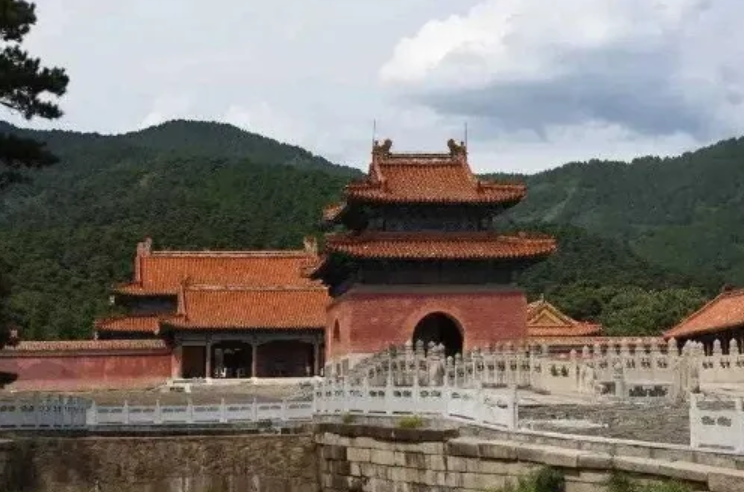
Yuling is the mausoleum of Emperor Qianlong, Aisin Gioro Hongli, located to the west of Xiaoling. The underground palace of Yuling is one of the most exquisite underground palaces in the Eastern Qing Tombs. It has a depth of 54 meters and is composed of nine vaults and four doors. The entire underground palace is covered with fine stone carvings, including the Eight Great Bodhisattvas, the Four Heavenly Kings, the Five Directional Buddhas, and illustrations of the Twenty-Four Filial Exemplars. The carving technique is superb, and it is praised as a “treasure house of stone carving art.”
The above-ground buildings of Yuling are also magnificent. The column layout of Long’en Hall adopts the “jinxiang doudicao” (golden box and bucket-bottom trough) form. The ceiling inside the hall is decorated with fine polychrome paintings, making it a masterpiece of Qing Dynasty architectural art.
Dingdongling
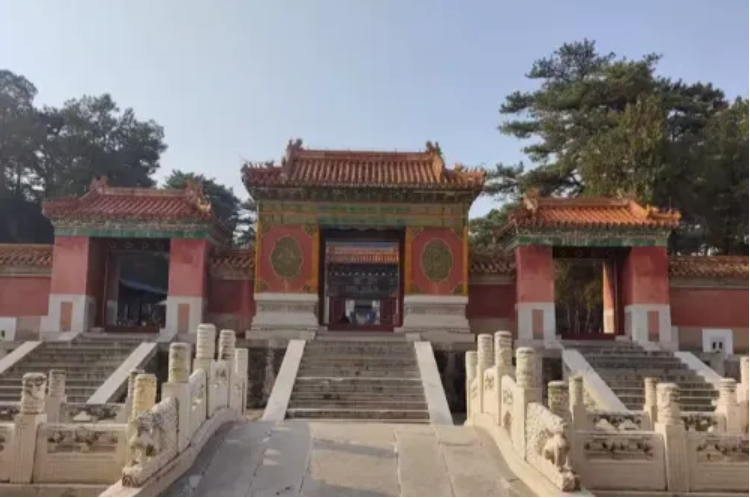
Dingdongling is the mausoleum of Empress Dowager Cixi, of the Yehenara clan, and Empress Dowager Ci’an, of the Niohuru clan. It is located east of Emperor Xianfeng’s Dingling. The architectural style of Dingdongling is unique, and Empress Dowager Cixi’s mausoleum in particular is more luxurious in building materials and decorative techniques.
In Cixi’s mausoleum, the timber frames of Long’en Hall and the east and west side halls are all made of precious huanghuali wood. The beams and architraves are decorated with gilded dragon-and-phoenix hexie polychrome paintings. The walls inside the hall are inlaid with 240 carved bricks, and the ceiling is decorated with thousands of gilded golden dragons. It is the most luxurious building in the Eastern Qing Tombs. The underground palace of Dingdongling is also exquisitely decorated. The stone doors are carved with fine Bodhisattva images, and the walls inside the underground palace are decorated with Buddhist-themed stone carvings.
Jingling
Jingling is the mausoleum of Emperor Kangxi, Aisin Gioro Xuanye, located east of Xiaoling. The architectural layout of Jingling is rigorous and its scale is grand. Its above-ground buildings are well preserved. On the spirit way is the Pavilion of the Stele of Sagely Virtue and Divine Merit. Inside the pavilion stands Emperor Kangxi’s merit stele, whose inscription records his civil achievements and military exploits.
The concubine burial complex at Jingling is one of the largest concubine burial complexes in the Eastern Qing Tombs. It contains the remains of 48 imperial concubines and 1 imperial prince. The buildings are neatly arranged, and the grave mounds are orderly, making it important material for studying the burial system for imperial concubines in the Qing Dynasty.
Tour Routes:
One-Day Tour
In the morning, start from the scenic area entrance and take the sightseeing bus to Xiaoling. Visit this principal mausoleum of the Eastern Qing Tombs, admire the stone archway, Great Red Gate, stone figures, and other buildings, and learn about the history of Emperor Shunzhi. Then go to Yuling to visit Emperor Qianlong’s mausoleum, focusing on the underground palace and its exquisite stone carvings.
In the afternoon, go to Dingdongling to visit the mausoleums of Empress Dowager Cixi and Empress Dowager Ci’an, and experience the luxury and exquisiteness of Cixi’s mausoleum. Finally, go to Jingling to visit Emperor Kangxi’s mausoleum and learn about his civil achievements and military exploits. The entire trip takes about 5–6 hours and allows visitors to fully appreciate the history, culture, and architectural art of the Eastern Qing Tombs.
Half-Day Tour
If time is limited, choose the half-day tour route, focusing on Xiaoling and Dingdongling. In the morning, visit Xiaoling to learn about the overall layout of the Eastern Qing Tombs and the history of Emperor Shunzhi; in the afternoon, visit Dingdongling to experience the luxurious architecture and historical stories of Cixi’s mausoleum.
In-Depth Tour
For the in-depth tour, two days are recommended. On the first day, visit Xiaoling, Yuling, and Dingdongling. On the second day, visit Jingling, Huiling, concubine burial complexes, and other attractions. This allows a more comprehensive understanding of the history, culture, and architectural art of the Eastern Qing Tombs and a deeper experience of the charm of Qing imperial mausoleums.
Travel Tips:
Season: April–May and September–October are the best seasons to visit the Eastern Qing Tombs. The weather is clear, the temperature is pleasant, and the ancient trees are either newly green or the mountains are covered with red leaves, making the scenery beautiful.
Itinerary: The scenic area is large. It is recommended to arrange 1–2 days for the visit so that you can fully appreciate the features of each attraction and avoid an overly tight schedule.
Clothing and Equipment: The scenic area contains many ancient buildings and stone-paved roads. Comfortable sports shoes and casual clothing are recommended. In summer, take sun protection measures and bring sunscreen, a sun hat, etc. In autumn, the temperature on the mountain is lower, so bring a jacket.
Dining and Accommodation: There are many farmhouse inns and restaurants around the scenic area, providing accommodation and dining services at relatively affordable prices. You can try local specialty foods such as Zunhua gezha and Zunhua roasted chicken.
Guide Service: The Eastern Qing Tombs are rich in history and culture. It is recommended to hire a guide or rent an audio guide to better understand the historical background and architectural features of the scenic area.
Notes:
Ticket Management: Scenic area tickets are for single use only. If you leave the park and need to re-enter, you must buy another ticket. It is recommended to keep your ticket safe.
Safety Tips: Some buildings have relatively high steps. Watch your step while visiting, especially elderly people and children, who should be accompanied by family members.
Environmental Protection: There are many ancient trees in the scenic area, which are important cultural heritage. Visitors should protect the environment, not climb ancient trees or litter, and help keep the scenic area clean.
Civilized Visiting: The Eastern Qing Tombs are a solemn historical and cultural scenic area. Visitors should tour in a civilized manner, avoid loud noise and rough play, respect history and culture, and not damage cultural relics or historic sites.
Medical Assistance: There is a medical room in the scenic area. In case of sudden illness or injury, contact staff promptly for help. Mobile phone signal in the scenic area is generally good, so you can contact the outside world at any time.
Transportation:
Self-Driving: From Beijing, take the Beijing–Hong Kong–Macau Expressway to the Capital Ring Expressway, then transfer to the Zunhua–Qinhuangdao Expressway, and get off at the Eastern Qing Tombs exit. The total distance is about 120 kilometers, and the drive takes about 1.5 hours. From Tianjin, take the Tianjin–Jizhou Expressway to the Capital Ring Expressway, then transfer to the Zunhua–Qinhuangdao Expressway. The total distance is about 180 kilometers, and the drive takes about 2.5 hours. From Tangshan, take the Tangshan–Chengde Expressway to the Zunhua–Qinhuangdao Expressway. The total distance is about 80 kilometers, and the drive takes about 1 hour.
Bus: There are direct buses to the Eastern Qing Tombs from Beijing Sihui Long-Distance Bus Station. Departure times are 8:00 and 10:00, and return times are 14:00 and 16:00. The fare is about 60 yuan, and the journey takes about 2 hours. There are also direct buses from Tangshan Bus Station. Departure times are 9:00 and 13:00, and return times are 15:00 and 17:00. The fare is about 30 yuan, and the journey takes about 1.5 hours.
Train: Take a train from Beijing East Railway Station to Zunhua Railway Station, then transfer to a local bus or taxi to the Eastern Qing Tombs. The train journey takes about 2 hours, and the fare is 25 yuan. The bus fare from Zunhua to the Eastern Qing Tombs is about 15 yuan, and the journey takes about 40 minutes.
Transportation Within the Scenic Area: The attractions in the scenic area are relatively far apart. It is recommended to take the sightseeing bus. The sightseeing bus fare is 30 yuan per person and can be purchased at the scenic area entrance.
Opening Hours:
The Eastern Qing Tombs Scenic Area is open from March 1 to November 30 each year, daily from 8:30 to 17:00 (ticket sales stop at 16:30); from December 1 to February 28 of the following year, daily from 9:00 to 16:00 (ticket sales stop at 15:30).
The scenic area is normally open on statutory holidays and during the peak tourist season (April–October). In case of extreme weather or special circumstances, the scenic area may be temporarily closed. For specific opening information, please consult the official scenic area authorities.
Tickets:
Tickets from 45 yuan.