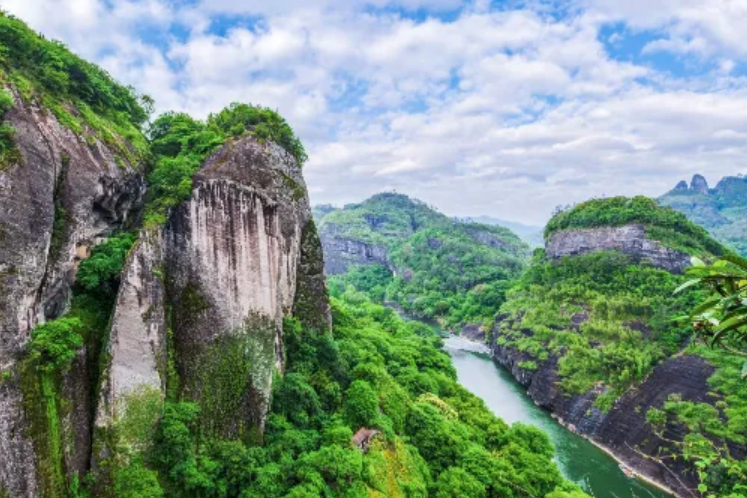
Located in Wuyishan City, Nanping, Fujian Province, the Wuyi Mountain Scenic Area is one of China’s first batch of nationally designated key scenic spots and a national 5A-level tourist attraction. In December 1999, it was inscribed on the UNESCO World Heritage List as a "Mixed Natural and Cultural Heritage Site." The planned area covers 79 square kilometers, with an average elevation of 350 meters. It features typical Danxia landforms and is renowned as "Clear Water and Red Cliffs" and "The Most Extraordinary and Beautiful Mountain in Southeast China." The area abounds with springs, waterfalls, mountain streams, and rivers. The Nine-Bend Stream originates from the southern slope of Mount Huanggang in the Wuyi Mountain Nature Reserve, with a total length of 60 kilometers, of which 9.5 kilometers flows through the scenic area.
History and Culture
Wuyi Mountain is the cradle of Zhu Xi's Neo-Confucianism and an important global base for the study of Neo-Confucianism and Eastern culture. From the Song and Ming dynasties onward, prominent Neo-Confucian scholars such as Yang Shi, You Zuo, Zhu Xi, and Wang Yangming resided here for extended periods. Zhu Xi founded the Min School (Fujian School) of Neo-Confucianism at Wuyi Mountain, becoming a master of this philosophical tradition. To this day, Wuyi Mountain preserves over 450 cliff inscriptions from the Song Dynasty and later, many left by Zhu Xi and other ancient luminaries.
Early human activity in Wuyi Mountain dates back to the Neolithic Age about 10,000 years ago. The remnants of cotton fabric found among burial goods such as the "boat-shaped coffins" and "rainbow bridge planks" are the earliest cotton textiles ever discovered in China. The 480,000-square-meter site of the Minyue King City from the Western Han Dynasty is the best-preserved Han Dynasty city south of the Yangtze River. Its site selection, layout, construction techniques, and style are unique, representing a typical example of ancient southern Chinese cities.
In addition, Taoist and Buddhist cultures flourished here. As early as the mid-8th century, the Tianbao Hall of Taoism was established, and Wuyi Mountain was designated as the "Shengzhen Yuanhua Cave Heaven," one of the Thirty-Six Lesser Caves of Taoism. In the mid-10th century, it was officially named a Taoist sacred mountain, and the Chongyou Temple was listed among the nine great Taoist temples nationwide. After the 11th century, Wuyi Mountain became one of the "Eight Lesser Famous Buddhist Mountains." Religious cultural sites are scattered throughout the mountain, and at its peak, there were as many as 187 temples, ancestral halls, palaces, and academies.
Major Attractions
Tianyou Peak
Located at the center of the scenic area, it connects to Xianyou Rock in the east, Qingyin Rock in the south, and Xianzhang Peak in the west. Towering above the surrounding peaks, it offers spectacular views of a sea of clouds after rain or at dawn, and occasionally the marvelous "Buddha's light" phenomenon.
First Line of Sky (Yixiantian)
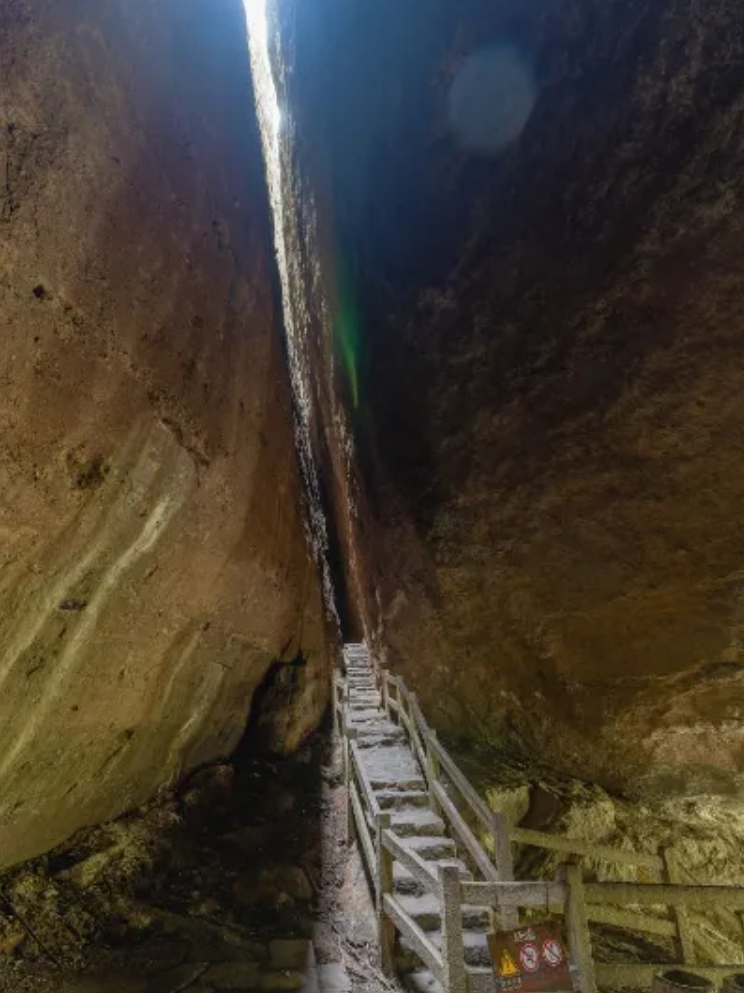
Also known as "One-Character Sky," it lies in a deep gorge south of the Second Bend of the Nine-Bend Stream. A massive cliff overhangs three adjacent caves, with a crack over 100 zhang (about 330 meters) long and less than 1 meter wide. Peering up from within the cave, one can see a thin sliver of sky.
Peach Blossom Spring (Taoyuan Cave)
Situated beside the Sixth Bend of the Nine-Bend Stream, this secluded spot is deeply hidden. Rocky cliffs form a gate, and a winding path leads inward, with a stream flowing under a stone bridge. The interior opens into a flat area reminiscent of the "utopia" described by Tao Yuanming. It contains halls such as Sanqing Hall, Yuhuang Hall, Lingguan Hall, and a mountain gate.
Cloud Nest (Yunwo)
Located below Tianyou Peak, it features over ten caves of varying sizes. In the early mornings and evenings of winter and spring, clouds often drift out of the caves, swirling gracefully among the peaks and rocks. Nearby attractions include Xiangsheng Rock, Danlu Rock, and Xianji Rock.
Wuyi Palace
Also known as Huixian Temple, Chongyou Temple, or Wannian Palace, it sits at the southern foot of Dawang Peak, facing the mouth of the Nine-Bend Stream. It was the site where emperors of past dynasties worshipped the Lord of Wuyi and was one of the six great famous temple sites nationwide in the Song Dynasty. Within the complex are Song Street, the Wuyi Mountain Historical Relics Exhibition Hall, and Sanqing Hall.
Dahongpao (Big Red Robe)
This area features steep cliffs and deep valleys with rugged rock formations—some isolated, some leaning, some rising high, some stacked, and some split—displaying a myriad of shapes. Streams crisscross the area, and waterfalls hang from cliffs. Attractions include Xiabin Rock, Yingzui Rock, Jiulongke (Nine-Dragon Nest), and Tianxin Rock.
Water Curtain Cave (Shuilian Cave)
Located in the central part of the scenic area, this is the largest cave in Wuyi Mountain, known as "the finest spot in the mountain." Formed by rock collapse, it is over 80 meters high and 170 meters wide, with a convex ceiling and concave floor. The cavern is spacious enough to hold a thousand people, with inscribed cliff faces adding to its charm. Nearby sights include Yanzi Peak, Danxia Peak, and Sanxian Temple.
Nine-Bend Stream (Jiuqu Xi)
Originating from Tongmuguan in Wuyi Mountain, it is 62.8 kilometers long and flows eastward into the Chongyang River. The lower 9.5-kilometer section, due to geological faulting, forms nine bends with eight rapids and five deep pools. With peaks and cliffs flanking both sides, the stream winds through mountains, creating a picturesque interplay of red cliffs and clear water. A bamboo raft tour along the stream feels like drifting through a landscape painting, offering endless visual delight.
Tour Routes:
One-Day Tour: Tianyou Peak → Tea Cave → Yuhua Peak → Cloud Nest → Snowflake Spring → Immortal Bath Pool → Humajian Tianyou Temple → Yilan Pavilion → Peach Blossom Spring → Sunbu Rock → Yinping Peak → Tianyou Pavilion → Zhongzheng Park → Nine-Bend Stream Rafting → Wuyi Palace.
Two-Day Tour:
Day 1: Tianyou Peak Scenic Area (Cloud Nest → Tea Cave → Yinping Peak → Tianyou Peak → Tianyou Pavilion, etc.) → Nine-Bend Stream Area (bamboo rafting → Wuyi Palace → Song Street → Wuyi Tea Culture).
Day 2: First Line of Sky → Wind Cave → Immortal’s Loft → Tiger Roar Eight Sights → Water Curtain Cave → Yingzui Rock → Tianjia Frame → Jiulongke → Great Buddha → Dahongpao Scenic Area.
Cycling Route around Wuyi Mountain: Start from Wuyi Square in the Wuyi Mountain Resort, cycle along the periphery of the mountain, passing by the North Entrance, Little Bamboo Grove, Lotus Peak, Langong Bridge, etc., and return to Wuyi Square. The total distance is about 50 kilometers.
Hiking Route in the Scenic Area: Start from the First Bend of the Nine-Bend Stream, hike up to Nvyu Peak, then pass through First Line of Sky, Tiger Roaring Rock, and other spots, ending at Xingcun Bamboo Raft Pier. The total distance is about 12 kilometers, taking approximately 6–7 hours.
Travel Tips:
Check the weather forecast in advance and choose appropriate travel dates. Be cautious on rainy days as trails may be slippery.
If time permits, plan a 3-day itinerary to fully enjoy the scenery and immerse yourself in the local culture.
When taking bamboo raft rides, follow the staff's instructions and secure your belongings to avoid dropping them into the water.
When trying local cuisine, adjust to your taste; if you prefer less spicy food, inform the restaurant when ordering dishes like Lan Gu smoked goose.
Important Notices:
Smoking is strictly prohibited in the scenic area. Do not damage vegetation or cultural relics.
Wear comfortable sports shoes for hiking; avoid high heels or sandals to prevent slips and injuries.
In summer, take sun protection and mosquito repellent measures—bring sunscreen, insect repellent, etc.
Follow order when using transportation and keep an eye on your valuables, especially in crowded places.
Book tickets and accommodation through official channels to avoid scams. During holidays and peak seasons, book in advance.
Transportation:
High-speed train: From Wuyishan North Station, take Bus No. 6, 7, or 9 to the resort area or the South/North entrances. From Nanpingshi Station, take K1 to the South Entrance or get off at bus stops along the resort route, or take the Wuyi tram to the South Entrance.
Flight: After arriving at Wuyishan Airport, take Bus No. 6, 7, or 9 to the resort area.
Self-driving: Enter the resort area via the [Jiuqu] or [Wuyishan] toll gates.
Parking: The main South and North entrances and other attractions have parking lots. Additional free temporary lots include Lanyuan Parking Lot and Shuixiu Parking Lot.
Opening Hours:
March 1 – November 30: 06:30–18:00 (last entry 16:30)
December 1 – February 28: 07:00–17:00 (last entry 16:00)
Tickets:
Entry tickets start from 70 RMB.