Gulangyu Scenic Area is located in Siming District, Xiamen, Fujian Province. It is a small island of about 1.88 square kilometres off the southwest coast of Xiamen Island, separated from the Xiamen mainland by the Egret River. As a national 5A-level tourist attraction and a UNESCO World Heritage Site, Gulangyu is renowned as the "Garden on the Sea," the "Museum of World Architecture," and the "Island of Pianos." The island has a green coverage rate of over 40%, and it preserves approximately 931 historic buildings, of which 51 groups comprising 131 historic structures are inscribed on the World Heritage List. The architectural styles integrate Minnan (southern Fujian), Western, and overseas Chinese cultural elements. The scenic area receives over 10 million visitors annually and is a comprehensive tourist destination combining natural scenery, history and culture, and leisure vacation.
History and Culture
The history of Gulangyu can be traced back to the Tang and Song dynasties. During the Southern Song dynasty, it was called "Round Sand Islet," and in the Wanli period of the Ming dynasty, it was first named "Gulangyu." After the Treaty of Nanjing in 1842, Gulangyu became an international concession, and 13 countries, including Britain, the United States, and France, established consulates there. Wealthy overseas Chinese merchants also built villas on the island, creating a unique architectural landscape. The concession ended in 1941, and after 1949, the island gradually developed into a tourist attraction.
In the early 20th century, Gulangyu became an important centre of cultural dissemination in southern Fujian. Piano culture flourished here, and by the end of the 20th century, the island had more than 500 pianos – an average of one for every three households – earning it the title "Island of Pianos." The island also saw the birth of China's earliest Western-style hospitals and church schools, such as the Hope Hospital and the Anglo-Chinese College, which contributed to the modern social development of Xiamen.
In 2017, "Gulangyu: Historic International Community" was inscribed on the UNESCO World Heritage List, becoming China's 52nd World Heritage site. Its value lies in demonstrating a unique model of international community in East Asia from the mid?19th to the early 20th century, reflecting cultural diversity and integrative exchange.
Major Attractions
Sunlight Rock (Riguang Yan)
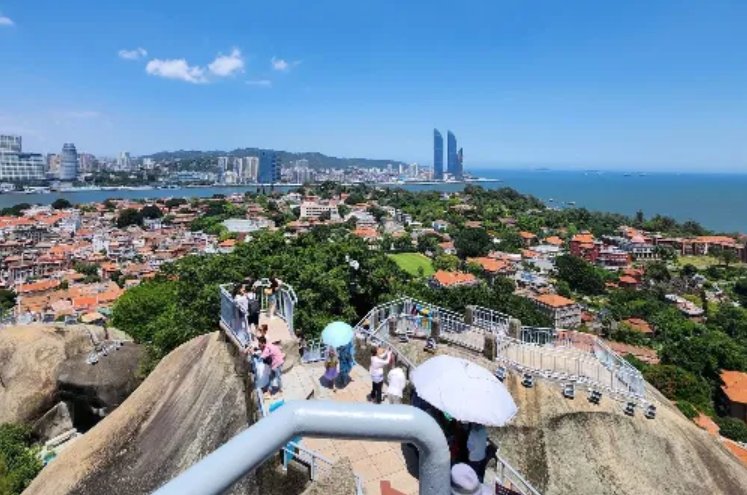
Located in the south?central part of the island, Sunlight Rock is the highest point on Gulangyu, at an elevation of 92.7 metres. The platform at the top covers about 40 square metres and offers a 360?degree panoramic view of Xiamen Island, Gulangyu, and the distant Jinmen Island. Sunlight Rock is formed by two huge boulders leaning against each other. On the rock face are cliff inscriptions such as "Sky Wind and Sea Waves" and "Gulang Cave Heaven," among which "Gulang Cave Heaven" was carved in the first year of the Wanli reign of the Ming dynasty, making it the oldest inscription on the island. The scenic area also includes Sunlight Rock Temple and the Zheng Chenggong Memorial Hall, where Zheng Chenggong once trained his naval forces.
Shuzhuang Garden
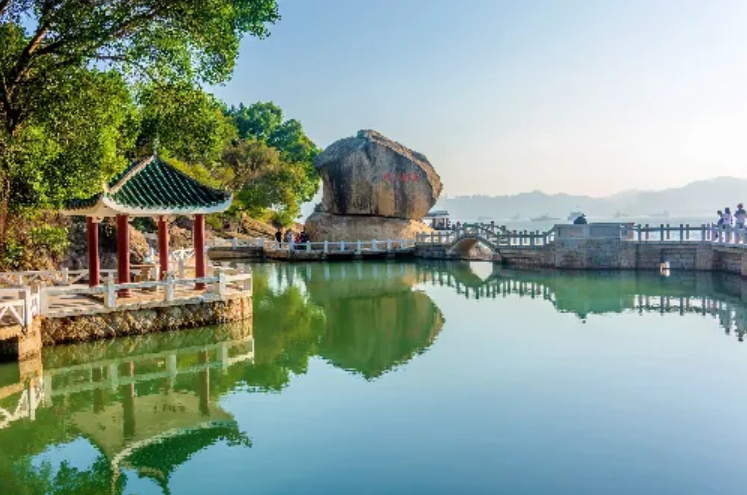
Built in 1913, this was originally the private villa of Lin Erjia, a wealthy Taiwanese merchant. It covers about 13,000 square metres and is divided into two parts: the Sea?Hiding Garden and the Hill?Complementing Garden. The Sea?Hiding Garden focuses on sea views, with a gate that hides the sea until one enters, revealing the ocean in a clever design. The Hill?Complementing Garden features mountain landscapes, including the Twelve Caverns rock maze and the Little Plank Bridge. The garden also houses a Piano Museum, displaying more than 30 antique pianos, including a rare and valuable gold?plated piano.
Haoyue Garden
Located on the southeastern seafront of Gulangyu, Haoyue Garden covers about 20,000 square metres and was built in commemoration of Zheng Chenggong's expulsion of Dutch colonists and his recovery of Taiwan. The centrepiece is a statue of Zheng Chenggong, 15.7 metres tall and weighing 1,617 tonnes, made of 625 pieces of granite assembled in 23 layers – the largest statue of a historical figure in China. The statue faces the Taiwan Strait, appearing majestic and imposing. The garden also includes the Half?Moon City and the Zheng Chenggong Historical Exhibition Hall, which display his life and achievements.
Organ Museum
Housed in the Bagua (Eight Trigrams) Building, built in 1907 and one of Gulangyu's landmarks, named for its octagonal roof. The museum displays more than 500 organs of various types, including the "Normanbier" pipe organ, which stands 6 metres tall – the only one of its kind in China and the world's largest vertical pipe organ. Regular organ concerts are held in the museum, allowing visitors to experience the charm of classical music.
Gulangyu Historical and Cultural Exhibition Hall
Located next to Yuyuan Garden, this exhibition hall has a floor area of about 1,500 square metres and presents the historical evolution of Gulangyu through cultural relics, photographs, and multimedia displays. The exhibition is divided into four sections: "Natural and Cultural Environment of Gulangyu," "Integration of Diverse Cultures," "Formation of the Historic International Community," and "Protection and Inheritance of Cultural Heritage." Notable exhibits include an 1893 map of Gulangyu and the seals of various consulates.
Suggested Itineraries:
One?Day Recommended Route:
8:00 Take a ferry from Xiamen International Cruise Center to Neicuo’ao Pier → 8:30 Visit Sunlight Rock (1.5 hours) → 10:00 Walk to Shuzhuang Garden (1.5 hours, including the Piano Museum) → 11:30 Lunch at Longtou Road → 13:00 Visit the Organ Museum (1 hour) → 14:00 Visit Haoyue Garden (1 hour) → 15:30 Visit the Gulangyu Historical and Cultural Exhibition Hall (1 hour) → 16:30 Relax at Gangzihou Seaside Bathing Beach → 18:00 Return by ferry from Sanqiutian Pier.
Two?Day Recommended Route:
Day 1: Morning – visit Sunlight Rock and Shuzhuang Garden; afternoon – visit the Organ Museum and the Carving Art Museum; evening – watch the sunset from Sunlight Rock and stroll through the Longtou Road night market.
Day 2: Morning – visit Haoyue Garden and the Gulangyu Historical and Cultural Exhibition Hall; afternoon – visit Huang Rongyuan Hall and Haitiantang (separate tickets required); evening – head to Meihua Beach, and later enjoy a free concert at the Gulangyu Concert Hall (advance booking required).
In?Depth Cultural Tour (3 Days):
Based on the 2?day itinerary, add visits to lesser?known spots such as Gulangyu Qin Garden (including the Bird Park) and Guancai Building. Join the guided explanation activities at the Piano Museum (daily at 10:00 and 15:00), and explore old villas on the island, such as Bagua Building and Ronggu Villa, to learn more about the historical stories behind the architecture.
Travel Tips:
Book ferry tickets 3 days in advance, especially during holidays and peak seasons, to avoid sold?out tickets. It is advisable to choose early morning ferries (7:10–8:00) to avoid large tour groups.
Gulangyu has hilly terrain, so wear comfortable sports shoes. Expect to walk about 15,000–20,000 steps per day. Bring a light backpack and drinking water.
Summer (June–August) is hot – take sun protection measures such as hats and sunscreen. Winter (December–February) has strong sea breezes – bring a windproof jacket.
Restaurants are concentrated around Longtou Road and Fujian Road. Lunch peak hours (11:30–13:00) can be crowded; consider eating at off?peak times or making reservations. Try the time?honoured "Lin's Fish Balls" and "Malaysia Juice."
For those interested in architectural culture, rent an audio guide (¥20/unit) or join the official architectural guided tour (¥100/group, advance booking required).
The Gulangyu Concert Hall (on Huangyan Road) offers free concerts at 19:30 daily, mainly classical music. Please arrive 30 minutes early.
Important Notes:
Ferry tickets include the return trip and are valid for 20 days. For the return, you may depart from either Sanqiutian Pier or Neicuo’ao Pier to Xiamen International Cruise Center or Songyu Pier.
Tickets for core attractions are valid only on the day of purchase. Plan your sightseeing order wisely to avoid buying duplicate tickets.
Gulangyu is a smoke?free scenic area. Smoking is prohibited throughout the island; violators are subject to fines of ¥50–¥200.
Gangzihou Seaside Bathing Beach has no lifeguards on duty. Swim with caution and do not go too far from shore. In summer afternoons, tides may rise – watch the water level.
Some old buildings on the island are private residences. Do not enter without permission or disturb residents. Please respect privacy when taking photos.
Longtou Road commercial street is crowded – keep your belongings secure, especially mobile phones and wallets, and avoid lingering in congested areas.
Gulangyu implements waste sorting. Visitors should dispose of rubbish in designated bins, separating kitchen waste from other waste.
Transportation:
Ferry: Visitors must take a ferry from Xiamen International Cruise Center (No. 2 Donggang Road, Huli District) or Haicang Songyu Pier to Gulangyu. The ticket is ¥35 per person (round trip), and the sailing time is about 20 minutes. Xiamen Ferry Terminal (No. 15 Lujiang Road, Siming District) is open only to local residents and visitors with valid identification.
Bus: Near the International Cruise Center, there is the "International Cruise Center" bus stop, served by routes 87, 51, 135, etc. Near Haicang Songyu Pier, there is "Songyu Bus Terminal," served by routes 842, 856, etc.
Metro: Take Xiamen Metro Line 2 to "Cruise Center Station," exit from Gate 3, and walk about 10 minutes to the International Cruise Center.
Taxi: From Xiamen Railway Station to the International Cruise Center is about 15 km, a 25?minute drive, costing about ¥40. From Gaoqi Airport to the International Cruise Center is about 12 km, a 20?minute drive, costing about ¥35.
Transport on the Island: Gulangyu is a car?free island – motor vehicles and bicycles are prohibited. Visitors must walk everywhere. Sightseeing battery carts are available: round?island route ¥50/person, sectional routes (e.g., Neicuo’ao Pier to Sunlight Rock) ¥30/person.
Opening Hours:
Gulangyu is open all day, though individual attractions may have varying hours, typically 8:00–18:00. Please check the specific opening times on the day of your visit.
Tickets:
Combo ticket:¥120/person.
Core attractions pass:¥90/person.
Single?attraction tickets are also available separately.