The Longmen Grottoes Scenic Area is located in Luolong District, Luoyang City, Henan Province. It is a national 5A-level tourist attraction, a World Cultural Heritage site, and one of China's four great grottoes. The planned area of the scenic spot is about 31.7 square kilometers, and the core sightseeing area is about 3 square kilometers. It consists of the West Hill Grottoes, East Hill Grottoes, Xiangshan Temple, and Bai Garden. There are more than 2,100 existing caves and niches, more than 100,000 statues, and more than 2,800 inscriptions and records. Among them, the "Twenty Works of Longmen" are the essence of Wei stele calligraphy, and the "Yi Que Fo Kan Zhi Bei" written by the great Tang dynasty calligrapher Chu Suiliang is a model of early Tang regular script art. With a large number of physical images and textual materials, the Longmen Grottoes reflect the development and changes of ancient Chinese politics, economy, religion, culture, and many other fields from different aspects, and can be called a museum of stone carving art.
Historical Culture
The Longmen Grottoes were first excavated during the reign of Emperor Xiaowen of the Northern Wei dynasty. After going through the Eastern Wei, Western Wei, Northern Qi, Sui, Tang, Five Dynasties, Song, and other dynasties, they were continuously and on a large scale constructed for more than 400 years, forming a grotto group stretching 1 kilometer from north to south. Representative grottoes of the Northern Wei period include Guyang Cave and Binyang Middle Cave. The statue style was influenced by Western Regions culture, with slender faces and flowing garments. In the Tang dynasty, Fengxian Temple was the representative, with statues that were full and rounded, reflecting the aesthetic fashion of the High Tang period.
The Longmen Grottoes are closely related to Buddhist culture. Many caves were excavated by the imperial family and nobility to pray for blessings and avert disasters. For example, Fengxian Temple was built by Emperor Gaozong Li Zhi of the Tang dynasty and Wu Zetian to commemorate Wu Zetian's mother, Lady Yang. It is said that the facial features of the Vairocana Buddha were modeled after Wu Zetian, demonstrating the combination of Buddhist art and imperial power. In addition, the Longmen Grottoes also preserve a large number of carvings and inscriptions on religious themes, and are important physical materials for studying the history of Chinese Buddhism.
Besides Buddhist culture, the inscriptions and records at the Longmen Grottoes have extremely high value in calligraphy art. Among them, the "Twenty Works of Longmen" are regarded as representative works of Wei stele calligraphy. Their font is vigorous and powerful, and their structure is rigorous, exerting a profound influence on the development of later calligraphy. The "Yi Que Fo Kan Zhi Bei" by the Tang dynasty calligrapher Chu Suiliang is a model of regular script. The inscription records the deed of Li Tai, the fourth son of Emperor Taizong of Tang, excavating Binyang South Cave to pray for blessings for his mother, Empress Zhangsun.
Main Attractions
Fengxian Temple
Fengxian Temple is the largest and most artistically exquisite group of cliff-side group sculptures in the Longmen Grottoes. It was excavated in the Tang dynasty and completed over three years and nine months. There are nine large statues in the temple. The central Vairocana Buddha is 17.14 meters tall, with a head 4 meters high and ears 1.9 meters long. His face is plump and elegant, with slightly upturned corners of the mouth, revealing concern for the human world and the light of wisdom. It is the landmark statue of the Longmen Grottoes. On both sides of the great Buddha stand disciples, bodhisattvas, heavenly kings, and strongmen. The group layout is rigorous and the momentum is majestic.
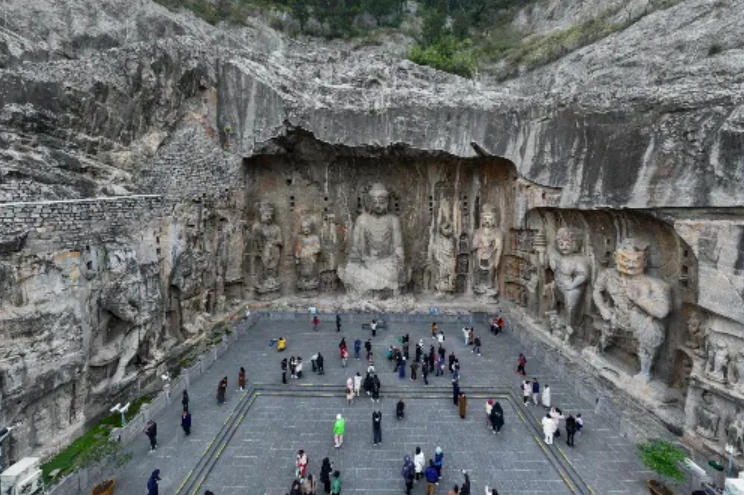
Guyang Cave
Guyang Cave is one of the earliest caves excavated in the Longmen Grottoes. It was excavated during the reign of Emperor Xiaowen of the Northern Wei dynasty and is the place where Northern Wei royal family and nobles most concentrated their votive statues. The four walls of the cave are covered with large and small Buddhist niches. The statues in the niches are mostly Shakyamuni Buddha, Maitreya Buddha, Amitabha Buddha, and bodhisattvas such as Guanyin and Manjushri. The cave ceiling is carved with lotus patterns and flying apsaras. The flying apsaras have graceful postures and fluttering ribbons, with typical Northern Wei artistic style. Nineteen of the "Twenty Works of Longmen" are located in this cave, making it a must-see place for calligraphy enthusiasts.
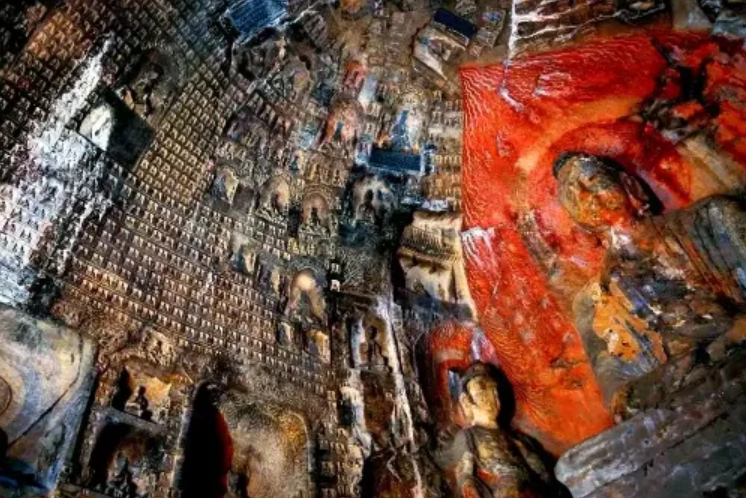
Binyang Middle Cave
Binyang Middle Cave was excavated during the Northern Wei period. It was built by Emperor Xuanwu of Northern Wei to accumulate merit for his parents, Emperor Xiaowen and Empress Wenzhao, and took 24 years to complete. The interior of the cave is hoof-shaped in plan with a domed ceiling. In the center is carved a double-petaled lotus canopy, surrounded by 10 celestial musicians. The main wall is carved with one Buddha, two disciples, and two bodhisattvas. The main Buddha, Shakyamuni Buddha, sits cross-legged on a lotus seat, with delicate facial features and smooth garment lines. Both sides of the cave gate are carved with reliefs such as Vimalakirti and jataka stories, with extremely high artistic level.
Xiangshan Temple
Xiangshan Temple is located halfway up the East Hill of Longmen. It was first built in the first year of Xiping in the Northern Wei dynasty (516 AD) and was rebuilt during the reign of Wu Zetian of the Tang dynasty. Existing buildings in the temple include the Hall of Heavenly Kings, the Great Buddha's Hall, and the Chiang-Soong Villa. The great Tang poet Bai Juyi once lived here and called himself "Xiangshan Jushi." The Nine Elders Hall in the temple is said to be the place where Bai Juyi gathered with Hu Gao, Ji Min, and eight other elders. At present, statues of the nine elders are placed in the hall, showing the elegant gathering culture of Tang dynasty literati.
Bai Garden
Bai Garden is a garden-style architectural complex built to commemorate the great Tang poet Bai Juyi. It is located on Pipa Peak of the East Hill of Longmen. The buildings in the garden are built according to the mountain, with lush trees. The main scenic spots include the Green Valley Area, Paradise Hall, Poetry Corridor, and Cemetery Area. In the center of the cemetery area is Bai Juyi's tomb, with a stele in front reading "Tomb of Duke Bai, Junior Tutor of Tang." The architectural style of Bai Garden is simple and elegant, blending with the natural landscape. It is an ideal place to experience Bai Juyi's poetry culture.
Tour Routes:
Classic one-day tour route: In the morning, enter from the scenic area entrance and first visit the West Hill Grottoes, visiting major caves such as Qianxi Temple, Binyang Three Caves, Ten Thousand Buddha Cave, and Fengxian Temple in order, focusing on appreciating the magnificent scene of the Vairocana Buddha. At noon, taste local specialties such as Luoyang Water Banquet or beef soup near the scenic area. In the afternoon, go to the East Hill Grottoes and visit Leigutai Three Caves, Kanjing Temple, and others. After that, visit Xiangshan Temple to learn about the connection between Bai Juyi and Xiangshan Temple. Finally, go to Bai Garden, stroll through the garden, experience Bai Juyi's poetic sentiments, and leave the scenic area from the Bai Garden exit.
In-depth cultural tour route: On the first morning, focus on visiting the West Hill Grottoes, carefully observe the statues and inscriptions in each cave, and focus on studying the artistic characteristics of the "Twenty Works of Longmen" and Fengxian Temple. In the afternoon, go to the East Hill Grottoes and gain an in-depth understanding of the stylistic changes in Tang dynasty Buddhist statues. On the second morning, visit Xiangshan Temple and tour buildings such as the Chiang-Soong Villa and Nine Elders Hall, experiencing the blend of history and culture. In the afternoon, visit Bai Garden and appreciate Bai Juyi's life and poetic creation amid the landscape garden, ending the in-depth cultural journey.
Travel Suggestions:
The suggested visiting time is 4-5 hours. If you want to gain an in-depth understanding of grotto culture and history, you can arrange 1 day.
When visiting, it is recommended to rent a scenic area audio guide (rental fee 20 yuan) or hire a guide (fee about 100 yuan) to better understand the historical background and artistic value of the grottoes.
The Longmen Grottoes are built along the mountain, and visiting requires going up and down steps. It is recommended to wear comfortable sports shoes and carry drinking water and a small amount of snacks.
In summer, pay attention to sun protection and carry a sun hat and sunscreen. In winter, pay attention to keeping warm, especially in the Bai Garden and Xiangshan Temple areas at the top of the mountain.
Every April during the Peony Culture Festival, there is a large flow of people around the scenic area. It is recommended to plan your itinerary in advance and avoid peak periods.
If you are interested in calligraphy art, you can focus on the inscriptions in Guyang Cave and Binyang Middle Cave, among which the "Twenty Works of Longmen" are the essence of Wei stele calligraphy.
Precautions:
Smoking and littering are prohibited in the scenic area. Keep the environment clean.
To protect cultural relics, the use of flash photography is prohibited inside caves. Some caves have signs prohibiting photography, which must be strictly observed.
When visiting, abide by the scenic area regulations. Do not touch or climb statues and inscriptions, so as not to damage cultural relics.
Xiangshan Temple and Bai Garden are located on the mountain and have many steps. It is recommended that the elderly and children visit accompanied by family members and pay attention to safety.
There are multiple commercial stalls at the entrance of the scenic area. When purchasing goods, compare prices to avoid being overcharged.
If it rains, the ground of the grottoes is slippery, so walk carefully. In winter, some steps may freeze, so it is recommended to wear non-slip shoes.
When leaving the scenic area, you can exit from the Bai Garden exit. There is a bus stop nearby, making it convenient to go to the city or other attractions.
Transportation:
Bus: In Luoyang city, take buses 53, 60, 67, 71, and 81 to reach the entrance of the Longmen Grottoes Scenic Area directly. Bus 81 departs from Luoyang Railway Station, with a journey of about 40 minutes and a fare of 1.5 yuan-2 yuan.
Taxi: From Luoyang Railway Station to the Longmen Grottoes is about 15 kilometers, and the taxi fare is about 30-40 yuan. From Luoyang Beijiao Airport to the Longmen Grottoes is about 30 kilometers, and the taxi fare is about 60-80 yuan.
Self-driving: Self-driving cars can reach Luoyang via Erguang Expressway, Zhengshaoluo Expressway, and others. The scenic area has a parking lot. The parking fee for small cars is 10 yuan per vehicle, and for large vehicles 15 yuan per vehicle.
Tourist line: Luoyang Longmen High-speed Railway Station (Luoyang Longmen Station) has a tourist shuttle to the Longmen Grottoes. The fare is 5 yuan, and the journey is about 15 minutes.
Opening Hours:
Open all year round. Opening hours are:
April 1-October 7: 08:00-18:30 (last entry at 17:30)
October 8-March 31 of the following year: 08:00-17:30 (last entry at 16:30)
During statutory holidays and the Peony Culture Festival, opening hours may be slightly adjusted. Please refer to the scenic area's announcement on the day.
Tickets:
Ticket price: 90 yuan per person.