Yuntai Mountain Scenic Area is located in Xiuwu County, Jiaozuo City, Henan Province. It is a national 5A-level tourist attraction, a World Geopark, and a National Forest Park. The scenic area covers a total area of about 240 square kilometers and includes major attractions such as Red Stone Gorge, Tanpu Gorge, Quanpu Gorge, Zhuyu Peak, Diecai Cave, and Wanshan Temple. The core sightseeing area is about 50 square kilometers. It is known for its unique "northern karst landform" and has geological relics dating back 3.4 billion years. Cliffs, flying waterfalls, and canyon streams interweave to form a natural landscape of "a spring every three steps, a waterfall every five steps, and a pool every ten steps." The Yuntai Sky Waterfall, with a drop of 314 meters, is the largest single-drop waterfall in Asia. Red Stone Gorge, formed from Mesoproterozoic quartz sandstone from 1.4 billion years ago, is a rare Danxia landform landscape in northern China.
Historical Culture
The history of Yuntai Mountain can be traced back to the Wei and Jin dynasties. It got its name because "the mountain has seventy-two peaks, and every peak produces clouds." The great Tang poet Wang Wei once wrote here the famous lines "Alone in a foreign land as a stranger, I miss my family even more on festive days." The "Zhuyu Peak" in the poem is located in the core scenic area of Yuntai Mountain, and Tang dynasty zhuyu planting relics are still preserved there.
The religious culture of the Yuntai Mountain area is profound. Wanshan Temple was first built in the Tang dynasty and was a royal temple. It was rebuilt during the Yongle period of the Ming dynasty. The temple preserves cultural relics such as Ming dynasty bronze Buddhas and Qing dynasty stone inscriptions. Diecai Cave is a mountain road excavated by local villagers in the 1970s over 10 years. It consists of 14 tunnels with a total length of 4,831 meters. The project is precipitous and is praised as an "artificial heavenly river," embodying the contemporary spirit of the foolish old man who moved mountains.
Yuntai Mountain was also a reclusive dwelling place of the "Seven Sages of the Bamboo Grove" during the Wei and Jin dynasties. Ji Kang, Ruan Ji, and others once lived in the Baijia Rock area. Relics such as Ji Kang's Sword Quenching Pool and Liu Ling's Sobering Platform still exist, making it an important place for studying Wei-Jin culture.
Major Attractions
Red Stone Gorge
Red Stone Gorge is a landmark attraction of Yuntai Mountain. It is about 2,000 meters long and 68 meters deep, formed from quartz sandstone from 1.4 billion years ago. Inside the gorge, Danxia rock walls and emerald water reflect each other, forming landscapes such as "One-Line Sky," "Huanglong Waterfall," and "Shoulong Pool." Among them, Huanglong Waterfall has a drop of 34 meters and flows continuously throughout the four seasons. The temperature inside the valley remains constant at 15°C, earning it the name "natural air conditioner." It is a rare Danxia landform gorge in northern China.
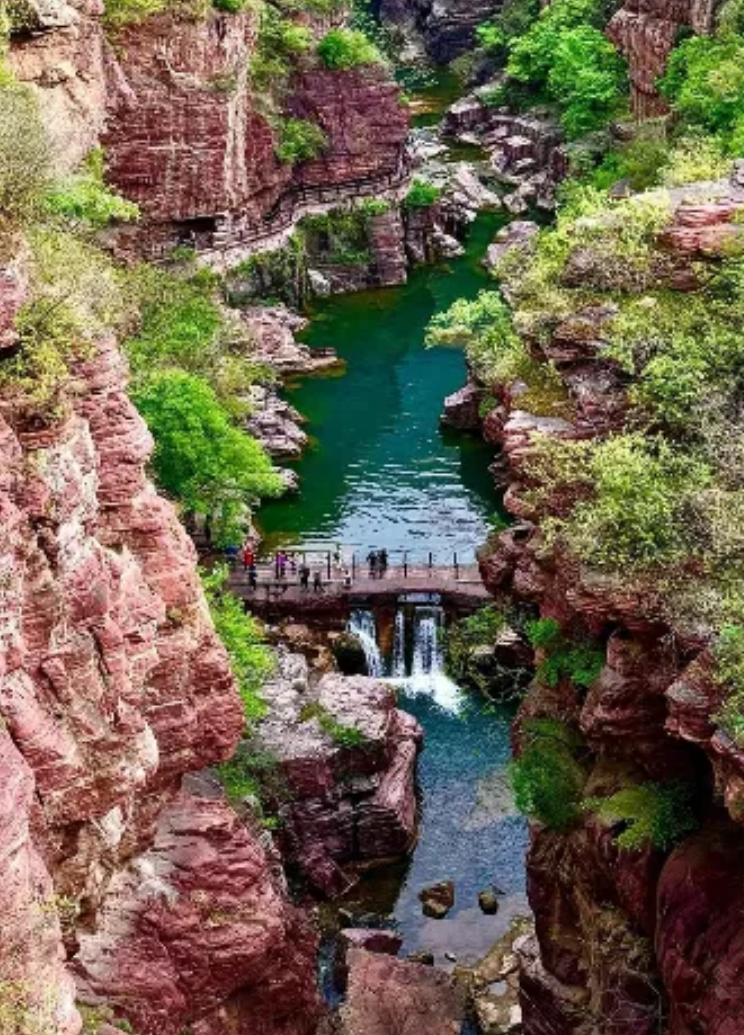
Tanpu Gorge
Tanpu Gorge is 2.5 kilometers long. It is named for "a spring every three steps, a waterfall every five steps, and a pool every ten steps." Its main landscapes include "Longshe Pool," "Yapu Pool," and "Lover's Waterfall." Among them, Lover's Waterfall consists of two waterfalls embracing each other, with a drop of more than 10 meters; Water Curtain Cave is more than 10 meters wide, with water flowing down like a curtain of pearls. It is a summer resort.
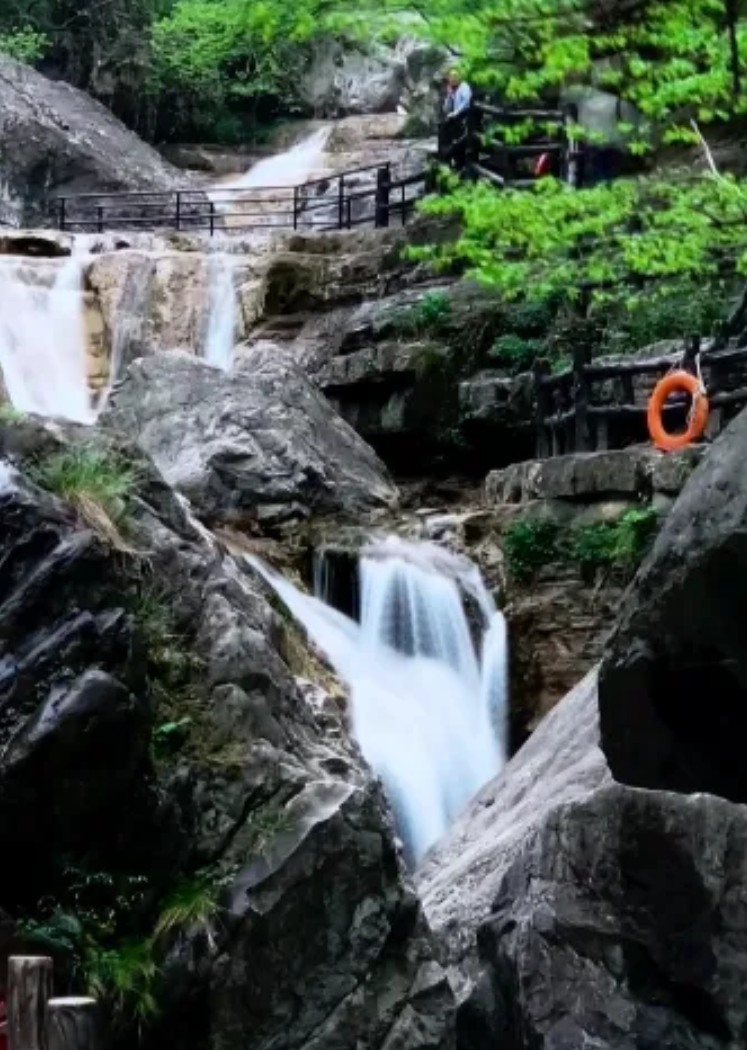
Quanpu Gorge
Quanpu Gorge is 3 kilometers long and is also called the "Yuntai Sky Waterfall Scenic Area." At its end is Yuntai Sky Waterfall, with a drop of 314 meters, the largest single-drop waterfall in Asia. The Tianpu Pool below the waterfall is 6 meters deep. In summer, the area is filled with mist; in winter, ice waterfalls hang frozen. Along the way, there are also landscapes such as "Whispering Spring" and "Whale Bay."
Zhuyu Peak
Zhuyu Peak is 1,308 meters above sea level and is famous because of Wang Wei's Tang poem. At the summit are landscapes such as the Temple of the Great Emperor Zhenwu and the Heavenly Bridge. The climbing trail has a total of 1,667 steps. Along the way are natural karst caves such as "Medicine King Cave" and "Kitchen Stove Cave." From the top, visitors can overlook the surrounding peaks. It is one of the main peaks of Yuntai Mountain.
Diecai Cave
Diecai Cave is a winding mountain tunnel connecting to Zhuyu Peak. It consists of 14 caves with a total length of 4,831 meters and a drop of nearly 1,000 meters. Inside the caves are designs such as U-shaped turns and 180-degree spirals. Traveling through by vehicle, visitors can view mountain landscapes such as "Three Beautiful Rocks" and "Xiying View." It is an engineering miracle combining geology and humanity.
Wanshan Temple
Wanshan Temple was first built in the Tang dynasty and rebuilt during the Yongle period of the Ming dynasty. It covers an area of 3,600 square meters. Inside the temple are buildings such as the Mahavira Hall and the Hall of Heavenly Kings. The existing Ming dynasty bronze Buddha is 1.6 meters tall. The Qing dynasty "Wanshan Temple Stele" records the history of the temple. The temple is surrounded by bamboo forests and is an attraction combining Buddhist culture and natural landscape.
Tour Routes:
Classic one-day tour route: In the morning, take the sightseeing bus to Red Stone Gorge and tour for 1.5 hours. Then go to Tanpu Gorge (1 hour) and Quanpu Gorge (1.5 hours), and have lunch in the service area. In the afternoon, take the sightseeing bus to Zhuyu Peak and climb it (2 hours). On the return trip, pass through Diecai Cave, and finally visit Wanshan Temple (0.5 hours) to end the trip.
In-depth two-day tour route: On the first day, visit Red Stone Gorge and Tanpu Gorge in the morning, and visit Quanpu Gorge and Wanshan Temple in the afternoon. On the second day, take the sightseeing bus through Diecai Cave to Zhuyu Peak in the morning, climb the mountain, and visit the glass skywalk (3 hours). In the afternoon, go to Baijia Rock and visit relics such as Ji Kang's Sword Quenching Pool (1.5 hours) to experience Wei-Jin culture.
Travel Suggestions:
It is recommended to spend 1-2 days visiting. For a one-day tour, choose Red Stone Gorge, Tanpu Gorge, Quanpu Gorge, and Zhuyu Peak. For a two-day tour, you can further experience cultural attractions such as Baijia Rock and Wanshan Temple.
Summer (July-August) is the period when Yuntai Sky Waterfall has the largest water volume. In winter, some attractions may be closed. It is recommended to follow the official scenic area website.
The climbing trail of Zhuyu Peak is relatively steep. It is recommended to wear non-slip shoes and carry drinking water. Climbing takes about 2 hours. If you lack physical strength, you can choose to take the cable car (one-way 70 yuan, round-trip 120 yuan).
The last bus time of the sightseeing bus in the scenic area adjusts with the seasons. In peak season, it is about 18:00. It is recommended to arrange your return trip reasonably to avoid missing the bus.
The glass skywalk requires a separate ticket. Visitors afraid of heights may take a detour. The surface of the skywalk is transparent glass. It is recommended to wear non-slip shoes.
Notes:
Smoking and littering are prohibited in the scenic area. Please protect the natural environment. Swimming is prohibited in canyons such as Red Stone Gorge.
The walkways in Quanpu Gorge and Tanpu Gorge are slippery. It is recommended to wear non-slip shoes. Extra care is needed on rainy days. In winter, some sections may freeze, so pay attention to safety.
Sharp objects are prohibited on the Zhuyu Peak glass skywalk. Running and jumping are prohibited. People with heart disease or high blood pressure should experience it with caution.
The sightseeing bus is boarded by ticket. Please keep your admission ticket and bus ticket properly. Tickets are checked at the entrance of each attraction.
Food in the scenic area is relatively expensive. You may bring your own snacks and drinking water. Fast food and snacks are available in the service area.
Wanshan Temple is a religious site. Please keep quiet when visiting, respect Buddhist customs, and follow the rules in areas where photography is prohibited.
Transportation:
Self-driving: From Zhengzhou and Luoyang, you can reach the scenic area directly via the Zheng-Yun Expressway and Jin-Xin Expressway. The scenic area parking lot charges 20 yuan/day for small cars and 30 yuan/day for large cars.
High-speed rail: From Zhengzhou East Station, take the Zheng-Jiao intercity railway to Xiuwu West Station, then transfer to the scenic area shuttle bus (15 yuan/person, one bus every 30 minutes).
Long-distance bus: There are direct buses to Yuntai Mountain from Zhengzhou General Bus Station and Jiaozuo Tourist Bus Station. The trip from Zhengzhou to Yuntai Mountain takes about 2 hours, with a fare of 40 yuan; the trip from Jiaozuo to Yuntai Mountain takes 1 hour, with a fare of 15 yuan.
Internal transportation in the scenic area: Sightseeing buses must be used within the scenic area. The fare is 60 yuan and covers all attractions. Buses depart every 5-10 minutes.
Opening Hours:
Open all year round. Opening hours are:
Peak season (March 1-November 30): 07:30-18:30 (last entry at 17:30)
Off-season (December 1-February 28 of the following year): 08:00-17:30 (last entry at 16:30)
Opening hours may be extended on statutory holidays and during the summer period (July-August). Please refer to the scenic area announcement for details. Some attractions such as Yuntai Sky Waterfall may be closed in winter due to freezing. It is recommended to check the official scenic area website before traveling.
Tickets:
Admission ticket (including sightseeing bus): 180 yuan/person. The glass skywalk is charged separately at 20 yuan/person.