The Funiu Mountain Scenic Area spans Luoyang City, Nanyang City, and Pingdingshan City in Henan Province, with its main body located in Luanchuan County, Luoyang City. It is a national-level nature reserve and a national 5A-level tourist attraction. The scenic area covers a total area of about 5,000 square kilometers and is composed of several sections, including Laojun Mountain, Jiguan Cave, Baiyun Mountain, and Baotianman. It is part of the eastern section of the Qinling Mountains' remaining range, with the main peak, Laojun Mountain, at an altitude of 2,217 meters. The scenic area is famous for its peculiar granite peak forest landforms, rich animal and plant resources, and profound Taoist culture. Its forest coverage rate is over 92%, and it is known as a "natural oxygen bar" and the "lungs of the Central Plains." It is a comprehensive scenic area integrating mountain and water sightseeing, geological scientific research, and cultural experience.
Historical Culture
Funiu Mountain is the transitional zone between the climates of northern and southern China, as well as the watershed between the Yellow River and Yangtze River basins. Historically, it was one of the important birthplaces of Taoist culture. Legend has it that Laozi once lived in seclusion and cultivated himself here, and Laojun Mountain was named after him. The existing Laojun Temple, Taiqing Temple, and other buildings were first built during the Northern Wei Dynasty, rebuilt during the Zhenguan period of the Tang Dynasty, and were granted the name "Laojun Mountain" by Emperor Wanli of the Ming Dynasty, becoming a sacred site of Taoism in the Central Plains.
The Jiguan Cave in the scenic area was formed 800 million years ago. The cave is rich in karst landscape features, and since the Tang Dynasty, men of letters have inscribed words here. The earliest surviving inscription is from the Northern Song Dynasty. Funiu Mountain is also an old revolutionary base area. During the War of Resistance Against Japan, it was an important part of the western Henan anti-Japanese base area, leaving behind many red historical relics.
Main Attractions
Laojun Mountain
Located in Luanchuan County, it is the main peak of Funiu Mountain, with an altitude of 2,217 meters. The scenic area contains more than 200 granite peaks, forming a unique "detachment peak forest" landform. The Ten-Mile Painting Screen landscape is about 3 kilometers long and is composed of countless stone pillars and peaks, known as the "Zhangjiajie of the North." The Taoist architectural complex on the mountain covers an area of about 15,000 square meters, including attractions such as Laojun Temple, Yuhuang Summit, and South Heavenly Gate. Among them, the Golden Summit Taoist Temple complex was built on the mountaintop at an altitude of more than 2,000 meters and consists of Ming and Qing style buildings such as the Wumu Golden Hall and Daode Mansion. It is the highest-altitude Taoist architectural complex in the Central Plains.

Jiguan Cave
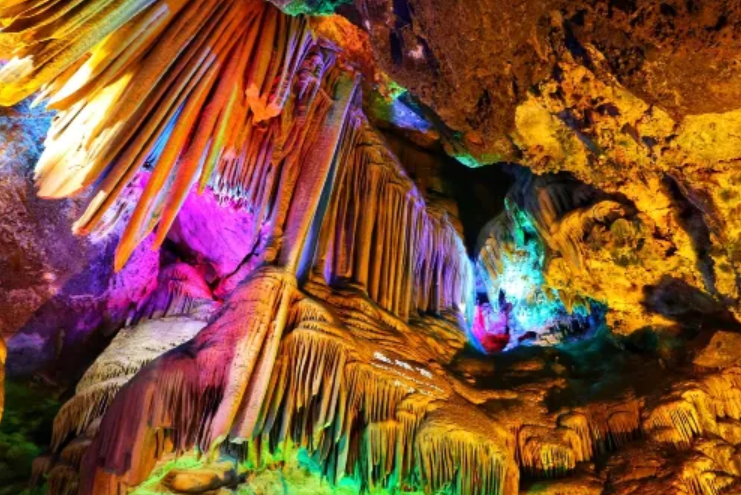
Located 3 kilometers west of Luanchuan County seat, it is a large limestone karst cave with a depth of 5,600 meters. The developed cave length is 1,800 meters, and the viewing area is 23,000 square meters. The cave has 8 major scenic zones and more than 180 scenic spots. Stalactites, stalagmites, stone pillars, and other karst landscapes are fully developed. Among them, landscapes such as "Immortals Welcoming Guests" and "Golden Turtle Ferrying the Immortal" have peculiar shapes. The temperature inside the cave remains at 15-18°C year-round, and it is known as a "natural large air conditioner." It is a typical representative of karst landforms in northern China.
Baiyun Mountain
Located in the southern part of Song County, the scenic area covers 168 square kilometers. The main peak, Yuhuang Summit, has an altitude of 2,216 meters and is known as the "Central Plains Extreme Summit." The scenic area includes attractions such as Yuhuang Summit, Baiyun Mountain, and Little Huangshan. The forest coverage rate reaches 98.5%, with 1,991 species of plants and 204 species of animals. Baiyun Lake has a water area of 11,000 square meters and a storage capacity of 120,000 cubic meters, making it the main water landscape resource in the scenic area; Jiulong Waterfall has a drop of 123 meters and a width of more than 10 meters, making it one of the largest waterfalls in the Central Plains.
Baotianman
Located in Neixiang County, it is a national-level nature reserve with an area of 5,400 hectares. The main peak, Muhu Summit, has an altitude of 1,830 meters. The scenic area is mainly composed of primitive forests and canyon landscapes, with dense larch forests, among which there are more than 100 ancient trees over a thousand years old. Seven Star Pool is composed of seven connected deep pools, with clear water and a cumulative drop of 400 meters; Fossil Point is named for its abundance of ancient biological fossils and is an important site for studying the geological evolution of the Qinling orogenic belt.
Chongdugou
Located in Tantou Town, Luanchuan County, the scenic area covers 20 square kilometers. It was named after Emperor Guangwu of the Eastern Han Dynasty, Liu Xiu, crossed the Yi River twice here. The scenic area has a dense bamboo sea landscape, with a bamboo forest area of more than 1,000 mu, making it the largest bamboo forest viewing area in the Central Plains. The Jinji River Waterfall Group is about 3 kilometers long and has more than 30 waterfalls of various sizes. Among them, Xiefen Cliff Waterfall has a drop of more than 60 meters and is the landmark landscape of the scenic area.
Tour Routes:
Classic one-day tour route of Laojun Mountain:
Mountain Gate → Zhongling Cableway → Dream-Chasing Valley → Glass Viewing Platform → Ten-Mile Painting Screen → Golden Summit Taoist Temple Complex → Descend by Yunjing Cableway (about 6 hours in total; taking the cableway is recommended to save energy)
Three-day in-depth tour route of Funiu Mountain:
Day 1: Jiguan Cave → Laojun Mountain (climb in the afternoon, watch the sunset and the night view of the Golden Summit)
Day 2: Laojun Mountain Ten-Mile Painting Screen → Baiyun Mountain (visit Baiyun Lake and Jiulong Waterfall)
Day 3: Baiyun Mountain Yuhuang Summit → Chongdugou (experience the bamboo sea and waterfall group)
Ecological scientific research route:
Baotianman Nature Reserve → Fossil Point Geological Section → Seven Star Pool Canyon → Neixiang County Government Office (learn about the geological evolution and human history of Funiu Mountain; about 2 days in total)
Travel Suggestions:
Suggested travel time: 3-5 days; core scenic areas such as Laojun Mountain and Baiyun Mountain can be chosen according to interest.
Laojun Mountain has a high altitude, and the temperature at the summit is 8-10°C lower than at the foot of the mountain. A jacket is needed in summer, and a down jacket is needed in winter.
The inside of Jiguan Cave is humid and the ground is slippery. Non-slip shoes are recommended. Flash photography is prohibited inside the cave.
Baiyun Mountain Scenic Area is large. It is recommended to take the sightseeing bus (70 yuan/person). Reaching Yuhuang Summit requires a 1.5-hour hike.
In April-May, azaleas bloom on Laojun Mountain, and in October-November, red leaves cover Baiyun Mountain. These are the best viewing seasons.
There are many farmhouse inns in the scenic area, priced at about 100-200 yuan per night, where visitors can experience western Henan homestays.
Precautions:
Funiu Mountain is mostly mountainous, and some attractions require hiking. Comfortable sports shoes are recommended, and drinking water and snacks should be carried.
The Golden Summit Taoist Temple complex on Laojun Mountain is a religious site. Visitors should keep quiet and respect Taoist customs.
Smoking, littering, and picking wild plants are prohibited in Baotianman Nature Reserve.
Mountainous areas have more rain in summer. Rain gear should be carried, and attention should be paid to preventing geological disasters such as mountain floods and landslides.
Tickets for each scenic area are purchased separately. It is recommended to book in advance on the official website or platforms to avoid queuing during peak seasons.
Chongdugou has folk performances at night. Performance times and locations can be inquired about in advance.
Transportation:
High-speed rail:
Luoyang Longmen Station → Luanchuan County. Visitors can take the high-speed rail to Luoyang, then transfer to a long-distance bus. The bus from Luoyang to Luanchuan takes about 2 hours, and the ticket price is 50 yuan.
Self-driving:
Zhengzhou → Zhengshaoluo Expressway → Luoluan Expressway → Luanchuan County (Laojun Mountain, Jiguan Cave), about 3.5 hours by car
Xi'an → Lianhuo Expressway → Luoluan Expressway → Luanchuan County, about 5 hours by car
Wuhan → Beijing-Hong Kong-Macau Expressway → Zhengluan Expressway → Song County (Baiyun Mountain), about 6 hours by car
Scenic area transportation:
There are sightseeing buses in each scenic area. Laojun Mountain, Baiyun Mountain, and others require cable cars to climb the mountain. The one-way operation time of Zhongling Cableway is about 8 minutes.
Opening Hours:
The opening hours of the various scenic areas of Funiu Mountain differ slightly, mainly as follows:
Laojun Mountain: Open all year, 8:00-18:00 (extended to 19:00 in summer)
Jiguan Cave: 8:30-17:30 (9:00-17:00 in winter)
Baiyun Mountain: 8:00-18:00; some attractions are closed in winter
Baotianman: 8:00-17:30; some mountain roads may be closed during the rainy season (July-August)
Chongdugou: 7:30-18:30; there are lighting landscapes at night in summer
Normally open on statutory holidays, subject to the announcements of each scenic area.
Tickets:Tickets for each section of Funiu Mountain are charged separately, as follows:
Laojun Mountain: 100 yuan/person.
Jiguan Cave: 80 yuan/.
Baiyun Mountain: 75 yuan/person.
Baotianman: 70 yuan/person.
Chongdugou: 120 yuan/person.