Shawan Ancient Town is located in Shawan Subdistrict, Panyu District, Guangzhou City, Guangdong Province, situated south of the Shiqiao River and northwest of the Shawan Waterway in the Pearl River Delta. It is the only ancient town in Guangzhou that has been awarded the title of "China's Famous Historical and Cultural Town." It is a national 4A-level tourist attraction and has also been honored as Guangdong Province's first Intangible Cultural Heritage Ancient Town, the "Hometown of Chinese Folk Culture and Arts," the "Hometown of Guangdong Music," and the "Hometown of Chinese Dragon and Lion Dance," among many other provincial and national cultural tourism accolades. The town covers a planned area of 1,475 mu (approximately 98.35 hectares), with a core tourism development zone of 265 mu (about 17.63 hectares), and the overall management area exceeds 2,300 mu. It preserves about 400 ancient buildings from the Ming and Qing dynasties and the Republic of China period, including 1 national key cultural relic protection unit, 17 municipal-level protected sites, and 109 registered cultural relic points. Over 70 ancestral halls of various grades remain, and the streets and lanes retain the traditional comb?like layout and original stone-paved alleyways of an ancient village. There is a wealth of Lingnan traditional architectural decorations such as brick carvings, wood carvings, stone carvings, and plaster mouldings. The town serves as a tangible showcase of Cantonese material and intangible culture in the Pearl River Delta. It has 17 registered intangible cultural heritage items, including 1 national-level and 5 provincial-level items. With ancient architecture, folk performances, and traditional cuisine as its core attractions, it is a Lingnan cultural tourism complex combining heritage appreciation, intangible culture experiences, gourmet food, leisure, and study tours.
History and Culture
Shawan Ancient Town was founded in the Jiading era of the Southern Song Dynasty, originally named Benshan Village. Because the settlement was built on a pig?waist?shaped ridge beside a crescent?shaped sandy bay, it gradually came to be called Shawan ("Sandy Bay"). It has a history of over 800 years. During the Song Dynasty, the northern part of Shawan had already formed dry land, while the south remained shallow sea. Generations of ancestors carried out land reclamation projects, expanding the land area, and gradually formed clustered settlements relying on waterway transportation. In the Yuan Dynasty, the He clan moved here and, through generations of farming and scholarship, became the most influential clan in Shawan, laying the foundation for the town's cultural heritage.
The Ming and Qing dynasties were the peak period of Shawan's development. Benefiting from maritime trade, local handicrafts, shipping, and market commerce flourished rapidly, forming a well?structured "three streets and six markets" urban pattern, with complete supporting facilities including lanes, shops, ancestral halls, and temples. Over several centuries, the He clan produced 8 candidates who passed the highest imperial examinations and more than 50 civil and military provincial graduates. This deep imperial?examination culture promoted large?scale construction of academies and ancestral halls, and most of the existing ancient ancestral halls and residential buildings date from this period. At the same time, local folk arts took shape, brick carving and plaster moulding techniques matured, and folk parades, dragon and lion dances, and local tunes became common forms of entertainment.
In modern times, Shawan became the birthplace of Guangdong music. He Liutang, He Yunian, and He Shaoxia, known as the "Three Hes," composed classic Guangdong music pieces such as Dragon Boat Race, Raindrops on Banana Leaves, and Hungry Horse Shakes Its Bell at the Sanxian Hall, making Shawan a core center of Lingnan folk music. Two folk customs—Shawan Piaose (floating color pageantry) and Shakeng Lion Dance—were successively inscribed as national?level intangible cultural heritage. The Piaose parade held annually on the birthday of the Northern Emperor has become a landmark folk event. In modern times, the town's ancient layout has not suffered large?scale damage, and the street texture and living style of the late Qing and early Republic periods have been completely preserved. In recent years, systematic restoration and protection have been carried out, with intangible heritage revitalization as the main development focus, creating a cultural tourism model that integrates intangible heritage displays, folk experiences, and traditional cuisine. In 2012, Shawan Ancient Town officially launched its tourism operations, completing the transition from a traditional ancient village to a standardized scenic area.
Major Attractions
Liukeng Tang (He Clan Ancestral Hall)
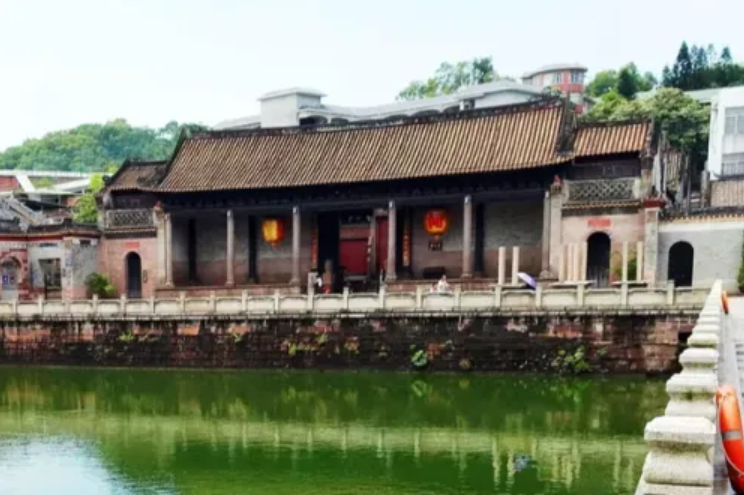
Liukeng Tang is a national key cultural relic protection unit and the main ancestral hall of the He clan in Shawan. It was first built in 1275 during the Southern Song Dynasty and underwent extensive renovation over seventeen years in the Qing Dynasty. Covering 3,334 square meters, it follows the architectural regulations for a fourth?rank official's ancestral temple, with a five?bay, five?depth layout—a grand Lingnan ancestral hall format. It is hailed as the "comprehensive art palace of Lingnan ancient architecture." The name comes from the family motto "Keep a plot of land in your heart to pass on to descendants." The building brings together the four traditional Lingnan crafts—brick carving, wood carving, stone carving, and plaster moulding. The wooden beams are carved with complete scenes from Romance of the Three Kingdoms, the stone carvings on the gate and terrace are exquisitely detailed, and the plaster figures and floral?bird paintings on the ridge remain well preserved after centuries. In front of the hall is a crescent?shaped pond, and on both sides stand ancient flagpole bases for imperial examination achievers, making it the most tangible witness to Shawan's farming?and?scholarship culture and the town's landmark building.
Sanxian Hall
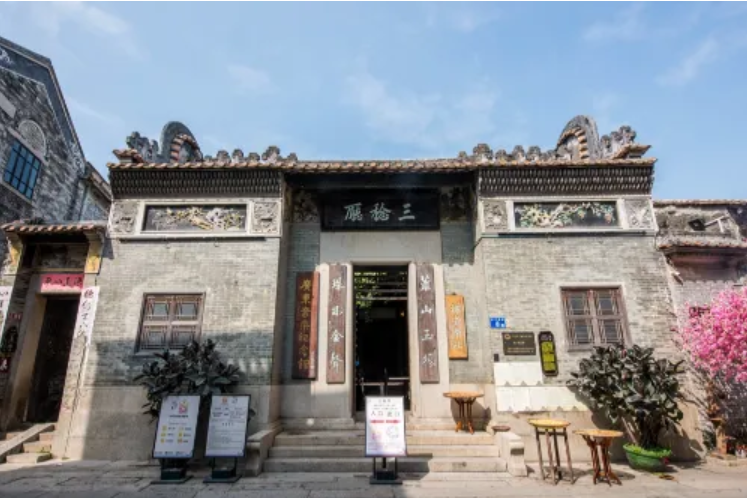
Located in the core historic lanes, Sanxian Hall is named after a century?old sanxian tree in its courtyard. It is widely recognized as the birthplace of Guangdong music. The building is a Qing?style ancestral hall with brick?and?wood structure. From the late Qing to the Republic period, the "Three Hes" composed and performed Guangdong music here for a long time, and many Lingnan folk musicians regularly gathered for performances. The folk tradition of private music clubs (sijuhu jams) continues to this day, with local musicians performing traditional Cantonese music daily. Inside, traditional instruments such as the gaohu, yangqin, and pipa are displayed, along with exhibition areas on the history of Guangdong music, fully documenting its origin and spread in Shawan. It is a core venue for experiencing Lingnan folk music culture.
Wenfeng Pagoda
Wenfeng Pagoda is the highest landmark in the town, a three?story pavilion?style Wenchang pagoda built entirely with local old blue bricks. Its solid structure was originally erected to pray for literary prosperity. Visitors can ascend to the second and third floors for a panoramic view of the continuous rows of guo'erwu (gable?like) roofs across the town—the best spot for taking overall scenic photos. Surrounded by ancient trees and greenery, the blue?brick pagoda and nearby Lingnan residences create a highly distinctive ancient town landscape. It is open to visitors free of charge all day.
Oyster Shell Wall Ancient Lanes
Oyster shell walls are concentrated along Chebei Street and Jinhui Lane. These are characteristic residential wall constructions from the Ming Dynasty in Lingnan, built by ramming oyster shells mixed with lime and glutinous rice mortar. They naturally provide insulation, moisture resistance, and coolness in summer and warmth in winter. The ancient lanes, paved with blue stone slabs, are flanked by multiple original oyster shell walls that retain the natural concave?convex texture of the shells, accompanied by traditional guo'erwu houses and tanglong (sliding lattice) doors. With rich light and shadow, these lanes are a popular free spot for Hanfu and neo?Chinese style photography, perfectly demonstrating the wisdom of ordinary Ming Dynasty residents in residential construction.
Shawan Folk Culture Museum
Located along Anning West Street, the museum is converted from an old Lingnan arcade building. It displays complete Piaose parade props, traditional fish lanterns, old farming tools, Cantonese wedding items, local folk handicrafts, and other physical exhibits, supplemented by graphic panels explaining the production techniques and festival usage of various intangible folk customs. It systematically presents the evolution of local living customs, festival traditions, and folk crafts over centuries. The museum is included in the joint ticket for the scenic area.
He Binglin Academician Memorial Hall
This memorial hall is dedicated to the life of Mr. He Binglin, a Shawan?born scientist known as the "father of Chinese ion?exchange resins" and a key founder of polymer chemistry in China. The exhibition displays items used by the academician, research manuscripts, certificates of honor, and video materials, divided into sections on his studies, scientific research, and patriotic dedication. It serves both educational and local memorial purposes and is a paid attraction covered by the joint ticket.
Anning West Street Food Lane
Anning West Street is a traditional commercial street that has preserved its late?Qing commercial layout. Along the street are decades?old local eateries serving Shawan specialties such as ginger?infused milk (Jiangzhuangnai), fish skin dumplings, fried milk, dog?porridge, and thin pancakes, as well as traditional pastry and souvenir shops. The blue?stone street, with old banyan trees and arcade buildings, exudes both lively local atmosphere and classic Lingnan old?street charm. The entire street is free to enter and is the main area for dining and buying souvenirs during a visit.
Suggested Tour Routes:
One?Day Classic Route (no backtracking):
South Gate Entrance → Daxiangyong Road → Liukeng Tang → Sanxian Hall → Chebei Street Fish?Lantern Lane → Oyster Shell Wall Ancient Lanes → Wenfeng Pagoda → Anning West Street (dining and souvenirs) → He Binglin Academician Memorial Hall → West Gate exit.
Half?Day Compact Route:
South Gate → Liukeng Tang → Wenfeng Pagoda → Oyster Shell Walls → Anning West Street for local snacks → return via the same route.
Travel Tips:
Recommended visit duration: 3–4 hours; for an in?depth visit including all exhibition halls, allow about 5 hours. Morning (9–11 am) and late afternoon (3–5 pm) offer soft light ideal for architectural photography.
The lanes are paved with blue stone slabs, with some uneven sections; wear flat, non?slip shoes—high heels are not recommended.
The public lanes are free; paid exhibition halls can be visited with a joint ticket based on personal interest. Simply strolling the ancient lanes and enjoying food does not require an admission fee.
In summer, lush greenery attracts mosquitoes; bring insect repellent. During the rainy season and humid weather, stone paths can become slippery; carry rain gear and watch your step.
For dining, choose the long?established shops on Anning West Street. Ginger?infused milk, fish skin dumplings, and fried milk are signature Shawan snacks; traditional pastries like handmade egg rolls, milk biscuits, and chicken biscuits make good souvenirs.
On weekends and public holidays, the town is crowded; for a quieter village atmosphere, visit on weekdays.
In the evening, the fish?lanterns along the lane are lit, creating a better nighttime ambiance; schedule the Fish?Lantern Lane visit for dusk.
Important Notices:
Paid exhibition halls are generally open from 09:00 to 17:00, with last entry at 17:00. Some halls are closed on Mondays for maintenance; check opening status before your visit.
Inside all ancient buildings and cultural exhibition areas, do not touch carved elements, wall paintings, or displayed artifacts. Graffiti, carving, climbing, or damaging structures is strictly prohibited.
Residential areas are intermingled with visitor zones; keep quiet, avoid loud noise, do not enter private residences, and respect the daily life of local residents.
Self?driving visitors should park at the official South Gate or West Gate parking lots. On holidays, parking spaces are limited; public transportation is preferred.
Some intangible heritage experience and craft workshops are separately charged; confirm prices and services before participating, and spend rationally.
Elderly visitors and children must be accompanied throughout the ancient lanes. The staircase at Wenfeng Pagoda is narrow and steep; ascend and descend in an orderly manner, without pushing or chasing.
Open flames, flammable, and explosive items are prohibited throughout the town. Green areas and ancient buildings are key fire?prevention zones; strictly observe fire safety regulations.
Transportation:
Metro Bus: Take Guangzhou Metro Line 3 to Shiqiao Station, exit B, then take Bus No. 67 or No. 12 (Panyu routes) to the Shawan Ancient Town South Gate bus stop; a 3?minute walk leads to the entrance. Total journey about 40 minutes.
Metro Taxi: From Shiqiao Station, take a taxi directly to the South Gate; the drive takes about 15 minutes, cost?effective for groups.
Self?driving: Navigate to Shawan Ancient Town South Gate Parking Lot or West Gate Parking Lot. The town is near Shawan Avenue and Fulong Road; road conditions are generally smooth, and official paid parking is available.
Long?distance bus: Arrive at Panyu Shiqiao Bus Station, then take city buses No. 6 or No. 68 (Panyu) directly to the scenic area entrance.
Opening Hours:
Outdoor lanes, public passages, and open?air attractions are accessible 24 hours a day, 365 days a year—visitors may enter and stroll at any time.
Paid museum and exhibition halls follow fixed operating hours: 09:00–17:30 daily, with last entry at 17:00. They are closed on Mondays for regular maintenance and facility checks, except on public holidays that fall on a Monday, when they remain open; other holidays follow normal schedules.
Open?air spots such as Wenfeng Pagoda, Oyster Shell Wall Ancient Lanes, Fish?Lantern Lane, and Anning West Street have no time restrictions and can be visited all day.
Tickets:
Public areas: free admission.
Exhibition hall ticket: ¥30/person (includes Liukeng Tang, He Binglin Academician Memorial Hall, Sanxian Hall, Shawan Guangdong Music Hall, and Yabo Art Museum).