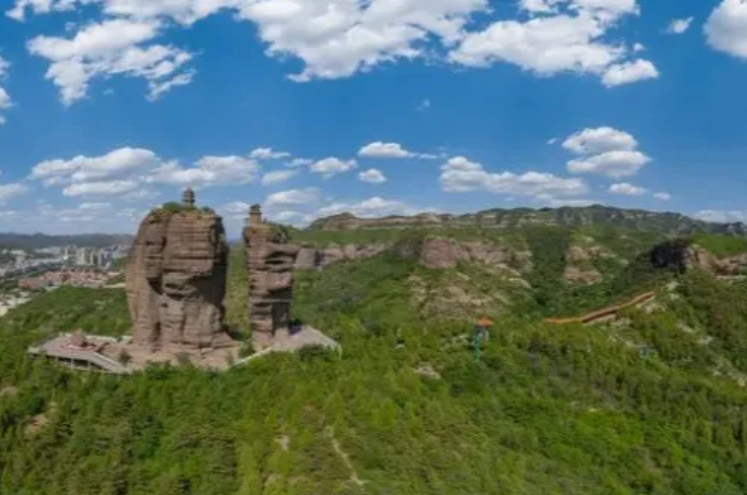
Shuangta Mountain Scenic Area is located in Shuangluan District, Chengde City, Hebei Province. It is a famous scenic area in Chengde combining natural and cultural landscapes and is a national 4A-level tourist attraction. The scenic area is centered on two towering giant rock peaks, each with an ancient pagoda on top, hence the name “Shuangta Mountain” (Twin Pagoda Mountain). The total area is about 600 hectares, with a high forest coverage rate. It has peculiar natural landscapes and long-standing cultural relics, and is a tourist destination integrating sightseeing, leisure, and exploration. The two peaks of Shuangta Mountain are about 40 meters and 30 meters high respectively. The mountain bodies are steep and difficult to climb, and the ancient pagodas on the summits add mystery, attracting many tourists to explore.
Historical Culture
The historical culture of Shuangta Mountain is mainly embodied in the two ancient pagodas on the summits. According to research, these two ancient pagodas were first built in the Liao Dynasty, nearly a thousand years ago. There is no clear historical record of their purpose, which has cast a mysterious veil over them. Some legends say they were subsidiary buildings of Liao aristocratic tombs, while others say they were related to religious activities at the time.
In the long course of history, Shuangta Mountain and its ancient pagodas have endured wind and rain erosion and dynastic changes, yet remain preserved to this day, becoming important physical materials for studying Liao Dynasty architectural art and history and culture. Emperor Qianlong of the Qing Dynasty was quite interested in Shuangta Mountain and sent people to try to climb to the summit to explore the mystery of the ancient pagodas, but they failed because the mountain was too steep. Only relevant records remain, adding more historical depth to the scenic area.
Main Attractions
Shuangta Peaks
Shuangta Peaks are the core attraction of the scenic area, composed of two huge rock pillars rising from the ground. The East Peak is about 40 meters high, and the West Peak is about 30 meters high. The two peaks are about 30 meters apart. The rock pillars are purplish-red, hard in texture, with steep surfaces almost perpendicular to the ground, truly a masterpiece of nature’s uncanny workmanship. On each summit is an ancient pagoda. The pagoda on the East Peak is about 2 meters high, and the one on the West Peak is about 5 meters high. Both are brick structures, with traces of doors and windows and a simple, ancient style, displaying the architectural characteristics of the Liao Dynasty.
Golden Turtle Rock
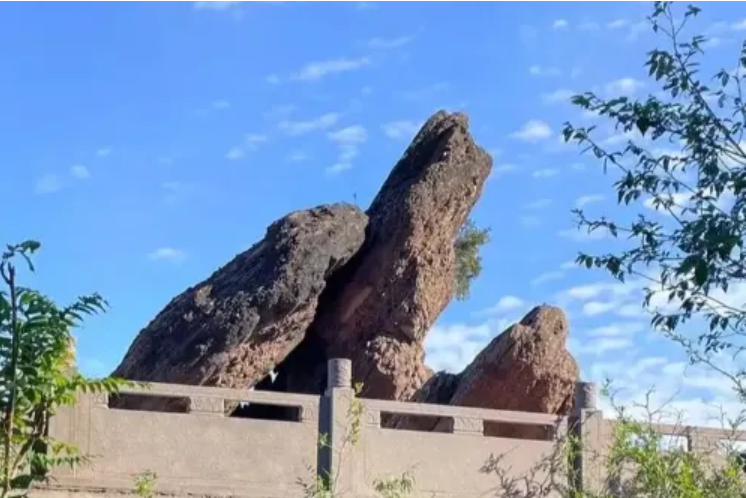
Golden Turtle Rock is located near Shuangta Peaks. It is a huge rock shaped like a turtle, about 5 meters long, 3 meters wide, and 2 meters high. The rock is lifelike, with clear outlines of its head and back, as if a giant turtle were raising its head and gazing toward Shuangta Peaks, hence its name. Golden Turtle Rock is surrounded by green trees and complements the surrounding natural scenery, making it a good place for tourists to take photos.
Camel Peak
Camel Peak is named for its shape, which closely resembles a camel. The peak is about 25 meters high and 40 meters long. Viewed from a specific angle, the camel’s head, humps, and body are clearly recognizable, vivid and lifelike. Around Camel Peak, the terrain rises and falls and the vegetation is dense. Visitors can enjoy this peculiar natural landscape while climbing.
Temple of the Three Immortals
The Temple of the Three Immortals is a Taoist temple with flourishing incense. The couplet on the door pillars reads: “The Dao penetrates the Great Ultimate and circulates beyond heaven and earth; the mind comprehends the profound and subtle, wondrous within the universe,” highlighting the mysterious realm of Taoism. The inner couplet in the hall expresses believers’ wishes to form karmic connections, pray for blessings, and receive the protection of the star lords. On the left is Zhao Gongming, the Martial God of Wealth; in the center is Wenquxing, also known as Zitong Dijun; and on the right is Sun Simiao, the King of Medicine. The three immortals share one hall, making it a treasure carrying rich historical culture and folk beliefs.
Qibao Tower
Qibao Tower is an imitation Qing-style half-walled hall built according to the mountain terrain. It is 4 meters wide and 5 meters high. The couplets outside the hall depict the special scene at Sudhana’s birth and his virtue of seeking knowledge and respecting the worthy. Inside, along a natural rock cave, are enshrined his 53 immortal teachers. The main statue is a reverse-seated Guanyin, modeled after the one in Longxing Temple in Zhengding. Her face is serene and her posture peaceful, as if she can dissolve worldly troubles. The Buddha statues vary in size, the tallest being 1 meter and the smallest only 70 centimeters. They are ingeniously arranged and each has distinctive features.
Hongshan Culture Diagram
Hongshan Culture is an important Neolithic culture in northern China. It originated in southern Inner Mongolia and the northern and northeastern parts of Hebei. Hongshan Culture dates back about 5,000 to 6,000 years and lasted about 2,000 years. The most representative elements of Hongshan Culture are the Hongshan Goddess and the Hongshan jade pig-dragon. In the center of the diagram is a scene of the Hongshan Goddess offering sacrifices after the harvest, with people plowing, sowing, and offering harvest sacrifices. In the late 1970s, large-scale surveys of Hongshan cultural remains were again carried out in Inner Mongolia, northern Hebei, western Liaoning, and other places, discovering nearly a thousand sites and a large number of precious relics, including stone tools, pottery, jade objects, and more. Hongshan Culture has important historical value. Its emergence made the Xilamulun River basin stand alongside the Yellow River basin and the Yangtze River basin as one of the three sources of Chinese civilization, advancing research on the origin of Chinese civilization from 4,000 years ago to 5,000 years ago. From then on, the Khitan people withdrew from the stage of Chinese history and disappeared into the long river of history.
Khitan Origin Diagram
The Khitan were a relatively early minority nomadic people in Chinese history. As a nomadic people, they were active in the long course of Chinese cultural history from very early times. Legend says that long ago, an immortal riding a white horse from the Laoha River and a heavenly fairy driving a blue-ox cart from the Xilamulun River met and fell in love at the Liao River. After marriage, they had eight sons, who later multiplied into the eight Khitan tribes: Xiwandan, Hedahe, Fufuyu, Yuling, Rilian, Pixu, Li, and Tuluyu. The Khitan established the Khitan State in 916 AD and changed the dynastic title to Great Liao in 947. The Khitan dynasty lasted more than 200 years in Chinese history, passed down nine emperors, and was destroyed by the Jin State in 1125.
Divine Workmanship
This is an extra-large cliff inscription, unique in the northern Yan region. It is located in the valley southeast of Camel Peak. A huge rock beside the road split vertically into two. One piece is 24.3 meters high and about 18.5 meters wide, forming a cliff face standing beside the road, inscribed with the two characters “Ghost Axe.” Each character is about 8 meters high and 6 meters wide. The large blue-outlined characters are particularly striking.
The other huge rock lies slanting in the valley, only 8 meters from the cliff rock. Its length, width, and grain all match the cliff rock exactly, as if some spirit had split this huge rock from the cliff—or from the sedimentary rock—with a single blow, dividing one into two. On the rock are inscribed the two characters “Divine Work,” also carved in stone and outlined in blue. The four characters “Divine Work and Ghost Axe” are in running script, with meticulous strokes, powerful and varied, and are the calligraphy of the famous calligrapher Mr. Yao Xiaoyao.
Liao-Qing Exhibition Hall
The Liao-Qing Exhibition Hall has two floors and is divided into five exhibition halls. The first four halls mainly use vivid wax figures to recreate major historical events involving Qing emperors in Chengde; the fifth hall displays Liao funeral culture and customs. Hall One uses 160 small wax figures to show Kangxi’s northern tour to the Mulan Paddock for hunting. Its main purpose was to improve the fighting ability of the Eight Banners soldiers and deter small border states. Hall Two uses vivid large wax figures to show Emperor Qianlong receiving the Sixth Panchen Lama at the Sizhi Study in the Chengde Mountain Resort. Hall Three uses vivid large wax figures to show Emperor Xianfeng entrusting his young son on his deathbed at the Yanbo Zhishuang Hall in the Chengde Mountain Resort. Hall Four uses 1:10 scale small wax figures to show Emperor Xianfeng’s coffin being transported from Chengde back to Beijing. Hall Five uses historical relics to review Liao Dynasty ancient pagodas and Liao funeral culture and customs.
Wild Macaques at Shuangta Mountain
In the early 1990s, a group of wild macaques, about 20 in number, came near Shuangta Mountain. In the early 2000s, in order to protect these small animals, people learned their habits, fed them at fixed points and times, and established a protected area, providing these wild macaques with a place to live and reproduce. Through effective protection, the wild macaques in the scenic area increased by 6 to 10 each year. After years of careful care and feeding, the monkey group has grown to more than 100, and is a beautiful sight in the scenic area.
Tour Routes:
Classic half-day route, about 3 hours: East Gate entrance → (sightseeing bus/walk 15 minutes) → Shuangta Mountain Viewing Platform → (trail 10 minutes) → Temple of the Three Immortals → (Sky Ladder Plank Road 30 minutes) → Summit Platform (close view of the twin pagodas) → return along the same route or descend via the west trail.
In-depth one-day route, about 5–6 hours: West Gate entrance → (hike 30 minutes) → Deep Valley Stream Trail → (15 minutes) → South Viewing Platform (photo spot) → (20 minutes) → Ape Man Rock → (Cliffside Plank Road 40 minutes) → Glass Viewing Platform → (descend 30 minutes) → Liao Dynasty Stone Carvings → East Gate exit.
Travel Suggestions:
It is recommended to spend 1 day so that you have enough time to visit the main attractions in the scenic area.
There are many mountain paths in the scenic area. It is recommended to wear comfortable sports shoes for climbing and walking.
In summer, take sun protection measures and bring a sun hat, sunglasses, sunscreen, etc.; in winter, pay attention to keeping warm and wear thick clothing.
There are few dining facilities in the scenic area. It is recommended to bring an appropriate amount of drinking water and food, eat in designated areas, and keep the environment clean.
The best seasons to visit are spring and autumn. In spring, all things revive and the scenery is fresh; in autumn, the weather is cool and the mountain forests are rich in color.
You may bring a camera or mobile phone to record the beautiful and peculiar scenery in the scenic area.
Precautions:
Some sections of the scenic area are steep. Pay attention to safety while visiting and do not leave the designated trails without permission to avoid danger.
Protect the natural landscapes and cultural relics in the scenic area. Do not carve or damage them at will.
Follow the rules of the scenic area. Do not smoke or use open flames in no-fire areas to prevent fires.
Take good care of the elderly and children to avoid getting lost or accidents.
Wild animals may appear in the scenic area. Do not disturb them when you encounter them and keep a safe distance.
During thunderstorms, shelter in safe indoor areas or under lightning-protection facilities. Do not stay on the summit or in open areas.
Transportation:
Bus: In the urban area of Chengde, you can take Bus No. 15, 52, 55, etc. to Shuangta Mountain Scenic Area Station, then walk about 500 meters to the scenic area gate.
Self-driving: From the urban area of Chengde, drive west along West Street, turn onto Shuangta Mountain Street, and follow the road signs to reach the scenic area. There is a parking lot in the scenic area, and the parking fee is 5 yuan per hour.
Taxi: Taking a taxi from the urban area of Chengde to Shuangta Mountain Scenic Area takes about 15 kilometers and costs about 30–40 yuan.
Opening Hours:
Opening hours are adjusted according to the season. Summer (April 1–October 31): 7:30–18:00; Winter (November 1–March 31 of the following year): 8:00–17:00. Ticket sales stop 1 hour before closing. Please arrange your visit time reasonably.
Tickets:
As of August 14, 2025, the ticket price is 50 yuan per person.