Xinglong Karst Cave Scenic Area is located in Taojiatai Village, Beishuiquan Township, Xinglong County, Chengde City, Hebei Province. It is a national 4A-level tourist attraction and one of the most distinctive large karst caves discovered in North China. The scenic area is centered on a karst cave developed in dolomite of the Mesoproterozoic Changcheng System from 1.4 billion years ago. The cave's landscapes are mainly composed of stalactites, stalagmites, stalagnates, and stone curtains formed by carbonate rocks, with peculiar and varied shapes, possessing extremely high geological research value and ornamental value. The karst cave is about 1,000 meters long, with an internal area of about 5,000 square meters. At present, about 600 meters of touring routes have been developed, divided into eight scenic zones and containing more than a hundred landscapes. The surrounding area features rolling mountains, high vegetation coverage, and a beautiful natural environment. It is a tourist destination integrating geological sightseeing, science education, and leisure vacation.
Historical Culture
The formation of Xinglong Karst Cave can be traced back to the Mesoproterozoic Era 1.4 billion years ago. Through long geological processes, including crustal movement and groundwater dissolution, the cave landscape gradually formed as it is today. However, as a natural geological landscape, its direct human historical and cultural relics are relatively few, mainly reflected in the local process of discovering and understanding the cave.
The cave was accidentally discovered by local villagers in 2002. Afterward, geological experts conducted surveys and verification and determined that it is a large carbonate rock karst cave of important value. During development, the scenic area has paid attention to protecting geological relics while combining local folk culture. Through science exhibition displays and other means, it shows visitors the principles of cave formation and the regional geological history, allowing visitors to understand the long process of Earth's evolution while viewing natural wonders, thus forming a unique geological culture dissemination system.
Main Attractions
Welcome Hall
Welcome Hall is the first scenic zone after entering the karst cave, with an area of about 300 square meters. Facing visitors in the hall is a huge stalagmite about 5 meters high, shaped like a hospitable host cupping hands in greeting, hence the name "Welcome Stone." Around it are distributed many small stalactites and stone curtains. Under the lighting, light and shadow intertwine, creating a mysterious atmosphere and opening the cave exploration journey for visitors.
Dragon Palace Treasure Hall
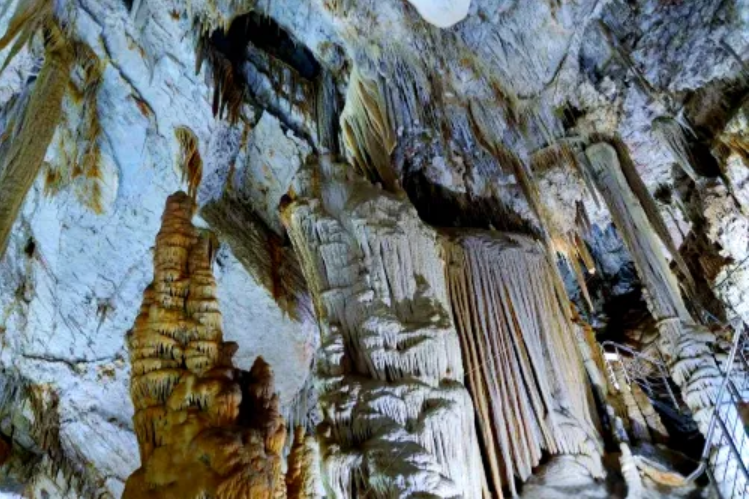
Dragon Palace Treasure Hall is one of the most spectacular scenic zones in the karst cave, with an area of about 800 square meters and a highest point of 20 meters. Stone pillars stand in great numbers in the area, among which a main stone pillar is about 15 meters high and about 3 meters in diameter. It is completely white throughout, like a jade pillar of the Dragon Palace, magnificent in momentum. The surrounding stone curtains hang down like drapes, and stalagmites resemble divine soldiers arrayed in formation. With colorful lighting, it feels as if one has entered the legendary undersea Dragon Palace, hence the name "Dragon Palace Treasure Hall."
Crystal Curtain
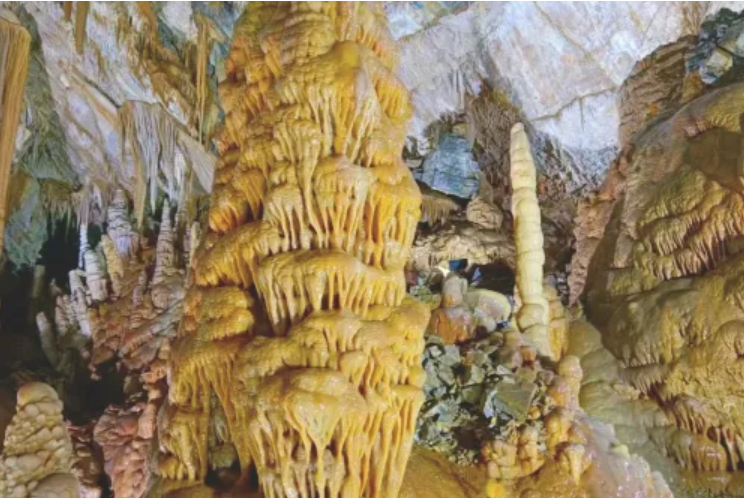
Crystal Curtain is located in the middle section of the karst cave and is a landscape composed of dense stone curtains. These stone curtains hang from the cave ceiling, varying in length, with the longest reaching up to 8 meters. Their texture is crystal clear, and under the lighting they look like curtains strung from countless crystals. When a gentle breeze passes (airflow inside the cave), one seems to hear a "ding-dong" sound, hence the name. This landscape took more than 100,000 years to form and is one of the finest landscapes in the cave.
Stone Flower Wonderland
Stone Flower Wonderland features large-area distribution of stone flowers, with an area of about 500 square meters. Stone flowers are a rare landscape in karst caves, formed by the condensation of calcite crystals. They resemble petals and star rays, with colors ranging from milky white to pale yellow. They densely cover rock walls and stalagmite surfaces, with a total area of about 200 square meters, just like a sea of flowers in a wonderland, hence the name "Stone Flower Wonderland." It has extremely high ornamental and scientific research value.
Pillar Holding Up the Sky
Pillar Holding Up the Sky is one of the landmark landscapes in the karst cave. It is located in the latter half of the cave, about 18 meters high and about 2.5 meters in diameter. It was gradually formed by the connection of a stalactite from the cave ceiling and a stalagmite from the ground, taking more than 500,000 years to form. The pillar is straight throughout, with clear textures, like a giant pillar supporting the cave dome, majestic in momentum, hence the name "Pillar Holding Up the Sky."
Tour Route:
After entering the scenic area, visitors first pass through the scenic area entrance square and walk about 200 meters to the karst cave entrance. After entering the cave, follow the designated touring footpath to visit Welcome Hall in sequence (about 10 minutes), enjoying the Welcome Stone and surrounding small landscapes; then enter Dragon Palace Treasure Hall (about 20 minutes), focusing on the giant stone pillar and Dragon Palace landscape; continue forward to Crystal Curtain (about 15 minutes), experiencing the crystal clarity of the stone curtains; afterward enter Stone Flower Wonderland (about 15 minutes), observing the rare stone flower landscape; finally arrive at Pillar Holding Up the Sky (about 10 minutes). After viewing the landmark stone pillar, return along the return footpath to the cave exit. The entire tour route is about 600 meters long, and the tour time is about 1.5-2 hours. After exiting the cave, visitors may go to the Geological Science Museum in the scenic area (area about 800 square meters) to learn about the geological knowledge of cave formation. In total, the entire scenic area visit takes about 3 hours.
Travel Suggestions:
It is recommended to spend half a day (3-4 hours), which is enough to fully visit the karst cave and surrounding supporting facilities.
The temperature inside the karst cave remains at 18-20°C year-round, and the humidity is relatively high. It is recommended to bring a light jacket and wear non-slip shoes.
The lighting inside the cave is dim, and some sections are slippery. Pay attention to your step while walking. It is recommended to follow a guide or tour along the signs.
The Geological Science Museum in the scenic area is free of charge. It is recommended to visit after touring the karst cave to increase geological knowledge. Opening hours are the same as those of the scenic area.
The best seasons to visit are spring and autumn, when the natural scenery around the scenic area is beautiful and the climate is suitable; in summer it is a good place to escape the heat, and in winter the cave is warm, so it is suitable for visiting in all these seasons.
It is recommended to bring a camera, but note that flash photography is prohibited inside the cave so as not to affect other visitors and landscape protection.
There are few dining facilities in the scenic area. It is recommended to bring drinking water and a small amount of snacks and eat them in designated rest areas.
Precautions:
The landscapes in the karst cave are non-renewable geological relics. It is strictly prohibited to touch or knock on stalactites, stalagmites, and other landscapes. Violators will face penalties.
Smoking and littering are prohibited inside the cave. Keep the cave environment clean and hygienic.
During the visit, comply with the scenic area regulations and do not leave the touring footpath without authorization, so as to avoid danger or damage to undeveloped areas.
Visitors with children should take good care of them and prevent them from running or climbing to ensure safety.
Some areas inside the cave are narrow. Pay attention to yielding to other visitors and pass through in an orderly manner.
Visitors with heart disease, high blood pressure, and other diseases should enter the karst cave cautiously according to their own condition. Ventilation conditions inside the cave are limited.
Obey the management of scenic area staff and follow instructions for evacuation in case of emergency.
Transportation:
Self-driving: From Beijing, drive along the Jingping Expressway and the Capital Ring Expressway, exit at Xinglong/Banbishan, and drive about 20 kilometers along signs to reach the scenic area. The total distance is about 160 kilometers, and the drive takes about 2.5 hours. From Chengde city area, drive along the Daguang Expressway and the Capital Ring Expressway, exit at Xinglong, and then drive about 15 kilometers to reach the scenic area. The total distance is about 130 kilometers, and the drive takes about 2 hours. The scenic area parking lot charges 5 yuan per entry.
Long-distance bus: Take a bus from Xinglong County Bus Station to Beishuiquan Township, get off at Taojiatai Village, and walk about 500 meters to reach the scenic area. Buses run every hour from 6:30 to 16:30 daily, and the fare is 10 yuan per person.
Tourist shuttle: Beijing Dongzhimen Bus Station and Chengde East Bus Station have tourist shuttle buses to Xinglong Karst Cave. In peak season (April-October), there are two buses daily (8:00, 9:00); in off-season (November-March), there is one bus daily (8:30). The ride takes about 3 hours, and the fare is 50 yuan per person (one way).
Opening Hours:
Opening hours are adjusted slightly according to the seasons. In peak season (April 1-October 31), opening hours are 8:00-17:30, and the last entry time is 16:30; in off-season (November 1-March 31 of the following year), opening hours are 8:30-16:30, and the last entry time is 15:30. The scenic area is open year-round, including holidays. In case of special weather (such as heavy rain or earthquakes), it may be temporarily closed. It is recommended to check the scenic area's official information before traveling.
Tickets:
As of August 14, 2025, the ticket price is 100 yuan per person.