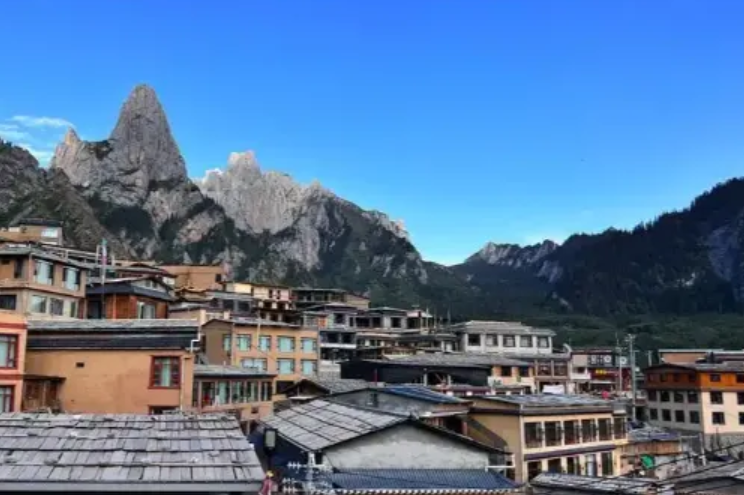
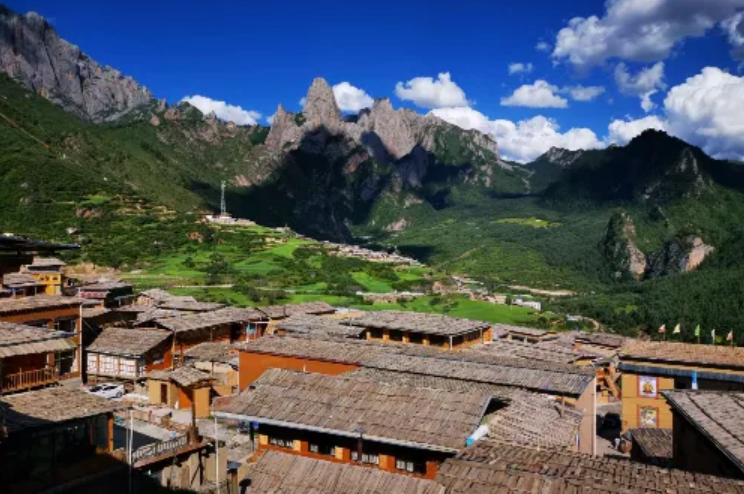
Zhagana is located in Yiwa Town, Diebu County, Gannan Tibetan Autonomous Prefecture, Gansu Province. It is a national 4A-level tourist attraction and has been listed among China's Top Ten Non-famous Peaks and a Gansu Provincial Geopark. The site presents a complete natural stone-city Tibetan-village composite landscape. The total area of the scenic area is about 20,000 hectares (200 km2), with the core village cluster covering roughly 80 mu (about 53,360 m2). The average elevation within the area is 1,160 m, while the highest peak exceeds 3,900 m. The core feature is a natural castle-like landform formed by encircling stone mountains—four massive limestone peaks enclose a closed valley, within which intact traditional Tibetan villages are distributed. The area integrates karst canyons, alpine meadows, primeval forests, Tibetan-style residences, and Tibetan Buddhist monasteries. Over a hundred traditional plank-house Tibetan buildings remain, arranged in terraced layers up the slopes, with no modern high-rise structures. The settlement preserves the traditional layout of the Ando Tibetan community, offering both geological scientific value and authentic ethnic cultural tourism appeal.
History and Culture
The human history of Zhagana can be traced back to the Tubo period. During the Tang Dynasty, as Tubo expanded eastward into the Ando region, some Tibetan tribes migrated to the Yiwagou valley and settled there, relying on the natural stone barrier of the surrounding mountains to establish their earliest villages—the original Zhagana Tibetan settlements. In Tibetan, "Zhagana" means "stone box," named for the enclosed stone mountains. Local Tibetans have long maintained a mixed pastoral and agricultural livelihood, continuing Ando Tibetan folk traditions for over a thousand years.
During the Qing Dynasty, Zhagana fell under the jurisdiction of the Choni Tusi (local chieftain), who promoted the Gelug school of Tibetan Buddhism in the area. Monasteries and prayer wheel corridors were built within the villages, establishing the region's religious core. The settlement formed four natural Tibetan villages—Yeri, Dari, Daiba, and Dongwa—which persist to this day, with ridges and streams serving as natural boundaries, maintaining an interconnected yet independent living system.
In 1925, American explorer Joseph Rock passed through Zhagana and described it in his travelogues as "the Garden of Eden created by God." His writings and photographs brought Zhagana to the outside world. The area preserves intangible cultural heritage such as Tibetan Guozhuang dance, Tibetan opera, incense-burning prayers, arrow-shaft mountain worship, and Tibetan calendar festivals. The monastery regularly holds traditional Gelug rituals. Architecture, clothing, food, and marriage customs remain largely uncommercialized, making Zhagana one of the best-preserved native Tibetan cultural villages in Gannan.
Major Attractions
Dongwa Village
Dongwa is the first village at the entrance to Zhagana, serving as the gateway. It has relatively flat terrain and contains the largest visitor assembly area and traditional Tibetan plank-house clusters. At the village entrance is a long prayer-wheel corridor with hundreds of wheels, next to a small white stupa. A stream runs through the village, with farmlands and shrubs on both banks. It offers a direct view of the entire rock face of the main northern peak, Guangai Mountain, making it a basic vantage point for panoramic mountain views. The village has folk inns and Tibetan restaurants, combining sightseeing and rest functions.
Yeri Village
Yeri is situated midway up the valley slope, higher than Dongwa, offering an unobstructed wide view—the prime spot for photographing Zhagana's panoramic sunrise and sea of clouds. Tibetan houses are scattered across the hillside, with an ancient cypress and a small incense-burning terrace nearby. A trail behind the village leads to alpine meadows, passing terraced barley fields. In spring and summer, the slopes are covered in green; in autumn, the layers of forest turn colorful. The view encompasses all four encircling stone mountains and the three villages below.
Dari Village
Dari is located on the high western side of the valley, close to Lhazang Monastery. It is a medium-sized village with simple folkways and relatively low commercial development. Many century-old original plank houses remain, with solid wood roofing and natural rammed-earth walls. An arrow-shaft platform sits at the village edge, used for local Tibetan mountain deity rituals. A hiking trail from the village leads directly to the entrance of the Yixiantian Gorge, making it an important transit point for trekking into the mountains.
Daiba Village
Daiba lies deep in the valley, surrounded by primeval forest, farthest from the entrance, and best preserved in its original state. Around the village are vast alpine meadows and stream wetlands, with frequent wildlife activity and no large-scale commercial facilities. The scenery is purely pastoral and mountainous, with only a few local herder households. It is ideal for in-depth hiking, camping, and authentic ethnic cultural experiences.
Lhazang Monastery
Lhazang Monastery is located on the hillside of Dari Village. It is a Gelug Tibetan Buddhist monastery, first built in the Qing Dynasty, covering about 1,200 m2. It consists of a main sutra hall, the living Buddha's residence, monks' quarters, a white stupa, and a prayer courtyard. The walls are painted in traditional red-and-white Tibetan colors. The monastery houses ancient thangkas, bronze Buddha statues, and ritual implements. Monks conduct daily chanting sessions, and large-scale thangka-unveiling ceremonies are held on fixed Tibetan calendar months. It is the religious and cultural center of the Zhagana area.
Yixiantian Gorge
Yixiantian Gorge lies along the hiking trail behind Dari Village. It was formed by long-term water erosion on limestone rock. The narrowest point is less than 2 meters wide, with vertical cliff walls over 100 meters high on both sides, leaving only a slit of sky above. A stream flows through the gorge year-round, with waterfalls, small karst caves, and wildflowers along the way. The total hiking section is about 3 kilometers, making it a classic light-trekking natural attraction.
Fairy Beach and Fairy Lake
Fairy Beach is a spacious alpine meadow platform at the mountaintop. In the center of the meadow, a natural freshwater lake—Fairy Lake—reflects the stone mountains and sky. The meadow is surrounded by fir forest. At an elevation of nearly 3,000 m, it is covered with Gesang flowers in summer. It is a prime highland spot for panoramic views, camping, picnicking, and stargazing. The round-trip hike from Yeri Village takes about 2.5 hours.
Suggested Itineraries:
One-day light sightseeing route: Scenic entrance → Dongwa prayer-wheel corridor → Lhazang Monastery → Yeri viewing platform → Fairy Beach & Fairy Lake → return.
Two-day in-depth trekking route: Day 1: Entrance → Dongwa → Dari → Yixiantian Gorge → overnight in Daiba; Day 2: Daiba → alpine meadow loop → Yeri sunrise viewpoint → entrance.
Half-day quick photo route: Entrance → Yeri panoramic viewpoint → Lhazang Monastery → Dongwa folk street.
Travel Tips:
For sunrise and sea of clouds, choose the Yeri viewing platform; the best time is 6:00–8:00 AM, with higher chances during rainy season mornings.
For light hiking, choose the Fairy Beach trail—gentle slopes suitable for beginners. For Yixiantian Gorge, allow 3 hours round-trip and wear non-slip hiking shoes.
For an authentic Tibetan experience, prefer homestays in Dari or Daiba; Dongwa is more convenient for first-time visitors.
The best travel season is June to September: June–July for meadow flowers, September for autumn colors. November to March is colder, suitable for snow photography.
Move slowly at high altitudes, avoid running, drink warm water regularly, and bring glucose for mild altitude discomfort.
For stargazing, Fairy Beach is recommended—no light pollution; best viewing from 10 PM to 2 AM in summer; bring a heavy coat for warmth.
Important Notices:
The average elevation across the area is above 2,800 m. Elderly visitors and those with heart/lung conditions or severe hypertension should assess their health beforehand; avoid rapid climbing.
When entering religious sites like Lhazang Monastery, do not wear shorts or sleeveless clothing, do not touch Buddha statues, thangkas, or ritual items, do not step on thresholds, and remain quiet.
Respect local Tibetan customs: do not step on arrow-shaft platforms or incense-burning terraces; do not photograph local Tibetans or monks without permission.
The temperature difference between day and night can reach 15°C. Even in summer, bring a windbreaker or light down jacket.
There are no shops or supply points in trekking areas—bring your own water, snacks, and sunscreen; UV radiation is strong.
Open flames are strictly prohibited in forests and meadows—no campfires or burning trash; extinguish cigarette butts completely and dispose of them properly.
On rainy days, trails are slippery; Yixiantian Gorge may have rockfalls. Avoid hiking during heavy rain; wait for clear weather.
Do not pick wildflowers, disturb wildlife, damage barley terraces or crops, or enter private Tibetan houses without permission.
Transportation:
Self-driving: From Diebu county town, drive along Yiwu Road for about 28 km (40 minutes). The entrance has a free public parking lot with ample space.
Public bus: Diebu bus station operates buses to Zhagana at 7:00 AM and 12:00 PM daily; return buses leave Dongwa at 4:00 PM.
Chartered car: Hire a car in Diebu for a round trip, with flexible stops at viewpoints—suitable for groups.
Long-distance cross-region: From Hezuo (capital of Gannan Prefecture), take a bus to Diebu (about 3 hours), then transfer to the local bus or chartered car to the scenic area. There is no direct long-distance bus to Zhagana.
Opening Hours:
Zhagana is open year-round with no closed season. The main gate is accessible from 6:00 AM to 8:30 PM daily; after 8:30 PM, outside vehicles and visitors are not allowed into the core villages. Guests staying overnight in village inns may move freely within the village. Lhazang Monastery is open 7:30 AM–6:00 PM; some halls may be temporarily restricted during rituals. Natural sites like Fairy Beach and Yixiantian Gorge have no strict time limits, but night hiking alone is not advised due to risks of getting lost or hypothermia. In winter, mountain roads may be temporarily closed after snowfall and reopened after clearing.
Tickets:
Entry ticket: from 80 RMB/person.