Nüwa Palace Scenic Area is located on Zhonghuang Mountain, Suobao Town, She County, Handan City, Hebei Province, 6 km from the county seat. It is a national 5A-level tourist attraction, a Major Historical and Cultural Site Protected at the National Level, and a National Scenic Area. The scenic area covers 5 square kilometers and consists of five parts: the Entrance Area, Butian Garden, Butian Lake, the main architectural complex of Nüwa Palace, and Butian Valley. It has 135 existing bays/rooms of ancient buildings and integrates three core resources—Northern Qi cliff-carved Buddhist sutras, the “living building and suspended temple” Nüwa Pavilion, and the Nüwa Worship Ceremony. It is known as the “Ancestral Temple of the Chinese Nation” and “China’s largest site of Nüwa worship,” and is an important base for studying ancestral-root culture and Buddhist scripture inscriptions.
History and Culture
Construction of Nüwa Palace began during the reign of Emperor Wenxuan of Northern Qi (Gao Yang, 550–560). It was initially an imperial traveling palace and later gradually evolved into a sacred site for Nüwa worship. The earliest surviving relics are the Northern Qi grottoes and cliff-carved sutras. The cliff-carved sutras comprise six Buddhist texts totaling 137,400 characters, making them the earliest and most extensive group of Buddhist scripture inscriptions extant in China. They are known as the “No. 1 Wall Scripture Group under Heaven.” The site was renovated in successive dynasties: Guangsheng Palace was first built in the Yuan Dynasty; the Bell and Drum Towers were rebuilt during the Wanli period of the Ming Dynasty; and Chaoyuan Palace and Tingcan Palace were expanded during the Kangxi and Qianlong periods of the Qing Dynasty, forming the layout of “three palaces at the foot of the mountain (Chaoyuan Palace, Tingcan Palace, and Guangsheng Palace) plus Nüwa Palace on the mountain.” Nüwa culture has continued here for thousands of years. Legend has it that the 18th day of the third lunar month is Nüwa’s birthday. Temple fairs took shape in the Han Dynasty, government public worship resumed in 2003, and in 2006 the “Nüwa Worship Ceremony” was listed as national-level intangible cultural heritage.
Main Attractions
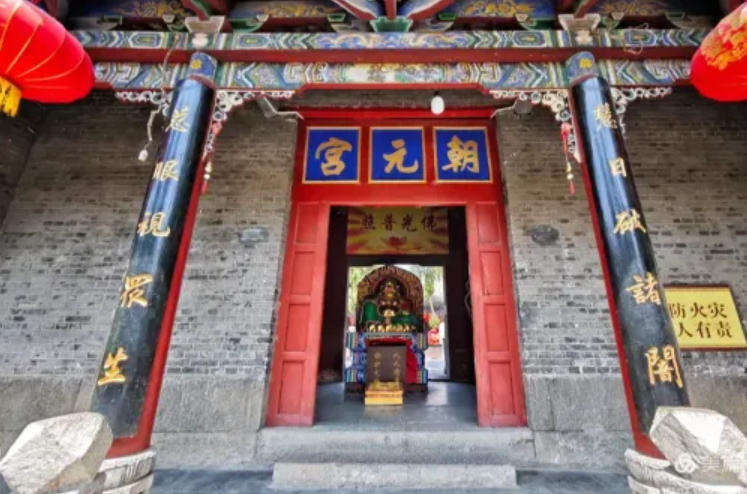
Chaoyuan Palace
First built in 1702, the 41st year of the Kangxi reign of the Qing Dynasty, Chaoyuan Palace covers 1,392 square meters and is a two-courtyard traditional quadrangle. It includes the Hall of Heavenly Kings, Mahayana Hall, Water Pool House, and other structures. The Hall of Heavenly Kings is three bays wide and 8.8 meters wide, and enshrines statues of the Four Heavenly Kings. The Mahayana Hall enshrines the Thousand-Hand, Thousand-Eye Bodhisattva, and its gable walls are painted with murals of 500 Arhats. It is the core of Buddhist culture at the front of the mountain.
Northern Qi Grottoes
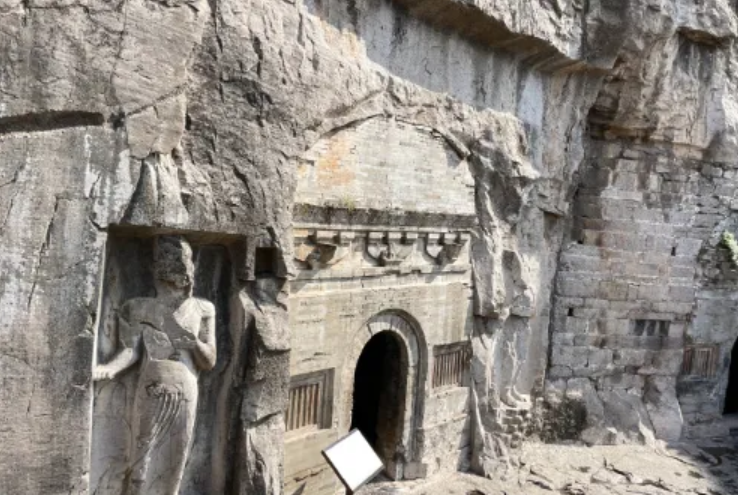
Located on the north cliff of Nüwa Pavilion, the surviving caves are the Central Cave (Yanguang Cave, or Eye-Light Cave) and the North Cave (Cangu Cave, or Silkworm Maiden Cave). The Central Cave is 4.48 meters high and 3.16 meters deep; it originally contained carvings of one Buddha and two Bodhisattvas, but the sutra texts are damaged by water seepage. The North Cave is 4.84 meters high. Its lintel bears the inscription “A Realm Made by Heaven and Earth,” and the guardian-warrior niches on its outer wall are well preserved. It is a representative example of Northern Qi grotto art.
Cliff-carved Sutras
Carved on the rear cliff of Nüwa Palace, the cliff-carved sutras cover a total area of 165 square meters. They include six Buddhist sutras, such as the Sutra of the Questions of Brahma Siyi. Four of them are the earliest complete sutras carved in stone in China. The surviving text is damaged by weathering; only the “Universal Gateway of Avalokite?vara” chapter of the Lotus Sutra is relatively well preserved. These carvings are precious physical materials for the study of early Buddhism.
Nüwa Pavilion
Nüwa Pavilion is a Ming Dynasty structure, 23 meters high, built against the cliff. Its lower level is supported by eight wooden pillars, and its top is tied to the cliff by nine iron chains. Because the structure sways slightly when visitors climb it, it is called the “Living Building and Suspended Temple.” It is one of the three hanging temples in northern China. The pavilion enshrines Nüwa and four maids. The second floor preserves Qing Dynasty murals, and the third floor features a sculpture themed on “Nüwa Mending Heaven.”
Butian Lake
Completed in 2012, Butian Lake has a water area of 100 mu (about 6.7 hectares). Walking paths and scenic corridors surround the lake, and the lake scenery and the reflection of Zhonghuang Mountain complement each other. It is the ecological core of the scenic area. Surrounding supporting facilities include Waterside Commercial Street (dining and shopping), Bagua Square (the main venue for the worship ceremony), and others.
Suggested Routes:
Half-day tour: Entrance Area → Chaoyuan Palace → Butian Lake → Nüwa Pavilion (by cable car) → Cliff-carved Sutras (about 4 hours)
One-day tour: Half-day route Butian Garden (Matriarchal Clan Culture Garden) → Butian Valley (forest trail) → Guangsheng Palace (fertility/praying-for-children culture). It is recommended to use the scenic-area shuttle (CNY 30 per person).
Travel Tips:
Wear non-slip shoes. The steps at Nüwa Pavilion are steep, and some sections require climbing.
In spring (during the March temple fair), visitors are concentrated. It is advisable to visit in the morning to avoid the peak and join folk activities in the afternoon.
The Butian Valley trail is suitable for families with children. Sculptures of Nüwa legends are set along the way. The walk takes about 2 hours; bring snacks and water.
For overnight accommodation, you can choose “Daiyun Shanfang” in the scenic area (CNY 200–300 per night). In the morning, you can watch the mountains shrouded in mist.
Precautions:
Touching or photographing is prohibited in the Northern Qi Grottoes and cliff-carved sutra area to protect cultural relics.
During the temple fair, incense burning is intense. Be careful about fire and do not carry flammable materials.
Some sections have no guardrails. Children must be accompanied by parents. Choose the Butian Valley route cautiously during the rainy season.
Prices in the scenic area are clearly marked. Buy specialty products at Waterside Commercial Street and avoid mobile vendors.
Transportation:
Self-driving: Take the Beijing–Hong Kong–Macao Expressway, transfer to the Qingdao–Lanzhou Expressway (She County exit), then follow Jiangjun Avenue → Wahuang Avenue. The whole journey takes about 40 minutes. The scenic-area parking lot holds 300 vehicles and charges CNY 10 per day.
Bus: From She County Bus Station, take Bus No. 604 (8:00–17:00, every 30 minutes). The fare is CNY 3, direct to the scenic-area entrance.
High-speed rail: Get off at Handan East Railway Station, transfer to a long-distance bus to She County (about 2 hours), then transfer to a local bus; or take a taxi to the scenic area (about 1.5 hours, around CNY 200).
Opening Hours:
Open year-round, 8:00–18:00 (last entry at 17:30). During the lunar March temple fair (the 1st to the 18th), hours are extended to 20:00, with additional nighttime blessing activities.
Tickets:
Tickets start at CNY 10.