Jiayuguan Cultural Relics Scenic Area is located in Jiayuguan City, Gansu Province, and is a national 5A-level tourist attraction. As the western starting point of the Ming Dynasty Great Wall, the scenic area was first built in the fifth year of the Hongwu reign of the Ming Dynasty (1372). Owing to its strategic terrain and magnificent architecture, it has long been known as the “First Grand Pass Under Heaven” and the “First Defile of the Hexi Corridor.” The scenic area consists of the Fortress, the First Beacon Tower of the Great Wall, the Hanging Great Wall, and the Wei-Jin Tombs, forming an ancient military defense system with “a fort within a fort, a wall outside the fort, and a moat beyond the wall.” Among them, the Fortress has a circumference of about 733 meters, the Great Wall stretches approximately 60 kilometers, and there is no publicly available precise figure for the total area of the scenic area.
History and Culture
The history of Jiayuguan can be traced back to the Qin and Han dynasties, when it was successively inhabited by tribes such as the Xirong, Wusun, and Xiongnu. During the reign of Emperor Wu of the Han Dynasty, it was incorporated into the central empire, and the four commanderies of Hexi were established while the Great Wall was built. In the fifth year of the Hongwu reign of the Ming Dynasty (1372), General Zhengxi Feng Sheng first built an earthen fort, which was later expanded several times: in the eighth year of the Hongzhi reign (1495), the gate towers were added; in the first year of the Zhengde reign (1506), ancillary buildings were improved; and in the eighteenth year of the Jiajing reign (1539), the flanking walls were constructed. The entire defense system took 168 years to complete. During the Qing Dynasty, Jiayuguan gradually lost its military function and was converted into a customs checkpoint, though it underwent multiple repairs. In the Republic of China period, government offices were still maintained there. The existing fortress layout essentially preserves the Ming Dynasty appearance.
Major Attractions
Jiayuguan Fortress
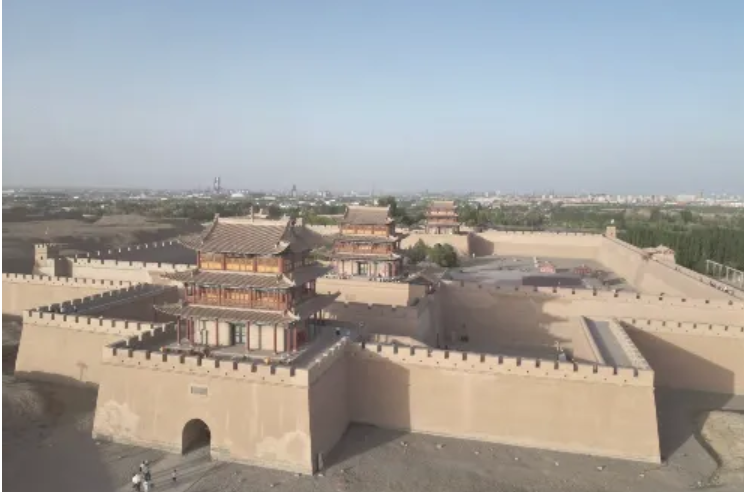
Located 6 kilometers southwest of the city center, it is the first major pass at the western end of the Ming Great Wall and a strategic point on the “Silk Road.” The Fortress consists of an outer city, inner city, barbican, outer enclosure, and moat, with a total area of about 33,500 square meters. The inner city contains the General’s Residence, the Guandi Temple, the Rouyuan Tower, and other buildings. The Guanghua Tower, Rouyuan Tower, and Jiayuguan Tower are all of the double-eave gable-and-hip roof style. On both flanks of the fortress, the Great Wall stretches across the Gobi Desert, connecting to the Hanging Great Wall in the north and the First Beacon Tower in the south.
Hanging Great Wall
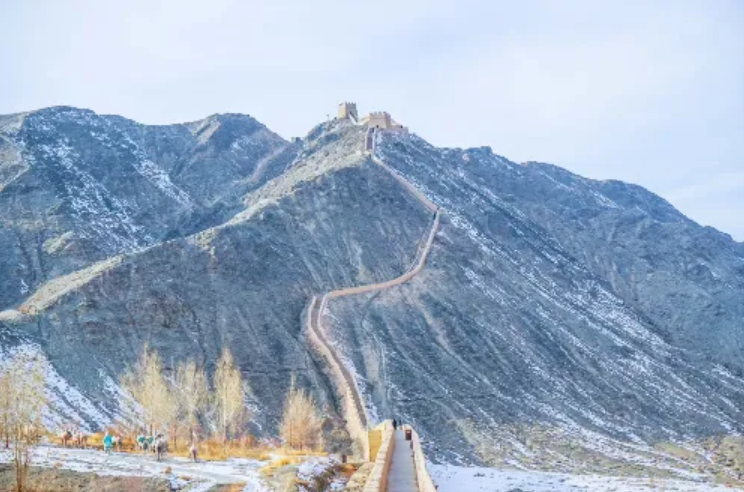
Located on the eastern slope of Heishan Mountain, 8 kilometers north of the Fortress, it was built in the nineteenth year of the Jiajing reign of the Ming Dynasty (1540). It is named for being built on a 45-degree ridge, giving it the appearance of hanging upside down. The original wall was 4 meters wide at the base and 2 meters wide at the top. The existing 750 meters were reconstructed in 1987. Together with the “Dark Wall” on the western side, it sealed off the Shiguanxia Gorge, forming a complete defensive system.
First Beacon Tower of the Great Wall
Built in the eighteenth year of the Jiajing reign of the Ming Dynasty (1539), it is situated on a cliff 56 meters high above the Taolai River and is the westernmost beacon tower of the Ming Great Wall. The attraction includes an underground valley, a sky-defying suspension bridge, and a replica ancient military camp. In 2013, a historical and cultural experience hall was added, covering a total area of about 32,000 square meters.
Wei-Jin Tombs
Located 20 kilometers northeast of the city center in the desert, there are more than 1,400 painted brick tombs from the Wei-Jin period (220–419 AD), known as the “world’s largest underground art gallery.” The tombs are scattered between the Orchard Township and Xincheng Township, with murals depicting scenes of farming, animal husbandry, banqueting, and other aspects of social life.
Jiuyanquan Lake
It is an important part of Jiayuguan’s history and natural landscape, serving as both the water source for the ancient fort’s construction and the core carrier of local intangible cultural heritage legends. Today, due to the decline of the groundwater level, the spring has been transformed into an artificial lake.
Jiayuguan Great Wall Museum
This is China’s first museum dedicated to the history and culture of the Great Wall. A new building was officially opened on May 1, 2003. The new museum covers a floor area of 4,523 square meters, with a construction area of 3,499 square meters and an exhibition area of 2,700 square meters. The main building is shaped like a beacon tower, giving it a simple and dignified appearance that complements the ancient fortress and together creates a unique landscape within the Jiayuguan Cultural Relics Scenic Area.
Rouyuan Tower
A three-story, three-eave gable-and-hip roof structure, 17 meters high. Its design is identical to the Guanghua Tower above the inner city’s east gate. Below it lies the west gate of the inner city, with the characters “Rouyuan” (meaning “Cherish the Distant”) engraved on the gate plaque. This signified the Ming dynasty’s policy of “huairou” (pacification) toward the nomadic peoples beyond the frontier, aiming to reassure distant regions and achieve long-term stability.
Suggested Tour Route:
Classic one-day itinerary:
Morning: Fortress Scenic Area (Inner City → Rouyuan Tower → Great Wall Museum, about 2 hours) → Photo stop at Jiuyanquan Lake;
Afternoon: Take the scenic area shuttle bus to Hanging Great Wall (climb and explore, about 1.5 hours) → Proceed to First Beacon Tower (cliff views experience hall, about 1.5 hours);
Transport tip: Buy the 35-yuan all-in-one shuttle ticket to cover the three core attractions and avoid the hassle of parking.
Travel Tips:
Clothing: Bring windproof jackets and comfortable sports shoes (the flagstone paths in the Fortress can be slippery); in summer, prepare sunscreen and sunglasses;
Timing: Avoid the midday heat; it is recommended to enter at 8:30 am for a less crowded experience;
Guides: Electronic audio guides are available for rent (20 yuan), or you can book a live guide (about 100 yuan per group);
Dining: There are few dining options inside the scenic area; it is suggested to try local snacks at the “Food Plaza” near the East Gate of the Fortress.
Important Notes:
Real-name ticketing: Please bring your ID card; facial recognition will be used at entry;
Cultural relic protection: Climbing the city walls, engraving on cultural relics, and similar acts are prohibited. Some sections of the Hanging Great Wall are steep, so caution is required;
Environmental hygiene: Waste bins are provided; please do not litter and do not smoke in non-smoking areas;
No-fly zone: Flying drones is prohibited over the Fortress and along the Great Wall; prior application is required for photography;
Child supervision: Minors must be accompanied by adults; special attention is needed near the cliff areas at the First Beacon Tower.
Transportation:
Public bus: Take Bus No. 4 or No. 6 from the city to the “Guancheng Scenic Area” stop; fare 1–2 yuan;
Self-driving: Navigate to “Jiayuguan Fortress”; the drive from downtown takes about 15 minutes; parking fee 5–10 yuan/day;
Scenic area shuttle bus:
Route 1: Fortress West Gate → Hanging Great Wall → Fortress East Gate, round trip 20 yuan, total distance 16 km;
Route 2: Fortress West Gate → First Beacon Tower → Fortress East Gate, round trip 20 yuan, total distance 16 km;
All-in-one round-trip ticket 35 yuan, covering the three major sites; buses run continuously from 8:30 am to 5:00 pm daily;
Taxi: From downtown to the Fortress about 15 yuan, to the First Beacon Tower about 30 yuan.
Opening Hours:
Daytime: 8:30–19:30 (ticket sales stop at 18:00);
Nighttime: 19:30–23:00 (ticket sales stop at 22:00);
Large groups need to book in advance; hours on special holidays are subject to official announcements.
Ticket Price:
Ticket: 105 yuan per person.