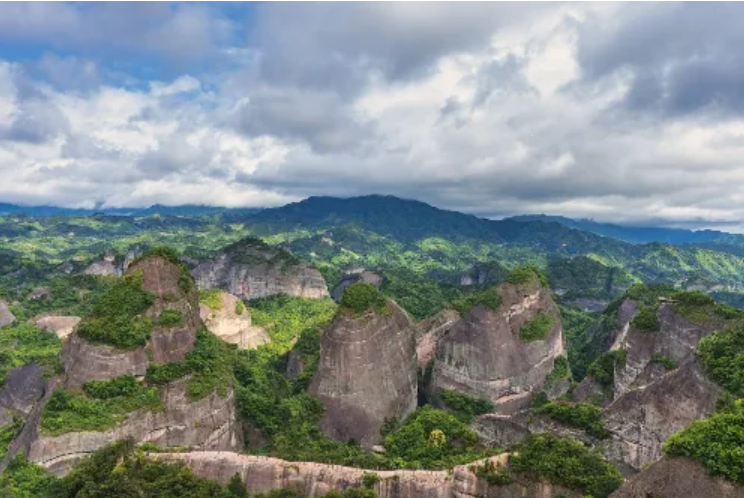
Langshan Scenic Area is located in Xinning County, Shaoyang City, Hunan Province, in the eastern section of the Yuechengling Mountains at the border of Hunan and Guangxi. The total area of the scenic area is 108 square kilometers, with a core scenic area of 40.38 square kilometers. It is a World Natural Heritage Site, a national 5A-level tourist attraction, a national-level scenic spot, and a national geological park. Langshan is known for its typical Danxia landform and is a representative of Chinese Danxia landforms that combines "majesty, wonder, peril, elegance, and seclusion." It has more than 60 major geological and landform attractions, including core landscapes such as Bajiaozhai, Chili Peak, Tianyi Lane, and Fuyi River. Its Danxia landform types are diverse and of high quality, and it has been praised by geologists as "the soul of Danxia, a national treasure."
Historical Culture
The development history of Langshan can be traced back to the Song Dynasty. According to the Annals of Xinning County, monks had already built hermitages for cultivation at Bajiaozhai during the Northern Song Dynasty. During the Ming and Qing Dynasties, Langshan gradually became a resort for literati and poets to visit and compose verses. The Qing Dynasty poet Jiang Shilin once wrote, "Langshan has many strange rocks, towering high into the clouds." In 2001, Langshan was approved by the Ministry of Land and Resources as a national geological park; in 2002, it was approved by the State Council as a national-level scenic spot; in 2010, Langshan successfully applied for World Heritage status together with Guangdong Danxia Mountain, Fujian Taining, and others, becoming a World Natural Heritage Site; in August 2016, Langshan Scenic Area was officially approved as a national 5A-level tourist attraction.
Xinning County, where Langshan is located, has a profound historical and cultural heritage. It is the intersection of Chu culture and Baiyue culture and has nurtured rich folk culture, such as Yao mountain songs and flower drum opera. The scenic area also preserves cultural relics such as ancient villages and ancient temples from the Ming and Qing Dynasties. Among them, the Ming and Qing residential complex in Yaoshi Village is well preserved and has high historical value.
Main Attractions
Bajiaozhai
Bajiaozhai is the main peak of Langshan, with an altitude of 818 meters. It is named after the eight protruding corners of the main peak. At the summit are the remains of Yuntai Temple, first built in the Northern Song Dynasty; the existing buildings are reconstructions in recent years. The most famous landscape here is "Whales Frolicking in the Sea." In cloudy and misty weather, the Danxia peak forest looks like thousands of whales playing in the waves of clouds, creating a spectacular sight. In addition, the "Dragon Head Incense" at Bajiaozhai is considered unique in the world. On a cliff at an altitude of 818 meters, a Danxia stone beam about 5 meters long extends outward, with a small temple built at its tip. It allows passage for only one person and is praised as "the first peril of Langshan."
Chili Peak
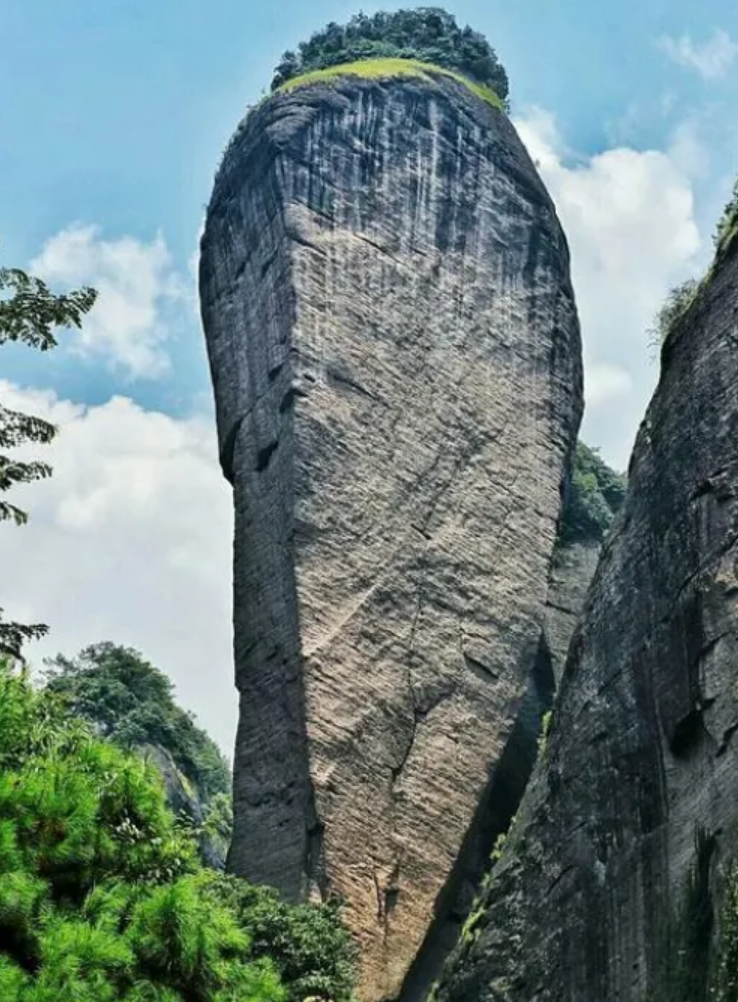
Chili Peak has an altitude of 180 meters and a vertical height of 128 meters. The stone peak is entirely red and resembles a huge red chili, making it a typical representative of Langshan's Danxia landform. In 2002, French "Spider-Man" Alain Robert free-climbed Chili Peak, setting a new climbing record. At the foot of the peak is the ancient village of Linjiazhai, which preserves more than 30 Yao residences from the Ming and Qing Dynasties and is a good place to experience Yao culture.
Tianyi Lane
Tianyi Lane is 238.8 meters long. The stone walls on both sides are 80-120 meters high. Its widest point is 0.8 meters, and its narrowest point is only 0.33 meters, allowing only one person to pass sideways. It was praised by Academician Chen Guoda of the Chinese Academy of Sciences as "the number one lane under heaven." The lane maintains a constant temperature of 18-22°C year-round, and rare animals and plants, such as bats and rock ear fungus, grow on the rock walls on both sides. There are three "skylights" at the top of the lane. Sunlight shines through the skylights, forming the peculiar "single line of sky" landscape.
Fuyi River
The Fuyi River is the mother river of Langshan, with a total length of 238 kilometers and a course of about 22 kilometers within the Langshan Scenic Area. The river water is so clear that the bottom can be seen. The Danxia peak forests on both banks are reflected in the water, forming pictographic landscapes such as "General Rock," "Woodpecker Rock," and "Warship Rock." Rafting on bamboo rafts allows visitors to enjoy the artistic conception of "monkeys crying unceasingly on both banks, while the light boat has already passed ten thousand mountains," making it the most poetic way to tour Langshan.
Zixiadong
Zixiadong is a typical Danxia landform, named after the Taoist temple Zixia Palace in the mountain. It contains cultural landscapes such as Zixia Palace and the tomb of Liu Guangcai. Liu Guangcai was a famous anti-French general in the late Qing Dynasty, and the stone figures and stone horses in front of his tomb are exquisitely carved and of high artistic value. Zixiadong is also a holy place of Buddhism and Taoism. Historically, it was known as "Zixia Immortal Mountain," and a large number of believers come to worship every year.
Tour Route:
Recommended three-day tour route: On the first day, visit Bajiaozhai in the morning to see "Whales Frolicking in the Sea" and "Dragon Head Incense," then go to Chili Peak in the afternoon to climb Chili Peak and visit the ancient village of Linjiazhai; on the second day, visit Tianyi Lane in the morning to experience the wonder of "the number one lane under heaven," then visit Zixiadong in the afternoon to see Zixia Temple and Liu Guangcai's tomb; on the third day, take a bamboo raft drift on the Fuyi River in the morning to enjoy the Danxia scenery on both banks, and return in the afternoon. The total walking distance is about 15 kilometers, and comfortable sports shoes are recommended.
Travel Tips:
Spring (April-May) and autumn (October-November) are the best seasons to visit Langshan. In spring, azaleas bloom, and in autumn, the Danxia colors are more vivid.
For Bajiaozhai, it is recommended to go in the morning, as it is easier to see the sea of clouds. Bring a jacket, as it is windy at the summit.
Tianyi Lane is relatively slippery inside. It is recommended to wear non-slip shoes. The lane is narrow and requires queuing, so it is advisable to visit during off-peak times.
When rafting on the Fuyi River, you may bring a camera to photograph the scenery on both banks, but be careful about water damage.
Dining prices within the scenic area are relatively high. It is recommended to eat in the county town or at farmhouses around the scenic area for better value.
Notes:
The scenic area is mostly mountain roads with steep steps. It is recommended to travel with companions and pay attention to safety, especially in perilous sections such as "Dragon Head Incense" at Bajiaozhai.
Protect the scenic environment, do not litter, and do not damage vegetation or geological landscapes.
When taking bamboo raft drifts, wear a life jacket properly, follow the raftman's instructions, and do not stand or play in the water at will.
During holidays, there are many tourists in the scenic area. It is recommended to book tickets and accommodation in advance to avoid delaying your itinerary.
Some attractions, such as Bajiaozhai and Tianyi Lane, require climbing. It is recommended to carry drinking water and snacks to replenish energy.
Transportation:
Plane: You can first arrive at Guilin Liangjiang International Airport or Changsha Huanghua International Airport. Guilin to Langshan is about 140 kilometers, a 2.5-hour drive; Changsha to Langshan is about 380 kilometers, a 4.5-hour drive. You can rent a car or take a bus from the airport.
Train: Take a train to Xinning Station (high-speed rail) or Shaoyang Station. Xinning Station has direct shuttle buses to the scenic area, about 40 minutes by car; Shaoyang Station to the scenic area is about 150 kilometers, a 2.5-hour drive. You can take a long-distance bus or charter a car.
Bus: Changsha, Guilin, Shaoyang, and other cities all have direct long-distance buses to Langshan. Changsha West Bus Station has two departures daily (8:30, 14:00), about 4.5 hours by car; Guilin Qintan Bus Station has three departures daily (9:00, 13:30, 16:30), about 2.5 hours by car.
Self-driving: From Changsha, take the Changsha-Shaoshan-Loudi Expressway and the Erlianhaote-Guangzhou Expressway, exit at Xinning, about 380 kilometers in total, a 4.5-hour drive; from Guilin, take the Quannan Expressway and Zixing Expressway, exit at Langshan, about 140 kilometers in total, a 2.5-hour drive. The scenic area has a large parking lot with a charging standard of 10 yuan/day.
Opening Hours:
The scenic area is open year-round. Opening hours are 7:30-17:30 (summer) and 8:00-17:00 (winter). Fuyi River rafting hours are 8:30-16:30, and specific times may be adjusted due to weather conditions.
Tickets:
The ticket price is 136 yuan/person.