Zhongshan Scenic Area is located in Xuanwu District, Nanjing, Jiangsu Province. It is one of China's famous scenic areas, a National 5A Tourist Attraction, and a calling card of Nanjing. With Zhongshan (Purple Mountain) at its core, the scenic area integrates mountains, water, city, forests, temples, and mausoleums, combining the charm of both natural and cultural landscapes. It is known as "China's No. 1 Mountain of Humanities in the City." The total area of the scenic area is about 45 square kilometers, of which the core scenic area covers about 31 square kilometers. It includes three core sections—Ming Xiaoling Mausoleum, Dr. Sun Yat-sen's Mausoleum, and Linggu Temple—as well as many other attractions such as the Purple Mountain Observatory, the Music Stage, and Meiling Palace. The forest coverage rate in the area is over 70%, and it is rich in animal and plant resources. At the same time, it preserves a large number of historical relics from the Three Kingdoms period to modern times, making it a microcosm of Nanjing's historical culture and natural ecology.
Historical Culture
The history of Zhongshan can be traced back to the Warring States period, when it was called "Jinling Mountain." In the Han Dynasty, it was renamed "Zhongshan." Because the rocks of the mountain are purplish-red, it was also called "Purple Mountain" after the Eastern Jin Dynasty. During the Three Kingdoms period, the Eastern Wu regime built a royal temple at the southern foot of Zhongshan, beginning the course of humanistic development in Zhongshan.
The Ming Dynasty was an important period in the historical and cultural development of Zhongshan. In 1381, construction of Ming Xiaoling Mausoleum began and was completed 25 years later. As the mausoleum of Zhu Yuanzhang, the founding emperor of the Ming Dynasty, and Empress Ma, its grand scale and unique architectural layout established Zhongshan's status as a royal mausoleum area and influenced the regulations of later imperial mausoleums. After that, many temples and pavilions were built around Zhongshan, making it an important place for royal sacrifices and sightseeing.
In modern times, Zhongshan witnessed major changes in Chinese history. In 1926, construction of Dr. Sun Yat-sen's Mausoleum began and was completed in 1929. As the mausoleum of Dr. Sun Yat-sen, its design blending Chinese and Western architectural styles became a model of modern architecture. During the Republic of China period, buildings such as Meiling Palace and the Music Stage were also built around Zhongshan, further enriching the cultural connotations of the scenic area.
Zhongshan Scenic Area is not only a gathering place of historical relics, but also a witness to China's modern revolutionary history. The tombs of Liao Zhongkai and He Xiangning, the tomb of Deng Yanda, and others in the area record the course of the democratic revolution. In 1961, Ming Xiaoling Mausoleum was listed as a Major Historical and Cultural Site Protected at the National Level; in 2003, Ming Xiaoling Mausoleum was inscribed on the World Cultural Heritage List as an extension project of the "Imperial Tombs of the Ming and Qing Dynasties"; in 2010, Zhongshan Scenic Area was rated a National 5A Tourist Attraction. Its profound historical and cultural heritage and unique landscape value have been widely recognized both internationally and domestically.
Main Attractions
Dr. Sun Yat-sen's Mausoleum
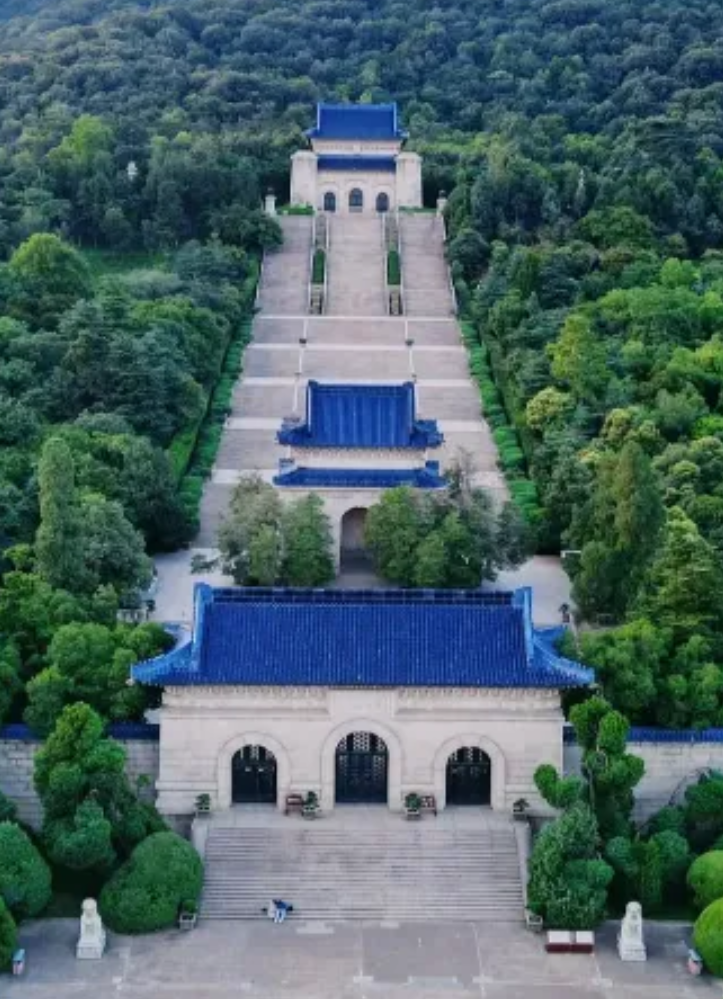
Dr. Sun Yat-sen's Mausoleum is located at the southern foot of Zhongshan. It is the mausoleum of Dr. Sun Yat-sen, the great forerunner of China's modern democratic revolution. It was designed by architect Lu Yanzhi, began construction in 1926, and was completed in 1929, with a total area of about 80,000 square meters. The mausoleum is laid out along a central axis, consisting successively of the Bo'ai Archway, the tomb path, the mausoleum gate, the stele pavilion, the memorial hall, and the tomb chamber, with a total of 392 steps, symbolizing China's population of 392 million at that time. Inside the memorial hall is a marble seated statue of Dr. Sun Yat-sen, and the full text of the "Outline of National Reconstruction" is engraved on the walls. Dr. Sun Yat-sen's Mausoleum combines traditional Chinese architecture with Western classical architectural styles. It is majestic and solemn. In 1961, it was listed as a Major Historical and Cultural Site Protected at the National Level, and it is a national patriotism education demonstration base.
Ming Xiaoling Mausoleum
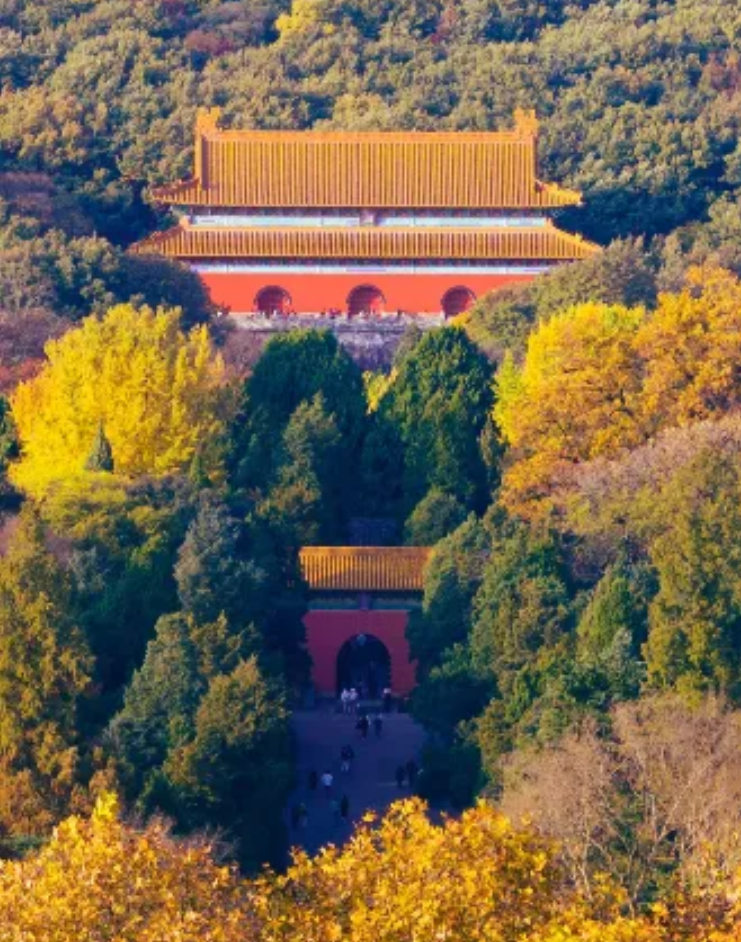
Ming Xiaoling Mausoleum is located at the foot of Dulongfu Wanzhu Peak at the southern foot of Zhongshan. It is the joint burial mausoleum of Zhu Yuanzhang, the founding emperor of the Ming Dynasty, and Empress Ma. Construction began in 1381 and was completed in 1405, lasting 25 years, with a total area of about 1.7 million square meters. It is the foremost imperial mausoleum of the Ming and Qing Dynasties and the only World Cultural Heritage site in Nanjing. The layout of the mausoleum is divided into two parts: the spirit way section includes stone statues of animals and human figures, with 12 pairs of stone beasts and 6 pairs of stone statues of civil officials and military generals, vividly sculpted and imposing; the main section includes the Jinshui Bridge, the Wenwu Fangmen Gate, the Hall of Enjoyment, and the Square City and Bright Tower, among which the Square City and Bright Tower are the landmark buildings of Ming Xiaoling Mausoleum. The architectural style of Ming Xiaoling Mausoleum broke the tradition of straight spirit ways in previous imperial mausoleums and adopted a curved spirit way design. It is praised as the "blueprint for the imperial mausoleums of the Ming and Qing Dynasties."
Linggu Temple
Linggu Temple is located at the northern foot of Zhongshan. It was first built in the 13th year of the Tianjian era of the Liang Dynasty in the Southern Dynasties (514 AD) and was originally named "Kaishan Temple." In the Ming Dynasty, because of the construction of Ming Xiaoling Mausoleum, the temple was relocated to its current site and was granted the name "Linggu Temple." It was one of the three great Buddhist temples of the Ming Dynasty. Most of the existing buildings were rebuilt in the Qing Dynasty, mainly including the Red Mountain Gate, the Beamless Hall, the Pine Wind Pavilion, and the Linggu Pagoda. The Beamless Hall (Wuliang Hall) is the landmark building of Linggu Temple. It was built during the Hongwu period of the Ming Dynasty. The entire hall uses not a single beam or pillar and is entirely built of brick. It is 22 meters high, 53.8 meters wide, and 37.85 meters deep, making it the largest existing beamless hall building in China. The Linggu Pagoda was built in 1931. It is 66.8 meters high and has 9 stories. Climbing the pagoda offers a panoramic view of Zhongshan. Linggu Temple has a quiet environment and towering ancient trees. It has long been known as "Linggu Deep Pines" and is an important Buddhist cultural site in Zhongshan.
Purple Mountain Observatory
The Purple Mountain Observatory is located at Tianbao Peak, the third peak of Zhongshan. It was founded in 1934 and is the first modern observatory designed and built by China itself. It is known as the "cradle of modern Chinese astronomy." The observatory covers an area of about 7,000 square meters and has large astronomical instruments such as a 60-centimeter reflecting telescope and a 20-centimeter refracting telescope, as well as an exhibition hall of ancient astronomical instruments. The hall displays precious cultural relics moved from the Beijing Ancient Observatory, including the armillary sphere, the simplified instrument, and the gnomon. Among them, the armillary sphere and the simplified instrument were cast in the Ming Dynasty and are outstanding representatives of ancient Chinese astronomical instruments. The Purple Mountain Observatory has achieved many results in modern astronomical research. It is now an important research institution under the Chinese Academy of Sciences and is also open to the public, serving as an important base for science popularization education.
Meiling Palace
Meiling Palace is located on Xiaohong Mountain in Zhongshan Scenic Area. It was completed in 1934 and was originally called the "Official Residence of the Chairman of the National Government." Because Chiang Kai-shek and Soong Mei-ling often lived here, it is called "Meiling Palace." The building is a three-story palace-style structure covering an area of about 3,000 square meters. The main body uses a reinforced concrete structure, the roof is covered with green glazed tiles, and the outer walls are decorated with Mount Tai facing bricks. The interior decoration is luxurious, blending Chinese and Western architectural styles. Meiling Palace is surrounded by a plane tree avenue. Viewed from the air, the road forms the shape of a necklace, and Meiling Palace is like a gem on the necklace, so it is praised as the "most beautiful necklace." The palace now displays Soong Mei-ling's daily necessities, calligraphy and painting works, and other items, reflecting the historical style of the Republic of China period.
Music Stage
The Music Stage is located southeast of Dr. Sun Yat-sen's Mausoleum. It was built in 1932 as an open-air performance venue commemorating Dr. Sun Yat-sen. It was designed by architect Yang Tingbao and covers an area of about 4,200 square meters. The Music Stage is overall semicircular, with the stage at the center and a radius of about 25 meters. Behind the stage is a curved sound-reflecting wall that enhances the acoustic effect; the audience area is a fan-shaped lawn that can accommodate more than 3,000 people. The design of the Music Stage blends Western classical architecture with traditional Chinese elements. The sound-reflecting wall is carved with interlocking peony patterns, giving it an elegant style. Today, the Music Stage has become a place for tourists to rest, and white pigeons often perch here, forming a scene of harmonious coexistence between people and white pigeons.
Tour Routes:
Zhongshan Scenic Area is large, and it is recommended to spend 1-2 days visiting.
One-day tour route: Arrive at Dr. Sun Yat-sen's Mausoleum before 8:30 a.m. and visit the Bo'ai Archway, the memorial hall, and other core areas (about 1.5 hours). Then walk to the nearby Music Stage (about 20 minutes) and enjoy the white pigeons and architectural landscape (about 1 hour). At noon, dine at Nanjing Impressions near the scenic area. In the afternoon, go to Ming Xiaoling Mausoleum, starting from the spirit way and appreciating the stone statues, the Square City and Bright Tower, and other sites (about 2.5 hours). After that, walk to Meiling Palace (about 15 minutes) and visit the interior of the building and the surrounding plane tree avenue (about 1 hour). Before evening, go to Linggu Temple and visit the Beamless Hall and Linggu Pagoda (about 2 hours). Climb the pagoda to overlook the sunset scenery of Zhongshan and end the trip.
Two-day tour route: On the first day, follow the one-day tour route to visit Dr. Sun Yat-sen's Mausoleum, Ming Xiaoling Mausoleum, Meiling Palace, and the Music Stage; on the second day, go to the Purple Mountain Observatory in the morning and visit the ancient astronomical instruments and modern observation equipment (about 2 hours). Then hike or take a sightseeing bus to the Toutuo Ridge Scenic Area and enjoy the natural scenery of Zhongshan (about 1.5 hours); at noon, taste vegetarian noodles near Linggu Temple; in the afternoon, visit historical relics around Linggu Temple such as the tomb of Deng Yanda and the tomb of Tan Yankai (about 2 hours), and then end the trip.
Travel Suggestions:
The best seasons to visit are spring and autumn (March-May, September-November). In spring, plum blossoms bloom on Plum Blossom Mountain (March), and in autumn the weather is cool, suitable for hiking and sightseeing; summer is hot, so it is recommended to avoid the midday period, and in winter some attractions may adjust their opening hours due to weather.
The scenic area is large and the attractions are scattered. It is recommended to wear comfortable sports shoes. The walking distance in a single day is about 15-20 kilometers; depending on physical strength, sightseeing buses can be chosen for transportation.
Popular attractions such as Dr. Sun Yat-sen's Mausoleum and Ming Xiaoling Mausoleum are crowded during peak seasons (holidays and weekends). It is recommended to arrive before 8:00 a.m. to avoid the peak flow of people; Dr. Sun Yat-sen's Mausoleum requires reservation 1-3 days in advance on the official WeChat account of "Zhongshan Culture and Tourism Bureau."
Carry an appropriate amount of drinking water and snacks. Dining in the scenic area is relatively expensive. There are convenience stores and restaurants near Ming Xiaoling Mausoleum and Dr. Sun Yat-sen's Mausoleum, while dining options in the Linggu Temple area are fewer.
If planning to climb Purple Mountain (Toutuo Ridge), you can choose to hike or take the cableway. The one-way cableway ticket is 50 yuan per person, and the round-trip ticket is 80 yuan per person. Hiking up the mountain takes about 1.5-2 hours.
Notes:
Smoking and littering are prohibited in the scenic area. Please protect cultural relics and historic sites, and do not climb or carve on buildings or sculptures.
There are many steps in areas such as Dr. Sun Yat-sen's Mausoleum and Ming Xiaoling Mausoleum. Pay attention to safety when visiting, take good care of the elderly and children, and be cautious on slippery rainy days.
When taking sightseeing buses in the scenic area, get on and off at designated stations, take good care of personal belongings, and observe boarding order.
Attractions such as the Purple Mountain Observatory and Linggu Pagoda have high climbing areas. Those afraid of heights should be cautious. When climbing the pagoda, do not linger or play in the stairwells.
Signals are weak in some areas of the scenic area (such as the spirit way of Ming Xiaoling Mausoleum and the bamboo forest of Linggu Temple). It is recommended to download offline maps in advance and keep in contact with companions.
Respect the religious beliefs and cultural customs of the scenic area. Keep quiet in religious places such as Linggu Temple and observe relevant regulations.
Transportation:
Subway: Nanjing Subway Line 2 directly reaches the scenic area. Among the stations, "Zhongshanling · Xiamafang Station" is about 1 kilometer from the entrance of Dr. Sun Yat-sen's Mausoleum, "Mingxiaoling · Muxuyuan Station" is about 500 meters from the entrance of Ming Xiaoling Mausoleum, and "Linggu Temple Station" is about 800 meters from Linggu Temple; "Wangjiawan Station" on Subway Line 4 is about 2 kilometers from the Purple Mountain Observatory.
Bus: Multiple bus lines can reach the scenic area, such as Tourist Line 1, Tourist Line 2, and Tourist Line 3, covering major attractions such as Dr. Sun Yat-sen's Mausoleum, Ming Xiaoling Mausoleum, and Linggu Temple, with a fare of 2 yuan per person; buses such as No. 20 and No. 315 can reach stations around the scenic area.
Sightseeing bus: Sightseeing buses are available in the scenic area, connecting major attractions. They are divided into the East Line (Dr. Sun Yat-sen's Mausoleum - Ming Xiaoling Mausoleum - Meiling Palace) and the West Line (Linggu Temple - Dr. Sun Yat-sen's Mausoleum). The single-ride ticket is 10 yuan per person, and the one-day pass is 50 yuan per person, allowing unlimited rides.
Self-driving: There are multiple parking lots around the scenic area, such as the Dr. Sun Yat-sen's Mausoleum Parking Lot and the Ming Xiaoling Mausoleum Parking Lot. The charging standard is 10 yuan per hour. In peak seasons, it is recommended to arrive early to avoid shortage of parking spaces.
Walking/cycling: The roads in the scenic area are smooth and suitable for walking or cycling. Shared bicycles can be rented in some areas at a cost of about 2 yuan per 30 minutes. Cycling around landscapes such as Lingyuan Road and the plane tree avenue is especially pleasant.
Opening Hours:
The opening hours of each attraction are as follows:
Dr. Sun Yat-sen's Mausoleum: Daily 8:30-17:00 (closed every Monday for maintenance, except statutory holidays and the anniversaries of Dr. Sun Yat-sen's birth and death), with entry stopping at 16:30.
Ming Xiaoling Mausoleum: Daily 6:30-18:30 (March 1-October 31); 7:00-17:30 (November 1-February 28 of the following year).
Linggu Temple: Daily 6:30-18:00 (March 1-October 31); 7:00-17:30 (November 1-February 28 of the following year).
Meiling Palace: Daily 8:30-17:00 (same opening hours as Dr. Sun Yat-sen's Mausoleum).
Music Stage: Daily 8:30-17:00 (March 1-October 31); 9:00-16:30 (November 1-February 28 of the following year).
Purple Mountain Observatory: Daily 9:00-16:30 (entry stops at 16:00), closed every Monday (except statutory holidays).
The outer areas of the scenic area (such as Lingyuan Road and the plane tree avenue) are open all day.
Tickets:
A separate ticket system is implemented for each attraction, with single-attraction tickets starting at 10 yuan. Combination tickets are also available starting at 90 yuan.