The Jinshan · Jiaoshan · Beigu Mountain Scenic Area is located in Zhenjiang City, Jiangsu Province. Together, the three are known as the "Three Mountains of Zhenjiang." All are national 5A-level tourist attractions and famous scenic spots along the Yangtze River. The scenic area uses the Yangtze River as a link, connecting the three mountains of Jinshan, Jiaoshan, and Beigu Mountain as well as the surrounding landscapes, with a total area of about 4.3 square kilometers. Among them, Jinshan covers an area of about 0.22 square kilometers and has an elevation of 43.7 meters; Jiaoshan covers an area of about 0.38 square kilometers and has an elevation of 71.0 meters, and is the only island mountain in the Yangtze River; Beigu Mountain covers an area of about 0.5 square kilometers and has an elevation of 55.2 meters. The scenic area is characterized by the deep integration of "mountains, water, temples, and history." It has both the natural landscape of mountains and water depending on each other and the cultural landscape of thousand-year-old ancient temples and historical relics. It is especially famous for the Three Kingdoms culture and Buddhist culture of the "Three Mountains of Jingkou," and is the core area that showcases Zhenjiang's feature of a "city in mountains and forests."
Historical Culture
Jinshan has a profound historical and cultural heritage. It is said that during the Eastern Jin Dynasty, the eminent monk Fahai opened the mountain and built a temple here, which was the origin of Jinshan Temple. Since the Tang Dynasty, Jinshan has been a Buddhist holy site, and literati such as Su Shi and Lu You once left poems here. The legend of "Flooding Jinshan" in The Legend of the White Snake also made Jinshan widely known. The temple retains scenic spots related to the legend, such as Fahai Cave and White Dragon Cave.
Jiaoshan is named after Jiao Guang, a hermit at the end of the Eastern Han Dynasty, who lived in seclusion here. Literati and poets of successive dynasties came in droves. More than 300 cliff inscriptions remain, among which works by famous calligraphers such as Wang Xizhi, Yan Zhenqing, and Mi Fu are especially precious, and it is known as the "Mountain of Calligraphy." During the Southern Song Dynasty, Jiaoshan was the front line against the Jin, and a fort was once set up to resist Jin soldiers. The existing ancient fort site is a major historical and cultural site protected at the national level.
Beigu Mountain is an important birthplace of Three Kingdoms culture. It is said that Liu Bei married Sun Shangxiang here, and Sun Quan and Zhou Yu once planned the "beauty trap" here. Ganlu Temple on the mountain was first built during the Three Kingdoms period. Although it has been rebuilt over the years, it still preserves relics related to the Three Kingdoms, such as the Sword-Testing Stone and the Hen Stone. Xin Qiji's Yongyule · Reminiscence at Beigu Pavilion in Jingkou further rooted the historical depth of Beigu Mountain in people's hearts, making it a place where literati of successive dynasties came to mourn the past.
Main Attractions
Jinshan Scenic Area
The Jinshan Scenic Area is centered on Jinshan Temple. Although the mountain is small, the temple buildings are constructed along the mountain, and the architectural layout of "mountain wrapping the temple" is unique. Jinshan Temple was first built in the Eastern Jin Dynasty. The existing buildings were rebuilt in the Ming and Qing Dynasties, with a total area of about 100,000 square meters. The main buildings include the Great Buddha's Hall, the Sutra Library, and the Cishou Pagoda. The Cishou Pagoda is 36 meters high and has 7 stories. Climbing the pagoda offers a panoramic view of the Yangtze River and Zhenjiang urban area. The scenic area also has supporting landscapes such as Jinshan Lake and the White Lady Love Culture Park. Among them, the White Lady Love Culture Park covers an area of about 100,000 square meters, takes The Legend of the White Snake as its theme, and recreates classic scenes from the legend.

Jiaoshan Scenic Area
The Jiaoshan Scenic Area is characterized by "mountains surrounded by water and the sound of ancient temple chanting." Visitors need to take a ferry (20 yuan per person one way) to reach the island. Dinghui Temple on the mountain was first built in the Eastern Han Dynasty and is a famous ancient temple in Jiangnan. The existing buildings include the Great Buddha's Hall and the Heavenly King Hall, covering an area of about 38,000 square meters. The Jiaoshan Stele Forest Museum houses more than 400 steles from successive dynasties. Among them, Yihe Ming is called the "ancestor of large characters" and is a treasure of calligraphy art. In addition, the Jiaoshan Ancient Fort Site is located at the eastern foot of the mountain. It was first built in the Song Dynasty and rebuilt in the Qing Dynasty. Eight gun emplacements remain, and it is important physical material for studying modern Chinese military history.
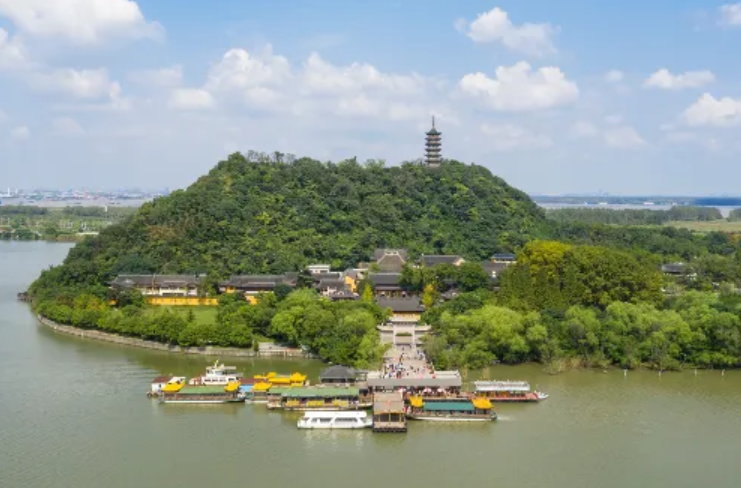
Beigu Mountain Scenic Area
The Beigu Mountain Scenic Area is divided into the front peak, middle peak, and rear peak. The rear peak is the core of the scenic area, with an elevation of 55.2 meters. Ganlu Temple is located at the top of the rear peak. The existing buildings were rebuilt in the late Qing Dynasty and consist of the Main Hall, Laojun Hall, Guanyin Hall, and others, covering an area of about 6,000 square meters. The Duojing Tower beside the temple was first built in the Tang Dynasty and is an excellent place to view the Yangtze River scenery. It is praised as "the finest landscape under heaven." Beigu Pavilion (Jijiang Pavilion) in the scenic area is where Xin Qiji wrote his ci poem. Climbing the pavilion and gazing into the distance, the Yangtze River scenery unfolds before the eyes, and feelings of nostalgia arise spontaneously.
Tour Routes:
One-Day Essence Tour of the Three Mountains
Arrive at Jinshan Scenic Area at 8:30 a.m. and visit Jinshan Temple, Cishou Pagoda, and the White Lady Love Culture Park, taking about 2 hours; at 10:30, go to Beigu Mountain Scenic Area, climb the rear peak to visit Ganlu Temple, Duojing Tower, and Beigu Pavilion, and experience Three Kingdoms culture, taking about 1.5 hours; at 12:00, have lunch at a restaurant near Beigu Mountain and taste pot-cover noodles and crystal meat; at 13:30 p.m., go to Jiaoshan Scenic Area, take the ferry to the island, and visit Dinghui Temple, Jiaoshan Stele Forest, and the ancient fort, taking about 2.5 hours; at 16:00, take the boat back to the shore and end the trip. This route is suitable for tourists with limited time and allows them to experience the core landscapes of the three mountains in a concentrated way.
Two-Day In-Depth Tour of the Three Mountains
Day 1: In the morning, visit Jinshan Scenic Area (3 hours), focusing on Jinshan Temple and the surrounding culture park; in the afternoon, go to Jiaoshan Scenic Area (3.5 hours), carefully appreciate the stele forest inscriptions and the ancient fort, and in the evening watch the Yangtze River sunset at the Jiaoshan ferry crossing; stay overnight in a hotel in Zhenjiang city area. Day 2: In the morning, visit Beigu Mountain Scenic Area (2 hours) and experience Three Kingdoms relics and poetry culture; in the afternoon, you may choose to visit the nearby Xijindu Ancient Street (free), experience the architectural style of the Ming and Qing Dynasties, taste specialty snacks, and end the trip before 16:00. This route is suitable for lovers of history and culture and allows for a deeper appreciation of the heritage of the three mountains.
Travel Suggestions:
The best seasons to visit are spring and autumn (March-May, September-November), when the climate is suitable. In spring, the vegetation of Jinshan and Jiaoshan is lush, and in autumn, the view from Beigu Mountain is broad.
The three mountains are relatively close to one another (Jinshan and Beigu Mountain are about 3 kilometers apart, and Beigu Mountain and Jiaoshan are about 5 kilometers apart). It is recommended to take a taxi or drive to connect the visits. Taxi fare is about 10-15 yuan per trip.
Jiaoshan requires a ferry to reach the island. It is recommended to allow enough time to avoid missing the last return ferry (16:30 in winter, 17:30 in summer).
To taste Zhenjiang cuisine, you can go to Xijindu Ancient Street, about 1 kilometer from Beigu Mountain. It gathers specialty foods such as pot-cover noodles, crystal meat, and Zhenjiang vinegar, with an average spending of 50-80 yuan per person.
If you are interested in calligraphy, it is recommended to hire a guide at the Jiaoshan Stele Forest (50 yuan per time) to gain a deeper understanding of the historical background and artistic value of the inscriptions.
Notes:
In temples such as Jinshan Temple and Dinghui Temple, loud noise is prohibited. Religious customs should be respected. Hats should be removed when entering the main hall, and Buddha statues should not be touched at will.
The Jiaoshan ferry is a small boat. In severe weather such as strong winds and heavy fog, services may be suspended. It is recommended to check the weather forecast or consult the scenic area before traveling.
Some sections of the rear peak of Beigu Mountain are steep. Pay attention to safety when visiting, wear non-slip sports shoes, and elderly people are advised to be accompanied by family members.
For specialties such as Zhenjiang vinegar sold in the scenic area, it is recommended to choose regular shops to avoid low-priced and inferior products.
In summer, there are many mosquitoes along the Yangtze River, so it is recommended to bring mosquito repellent; in winter, the wind on the river is strong, so attention should be paid to windproofing and keeping warm.
Each scenic area has cultural and creative shops where souvenirs related to Three Kingdoms culture and Buddhist culture can be purchased, with prices ranging from 20 yuan to 200 yuan.
Transportation:
Bus: Multiple buses in Zhenjiang city can reach the three mountain scenic areas. For Jinshan Scenic Area, take Bus 2, 8, or 17 to "Jinshan Park Station" and walk about 5 minutes; for Jiaoshan Scenic Area, take Bus 104 or 133 to "Jiaoshan Scenic Area Station"; for Beigu Mountain Scenic Area, take Bus 4, 104, or 135 to "Beigu Mountain Park Station." Bus fares are 1-2 yuan per person, and operating hours are 6:00-22:00.
Self-driving: From Nanjing, take the G42 Shanghai-Chengdu Expressway and get off at the Zhenjiang exit. The drive takes about 1.5 hours; from Shanghai, take the G60 Shanghai-Kunming Expressway and transfer to G42. The drive takes about 2.5 hours. Parking at Jinshan Scenic Area costs 5 yuan per hour, at Jiaoshan Scenic Area 10 yuan per time, and at Beigu Mountain Scenic Area 8 yuan per time.
High-speed rail: Take the high-speed rail to Zhenjiang Station or Zhenjiang South Station. Zhenjiang Station is about 3 kilometers from Jinshan Scenic Area. You can take a taxi (about 10 yuan) or Bus 2 directly; Zhenjiang South Station is about 10 kilometers from the scenic area. A taxi costs about 25 yuan, or you can take Bus 133 and transfer to other routes.
Opening Hours:
Jinshan Scenic Area: Daily 8:00-17:00 (last entry at 16:30), extended to 17:30 in summer (June-August) (last entry at 17:00); Jiaoshan Scenic Area: Daily 8:00-17:00 (last entry at 16:30, and the last ferry leaves the shore for Jiaoshan at 16:30), extended to 17:30 in summer; Beigu Mountain Scenic Area: Daily 8:00-17:00 (last entry at 16:30), extended to 17:30 in summer. In winter (December-February), the opening hours of all scenic areas are shortened by 30 minutes, to 8:30-16:30 (last entry at 16:00).
Tickets:
Jinshan Scenic Area ticket is 50 yuan per person, Jiaoshan Scenic Area ticket is 50 yuan per person, and Beigu Mountain Scenic Area ticket is 30 yuan per person.