The Lingshan Grand Buddha Scenic Area is located on Lingshan Road, Mashan Subdistrict, Binhu District, Wuxi City, Jiangsu Province. It is a national 5A-level tourist attraction and a well-known Buddhist culture-themed park in China. With the Lingshan Grand Buddha at its core, the scenic area integrates Buddhist culture, natural landscapes, and modern landscape design, showcasing profound Buddhist heritage and humanistic spirit. The scenic area covers an area of about 30 hectares, and its main structures include the Lingshan Grand Buddha, the Nine Dragons Bathing the Buddha, the Brahma Palace, and Xiangfu Zen Temple. Among them, the Lingshan Grand Buddha is 88 meters high, making it one of the tallest bronze seated Buddha statues in the world. It was officially consecrated in 1997 and has become a landmark cultural landscape of Wuxi and even East China. Relying on the thousand-year history of Xiangfu Zen Temple, the scenic area combines traditional Buddhist culture with modern tourism experiences, forming a tourist destination that integrates prayer, sightseeing, and cultural experiences.
Historical Culture
The historical and cultural foundation of the scenic area originates from Xiangfu Zen Temple. Xiangfu Zen Temple was first built during the Zhenguan period of the Tang Dynasty (627-649), more than 1,300 years ago. It was originally named "Xiangfu Temple," was once renamed "Xiangfu Chan Yuan" during the Song Dynasty, and after periods of rise and decline, regained the name "Xiangfu Zen Temple" after reconstruction in the Ming Dynasty. Historically, Xiangfu Zen Temple produced many eminent monks and had flourishing incense offerings. It was an important Buddhist site in the Jiangnan region and had deep ties to the spread of Buddhist culture.
The construction of the Lingshan Grand Buddha continued the Buddhist inheritance of Xiangfu Zen Temple. In 1994, the Lingshan Grand Buddha project was launched, with the purpose of "promoting Buddhist culture and fostering social harmony," and it was completed after three years. The design of the Grand Buddha combines the fullness and roundness of Tang Dynasty Buddha statues with the realistic style of Song Dynasty Buddha statues. It not only embodies the essence of traditional Buddhist statuary art but also incorporates modern craftsmanship, making it a model of contemporary Buddhist art. Structures in the scenic area such as the Nine Dragons Bathing the Buddha and the Brahma Palace are also based on Buddhist scriptures and reproduce Buddhist stories and cultural connotations through artistic forms, allowing visitors to experience the breadth and depth of Buddhist culture during their tour.
Main Attractions
Lingshan Grand Buddha
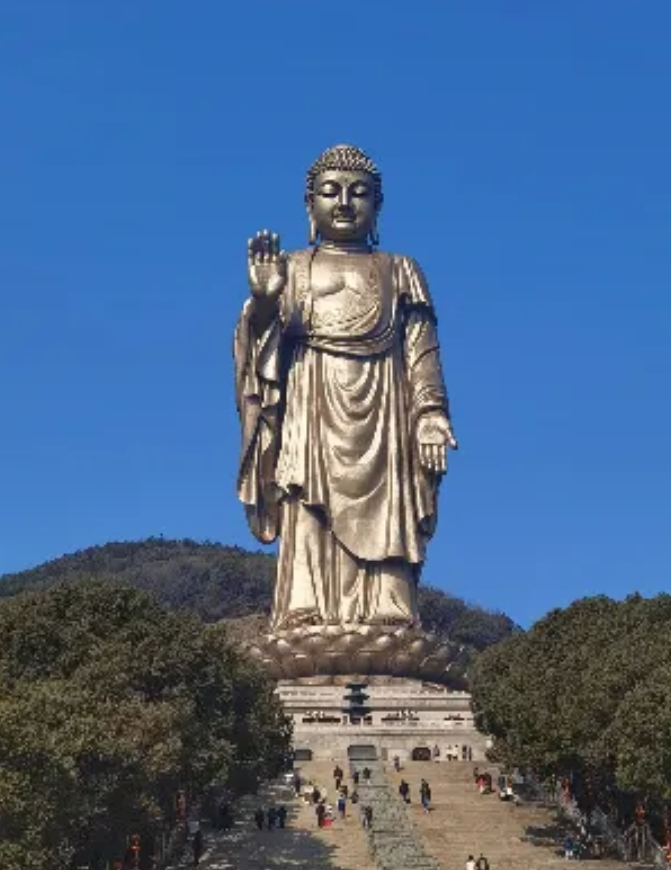
The Lingshan Grand Buddha is the core attraction of the scenic area. It is a bronze seated statue of Sakyamuni, with a total height of 88 meters, of which the Buddha statue itself is 79 meters high and the lotus pedestal is 9 meters high. It is assembled from 1,560 bronze castings and weighs more than 700 tons in total. The statue faces south, with a compassionate expression. Its right hand forms the "Abhaya Mudra" and its left hand forms the "Varada Mudra," symbolizing the Buddha's compassion and protection for all sentient beings. Visitors can climb onto the base of the lotus pedestal to feel the solemn majesty of the statue up close, and can also look out over Taihu Lake and the surrounding landscape from the viewing platform at the foot of the Buddha. Since its consecration, the Grand Buddha has become a holy place for many believers to pray and make wishes, attracting a large number of tourists every year.
Nine Dragons Bathing the Buddha
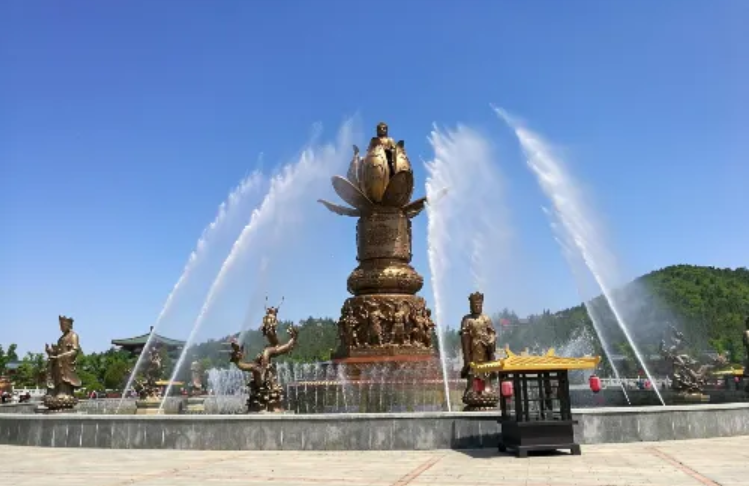
The Nine Dragons Bathing the Buddha is located in the square in front of the Lingshan Grand Buddha. It is a large-scale dynamic landscape built according to the Buddhist classic story of "the birth of the Buddha." The main body of the landscape is a 27.5-meter-high lotus platform, on which is enshrined the statue of Prince Siddhartha, 7.2 meters high and entirely gilded, symbolizing the Buddha's declaration at birth that "I alone am honored in heaven and on earth." Surrounding it are nine giant dragons, 11 meters high, which can spray water columns up to 30 meters high from their mouths to bathe the prince's statue. A "Bathing the Buddha" performance is held regularly every day. When the music begins, the lotus slowly opens, the prince's statue rotates out, and the nine dragons spray water to bathe it, creating a spectacular scene. After the performance, staff distribute "holy water" to visitors, symbolizing good fortune and auspiciousness.
Lingshan Brahma Palace
The Lingshan Brahma Palace is a landmark building in the scenic area that integrates Buddhist art exhibitions and cultural exchange. Its building area reaches more than 70,000 square meters. Its architectural style combines traditional Chinese Buddhist architecture with the characteristics of Southeast Asian Buddhist architecture, making it magnificent and exquisitely beautiful. The dome inside the palace is 34 meters high and painted with exquisite Buddhist murals and constellation patterns. When the lighting changes, it looks like a starry sky. The hall is filled with wood carvings, stone carvings, jade carvings, and other artworks. Among them is the 17-meter-long "Lingshan Sacred Realm" wooden carved screen, made from more than a thousand pieces of red sandalwood and exquisitely carved. The Brahma Palace also regularly holds Buddhist cultural exhibitions and performances, such as the large-scale situational performance "Lingshan Auspicious Ode," which uses sound, light, and electrical technologies to reproduce classic Buddhist scenes and bring visitors a stunning artistic experience.
Xiangfu Zen Temple
Xiangfu Zen Temple is the oldest building in the scenic area. It was first built in the Tang Dynasty, and the existing buildings were rebuilt on the original site in 1994. The temple is laid out along a central axis, consisting successively of the mountain gate, the Hall of Heavenly Kings, the Mahavira Hall, and the Sutra Library, with a total building area of about 5,000 square meters. In the Mahavira Hall are enshrined three main Buddhas: Sakyamuni Buddha, Medicine Buddha, and Amitabha Buddha. The statues are 12 meters high and solemn and majestic. The temple also preserves historical relics such as a Tang Dynasty ancient ginkgo tree and a Song Dynasty stone sutra pillar, bearing witness to the temple's thousand-year rise and fall. As a place for Buddhist activities, Xiangfu Zen Temple holds religious ceremonies such as morning and evening chanting every day, where visitors can feel the peaceful atmosphere of Buddhist practice.
Five Mudra Mandala
The Five Mudra Mandala is located on the west side of the scenic area. It is a building that integrates Tibetan Buddhist architectural style and artistic characteristics. It covers an area of about 5,000 square meters and is 31.5 meters high, divided into three above-ground floors and one underground floor. The mandala centers on the Buddhist concept of the "Five Directions and Five Buddhas." Inside are enshrined statues of Buddhas and Bodhisattvas of Tibetan Buddhism, decorated with large amounts of thangkas, murals, butter sculptures, and other artworks, with brilliant colors and exquisite craftsmanship. Visitors can climb to the top of the mandala along the spiral staircase, overlook the surrounding landscape, and learn about the culture and artistic characteristics of Tibetan Buddhism. The architectural layout and decorative details of the mandala all follow Tibetan Buddhist rituals and serve as a witness to cultural exchange between Han and Tibetan Buddhism.
Suggested Tour Route:
The suggested visiting time is one day. Arrive at the scenic area before 8:30 a.m. After entering through the main gate, first go to the Nine Dragons Bathing the Buddha to watch the 9:00 "Bathing the Buddha" performance and participate in the "holy water" reception activity (about 1 hour); then go to the Lingshan Brahma Palace to visit the interior architecture and artworks and watch the 10:30 performance of "Lingshan Auspicious Ode" (about 1.5 hours). At noon, you can dine at the vegetarian restaurant near the Brahma Palace (about 1 hour). In the afternoon at 13:30, go to Xiangfu Zen Temple to visit the temple buildings and experience the Buddhist atmosphere (about 1 hour); afterward, climb to the base of the Lingshan Grand Buddha to worship the Buddha up close and overlook the panoramic view of the scenic area (about 1.5 hours); finally, go to the Five Mudra Mandala to learn about Tibetan Buddhist culture (about 1 hour), and end the itinerary and leave the scenic area before 16:30. If time permits, you can buy Buddhist-related souvenirs at the cultural shops in the scenic area.
Travel Tips:
It is recommended to visit in spring and autumn, when the weather is mild and suitable for outdoor activities; summer temperatures are relatively high, so sun protection measures are needed; winter is colder, so warm clothing is recommended.
Religious activities and performance times in the scenic area are fixed. It is recommended to check the day's performance schedule in advance through official channels and plan your itinerary reasonably to avoid missing core experiences such as "Lingshan Auspicious Ode" and "Bathing the Buddha."
The scenic area is large, and a full walking tour takes about 6-7 hours. It is recommended to wear comfortable sports shoes. Sightseeing buses are also available in the scenic area, priced at 30 yuan per person, and can travel between the main attractions.
For dining, it is recommended to choose the vegetarian restaurant in the scenic area and taste specialty vegetarian dishes such as Lingshan vegetarian noodles and vegetarian buns to experience Buddhist food culture; if you want to experience local flavors, you can go to downtown Wuxi for a meal after the tour.
There are many visitors on holidays and weekends. It is recommended to arrive before 8:00 a.m. to avoid peak crowds and improve the touring experience.
Notes:
The scenic area is a Buddhist cultural site. Visitors need to observe etiquette, keep quiet when entering temples, the Brahma Palace, and other areas, avoid making noise and chasing one another, and respect religious beliefs.
When visiting Buddha statues and religious artworks, please do not touch, climb, or carve on them. Follow the scenic area's signage and visit in a civilized manner.
During the Nine Dragons Bathing the Buddha performance, the area in front of the platform may be sprayed with water mist. It is recommended to bring an umbrella or raincoat to avoid getting clothes wet; pay attention to keeping warm when watching in winter.
There are many steps in the base of the Lingshan Grand Buddha and in buildings such as the Brahma Palace. Pay attention to safety while touring, take good care of the elderly and children, and be cautious on slippery ground when it rains.
Smoking and littering are prohibited in the scenic area. Please protect the environment and keep the scenic area clean.
When purchasing souvenirs, it is recommended to choose official shops in the scenic area to avoid buying overpriced or counterfeit goods from informal stalls.
Transportation:
Bus: You can take Wuxi Bus No. 88 or No. 89 directly to Lingshan Shengjing Station. The fare is 2 yuan per person, the ride takes about 1 hour, and the interval between buses is 15-20 minutes.
Tourist line: In Wuxi city, the tourist line "Le You Line 2" connects Wuxi Railway Station and the Lingshan Grand Buddha Scenic Area. The fare is 10 yuan per person, the ride takes about 50 minutes, and it is comfortable and convenient.
Self-driving: The scenic area has a large parking lot. The charging standard is 20 yuan per time (small car). Self-driving visitors can navigate to "Wuxi Lingshan Grand Buddha Scenic Area Parking Lot." The parking lot is about 300 meters from the scenic area entrance.
Taxi/ride-hailing: Taking a taxi or ride-hailing car from downtown Wuxi to the scenic area takes about 40-50 minutes. The cost varies depending on the departure point, generally between 80 and 150 yuan.
High-speed rail/bullet train: Out-of-town visitors can take high-speed rail or bullet train to Wuxi Station or Wuxi East Station. From Wuxi Station, you can directly transfer to Bus No. 88. From Wuxi East Station, you need to first take Metro Line 2 to "He Lie Kou Station," then transfer to Bus No. 89 to reach the scenic area.
Opening Hours:
The opening hours of the scenic area are adjusted according to the seasons: from March 1 to October 31 each year, the opening hours are 7:30-17:30 (last entry at 17:00); from November 1 to February 28 (or 29) of the following year, the opening hours are 8:00-17:00 (last entry at 16:30). The performance times of "Lingshan Auspicious Ode" are: from March 1 to October 31, every day at 10:30, 11:30, 14:00, and 16:00; from November 1 to February 28 (or 29) of the following year, every day at 10:30 and 14:00. Specific performance times may change due to seasons or holidays. Visitors are advised to check the scenic area's announcements in advance.
Tickets:
Tickets are 210 yuan per person.