Suzhou Gardens are located in Suzhou City, Jiangsu Province, and are outstanding representatives of classical Chinese gardens. Among them, several gardens, including the Humble Administrator's Garden, the Lingering Garden, the Lion Grove Garden, and the Canglang Pavilion, are national 5A-level tourist attractions. With the gardening philosophy of "though made by man, it appears as if created by heaven," Suzhou Gardens skillfully integrate architecture, landscapes, and plants, embodying traditional Chinese views of nature and humanistic spirit. To date, more than 60 gardens still exist in Suzhou, among which the most representative include the Humble Administrator's Garden, the Lingering Garden, the Lion Grove Garden, the Canglang Pavilion, the Master-of-Nets Garden, and the Mountain Villa with Embracing Beauty. The Humble Administrator's Garden is the largest classical landscape garden among Suzhou Gardens, covering an area of about 52,000 square meters; the Lingering Garden covers an area of about 23,000 square meters and is known for its exquisite architectural layout; the Lion Grove Garden covers an area of about 11,000 square meters and is characterized by its Taihu rockeries. These gardens combine ornamental, artistic, and practical value, and are the pinnacle of Chinese garden art.
Historical Culture
The history of Suzhou Gardens can be traced back to the Spring and Autumn period, when the State of Wu established its capital at Gusu (present-day Suzhou), and palace gardens had already begun to take shape. During the Wei, Jin, Southern and Northern Dynasties, literati and scholars began to build private gardens here as places for seclusion and rest, and the garden style gradually incorporated literati aesthetics.
During the Tang and Song dynasties, Suzhou Gardens further developed, and gardening techniques became increasingly mature, giving rise to gardening methods modeled on natural landscapes. The Ming and Qing dynasties were the heyday of Suzhou Gardens. Due to the prosperity of the commodity economy, literati, officials, and merchants all built gardens here, forming a pattern of "gardens within the city, and the city within gardens." According to records, during the Ming and Qing dynasties, the number of gardens in Suzhou reached more than 200, and gardening techniques reached their peak, forming a unique artistic style that emphasized "learning from nature but surpassing nature" and pursued the artistic conception of "a miniature landscape within a foot."
Suzhou Gardens are not only carriers of architectural art, but also contain profound cultural connotations. The plaques, couplets, and inscriptions in the gardens all reflect the influence of Confucianism, Daoism, Buddhism, and other schools of thought, and are an important part of traditional Chinese culture. In 1997, the Humble Administrator's Garden, the Lingering Garden, the Master-of-Nets Garden, and the Mountain Villa with Embracing Beauty among the classical gardens of Suzhou were inscribed on the World Cultural Heritage List. In 2000, the Canglang Pavilion, the Lion Grove Garden, the Garden of Cultivation, the Couple's Retreat Garden, and the Retreat and Reflection Garden were also inscribed as extensions, marking international recognition of the artistic value of Suzhou Gardens.
Main Attractions
Humble Administrator's Garden
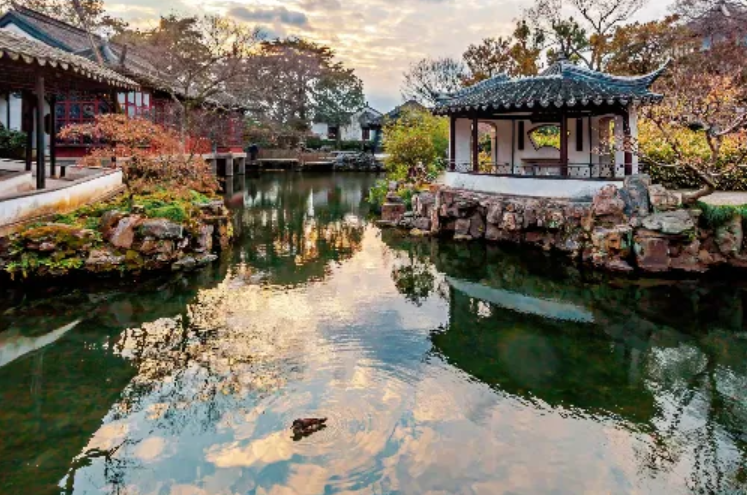
The Humble Administrator's Garden was first built in the fourth year of the Zhengde reign of the Ming dynasty (1509) by Censor Wang Xianchen. It is the largest of the Suzhou Gardens and one of China's four great famous gardens. The garden is divided into three parts: east, middle, and west. The central part is the core area of the garden, with a pond at its center, surrounded by pavilions, terraces, towers, and verandas, embodying the gardening layout of "one pond and three mountains." The main attractions in the garden include the Hall of Distant Fragrance, the Fragrant Isle, and the Pavilion of Lotus Breezes on All Sides. Among them, the Hall of Distant Fragrance is the main building in the central section. Its name is taken from the phrase "fragrance travels far and becomes ever more pure" in Zhou Dunyi's "On the Love of the Lotus." Windows open on all four sides, allowing different views of the surrounding scenery, and it is praised as a model of a "four-sided hall." The Humble Administrator's Garden is known for its waterscape. In summer, when the lotuses bloom, the entire garden is filled with lotus leaves and intoxicating fragrance, recreating the artistic conception of "obtaining the pleasure of mountains and forests without leaving the city walls."
Lingering Garden
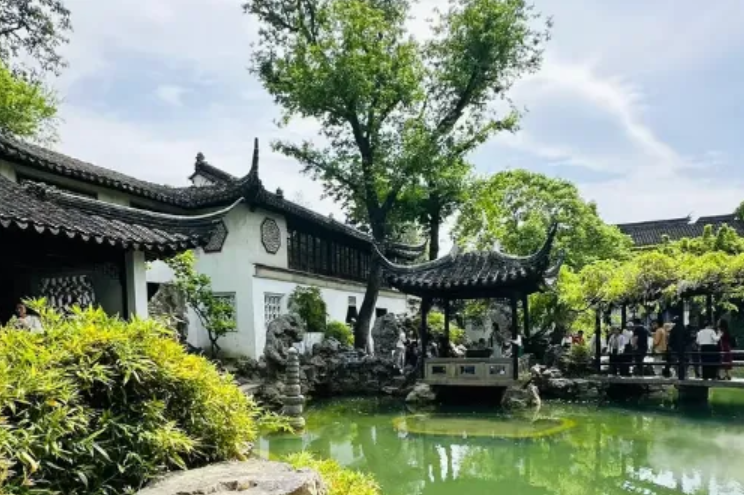
The Lingering Garden was first built in the 21st year of the Wanli reign of the Ming dynasty (1593). During the Qing dynasty, it underwent multiple repairs and expansions, forming its current scale. The Lingering Garden is known for its exquisite architectural layout and rich spatial variation. The whole garden is divided into four parts: central, eastern, western, and northern. The central part is mainly composed of landscapes, the eastern part is known for its architecture, the western part is mostly natural scenery, and the northern part features pastoral views. Famous attractions in the garden include the Cloud-Capped Peak, the Nanmu Hall, and the Hanbi Mountain Villa. The Cloud-Capped Peak is about 6.5 meters high and is a relic from the Song dynasty's Flower and Stone Convoy. It is the largest Taihu rock in Jiangnan gardens and is known for being "lean, porous, leaky, and wrinkled." Together with the Auspicious Cloud Peak and the Cloud Cave Peak, it is called one of the "Three Peaks of the Lingering Garden." The architecture and landscape of the Lingering Garden are skillfully combined. Through borrowed scenery techniques such as leaky windows and moon gates, spaces interpenetrate each other, creating a "scene changes with each step" effect.
Lion Grove Garden
The Lion Grove Garden was first built in the second year of the Zhizheng reign of the Yuan dynasty (1342) by Zen Master Tianru in memory of his teacher, Zen Master Zhongfeng. It was originally named "Orthodox Bodhi Temple," and because the Taihu rockeries in the garden resemble lions, it is also called the "Lion Grove." It is the only garden in Suzhou Gardens originally built in the Yuan dynasty. Its greatest feature is its Taihu rockery, which covers an area of about 1,100 square meters and is built from a large number of Taihu stones. With crisscrossing caves and winding paths, it is known as the "Kingdom of Rockeries." The rockeries in the garden include caves such as "Hanhui," "Tuyue," "Xuanyu," and "Angxiao." Visitors walking through them feel as if they are in a maze. The main attractions include the Yifeng Zhibai Pavilion, the Wenmei Pavilion, and the Lixue Hall, most of which are related to Buddhist culture, reflecting the combination of gardens and religion.
Canglang Pavilion
The Canglang Pavilion is the oldest surviving garden in Suzhou. It was first built in the fifth year of the Qingli reign of the Northern Song dynasty (1045) by the poet Su Shunqin. After changing owners several times, most of the existing buildings were constructed in the Qing dynasty. The garden is characterized by "high mounds and broad waters." There is an earthen hill in the garden, on which the Canglang Pavilion stands, and it is the landmark building of the garden. The pavilion bears a plaque reading "Canglang Pavilion," taken from the meaning in "Chu Ci": "When the water of the Canglang is clear, I can wash my cap tassels; when the water of the Canglang is muddy, I can wash my feet," reflecting the owner's reclusive sentiments. The layout of the Canglang Pavilion is unique. It has no enclosing wall; instead, it is separated from the outside by a winding double corridor. Embedded in the corridor walls are 38 inscriptions from the Song, Yuan, Ming, and Qing dynasties, known as the "Canglang Pavilion Stone Inscriptions," which are of important historical value.
Master-of-Nets Garden
The Master-of-Nets Garden was first built during the Chunxi reign of the Southern Song dynasty (1174-1189) and was originally named "Fisherman's Retreat." During the Qianlong reign of the Qing dynasty, it was rebuilt and renamed "Master-of-Nets Garden," taking the meaning of "fisherman" (master of nets) and implying retirement from worldly affairs. The Master-of-Nets Garden covers an area of about 8,000 square meters, making it the smallest of the Suzhou Gardens, but its layout is compact, exquisite, and elegant, and it is known for "revealing the large within the small." The garden centers on the "Rosy Cloud Pond," with buildings surrounding it. The main attractions include the Pavilion Where the Moon Arrives and the Wind Comes, the Zhuoying Water Pavilion, and the Reading Paintings by Pines Studio. The Pavilion Where the Moon Arrives and the Wind Comes is located on the west bank of the pond, facing water on three sides. Inside the pavilion is a couplet: "When the moon reaches the center of the sky, when the wind comes to the surface of the water." On Mid-Autumn Night, one can watch the moon reflected in the pond here, with a gentle breeze, making the scenery superb. The gardening craftsmanship of the Master-of-Nets Garden is exquisite and is considered a model of achieving much with little among Suzhou Gardens.
Suggested Itinerary:
Suzhou Gardens are relatively concentrated, and 1-2 days can be arranged for sightseeing. Recommended one-day itinerary: In the morning, go to the Humble Administrator's Garden and tour for about 2-3 hours to experience its grand landscape layout; then walk to the nearby Lion Grove Garden and tour for about 1.5 hours to experience the fun of the rockery maze; at noon, taste Suzhou-style noodles near the gardens. In the afternoon, go to the Lingering Garden and tour for about 2 hours to appreciate its exquisite architectural layout; afterward, go to the Master-of-Nets Garden and tour for about 1.5 hours to experience the artistic conception of "revealing the large within the small." If time permits, you can experience the nighttime opening program at the Master-of-Nets Garden and enjoy traditional opera performances.
For a two-day tour, based on the one-day itinerary, add attractions such as the Canglang Pavilion and the Garden of Cultivation. On the second morning, visit the Canglang Pavilion to experience its antique style, then go to the Garden of Cultivation to experience the tranquility of a lesser-known garden; in the afternoon, go to the Pingjiang Road Historic District to experience the style of the ancient city of Suzhou and taste local snacks.
Travel Tips:
The best seasons to visit are spring (March-May) and autumn (September-November). In spring, hundreds of flowers bloom in the gardens, and in autumn the climate is pleasant, and you can also taste Yangcheng Lake hairy crabs.
It is recommended to rent an electronic guide device or hire a tour guide (the guide fee at the Humble Administrator's Garden is about 100 yuan per time) to learn about the historical background and gardening techniques of the gardens and enhance the touring experience.
The gardens have many stone-paved paths, so it is recommended to wear comfortable flat shoes and avoid high heels.
During peak seasons (holidays and weekends), there are many tourists, so it is recommended to arrive as early as possible (within 1 hour after opening) to avoid crowds.
Carry drinking water and a small amount of snacks. There are few dining options in the gardens, and prices are relatively high.
Notes:
Smoking and littering are prohibited in the gardens. Please do not climb on rockeries, damage flowers and trees, and protect cultural relics and historic sites.
After entering the gardens, please do not speak loudly and keep quiet, respecting the touring experience of other visitors.
Some gardens (such as the Master-of-Nets Garden) require separate tickets for nighttime opening and advance reservations. It is recommended to check official information in advance.
On rainy days, be careful of slippery paths. You can bring a folding umbrella or rent rain gear in the garden (some gardens provide rental services).
Observe the scenic area's opening hours and plan your visiting time in advance to avoid missing the closing time and affecting your itinerary.
Transportation:
Metro: Suzhou Metro Lines 1 and 2 and other lines can reach the vicinity of major gardens. Near the Humble Administrator's Garden and the Lion Grove Garden is Metro Line 4's "Beisita Station," about a 10-minute walk away; near the Lingering Garden is Metro Line 2's "Shilu Station," about a 15-minute walk away; near the Master-of-Nets Garden is Metro Line 3's "Master-of-Nets Garden Station," about a 5-minute walk away.
Bus: Multiple bus lines can reach the gardens, such as tourist special lines You 1, You 2, and You 5, covering major attractions such as the Humble Administrator's Garden, the Lingering Garden, and the Lion Grove Garden. Among them, You 1 can directly reach the Humble Administrator's Garden, the Lion Grove Garden, and the Lingering Garden, with a fare of 2 yuan per person.
Taxi: The starting fare for taxis in Suzhou is 10 yuan (within 3 kilometers), and 2 yuan per kilometer beyond 3 kilometers. From Suzhou Railway Station to the Humble Administrator's Garden it is about 15-20 yuan, and to the Lingering Garden about 10-15 yuan.
Shared bicycles: Shared bicycles are densely distributed in the ancient city of Suzhou. For short trips to the gardens, shared bicycles are convenient and flexible, costing about 2 yuan per 30 minutes.
Opening Hours:
Opening hours vary slightly among the attractions. In peak season (April 1-October 31), they are generally 7:30-17:30 (last entry at 17:00); in off-season (November 1-March 31 of the following year), they are generally 7:30-17:00 (last entry at 16:30).
Among them, the Master-of-Nets Garden has nighttime opening hours. In peak season (April 1-October 31), nighttime opening hours are 19:30-22:00 (last entry at 21:00), providing performances such as Pingtan and Kunqu opera, subject to the scenic area's announcement on the day.
Tickets:
A separate ticket system is implemented for each attraction. Single-attraction tickets start at 5 yuan, and combination tickets start at 65 yuan.