Zhouzhuang Ancient Town is located in Kunshan City, Suzhou City, Jiangsu Province. It is one of the six major ancient towns in Jiangnan and a national 5A-level tourist attraction, enjoying the reputation of "China's No. 1 Water Town." The ancient town is surrounded by water on all sides, and the rivers within the town are distributed in a "well" shape. It has preserved 14 ancient bridges with distinctive features, among which Fu'an Bridge and Zhenfeng Bridge, first built during the Zhizheng period of the Yuan Dynasty, are the most famous. Zhouzhuang Ancient Town covers a total area of about 38.96 square kilometers, with the core scenic area covering about 0.47 square kilometers. It still retains the architectural style of the Ming and Qing dynasties. The town has nearly a hundred classical residences and more than 60 brick-carved gate towers, reflecting the typical layout of Jiangnan water towns with "small bridges, flowing water, and households." It is an outstanding representative of Jiangnan water town culture.
Historical Culture
The history of Zhouzhuang Ancient Town can be traced back to the Spring and Autumn period, when it was the fiefdom of Yao, the youngest son of the King of Wu, and was called "Zhenfeng Li." In the first year of Yuanyou in the Northern Song Dynasty (1086), Zhou Digonglang established a manor here. Because the Zhou family lived in clusters, it gradually became known as "Zhouzhuang."
During the Yuan Dynasty, Zhouzhuang began to rise commercially because it was located on an important water transport route, and a market began to take shape. In the Ming Dynasty, Zhouzhuang became an important distribution center for grain and silk in Jiangnan, and its economy became increasingly prosperous. Many wealthy merchants built residences here, forming the basic layout of the ancient town. In the Qing Dynasty, the commerce and handicraft industry of Zhouzhuang further developed. Relying on its superior waterway transportation, it became an important node connecting Shanghai, Suzhou, and Hangzhou. The town had many shops and gathered merchants.
Zhouzhuang Ancient Town was not only an important commercial town but also a place of cultural prosperity. Historically, many literati and scholars emerged here. For example, Shen Wansan, a wealthy man from Jiangnan in the Ming Dynasty, once lived here, and related legends are still circulating among the people today. The buildings, bridges, streets, and alleys in the ancient town all carry rich historical information. In 2003, Zhouzhuang was rated as a Chinese Historical and Cultural Town. Its unique water town culture and architectural style have become important physical materials for studying the history, folk customs, and architecture of the Jiangnan region.
Main Attractions
Shen Hall
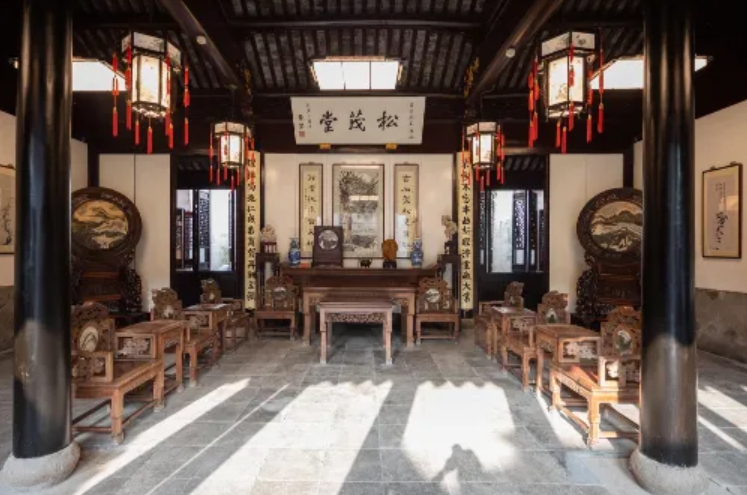
Shen Hall is located on the south side of the east end of Fu'an Bridge in Zhouzhuang. It was built in the seventh year of Qianlong in the Qing Dynasty (1742) by Shen Benren, a descendant of Shen Wansan, a wealthy man from Jiangnan in the Ming Dynasty. It was originally named "Jingye Hall" and later changed to "Songmao Hall." It covers a total area of about 1,700 square meters and has 7 rows and 5 gate towers, with more than 100 rooms of various sizes. It is the largest Ming Dynasty residential building complex in Zhouzhuang. Shen Hall faces east and is built along the river. It consists of a water wall gate, river port, main hall, rear hall, flower hall, and storied buildings. The overall architectural layout is rigorous, with carved beams and painted rafters. In particular, the beams and square timbers of the main hall "Songmao Hall" are carved with exquisite patterns, demonstrating the superb craftsmanship of Jiangnan residential architecture. The hall displays Shen Wansan's life story and related cultural relics, and is an important window for understanding the life of a Jiangnan tycoon.
Zhang Hall
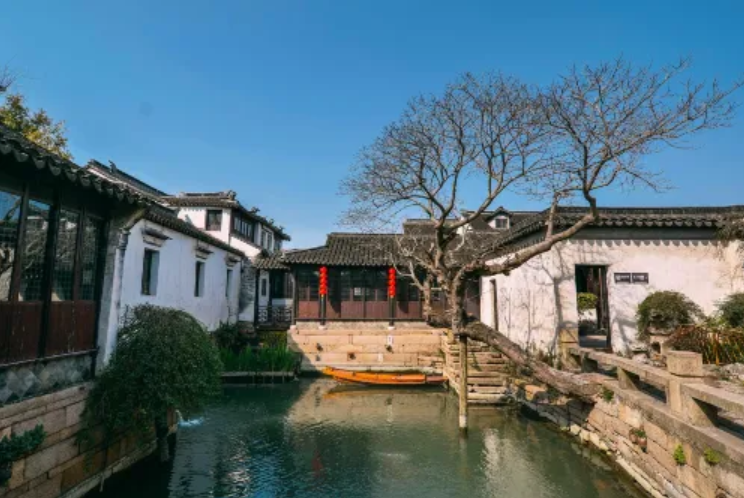
Zhang Hall is located at the south end of Beishi Street in Zhouzhuang. It was first built during the Zhengtong period of the Ming Dynasty (1436-1449) by a descendant of Xu Kui, younger brother of Xu Da, the Zhongshan King of the Ming Dynasty. In the early Qing Dynasty, it was transferred to a family surnamed Zhang, hence the name "Zhang Hall." Zhang Hall covers a total area of about 1,800 square meters, with 6 rows front and back and more than 60 rooms. Its feature is that "sedan chairs enter through the front gate, and boats pass through the house." A small river runs through the courtyard, commonly known as "one river, two banks," reflecting the close integration of Jiangnan water town residences with water. The furnishings in the hall maintain the Ming Dynasty style, and the wood carvings, brick carvings, and other decorations are exquisite, showing the architectural characteristics of Ming Dynasty residences.
Double Bridge
The Double Bridge consists of Shide Bridge and Yong'an Bridge. It is located in the center of Zhouzhuang Ancient Town and was first built during the Wanli period of the Ming Dynasty (1573-1620). The two bridges are connected at right angles and look much like an ancient key, so they are also called the "Key Bridge." Shide Bridge is a stone arch bridge spanning the North-South Market River, 16 meters long and 3 meters wide; Yong'an Bridge is a stone beam bridge spanning Yinzi Bay, 13.3 meters long and 2.4 meters wide. The Double Bridge is a landmark building of Zhouzhuang. In 1984, the oil painting "Memory of Hometown" created by painter Chen Yifei based on the Double Bridge was exhibited overseas, making Zhouzhuang famous far and wide. The Double Bridge also became the symbol of Zhouzhuang.
Fu'an Bridge
Fu'an Bridge is located at the east end of Zhongshi Street in Zhouzhuang. It was first built in the 15th year of Zhizheng in the Yuan Dynasty (1355) and rebuilt in the 14th year of Chenghua in the Ming Dynasty (1478). It is a single-arch stone bridge, 17.4 meters long, 3.8 meters wide, and with a span of 6.6 meters. There are bridge buildings on both sides of the bridge body, which is relatively rare among ancient bridges in Jiangnan. The bridge buildings once housed teahouses and shops, reflecting the feature of "integration of bridge and market." The name Fu'an Bridge implies "wealth unmatched in the region, peace and good fortune." It is one of the oldest bridges in Zhouzhuang and has witnessed the rise and fall of Zhouzhuang.
Zhouzhuang Museum
Zhouzhuang Museum is located on the east side of Zhouzhuang Ancient Town. It was originally the residence of a family surnamed Zhu during the Republic of China period and was converted into a museum in 2004, with a building area of about 1,000 square meters. Through exhibition halls such as "Water Town History," "Water Town Customs," and "Water Town Architecture," the museum displays the development process of Zhouzhuang from ancient times to modern times. The museum houses a large number of cultural relics related to Zhouzhuang's history, such as ancient farming tools, fishing gear, clothing, calligraphy and paintings, as well as exhibits reflecting water town folk customs, such as restored scenes of wedding customs and festivals, allowing visitors to fully understand Zhouzhuang's historical culture and folk customs.
Tour Routes:
The core scenic area of Zhouzhuang Ancient Town is not large, and it is recommended to spend 1-2 days visiting. Recommended one-day tour route: In the morning, enter from the south gate of the ancient town and first visit Zhang Hall to experience the characteristics of Ming Dynasty residences; then walk to the Double Bridge to admire the unique landscape of the "Key Bridge" and take photos; next, go to Shen Hall to learn about the historical story of Shen Wansan; at noon, taste local specialties such as Wansan pork knuckle and Azao noodles in the ancient town. In the afternoon, visit Fu'an Bridge and climb the bridge building to overlook the water town scenery; afterward, go to Zhouzhuang Museum to comprehensively understand Zhouzhuang's historical culture; in the evening, enjoy the sunset by the river and feel the tranquil atmosphere of the water town; at night, you can take a boat tour of the ancient town and enjoy the water town night view under the lights.
For a two-day tour, based on the one-day tour, you can add surrounding attractions. On the second morning, visit the "Museum of Life Mysteries" around the ancient town to learn about the mysteries of biological evolution; in the afternoon, go to "Nanhu Autumn Moon Garden" to enjoy the natural scenery of Nanhu and experience the artistic conception of "Nanhu Autumn Moon," then end the trip.
Travel Suggestions:
The best seasons to visit are spring (March-May) and autumn (September-November). In spring, hundreds of flowers bloom in the ancient town, and in autumn, the climate is pleasant, suitable for walking and boat tours.
It is recommended to stay one night in the ancient town to experience the fun of night tours. At night, Zhouzhuang is brightly lit and less noisy than during the day, with a stronger water town charm.
The streets and alleys in the ancient town are narrow and there are many tourists. It is recommended to wear comfortable flat shoes for easy walking.
When buying specialties, it is recommended to choose time-honored shops in the ancient town, such as the "Shen Wansan Former Residence Specialty Shop," to ensure product quality.
If you want to avoid peak crowds, you can choose to go on weekdays or enter the ancient town between 7:30 and 8:30 in the morning.
Precautions:
There are many rivers in the ancient town. Pay attention to safety when touring, do not get close to riverside railings, and especially keep an eye on children.
When taking a hand-rowed tour boat, follow the boatman's instructions, wear a life jacket, and do not stand or shake on the boat to avoid danger.
Some buildings in the ancient town are wooden structures. Smoking is prohibited. Do not use open flames and protect cultural relics and historic sites.
Please keep the ticket when purchasing it. Some attractions require ticket inspection for entry. The ticket is valid for 3 days, and you can enter and leave the ancient town multiple times.
Respect the living habits of local residents. Do not make loud noises when touring, and do not arbitrarily photograph residents' private life scenes.
Transportation:
Bus: There are many bus routes in Kunshan urban area that can directly reach Zhouzhuang, such as Kunshan Route 161 and Kunshan Route 263. It takes about 1 hour from Kunshan South Bus Station to Zhouzhuang Bus Station, with a fare of 5 yuan per person. There is a direct tourist shuttle bus from Suzhou North Bus Station to Zhouzhuang, with a journey of about 1.5 hours and a fare of 17 yuan per person.
High-speed rail/EMU: Take high-speed rail or EMU to Kunshan South Station, then transfer to Kunshan Route 161 bus to Zhouzhuang Bus Station, and walk about 10 minutes to the entrance of the ancient town. The whole journey takes about 1.5 hours.
Self-driving: From Shanghai, take the Shanghai-Kunming Expressway to the Changjia Expressway, get off at the Zhouzhuang exit, and the drive takes about 1.5 hours; from Suzhou, take the Changtai Expressway to the Changjia Expressway, get off at the Zhouzhuang exit, and the drive takes about 1 hour. There are multiple parking lots around the ancient town, with a charging standard of 10 yuan per day.
Boat tour: In Zhouzhuang Ancient Town, you can take a hand-rowed tour boat. The ticket price is 150 yuan per boat (can seat 6 people), and the journey takes about 30 minutes. It starts from the central river channel of the ancient town and passes through attractions such as the Double Bridge and Fu'an Bridge, allowing you to experience the artistic conception of "the boat travels in the water, and people sit in a painting."
Opening Hours:
Open all year round. Opening hours are 7:30-21:00 (April 1-November 30, last entry at 20:00); from December 1 to March 31 of the following year, opening hours are 7:30-20:00 (last entry at 19:00).
The opening hours of attractions in the ancient town are consistent with the opening hours of the ancient town. The indoor areas of some attractions, such as Shen Hall and Zhang Hall, close after 17:30. Please refer to the scenic area's announcement on the day for specifics.
Tickets:
Ticket: 50 yuan per person.