The Western Qing Tombs Scenic Area is located at the foot of Yongning Mountain, 15 kilometers west of Lianggezhuang, Yi County, Baoding City, Hebei Province. It is a national 5A-level tourist attraction, a World Cultural Heritage site, and one of the largest and best-preserved Qing Dynasty imperial tomb complexes in China. The scenic area is bordered by Yongning Mountain to the north and the Yi River to the south, covering about 800 square kilometers, with the core tomb area covering about 40 square kilometers. It consists of 14 tombs of emperors, empresses, and princes, and is a model of Qing royal mausoleum architecture.
There are more than 1,000 palace-style buildings and more than 100 stone carvings and stone structures, including four emperor tombs—Tailing (Yongzheng), Changling (Jiaqing), Muling (Daoguang), and Chongling (Guangxu)—three empress tombs, as well as imperial concubine burial complexes and prince burial complexes. The architectural layout strictly follows Qing tomb regulations and is symmetrically distributed along a central axis, embodying the ritual idea that “the center is supreme.” At the same time, it is organically integrated with the natural landscape of mountains and rivers, forming a unique pattern in which “the tomb system is in harmony with the landscape.”
History and Culture
The Western Qing Tombs were first built in the eighth year of Emperor Yongzheng’s reign (1730) and were completed in 1915 with the completion of Chongling, the tomb of Emperor Guangxu, lasting 185 years. Emperor Yongzheng, believing that the soil at Jiufeng Chaoyang Mountain in the Eastern Tombs contained sand and gravel, ordered another site to be selected in Yi County, beginning the construction of the Western Qing Tombs. Later, three emperors—Jiaqing, Daoguang, and Guangxu—were buried here successively, forming a royal tomb area that echoes the Eastern Qing Tombs from afar.
The architectural style of the Western Qing Tombs reflects the evolution of Qing tomb architecture. Yongzheng’s Tailing uses yellow glazed tile roofs, highlighting imperial dignity. Daoguang’s Muling, due to declining national strength, eliminated the Minglou and Fangcheng, but its Long’en Hall was built of golden nanmu, with exquisite carved dragon patterns. Guangxu’s Chongling incorporated modern construction techniques; its underground palace used reinforced concrete and is China’s last imperial tomb. These buildings witnessed the Qing Dynasty’s transition from prosperity to decline and are important physical materials for studying Qing politics and culture.
Main Attractions
Tailing
Tailing is the first tomb of the Western Qing Tombs and the tomb of Emperor Yongzheng. It was built from 1730 to 1739 and covers about 124 hectares. From south to north, the tomb area includes the five-bay, six-pillar, eleven-roof stone archway, the Great Red Gate, the Shengde Shengong Stele Pavilion, the Seven-Arch Bridge, the stone statues, and the Dragon and Phoenix Gate. The stone archway is one of the largest existing stone archways in China, and the Seven-Arch Bridge, 107 meters long, is an important landmark of the tomb area. The Long’en Hall hangs a plaque reading “Revere Heaven and Diligently Serve the People” and is the core venue for sacrificial activities.
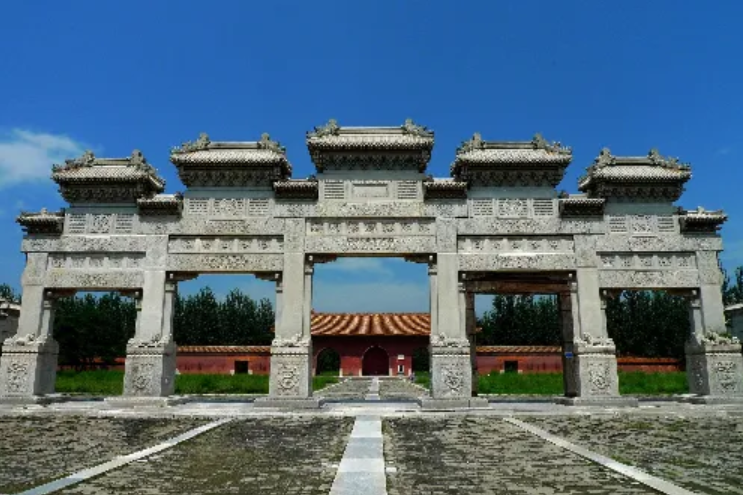
Changling
Changling is the tomb of Emperor Jiaqing, built from 1796 to 1803, located west of Tailing. The 18 pairs of stone statues on the spirit way are vividly carved. The golden bricks paved on the floor of the Long’en Hall each cost as much as the annual income of a middle-income family. The Changling underground palace is the only imperial underground palace open to the public in the Western Qing Tombs. Its vault is painted with Sanskrit and Buddhist images, and the carvings on the underground palace door arches are exquisite, making it a typical representative of Qing imperial tomb underground palaces.
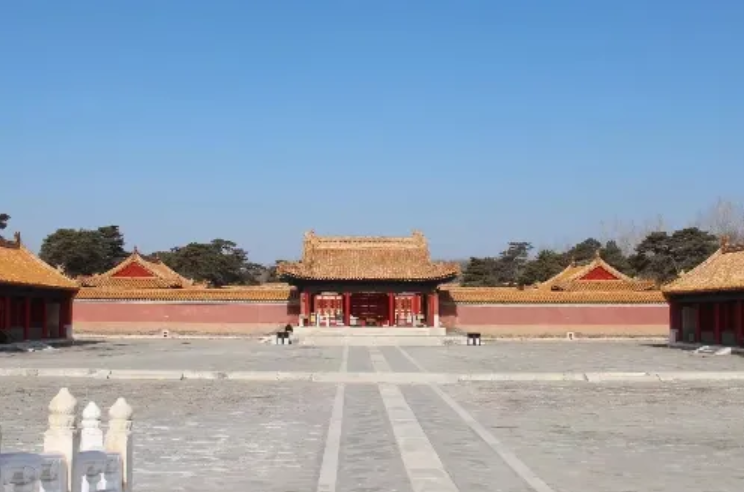
Muling
Muling is the tomb of Emperor Daoguang, built from 1831 to 1835, located southwest of Tailing. Its most distinctive feature is that the Long’en Hall and the east and west side halls are all built of golden nanmu, with no painted decoration, showing the natural color of the wood grain. More than a thousand cloud dragons and wandering dragons are carved on the beams, architraves, and sparrow braces in the hall. The dragon heads point downward and the tails upward, as if a host of dragons were soaring into the air. It is the pinnacle of Qing woodcarving art. Muling eliminated the Minglou and Fangcheng and is the most simple imperial tomb of the Qing Dynasty.
Chongling
Chongling is the tomb of Emperor Guangxu, built from 1909 to 1915. It is the last tomb completed in the Western Qing Tombs and the last imperial tomb in Chinese history. The underground palace is of brick and stone structure, and its vault was poured with concrete, making it the only building in Qing imperial tombs to use reinforced concrete. The underground palace contains the remains of Emperor Guangxu and Empress Longyu. Buddhist murals are painted on the walls, reflecting the integration of late Qing tomb architecture and Buddhist culture.
Yongfu Temple
Yongfu Temple was built in 1786. It is the only royal temple in the Western Qing Tombs, located 5 kilometers east of Tailing and covering about 30,000 square meters. The temple consists of a mountain gate, bell tower, drum tower, archway, stele pavilion, front hall, main hall, rear hall, and other structures. It is a well-preserved example of a Qing royal temple. The temple enshrines statues of Sakyamuni Buddha and other Buddhas and was a place where emperors held Buddhist activities when paying respects at the tombs, embodying the Qing governing philosophy of “revering Heaven and following ancestors.”
Suggested Itineraries:
Classic One-Day Tour
In the morning, take the sightseeing bus from the visitor center to Tailing and visit the stone archway, Great Red Gate, Shengde Shengong Stele Pavilion, and other sites. Climb the Fangcheng Minglou to overlook the tomb area, about 2 hours. Then go to Changling to visit the Long’en Hall and underground palace, about 1.5 hours. At noon, taste the Manchu Eight Great Bowls in Lianggezhuang Town. In the afternoon, go to Muling to admire the woodcarvings in the golden nanmu hall, about 1 hour. Then go to Chongling to visit the underground palace, about 1.5 hours. Finally, go to Yongfu Temple to experience the atmosphere of a royal temple, about 1 hour. End the trip.
Cultural In-Depth Two-Day Tour
On the first morning, visit Tailing and Changling to gain an in-depth understanding of early Qing tomb culture. In the afternoon, visit Muling and Yongfu Temple, focusing on Muling’s woodcarving art and Buddhist culture. In the evening, stay in a Manchu homestay. On the second morning, go to Chongling to visit the underground palace and the exhibition on Guangxu’s life. In the afternoon, go to the Western Qing Tombs Cultural Relics Management Office to visit the historical and cultural exhibition. Afterwards, you can go to Yishui Lake (20 kilometers from the scenic area, admission 50 yuan) for a boat tour and experience the beauty of the integration of mountains, water, and tombs.
Travel Tips:
Suggested visiting time is 1–2 days. Spring (April–May) and autumn (September–October) have pleasant weather. In summer, sun protection is needed; in winter, keep warm.
Attractions in the scenic area are scattered. It is recommended to take the sightseeing bus (included in the combined ticket) to avoid fatigue from walking.
Rent an audio guide (20 yuan per unit) or follow a tour guide to gain an in-depth understanding of tomb history and architectural details. Audio guides can be rented at the visitor center.
Yishui Lake and the Western Qing Tombs can be visited in sequence. The boat tour is 50 yuan per person. The lake and mountain scenery and the royal tombs form a unique landscape combination.
Restaurants around the scenic area are crowded in peak season. It is recommended to book in advance. Recommended dishes include the Manchu Eight Great Bowls and wild fish from Yishui Lake.
Notes:
There are many ancient buildings in the scenic area. Do not touch or carve on cultural relics. Smoking is prohibited in non-smoking areas.
Tailing, Changling, and other attractions have many steps. It is recommended to wear non-slip shoes, and the elderly and children should pay attention to safety.
The underground palaces are dimly lit and the floors are slippery. Watch your step and avoid crowding or pushing.
Self-driving visitors must park in designated areas and avoid parking in non-parking areas to avoid penalties.
Food in the scenic area is slightly more expensive than in the city. You may bring appropriate drinking water and snacks, and keep the environment clean.
Transportation:
Self-driving: From Beijing, take the Beijing–Hong Kong–Macao Expressway → Capital Ring Expressway, about 2.5 hours. From Tianjin, take the Tianjin–Xiongan Expressway → Capital Ring Expressway, about 3 hours. From Baoding, take the Beijing–Kunming Expressway → Capital Ring Expressway, about 1.5 hours. Parking in the scenic area is 10 yuan per hour.
Long-distance bus: Direct buses from Baoding Passenger Transport Center depart at 8:00, 10:00, 14:00, and 16:00. Fare is 35 yuan, travel time 1.5 hours. From Beijing Liuliqiao Passenger Station, take a bus to Yi County, then transfer to a local bus to the scenic area.
Train: Take a train from Beijing West Railway Station to Baoding Station, then transfer to a long-distance bus; or take a high-speed train to Baoding East Station and take a taxi to the scenic area for about 150 yuan.
Scenic Area Sightseeing Bus: The combined ticket includes the sightseeing bus fare. Buses run in a loop between attractions, from 8:00 to 17:00, about one every 20 minutes.
Opening Hours:
The scenic area is open all year. Opening hours are: April 1–October 31, 8:00–18:00 (last entry at 17:30); November 1–March 31 of the following year, 8:30–17:00 (last entry at 16:30). Closed on New Year’s Eve. From the first to the sixth day of the first lunar month, opening hours are 8:00–16:30. In case of major events or severe weather, opening hours may be adjusted, subject to announcements by the scenic area.
Tickets:
Tickets are 108 yuan per person.