Baodu Village Scenic Area is located in Luquan District, Shijiazhuang City, Hebei Province. It is a national 4A-level tourist attraction, about 16 kilometers from the urban area of Shijiazhuang. The scenic area is famous as "A Wonder Village Under Heaven" and "Baodu Blessed Land." It is a mountain ancient village-type scenic area that integrates natural landscapes and cultural landscapes. Baodu Village has an altitude of 580 meters and covers an area of 660 mu. Its mountain form is towering and rugged, surrounded by cliffs on all sides, while the top is flat and open, earning it the name "Garden on the Mountain Top." The buildings in the scenic area are mostly in Ming and Qing dynasty styles, built along the mountain and arranged in an orderly yet varied manner. They mainly include village gates, temples, pavilions, and terraces. Among them, the core building complex covers an area of about 80 mu and preserves a large number of historical relics and cultural landscapes. It combines military defense and religious culture, and is a famous tourist destination in North China.
Historical Culture
Baodu Village has a long history, and the origin of its name can be traced back to ancient times. According to historical records such as Records of the Grand Historian, military defense facilities already existed here during the Warring States period, making it a strategic location contested by ancient military strategists. Legend has it that because the mountain top was flat and open, a farmer once carried a calf up to the top to raise it for convenience in farming, hence the name "Baodu Village."
In the late Sui and early Tang dynasties, this place became a stronghold for peasant uprising forces. The existing village walls, village gates, and other relics were mostly built at that time, bearing witness to the wisdom of ancient military defense systems. During the Ming and Qing dynasties, Taoist culture flourished here, and Taoist building complexes such as the Jinque Palace and Sanqing Temple were successively built, making Baodu Village an important Taoist activity site in the north. Historically, many men of letters visited this place and left numerous poems and inscriptions, adding profound cultural heritage to the scenic area.
Main Attractions
South Heavenly Gate
The South Heavenly Gate is a landmark building of Baodu Village, located at the entrance of the scenic area. It is built in imitation of Ming and Qing palace-style architecture, 23.9 meters high and 21 meters wide, supported by 13 large vermilion columns, and is magnificent. The three large characters "South Heavenly Gate" on the gate plaque are vigorous and powerful, and couplets are carved on both sides, displaying the momentum and heritage of Baodu Village. Ascending the South Heavenly Gate, visitors can overlook the scenery below the mountain. It is the necessary route to enter the village top.
Jinque Palace
Jinque Palace is the core Taoist building complex of Baodu Village. It was first built in the Tang dynasty and later repaired many times. The building complex covers an area of about 5,000 square meters and consists of the Jade Emperor Hall, Sanqing Hall, Queen Mother Hall, and others. The halls have flying eaves and upturned corners, carved beams and painted rafters. Statues of Taoist deities are enshrined inside the halls with solemn expressions. Ancient cypresses tower in the palace, and incense burns abundantly. It is an important place for Taoist believers to worship and also reflects the typical style of northern Taoist architecture.
Han Xin Temple
Han Xin Temple was built to commemorate Han Xin, a famous general of the Western Han dynasty. It covers an area of about 300 square meters. Inside the temple are a statue of Han Xin and displays related to his historical deeds. It is said that Han Xin once stationed troops and trained soldiers here, leaving the prototype of the allusion of "fighting with one's back to the river," and the inscriptions in the temple record in detail the historical origins between Han Xin and Baodu Village. It is an important attraction for understanding local military history.
Ten Thousand Buddha Cave
The Ten Thousand Buddha Cave is one of the cultural wonders of Baodu Village. The cave is 50 meters deep, and more than 10,000 small Buddha statues are carved on the walls inside. The largest is about 30 centimeters high, and the smallest is only 5 centimeters. They vary in shape and are lifelike, covering the sculptural styles of different periods from the Northern Wei to the Ming and Qing dynasties. These Buddha statues are exquisitely carved and highly skilled, possessing extremely high artistic value. They are important physical materials for studying the art of Chinese Buddhist sculpture.
Wanghai Pavilion
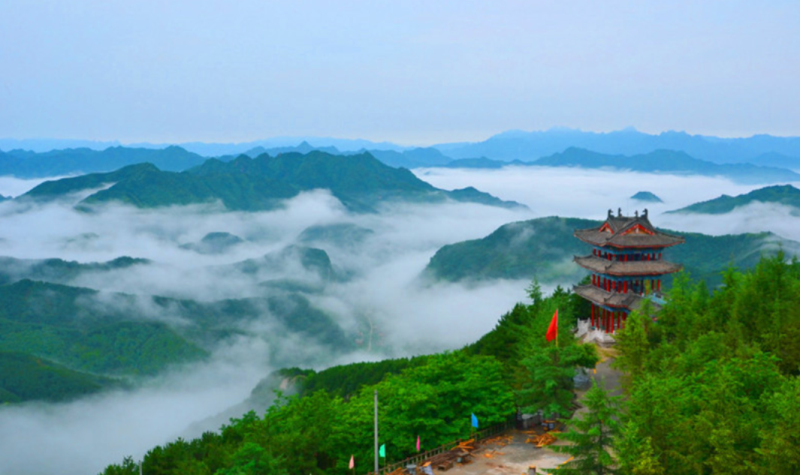
Wanghai Pavilion is located on the mountain top in the northeast part of Baodu Village. It is a hexagonal pavilion, 8 meters high and covering an area of about 15 square meters. Because the sea of clouds over the Taihang Mountains can be seen in the distance when the weather is clear, it is named "Wanghai Pavilion." Stone tables and stools are set inside the pavilion. Visitors can rest and enjoy the view here, overlooking the surrounding natural landscape of rolling peaks and layered ridges. It is an excellent spot in the scenic area for watching the sunrise.
Food
Baodu Village Braised Chicken
Baodu Village Braised Chicken is a local specialty food. It uses locally free-range native chickens and is slowly braised over gentle heat with more than 20 kinds of spices. The finished product is bright red in color, tender in texture, rich in braised aroma, and fatty but not greasy. It is a must-try food for tourists when visiting and can be tasted in restaurants and farmhouses around the scenic area.
Luquan Ganglu Baked Sesame Cake
Luquan Ganglu Baked Sesame Cake is a traditional snack in Luquan District, Shijiazhuang, commonly seen in markets and restaurants around Baodu Village. It uses flour and sesame as the main ingredients and adopts the ganglu baking process. The finished product is crispy outside and soft inside, salty and delicious. It can be eaten directly or stuffed with meat or vegetables. It has a unique flavor and is easy to carry, making it a favorite snack among tourists.
Fried Fresh Milk
Fried Fresh Milk is a specialty dish of farmhouses around Baodu Village. It uses fresh milk and adds ingredients such as eggs and starch, then is stir-fried over low heat. The finished product is white in color, smooth in texture, rich in milk fragrance, and nutritious. It is a dessert that combines deliciousness and nutrition, especially suitable for children and the elderly.
Surrounding Food
There are many specialty foods in Luquan urban area near the scenic area, such as Eight Great Bowls (a traditional banquet dish consisting of eight stewed dishes, with a mix of meat and vegetables and a mellow taste), Hele Noodles (made by pressing buckwheat noodles or wheat noodles, paired with mutton gravy, with a chewy texture), and Braised Chicken (made from local broiler chickens through multiple procedures, with tender meat and a fragrant aroma). Tourists can go to taste them after visiting.
Tickets:
As of August 9, 2025, the ticket price is 65 yuan per person. You can search for the official WeChat public account "Shijiazhuang City Luquan District Baodu Village Scenic Area" to obtain the latest updates or purchase tickets online.
Opening Hours:
Opening hours are adjusted according to the seasons. From April 1 to October 31, it is the peak season, with opening hours from 7:30 to 18:00; from November 1 to March 31 of the following year, it is the off-season, with opening hours from 8:00 to 17:00. The scenic area is open all year round. In extreme weather such as heavy rain, heavy snow, or strong winds, it may be temporarily closed. It is recommended to check the scenic area announcement before traveling.
Tour Route:
Starting from the entrance of the scenic area, visitors first visit the South Heavenly Gate and experience its magnificent momentum; then follow the main road forward to Jinque Palace, tour the Taoist building complex, and experience Taoist culture; next go to Han Xin Temple to learn about historical allusions; afterward walk to the Ten Thousand Buddha Cave to appreciate stone carving art; then go to Wanghai Pavilion to enjoy the view and rest, overlooking the mountain scenery; finally go down the mountain along the west side trail, where natural landscapes and scattered pavilions and garden features can be enjoyed along the way. The entire tour takes about 4-5 hours. Those with weaker physical strength can choose to take the cableway up and down the mountain (the cableway is 1,800 meters long, and a one-way trip takes about 15 minutes).
Transportation:
Bus: In Shijiazhuang city, you can take Tourist Bus Route 5 or Bus Route 320 directly to the entrance of Baodu Village Scenic Area. Tourist Bus Route 5 runs at intervals of about 20 minutes, with the first bus at 6:00 and the last bus at 19:00, and the fare is 2 yuan; Bus Route 320 runs at intervals of about 30 minutes, with the first bus at 6:30 and the last bus at 18:30, and the fare is 2 yuan.
Self-driving: Starting from the urban area of Shijiazhuang, drive west along Heping West Road, turn into Guanjing Street in Luquan District, and drive straight for about 5 kilometers to reach the scenic area parking lot. The parking fee is 10 yuan per day for small vehicles and 20 yuan per day for large vehicles.
Tourist Special Line: Some travel agencies in the city offer one-day tour special lines to Baodu Village, including round-trip transportation and tickets. You can consult and register in advance.
Must-Visit Attractions:
South Heavenly Gate: A landmark building of the scenic area, 23.9 meters high and magnificent. It is the gateway to the village top and offers an overlook of the scenery below the mountain. It is one of the must-check-in attractions.
Jinque Palace: The core Taoist building complex, covering 5,000 square meters. The halls are exquisite, and incense burns abundantly. It reflects profound Taoist culture and is worth in-depth visiting.
Ten Thousand Buddha Cave: More than 10,000 Buddha statues are carved inside the cave, covering styles from multiple periods. Its artistic value is extremely high, and it is an important attraction for understanding Buddhist carving art.
Travel Suggestions:
Recommended visiting time: Spring and autumn are best. In spring, mountain flowers bloom; in autumn, the sky is high and the air is crisp. The suggested tour length is 4-5 hours. You can choose walking or the cableway according to your physical strength.
Clothing: The scenic area has many mountain roads and steps. It is recommended to wear comfortable sports shoes. In summer, take sun protection measures; in winter, pay attention to anti-slip and warmth.
Food: There are snack stalls and restaurants in the scenic area where you can taste local specialty foods. You can also bring your own drinking water and snacks to save expenses.
Guide service: The scenic area provides electronic interpretation (rental 20 yuan per device) or human guides (100 yuan per time). It is recommended to rent one to better understand the history and culture of the attractions.
Precautions:
There are many steps in the scenic area, and some sections are steep. Pay attention to safety when walking, take good care of the elderly and children, and avoid crowding and stampedes.
Protect cultural relics and historic sites. Do not scribble on or touch Buddha statues and ancient buildings at will, and comply with the regulations of the scenic area.
Keep quiet in religious places, respect religious customs, do not make noise, and do not take photos (photography is prohibited in some areas).
In summer, thunderstorms may occur in mountainous areas. It is recommended to carry rain gear. During thunderstorms, avoid staying on the mountain top or under trees.
The cableway operates at fixed times. Before riding, confirm the time of the last trip to avoid missing the downhill schedule.