Zhangshiyan Scenic Area is located in Zanhuang County, Shijiazhuang City, Hebei Province. It is a national-level scenic area, a national geopark, and a national 4A-level tourist attraction. The scenic area is known for its unique Zhangshiyan landform, which, together with Danxia landform and Zhangjiajie landform, is known as one of China's three major sandstone landforms. Its features include red cliffs, numerous bizarre peaks, and deep valleys. The total area of the scenic area is about 120 square kilometers, with the core scenic area covering about 40 square kilometers. The altitude within the area ranges from 1,000 to 1,700 meters, and the highest peak, Huang'an Nao, stands at 1,774 meters above sea level. The vegetation coverage rate in the scenic area is over 90%, and it is rich in animal and plant resources, making it a rare natural botanical garden and wildlife paradise in North China. In addition, the scenic area also contains many historical relics and cultural landscapes, such as ancient Great Wall sections, ancient temples, and ancient inscriptions, forming a unique style in which natural and cultural landscapes blend with each other.
Historical Culture
The Zhangshiyan area has a long history, and human activity here dates back to the Neolithic Age. According to historical records, during the Warring States period, this was an important territory of the State of Zhao, leaving behind many remains of ancient battlefields.
The ancient Great Wall in the scenic area is one of the important historical and cultural relics. It was first built during the Warring States period and underwent repairs and expansion through the Qin, Han, and Ming dynasties, with a total length of about 20 kilometers. Most of these wall sections were built using local materials, constructed with local sandstone. Although they have endured many years, some sections are still well preserved and are important physical materials for studying ancient Chinese Great Wall architectural art and military defense systems.
In addition, there are also some ancient temple sites in the scenic area, such as Yuantong Temple and Yuhuang Temple. These temples were first built in the Tang Dynasty and flourished for a time in history. Later, due to wars and other reasons, they gradually fell into ruin, but the surviving inscriptions, stone carvings, and other cultural relics still reflect the religious culture and architectural art level of that time. The name "Zhangshiyan landform" of Zhangshiyan comes from 1972, when it was discovered and named by Mr. Guo Kang of the Institute of Geography of the Chinese Academy of Sciences. Since then, it has gradually been recognized by the academic community and has become one of China's three major sandstone landforms, possessing important value for geological scientific research.
Main Attractions
Jiunü Peak
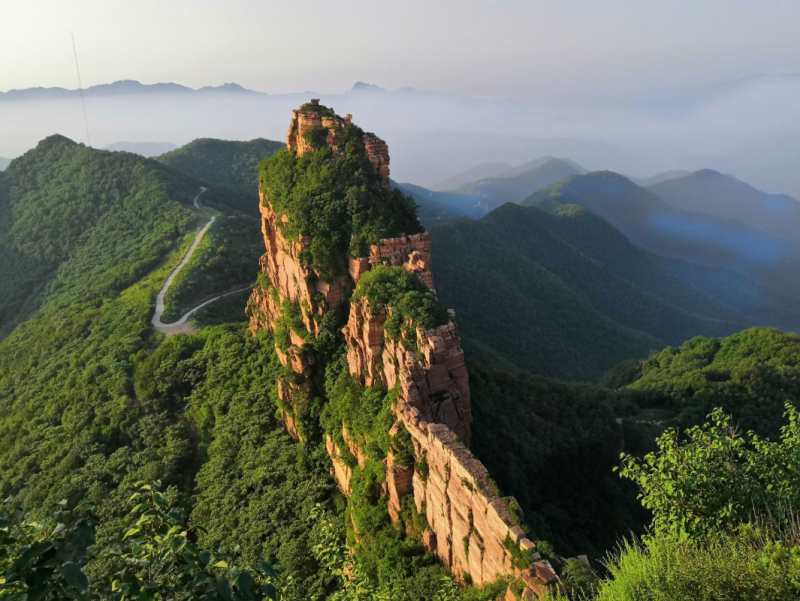
Jiunü Peak is one of the landmark attractions of Zhangshiyan Scenic Area. It is located in the eastern part of the scenic area and is named because nine beautiful peaks are connected together, resembling nine graceful maidens. Jiunü Peak is about 1,450 meters above sea level. The peaks are linked one after another in a well-arranged and picturesque manner. Each peak has its own unique shape; some are like sharp swords piercing the sky, while others resemble fairies dressing up. Standing on the viewing platform of Jiunü Peak, visitors can overlook the magnificent surrounding scenery, with distant mountains and nearby valleys all coming into view. Especially in the early morning or evening, when mist swirls and rosy clouds shine, the scenery is particularly enchanting.
Yixiantian
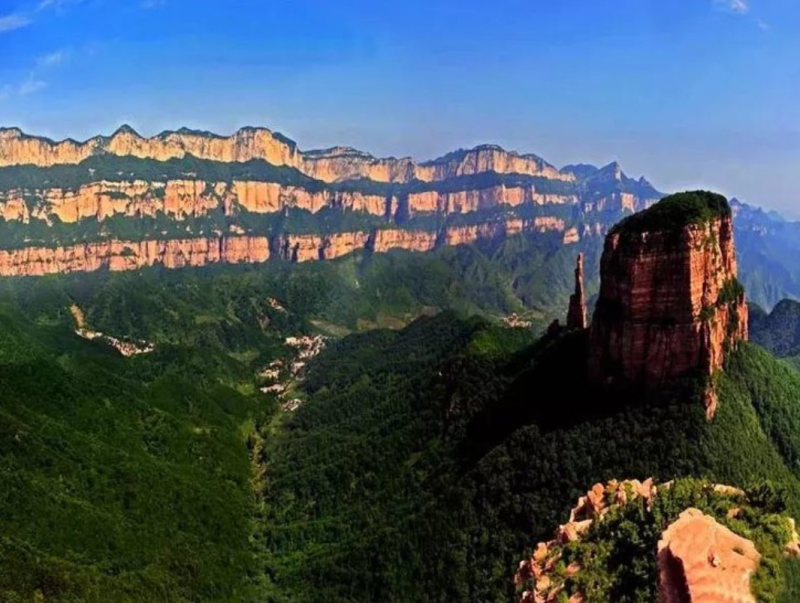
Yixiantian is located in the central part of Zhangshiyan Scenic Area. It is a valley about 1,500 meters long and, at its narrowest point, only wide enough for one person to pass through. The stone walls on both sides rise 100 to 200 meters, as steep as if cut by a knife or axe. Looking up, one can only see a single strip of sky, hence the name "Yixiantian" (One-Line Sky). Inside Yixiantian, there are jagged rocks and murmuring streams. The air is fresh and cool, making it a good place to escape the summer heat. In the middle section of Yixiantian, there is a huge rock stretching across the stone walls on both sides, known as the "Heavenly Bridge." Standing on the Heavenly Bridge, visitors can feel the thrill of the abyss below and the deep seclusion of the surrounding canyon.
Yuantong Temple Scenic Area
Yuantong Temple Scenic Area is one of the core scenic areas of Zhangshiyan Scenic Area. It is named after the Yuantong Temple ruins within the area. This scenic area is known for its unique landscape of "three plank roads linking nine valleys, four screens hiding eight scenes." Among them, the "three plank roads" refer to three parallel cliffside paths, the "nine valleys" refer to nine deep gorges, and the "four screens" refer to four peaks like folding screens. There are many famous attractions in the scenic area, such as Dicui Pavilion, Ruquan Cave, and Yunchao Cave. Dicui Pavilion is a natural stone pavilion surrounded by green trees and with spring water dripping down, offering a serene scene. Inside Ruquan Cave there is a clear spring. The spring water is sweet and tasty and is named because it resembles milk. Yunchao Cave is a huge cave filled with swirling mist, like a place where immortals live.
Huang'an Nao
Huang'an Nao is the highest peak in Zhangshiyan Scenic Area, with an altitude of 1,774 meters. It is located in the southwestern part of the scenic area. Climbing to the top of Huang'an Nao, visitors can gaze far into the scenery of both Shanxi and Hebei. On clear days, it is even possible to see cities more than a hundred li away. At the top there is a huge platform with an area of about 1,000 square meters, making it an excellent place to watch the sunrise and enjoy the sea of clouds. In addition, there are many peculiar rock landscapes around Huang'an Nao, such as "Mother and Child Stones" and "Turtle Stone," which have various shapes and are remarkably lifelike.
Zhihutao
Zhihutao is an important scenic area within Zhangshiyan Scenic Area. It is named "Zhihutao" because of a local folk legend that the peaks here look as if they were pasted together with paper. This scenic area is mainly characterized by water scenery such as canyons, waterfalls, and streams. The most famous is the "Baizhang Waterfall." The waterfall is about 100 meters high, and the water pours down from the cliff like the Milky Way falling from the ninth heaven, magnificent and imposing. In addition, there are also attractions such as "Water Curtain Cave" and "Crocodile Stone" in the scenic area. The scenery is pleasant and has attracted many tourists to come sightseeing.
Food
Zanhuang Golden Silk Jujube
Zanhuang Golden Silk Jujube is a specialty of Zanhuang County, where Zhangshiyan is located, and is also a Chinese national geographical indication product. This kind of jujube is large, thin-skinned, thick-fleshed, and small-cored, with a sweet taste. It is rich in nutrients such as protein, vitamins, and minerals. In Zhangshiyan Scenic Area and surrounding restaurants and markets, fresh Zanhuang Golden Silk Jujubes can be bought, and various foods made with jujubes can also be tasted, such as jujube porridge and jujube cake.
Zhangshiyan Scrambled Eggs
Zhangshiyan scrambled eggs are a local specialty dish. The eggs used are free-range eggs from local farmers, with a tender taste and rich nutrition. When making it, crack the free-range eggs into a bowl and beat them well, add an appropriate amount of chopped scallions, salt, and other seasonings, then stir-fry them in a pan until cooked. This dish is simple to make, but delicious, and is one of the must-try foods for tourists visiting Zhangshiyan.
Big Pot Dish
Big Pot Dish is a traditional dish in rural areas of Hebei and is also very popular around Zhangshiyan. This dish is usually made by stewing pork belly, Chinese cabbage, vermicelli, tofu, and other ingredients together in a large iron pot. It has a rich flavor and a fragrant aroma. The characteristics of Big Pot Dish are abundant ingredients and balanced nutrition. It is suitable for sharing among many people and is a common dish in restaurants around the scenic area.
Braised Free-Range Chicken with Mushrooms
Braised Free-Range Chicken with Mushrooms is a classic Northeastern dish, and there is also a unique way of making it in the Zhangshiyan area. The free-range chicken used is a locally raised native chicken, and the mushrooms are wild mushrooms picked from local mountains, such as shiitake mushrooms and oyster mushrooms. Cut the free-range chicken into pieces, put them into a pot together with the mushrooms, add an appropriate amount of water and seasonings, and simmer slowly over low heat for several hours until the chicken is tender and the broth is rich. This dish has tender meat and fragrant mushrooms, making it a nutritious delicacy.
Tickets:
As of August 10, 2025, the ticket price is 65 yuan per person. You can search for the official WeChat public account "Hebei Zhangshiyan" to get the latest updates or buy tickets online.
Opening Hours:
Opening hours are adjusted according to the seasons. In peak season (April to October), opening hours are 7:00-18:00, and in off-season (November to the following March), opening hours are 8:00-17:00. Tourists are advised to arrange their itineraries in advance and enter the scenic area during opening hours so as not to affect the travel experience.
Tour Route:
Zhangshiyan Scenic Area is large and has many attractions. It is recommended that tourists arrange two days for sightseeing. On the first day, you can enter through the east gate of the scenic area, first visit Jiunü Peak Scenic Area and enjoy the beautiful scenery of Jiunü Peak, then go to Yixiantian to experience the deep and steep canyon, and afterward go to Yuantong Temple Scenic Area to visit the Yuantong Temple ruins and surrounding attractions. At night, you can stay in a farmhouse near Yuantong Temple Scenic Area. On the second day, you can get up early and go to Huang'an Nao to watch the sunrise, then visit Huang'an Nao Scenic Area, and afterward go to Zhihutao Scenic Area to enjoy water scenery such as waterfalls and streams, and finally leave from the west gate of the scenic area. If tourists have limited time, they can also choose a one-day tour route: enter from the east gate, visit major attractions such as Jiunü Peak, Yixiantian, and Yuantong Temple, and leave from the east gate in the afternoon.
Transportation:
Self-driving: Starting from downtown Shijiazhuang, drive south along the Beijing-Hong Kong-Macao Expressway, exit at Yuanshi Exit, then drive along the Yuanshi-Zanhuang Highway toward Zanhuang County. After arriving in Zanhuang County, drive along the Zanhuang-Xiyang Highway toward Zhangshiyan Scenic Area. The total distance is about 100 kilometers, and the drive takes about 2 hours.
Public bus: Take a bus from Nanjiao Passenger Station in downtown Shijiazhuang to Zanhuang County. The journey takes about 1.5 hours, and the fare is about 15 yuan. After arriving at Zanhuang County Passenger Station, transfer to a bus to Zhangshiyan Scenic Area. The journey takes about 1 hour, and the fare is about 10 yuan. There are multiple buses from Zanhuang County to Zhangshiyan Scenic Area every day, and departure times are relatively flexible.
Tourist line: During the peak tourist season, Shijiazhuang city opens tourist lines to Zhangshiyan Scenic Area. Tourists can board at designated locations. For specific departure times and locations, you can consult the local tourism department or travel agency.
Must-Visit Attractions:
Jiunü Peak: A landmark attraction of the scenic area. The nine peaks resemble maidens and have different shapes. It is about 1,450 meters above sea level and is a good place to watch the sunrise and sea of clouds.
Yixiantian: A 1,500-meter-long valley, at its narrowest point only wide enough for one person to pass through. The stone walls on both sides are steep, and the scenery is peculiar. It is a typical representative of Zhangshiyan landform.
Huang'an Nao: The highest peak in the scenic area, 1,774 meters above sea level. From the top, visitors can overlook the scenery of Shanxi and Hebei. The summit platform is an excellent place to watch the sunrise and enjoy the sea of clouds.
Zhihutao: Mainly characterized by water scenery, with famous attractions such as Baizhang Waterfall. The waterfall is about 100 meters high, magnificent and pleasant.
Travel Suggestions:
The terrain in Zhangshiyan Scenic Area is complex and the mountain roads are steep. Tourists are advised to wear comfortable sports shoes and sportswear for a better visiting experience.
The climate in the scenic area is changeable, and the temperature difference between morning and evening is large. Even in summer, it is necessary to bring a jacket to avoid catching a cold.
Dining and accommodation conditions in the scenic area are limited. Tourists are advised to book accommodation in advance and may also bring some dry food and drinking water.
Pay attention to safety when visiting, abide by the regulations of the scenic area, and do not enter undeveloped areas without authorization to avoid danger.
The scenic area is rich in vegetation and is a natural oxygen bar. Tourists are advised to slow down and fully enjoy the beauty of nature. At the same time, please protect the environment and do not litter.
If tourists have enough time, they can stay one night in the scenic area, experience the tranquility of the mountains and the starry night, and feel a lifestyle different from that in the city.
Precautions:
Some sections of the scenic area are relatively steep. Pay attention to safety underfoot when visiting, and do not stay or take photos in dangerous places.
In summer, there may be thunderstorms in the scenic area. Tourists should take precautions. When encountering thunderstorms, they should promptly take shelter in a safe place and should not stay on mountain tops or in open areas.
Smoking and open flames are prohibited in the scenic area to prevent fires and protect the ecological environment of the scenic area.
Respect local customs and religious beliefs. Do not make loud noises or behave inappropriately in temples and other religious places.
When buying local specialties, choose legitimate merchants to avoid purchasing counterfeit or inferior products.
If you encounter difficulties or emergencies during the visit, you can contact the scenic area staff in a timely manner.