The Du Fu Thatched Cottage is located at No. 37 Qinghua Road, Qingyang District, Chengdu, Sichuan Province. It is a national 4A-level tourist attraction and one of the first batch of national first-class museums. Covering an area of nearly 300 mu, it fully preserves the architectural layout from the renovations and expansions in the 13th year of the Hongzhi reign of the Ming Dynasty (1500) and the 16th year of the Jiaqing reign of the Qing Dynasty (1811). The screen wall, main gate, Daxie, Shishitang, Chaimen, and Gongbu Shrine are arranged along a central axis, flanked by symmetrical corridors and other ancillary buildings, forming a unique "hybrid-style" Chinese classical garden.
Historical Culture
The Du Fu Thatched Cottage is the former residence of the great Tang Dynasty poet Du Fu during his stay in Chengdu. In the winter of the 2nd year of the Qianyuan reign of Emperor Suzong of Tang (759), Du Fu, to escape the "An Lushan Rebellion," brought his family from Longyou into Shu and eventually arrived in Chengdu. The following spring, with the help of friends, he built a thatched cottage by the Huanhua Creek in the western suburbs of Chengdu. In the spring of the 2nd year of the Shangyuan reign (761), the thatched cottage was completed and called "Chengdu Thatched Cottage." Du Fu lived here for nearly four years and composed more than 240 poems.
After Du Fu left, the thatched cottage collapsed and no longer existed. It was later repaired and expanded through the Song, Yuan, Ming, and Qing dynasties, gradually evolving into the famous cultural holy site it is today, integrating the layout of a memorial shrine with the style of the poet's former residence. The two large-scale renovations in the 13th year of the Hongzhi reign of the Ming Dynasty (1500) and the 16th year of the Jiaqing reign of the Qing Dynasty (1811) established the basic layout of the existing architectural complex. In 1955, a memorial hall was established at the Du Fu Thatched Cottage, and in 1985 it was renamed the Chengdu Du Fu Thatched Cottage Museum. It is now a nationally key cultural relic protection unit.
Main Attractions
Main Gate
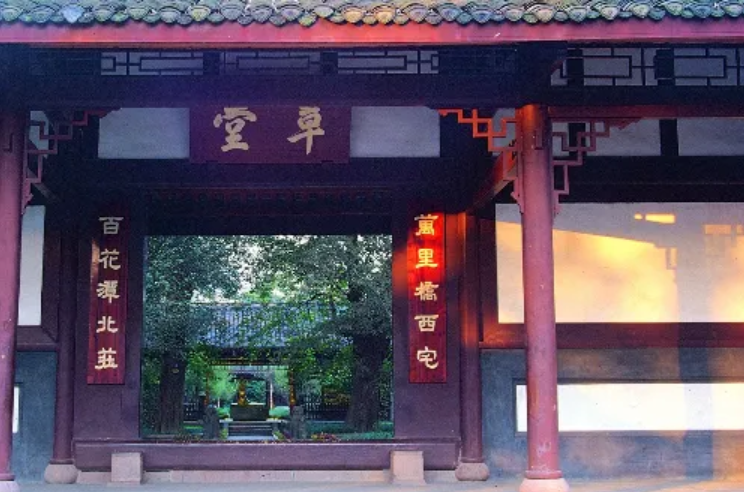
The two characters "Caotang" on the plaque were rubbed and carved from the "Shaoling Caotang" stone tablet in the Stele Pavilion. The couplet on both sides, "Residence west of Wanli Bridge, villa north of Baihua Pool," comes from Du Fu's poem "Recalling My Dwelling by the Jin River, Two Poems." This couplet identifies the geographical location of Du Fu's thatched cottage at that time: west of Wanli Bridge and north of the ancient Baihua Pool. The location of the original thatched cottage matches exactly with the current location of the museum.
Daxie
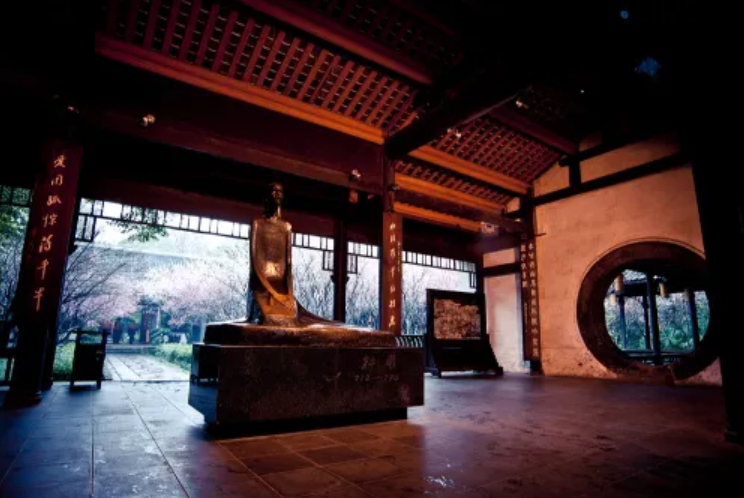
Daxie is an official building constructed by later generations to commemorate the poet, symbolizing reverence for the Poet Sage. A long couplet hangs in the hall, and in the center stands a bronze statue of Du Fu, 2 meters tall, wearing a blue robe, holding a scroll, with profound eyes. On both sides are displayed printed editions and photocopies of Du Fu's poetry collections from successive dynasties, as well as related research literature, demonstrating Du Fu's lofty status in literary history.
Shishitang
Shishitang is the core building of the Thatched Cottage, named because Du Fu's poetry is praised as "poetry history." A portrait of Du Fu hangs on the main wall inside the hall, and on both sides are couplets inscribed by celebrities such as Zhu De and Guo Moruo. The hall displays an exhibition of Du Fu's life and deeds, showing the poet's life trajectory from birth to death and the development of his poetic creation. It is an important window for understanding Du Fu culture.
Chaimen
The two characters "Chaimen" on the plaque were inscribed by the modern Chinese painting master Pan Tianshou. In Du Fu's poem "Old Villager," there is a line: "The old villager by the fence, the riverbank turns; the brushwood gate, not straight, opens along the river," referring to his own courtyard gate as a brushwood gate. When the Thatched Cottage was rebuilt in the 13th year of the Hongzhi reign of the Ming Dynasty, this place was called "Huanhua Deep Place." When rebuilt in the 16th year of the Jiaqing reign of the Qing Dynasty, it was called "Medicine Rail Flower Path." In the 1960s, it was named "Chaimen" after the original line in Du Fu's poem "Old Villager." The seven stone tablets embedded in the walls on both sides are mostly poems inscribed by Qing Dynasty literati and local officials.
Gongbu Shrine
Gongbu Shrine is a commemorative building of the Thatched Cottage, named because Du Fu once served as a vice director of the Ministry of Works. Inside the shrine, a statue of Du Fu is enshrined, flanked by statues of Lu You and Huang Tingjian. The three are known as the "Three Worthies" who were "different in age but not in time." In front of the shrine is the "Shaoling Caotang" Stele Pavilion. The inscription was written by Prince Guo Yunli during the Kangxi reign of the Qing Dynasty and is one of the landmark sights of the Thatched Cottage.
Stele Pavilion
The stone tablet in the pavilion is about 175 centimeters high and about 80 centimeters wide. The top of the tablet is decorated with a double-dragon playing with a pearl pattern, and the upper end and both sides of the tablet body also have dragon patterns. In the 12th year of the Yongzheng reign of the Qing Dynasty, Prince Guo Aisin Gioro Yunli was ordered to go to Taining to escort the Dalai Lama back to Tibet. When passing through Chengdu, he visited the Thatched Cottage and wrote the four large characters "Shaoling Caotang." "Shaoling" was originally Du Fu's alias, so later generations called him Du Shaoling, and the thatched cottage where he lived was also called Shaoling Thatched Cottage. In the 16th year of the Jiaqing reign of the Qing Dynasty, when Sichuan Governor Changming and Provincial Administration Commissioner Fang Ji presided over the reconstruction of the Thatched Cottage, they specially built a tile-roofed house to protect the "Shaoling Caotang" stone tablet. Around the late Qing Dynasty and early Republic of China period, people converted the tile-roofed house into a hexagonal round pavilion covered with thatch to symbolize Du Fu's old thatched cottage.
Thatched Cottage Former Residence
The Thatched Cottage Former Residence is a Tang Dynasty residential architectural complex reconstructed based on Du Fu's poetic description: "The hall is completed facing the city, shaded by white thatch; along the river the road is familiar, overlooking the green suburbs." It covers about 2 mu and consists of a thatched house, living room, study, bedroom, and so on. The interior is furnished with Tang-style furniture, restoring the scene of Du Fu's life at that time. Bamboo, plum, chrysanthemum, and other plants are grown around the thatched cottage, reflecting the poet's joy in life: "Loving bamboo can welcome guests; seeking plum does not yield to spring."
Flower Path
In front of Du Fu's thatched cottage there was a small path planted with flowers and trees on both sides, called the Flower Path. In his poem he wrote: "The flower path has never been swept for guests; the thatched gate now first opens for you." Today's Flower Path is a red-wall-lined passage connecting the memorial shrine of the Thatched Cottage site and the original Caotang Temple architectural complex. Because of its beautiful scenery and rich poetic flavor, it has appeared in many promotional videos or films about Chengdu.
Wanfo Tower
Wanfo Tower was first built in the Tang Dynasty. Historically it was a famous Buddhist temple in Chengdu, later destroyed in war. It was rebuilt in 2005. The tower is 21 meters high, with five stories, upturned eaves, and a magnificent momentum. It enshrines ten thousand Buddha statues, hence the name "Wanfo Tower." Climbing the tower offers a panoramic view of the Thatched Cottage and allows visitors to experience the beauty of the integration of classical garden and Buddhist culture.
Caotang Academy
First built in the Yuan Dynasty, it was once known, together with Yang Xiong's Mochi and Wen Weng's Stone Chamber, as one of the three famous academies in Chengdu. During the Ming and Qing dynasties, Caotang Academy underwent multiple renovations and expansions, gradually increasing in scale. It once had the glory of "collecting three hundred thousand volumes of books," but later declined due to war. Caotang Academy was rebuilt in 2017, and after completion it covers an area of 3,586 square meters.
Recommended Tour Route:
Recommended tour route: Main Gate → Daxie → Shishitang → Chaimen → Gongbu Shrine → Shaoling Caotang Stele Pavilion → Thatched Cottage Former Residence → Tang Dynasty Site Exhibition Hall → Flower Path → Wanfo Tower → Caotang Bookstore → Exit. This route unfolds along the central axis and allows visitors to visit the main buildings and attractions of the Thatched Cottage in sequence. The entire journey takes about 2 hours, allowing visitors both to appreciate the architectural beauty of the classical garden and to gain an in-depth understanding of Du Fu's life and cultural achievements.
Tour Suggestions:
It is recommended to visit in spring (March-May) or autumn (September-November), when Chengdu's climate is mild and the flowers and trees in the Thatched Cottage are flourishing, with pleasant scenery.
Book tickets in advance through the scenic area's official WeChat public account to avoid queuing during holidays.
Hire a scenic area guide (about 100 yuan per time) or rent an audio guide device (20 yuan per unit) to gain an in-depth understanding of Du Fu culture and the history of the Thatched Cottage.
There is a teahouse in the Thatched Cottage where visitors can experience Chengdu's characteristic "gaiwan tea" and feel the leisurely Shu lifestyle surrounded by bamboo groves.
Nearby attractions include the Sichuan Museum and Qingyang Palace, which can be arranged as a one-day tour for an in-depth experience of Chengdu culture.
Notes:
Smoking and littering are prohibited in the Thatched Cottage; please keep the environment clean.
When visiting the Thatched Cottage Former Residence, please do not touch the furnishings inside the house to avoid damaging cultural relics.
There are many visitors during holidays; please take care of personal belongings and look after the elderly and children.
The Thatched Cottage contains many classical buildings, and the ground is relatively slippery. It is recommended to wear non-slip shoes.
Please do not use flash when taking photos to avoid damaging cultural relics.
Transportation:
Bus: Take buses 1024, 165, 170, 35, 58, 82, G74, etc., and get off at "Du Fu Thatched Cottage Station."
Subway: Take Metro Line 4, get off at "Provincial Orthopedic Hospital of Traditional Chinese Medicine Station," then transfer to a bus or walk about 1.5 kilometers to arrive.
Self-driving: The Thatched Cottage has a parking lot located at No. 37 Qinghua Road. The parking fee is about 10 yuan per hour.
Opening Hours:
Open all year round from 09:00 to 18:00 (last entry at 17:00). During statutory holidays and major events, opening hours may be adjusted. Please refer to the scenic area's official announcements for specifics.
Tickets:
The ticket price is 50 yuan per person.