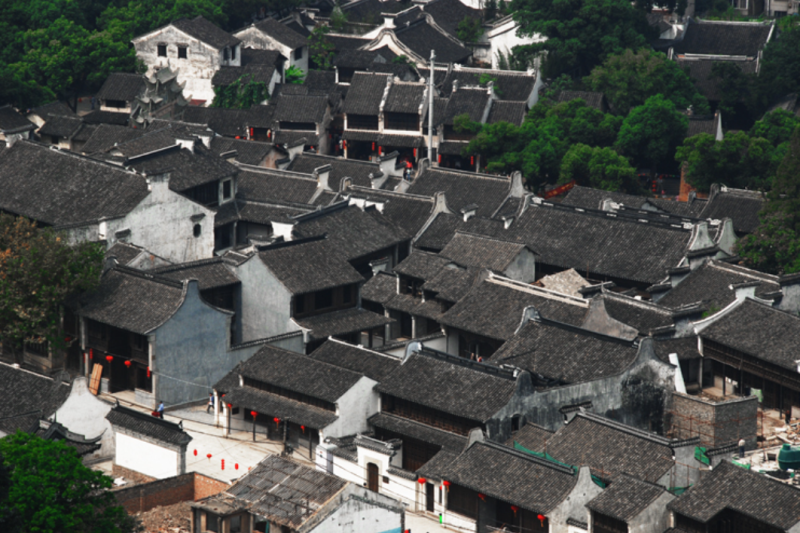
The Huishan Ancient Town Scenic Area is located in Liangxi District, Wuxi City, Jiangsu Province, at the northern foot of Huishan. It is a national 5A-level tourist attraction. The scenic area features an ancient ancestral hall complex as its core characteristic, integrating multiple elements such as Jiangnan water town scenery, tea culture, and traditional handicrafts. It is an important carrier of Wuxi's history and culture. The scenic area covers a total area of about 3.5 square kilometers, of which the core area (including the ancestral hall complex, ancient streets, and gardens) covers about 0.7 square kilometers. It has 118 ancestral halls of various types from the Tang Dynasty to the Republic of China period. The number, variety, and degree of preservation of these halls rank first among similar ancient towns in China, and it is known as the "Museum of Chinese Ancestral Hall Culture." In addition, the scenic area also contains more than 20 ancient bridges, more than 300 ancient and famous trees, and many dwellings and shops from the Ming and Qing dynasties, forming a unique landscape in which "mountains, water, forests, springs, ancestral halls, and streets" are intertwined.
Historical Culture
The history of Huishan Ancient Town can be traced back to the Shang and Zhou dynasties, more than 3,000 years ago. As early as the Tang Dynasty, the Huishan area became a gathering place for literati and scholars because of its production of the tribute tea "Yangxian tea," and tea houses and temples gradually emerged. During the Song Dynasty, with the development of the imperial examination system, ancestral halls commemorating former sages began to appear in Huishan. By the Ming and Qing dynasties, it reached its peak, forming a massive ancestral hall complex involving officials, clans, trades, and other categories, recording the family changes and social and cultural development of Wuxi and even the Jiangnan region.
The Huishan spring water in the scenic area is praised as the "Second Spring Under Heaven." It has been famous since the Tang Dynasty. Lu Yu made special records of it in The Classic of Tea, and writers such as Su Shi and Bai Juyi also left poems praising it. In modern times, traditional handicrafts such as Huishan clay figurines and bamboo carving have been inherited and developed here. Among them, Huishan clay figurines are known as one of the "Three Treasures of Wuxi" and were included in the first batch of national intangible cultural heritage lists in 2006. In 2019, Huishan Ancient Town was rated a national AAAAA-level tourist attraction, becoming an important window for displaying traditional Jiangnan culture.
Main Attractions
Huishan Ancient Ancestral Hall Complex
The Huishan Ancient Ancestral Hall Complex is the core landscape of the scenic area, distributed along both sides of Huishan Bang and Zhijie Street, stretching about 1.5 kilometers. Among them, the Tang Dynasty Huishan Temple Ancestral Hall, the Song Dynasty Fan Zhongyan Ancestral Hall, the Ming Dynasty Gu Xiancheng Ancestral Hall (a memorial site for Donglin Party members), and the Qing Dynasty Zhang Zhongcheng Ancestral Hall are the most famous. These ancestral halls have different architectural styles. They combine the exquisite elegance of Jiangnan gardens with the solemn dignity of official architecture, and their brick carving, wood carving, and stone carving techniques are superb. For example, the "Hundred Longevity Chart" brick-carved screen wall of Zhang Zhongcheng Ancestral Hall is carved with 100 "shou" characters in different fonts, making it a masterpiece of brick carving art.
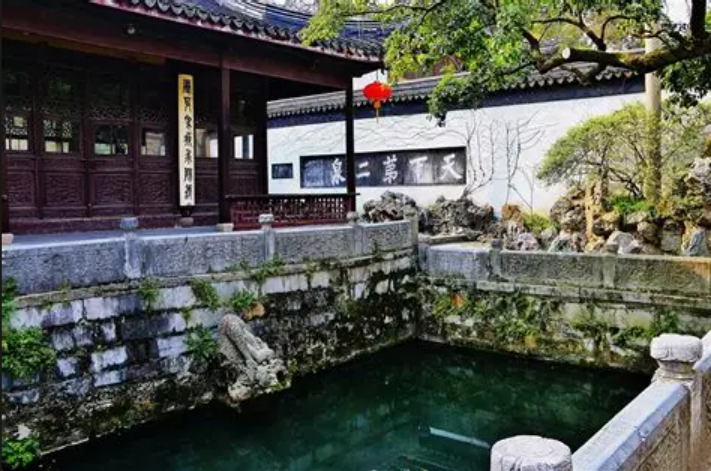
Second Spring Under Heaven
The Second Spring Under Heaven is located near Huishan Temple. It was originally excavated by the Tang Dynasty monk Ruobing and was originally named "Huishan Spring." The spring is divided into three pools: upper, middle, and lower. The upper pool is octagonal and has the best water quality; it was once a tribute to the imperial family. The middle pool is square, and the lower pool is the largest and rectangular. Beside the pool is a stone inscription reading "Second Spring Under Heaven," written by the Yuan Dynasty calligrapher Zhao Mengfu. The modern musician Hua Yanjun (Blind Abing) once created Moon Reflected on Second Spring here, making the spring widely known. Today, visitors can drink tea by the spring and experience the sweetness described by Lu Yu, the "Sage of Tea."
Jichang Garden
Jichang Garden is a classical garden within Huishan Ancient Town. It was first built in the Ming Dynasty and was originally the private garden of the Qin family. It is one of the representative works of Jiangnan gardens and is listed as a Major Historical and Cultural Site Protected at the National Level. The garden covers about 10,800 square meters and is famous for its "borrowed scenery" technique, integrating the scenery of Huishan and Xishan into the garden and creating an artistic conception of "mountains beyond mountains." In the garden are landscapes such as the "Jinhui Yi" pond, the "Zhiyu Jian" pavilion, and the "Bayin Jian" rockery. Among them, Bayin Jian uses the height difference of the terrain to create the sound effect of "high mountains and flowing water," making it a masterpiece of garden design.
Huishan Clay Figurine Museum
The Huishan Clay Figurine Museum is located on Zhijie Street in the ancient town, with a building area of about 3,000 square meters. It systematically displays the history and craftsmanship of Huishan clay figurines. The museum houses more than 5,000 clay figurine works dating from the Qing Dynasty onward, including classic categories such as "Da Afu" and "hand-pinched opera figures." Visitors can watch artists make clay figurines on site, learn about processes such as "kneading clay, shaping, and painting," and also personally experience making simple clay figurines, experiencing the charm of intangible cultural heritage.
Food
Wuxi Braised Spare Ribs
Wuxi braised spare ribs are a traditional famous dish of Jiangsu. Authentic flavors can be tasted at the "Sanfengqiao Meat Shop" branch in Huishan Ancient Town. This dish uses pork ribs and stews them for several hours with seasonings such as soy sauce, rock sugar, and cooking wine. The meat is tender and soft, the sauce is rich, and the flavor is moderately sweet and salty. The braised spare ribs in the scenic area are sold by portion, about 500 grams per portion, priced at 68 yuan. They are a must-try Wuxi flavor for tourists.
Huishan Flaky Pastry
Huishan flaky pastry is a traditional Wuxi pastry named after its production in Huishan. It is sold at the "Zhu Shunxing Flaky Pastry Shop" in the ancient town. The pastry uses flour, sesame, and white sugar as ingredients and is made by frying. It is spiral-shaped, with a crisp outer layer and a sweet filling. The shop was founded in the Qing Dynasty and insists on traditional craftsmanship, making and selling fresh pastries on site. The unit price is 3 yuan each, suitable as a tea snack or souvenir.
Clear Water Fried Gluten
Clear water fried gluten is a distinctive Wuxi vegetarian food that can be tasted at the "Old Wuxi Restaurant" in the ancient town. It uses Wuxi's specialty wheat starch as a raw material to make spherical gluten. After frying, it turns golden yellow and has a soft, elastic texture. It can be paired with mushrooms and green vegetables in soup or stir-fried with minced meat. In the scenic area, each portion of fried gluten (about 6 pieces) is priced at 20 yuan. It is light and refreshing, reflecting the characteristics of Jiangnan cuisine.
Surrounding Food
Nanchang Street, 1 kilometer from Huishan Ancient Town, has more Wuxi foods, such as "Mu Guiying Food's" magnolia cake (glutinous rice outer skin wrapped with meat filling, made by frying, 3 yuan each) and "Xishengyuan's" xiaolongbao (thin skin, full filling, delicious soup, 15 yuan per steamer). In addition, the "Three Whites Wontons" on Nanchang Street (with whitefish, white shrimp, and silver fish as filling) are also worth trying, with an average consumption of about 40 yuan per person.
Tickets:
Admission is free, but some attractions require separate charges. For example: combined ticket (Cultural Relics and Historic Sites Area Xihui Scenic Area) 70 yuan per person, single ticket (Xihui Scenic Area) 10 yuan per person.
You can search for the official public account "Huishan Ancient Town Scenic Area" on WeChat to get the latest updates or buy tickets online.
Opening Hours:
Opening hours are 08:00 - 17:00.
Tour Route:
Recommended one-day in-depth route: Enter Huishan Ancient Town at 8:30 in the morning and first visit the freely open ancient ancestral hall complex. Focus on visiting Fan Zhongyan Ancestral Hall and Gu Xiancheng Ancestral Hall, and appreciate the ancestral hall architecture and carving art. At about 10:00, go to the Second Spring Under Heaven to drink tea and rest; at 11:00, enter Jichang Garden, stroll through the garden, and experience Jiangnan garden design art. At 12:30, dine at the "Old Wuxi Restaurant" in the ancient town.
In the afternoon, at 14:00, visit the Huishan Clay Figurine Museum and experience clay figurine making; at 15:30, stroll along the ancient town's Zhijie Street and buy souvenirs such as Huishan flaky pastries and clay figurines; at 16:30, go to Huishan Temple (open for free) and feel the tranquility of the ancient temple; at 17:30, end the itinerary, or go to nearby Nanchang Street for dinner.
This route involves about 5 kilometers of walking in total, balancing cultural experience and leisure, and is suitable for tourists of all ages.
Transportation:
Bus: Within Wuxi city, you can take buses 15, 39, 43, 611, and 635 to the "Huishan Ancient Town Station" and walk about 5 minutes to the main entrance of the scenic area; take Metro Line 4 to "Huishan Ancient Town Station" (Exit 2) and walk about 8 minutes to arrive.
Self-driving: Starting from Wuxi Railway Station, go south along Tongjiang Avenue and turn onto the express inner ring, exit at Fengxiang South Road, drive east along Sheng'an West Road for about 3 kilometers to arrive. The drive takes about 20 minutes; the scenic area parking lot charges 5 yuan per hour, with a daily cap of 20 yuan.
Taxi: Taking a taxi from downtown Wuxi (such as Chong'an Temple) to Huishan Ancient Town takes about 15 minutes and costs about 25 yuan.
Must-Visit Attractions:
Huishan Ancient Ancestral Hall Complex: 118 ancestral halls from successive dynasties, with exquisite brick and wood carvings, displaying the essence of Chinese ancestral hall culture. Open for free.
Jichang Garden: A 10,800-square-meter Jiangnan classical garden, famous for borrowed scenery and Bayin Jian. Tickets are 45 yuan. A must-visit for garden art enthusiasts.
Second Spring Under Heaven: A famous Tang Dynasty spring, deeply connected with Moon Reflected on Second Spring. You can enjoy tea and the spring. Open for free.
Huishan Clay Figurine Museum: A 3,000-square-meter exhibition hall with more than 5,000 clay figurine collections. Visitors can experience making them. Tickets are 30 yuan. Suitable for family trips.
Travel Suggestions:
Suggested visit time is 1 day. If you are particularly interested in gardens and ancestral hall culture, you can arrange most of a day for an in-depth tour.
Spring and autumn (March-May, September-November) have suitable climates and the best scenery. Avoid high summer temperatures and severe winter cold.
There are many steps and stone-paved roads in the scenic area. It is recommended to wear comfortable flat shoes. Elderly people can bring a lightweight folding stool.
For Jichang Garden and the Clay Figurine Museum, it is recommended to visit during off-peak times (before 9:00 a.m. or after 15:00 p.m.) to avoid tour group peaks.
When tasting Wuxi food, note that local flavors tend to be sweet. If you do not like sweetness, you can tell the restaurant in advance to use less sugar.
Notes:
Smoking and carving are prohibited in the ancient ancestral hall complex. Some ancestral halls are privately owned, and "No Entry" signs must be observed.
Climbing rockeries and picking flowers and trees are prohibited in Jichang Garden. Please protect cultural relics and natural landscapes.
Touching exhibits is prohibited in the Huishan Clay Figurine Museum. When experiencing production, please follow the guidance of the artists.
There are many shops in the scenic area. When buying specialties, it is recommended to compare prices at several shops and check production dates and price tags.
Tourists are dense on holidays. It is recommended to travel during off-peak times.