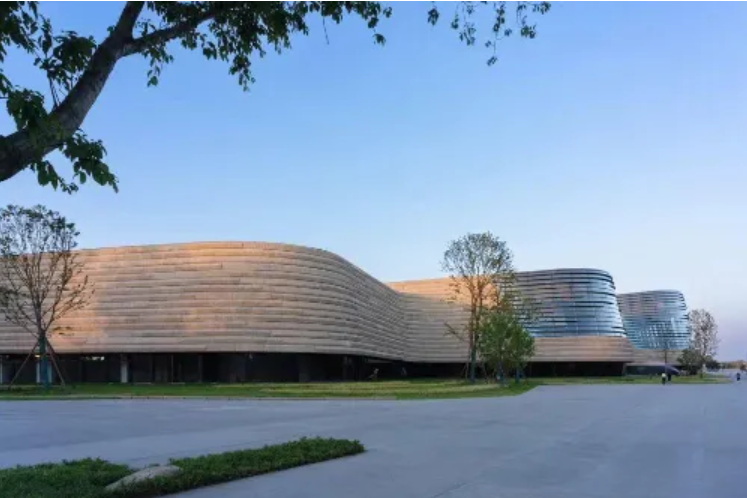
The Sanxingdui Museum is located on the banks of the Yazi River in the west of Guanghan City, Sichuan Province, at the northeast corner of the Sanxingdui Site, a Major Historical and Cultural Site Protected at the National Level. It is 38 kilometers south of Chengdu and 26 kilometers north of Deyang. The museum is a National First-Class Museum and one of the first batch of National 4A-Level Scenic Areas. It is a large modern thematic site museum in China, featuring four major characteristics: cultural relics, architecture, exhibitions, and gardens. The museum covers an area of about 1,000 mu, with a building area of about 16,767.28 square meters. Its new building officially opened on July 27, 2023. The new building covers an area of 66 mu, with a building area of 55,000 square meters, making it the largest single museum building in Southwest China.
History and Culture
In 1929, a pit of jade and stone artifacts was discovered in the Yan family courtyard of Zhenwu Village at the Sanxingdui Site, and three to four hundred jade and stone artifacts were unearthed. After that, related excavations were carried out successively. After the founding of New China, excavations at the Sanxingdui Site continued to deepen. In the 1980s and 1990s, in order to protect and develop the Sanxingdui Site, the Sanxingdui Museum borrowed 20 million yuan to build a museum, setting a precedent for building museums with loans nationwide. The foundation stone was laid in August 1992, and it officially opened in October 1997.
The Sanxingdui Site covers an area of about 12 square kilometers and dates back 4,500 to 2,900 years. In 1986, Sacrificial Pits No. 1 and No. 2 were discovered, yielding more than 4,000 cultural relics, including the bronze sacred tree and the bronze standing figure, "astonishing the world at once." Since 2019, Sacrificial Pits No. 3 to No. 8 have been newly discovered, yielding more than 17,000 cultural relics of various types, "astonishing the world again." Archaeology shows that the Sanxingdui Site is the largest known capital site of the ancient Shu state from the Shang period in the Yangtze River basin. It is an important witness to the origin and development pattern of the pluralistic unity of Chinese civilization and an important part of Chinese civilization.
Main Attractions
New Building (the old building has been closed)
The exhibition in the new building closely follows the theme of "ancient city, ancient state, and ancient Shu culture," and is divided into three major exhibition areas: "Century-Long Pursuit of Dreams," "Majestic Royal Capital," and "Heaven, Earth, and Gods." Newly displayed artifacts are a highlight. In addition to some artifacts unearthed in 1986 being moved to the new building, nearly 600 artifacts are unveiled for the first time, with a total of more than 1,500 artifacts (sets) of various types on display, three times the number of the original exhibition. Some artifacts achieve a "reunion across pits after three thousand years," and a "digital restoration demonstration" exhibition method is used to reproduce the appearance of the artifacts. It also incorporates an immersive archaeological excavation cabin scene, multimedia sand-table folded screens, and an immersive special hall called "Duguang Zhiye," showcasing the ancient Shu style.
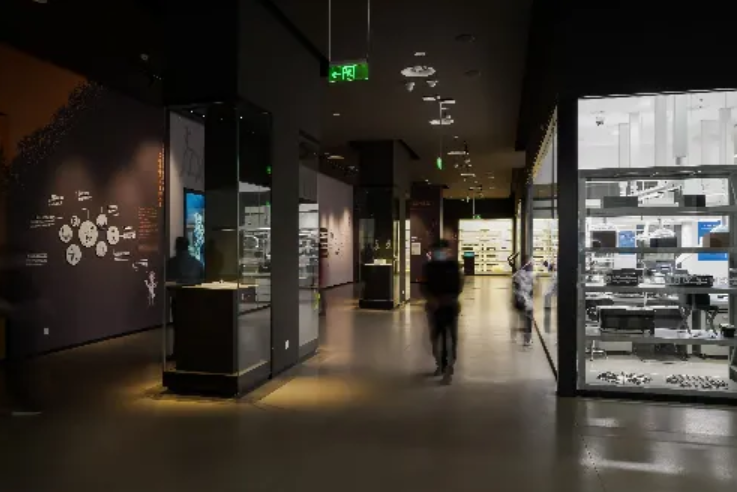
Restoration Hall
A cultural relic storage area and restoration rooms for pottery, jade, metal, ivory, and other materials have been established, allowing protection and restoration work to be carried out for different types of cultural relics. The hall has a dedicated analytical instrument room equipped with advanced instruments such as scanning electron microscopes, laser Raman spectrometers, and X-ray color analyzers to detect the composition of cultural relics. Glass partitions are used, allowing visitors to observe conservators restoring cultural relics on site in an immersive way.
Interactive Experience Exhibition Hall
The exhibition hall has an area of 1,300 square meters. It is an immersive interactive exhibition hall integrating visiting, interactive experience, and science education. It is an expansion and extension of the new building's exhibition and also a balance between the academic and popular science aspects of the new building's basic exhibition.
Suggested Visiting Route:
After the new building opened, you can first visit the new building and tour the three major exhibition areas in order: "Century-Long Pursuit of Dreams," "Majestic Royal Capital," and "Heaven, Earth, and Gods," to appreciate more than 1,500 artifacts (sets), with particular attention to the artifact combinations reunited across pits and the digital restoration demonstration. After that, go to the Comprehensive Hall and follow the order of six exhibition areas, including "Dominating the Southwest" and "Communicating with Gods Through Jade," to experience the material civilization of ancient Shu culture. Finally, you can go to the Restoration Hall to watch the process of cultural relic restoration and see the advanced instruments and equipment.
Visiting Suggestions:
Learn about Sanxingdui culture in advance, such as by reading books and watching documentaries, so that you can better understand the cultural connotations behind the exhibits.
Hire a human guide or rent an audio guide. Human guides can provide professional and rich explanations, while audio guides allow you to explore according to your personal interests, helping you gain a deeper understanding of artifact information.
Arrange at least half a day for the visit. If you want to visit in detail, it is recommended to arrange a full day so that you can fully appreciate the artifacts in each hall and experience projects such as the digital displays in the new building.
You may bring a notebook to record information about artifacts that interest you and your personal reflections for later review.
Notes:
Do not touch cultural relics in the museum. Follow the museum's "Please Do Not Touch" instructions to avoid damaging precious cultural relics.
Do not use flash photography. Some cultural relics are sensitive to light, and flash may accelerate aging and fading.
Keep quiet in the museum and avoid loud noise, so as to create a good visiting environment for other visitors.
Follow the scenic area's visiting route instructions and do not leave the group arbitrarily or enter unopened areas.
Pay attention to the safety of personal belongings, especially in crowded areas.
Transportation:
Self-driving: Departing from Chengdu, take National Highway 108 and the Chengdu-Mianyang National Highway, and you can arrive in about half an hour; departing from Deyang, it is also relatively convenient to go along the corresponding roads.
High-speed rail: You can take an intercity train to Guanghan, then transfer to a bus to the museum.
Long-distance bus: At bus stations in surrounding cities such as Chengdu and Deyang, there are long-distance buses to Guanghan. After arriving in Guanghan, transfer to a local bus or take a taxi to the museum.
Opening Hours:
The Sanxingdui Museum is closed one day each year on New Year's Eve. At other times, in principle, it does not close (except for temporary announcements of closure). Daily opening hours are: Exhibition Hall 08:30-18:00, last entry at 17:00; Restoration Hall 09:00-18:00. During Golden Weeks, short holidays, and winter and summer vacations (January, February, July, and August), extended service hours are implemented, with opening hours from 08:30 to 20:00 and last entry at 18:00.
Tickets:
Tickets are 72 yuan per person.