The Eastern Buddha Capital is located at No. 362 Lingyun Road, Shizhong District, Leshan City, Sichuan Province. It shares the Lingyun Nine Peaks with the Leshan Giant Buddha and lies within the protection area of the world "Double Heritage." The scenic area is a national 4A-level tourist attraction, covering more than a thousand mu of forest land. It is a cultural tourism destination integrating Buddhist culture, sculpture art, and natural scenery.
The scenic area centers on a large-scale Buddha statue group, with thousands of Buddhas hidden in the forest and hundreds of caves in the mountains. It gathers more than ten thousand exquisite Buddha statues, all sculpted by old professors from the Sichuan Fine Arts Institute, with Chinese sculpture master Liu Kaiqu serving as the founding consultant. Among them, a 173-meter open-air reclining Buddha lies across the mountain forest, and the grand underground palace is nearly one kilometer long, making it worthy of the title "China's Fifth Largest Grotto Cluster."
Historical Culture
The Lingyun Nine Peaks, where the Leshan Giant Buddha is located, once had "a temple on each peak" during the Tang Dynasty. They were later destroyed by the fires of war during resistance against the Yuan Dynasty, leaving only the Leshan Giant Buddha. The Eastern Buddha Capital follows the traces of the ancients, taking the restoration of Tang Dynasty style as its purpose, recreating the Tang Dynasty mountain forest Buddhist cultural landscape and continuing a thousand years of Buddhist affinity.
In terms of artistic inheritance, the scenic area integrates Eastern statue-making principles with Western modeling experience, blending traditional and modern elements. It not only inherits the essence of ancient Buddhist statue art but also endows the culture with new vitality through innovative methods, becoming an art corridor that crystallizes historical and spiritual wealth.
Main Attractions
Ten Thousand Buddha Cave
The Ten Thousand Buddha Cave is the core attraction of the scenic area. Carved into the mountain, it has a total length of more than 700 meters. The caves are divided from south to north into six parts: the South Cave, South Corridor, Central Cave, North Corridor, North Cave, and Underground Palace. The Buddha statues inside are carved from the original stone of the entire mountain according to traditional techniques, with both spirit and form fully expressed. They include Bodhisattvas, Arhats, and Buddha statues from around the world, making it worthy of the title "China's Fifth Largest Grotto Cluster."
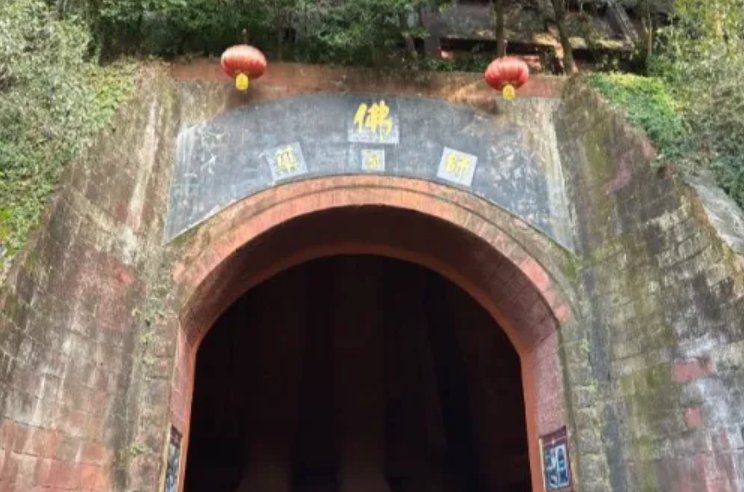
Great Buddha Bay
Great Buddha Bay is surrounded by peaks on three sides, with three vertically arranged halls descending like a dragon throne. In the center of the grotto hall stands China's only double-pillared Xin Shen Che Grotto. The door opening follows the meaning of Buddhism's "Three Gates of Liberation" (the Gate of Emptiness, the Gate of Form, and the Gate of Action), with Bodhisattva reliefs decorating the intervals. Around the door corridor are shallow relief statues of Dunhuang flying apsaras, creating a unique artistic style.
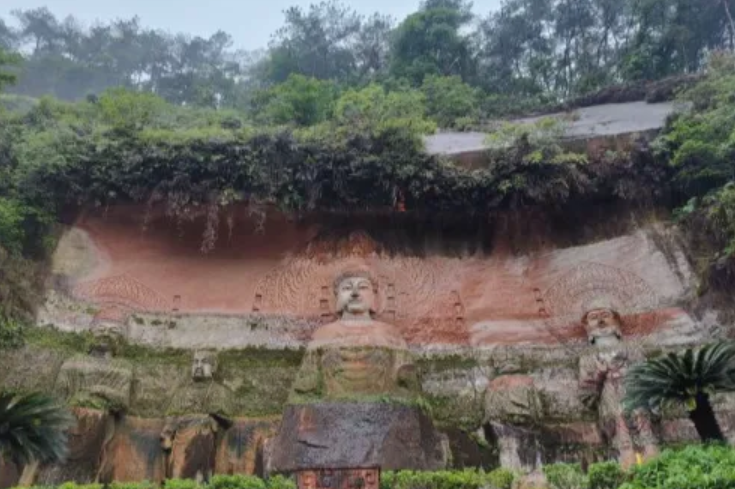
Giant Reclining Buddha
The Giant Reclining Buddha is 170 meters long in total. Using the Dazu Rock Carvings as a prototype and following the mountain's natural contours, the head is carved at the southern end and the feet at the northern end, while the middle retains natural vegetation, resembling a Nirvana Shakyamuni Buddha covered by a green blanket. The Buddha's head is 24 meters long and 32.7 meters wide, the mouth is 4.5 meters wide, the hair bun consists of 115 coils (each 1 meter in diameter), and the instep is 10.2 meters wide. Above the head is carved a scene of two dragons playing with a pearl, creating a magnificent sight.
Demon-Subduing Pool
The Demon-Subduing Pool, also known as "The Buddha Subdues the Demoness," recreates the scene in which Mara sent three jade maidens to tempt Shakyamuni as he attained Buddhahood. The main Buddha statue is the only work completed by Liu Kaiqu, the founder of Chinese sculpture, before his death, and was praised by Zhao Puchu as "the final solemnity of life." The statues on both sides range from the Northern Wei to the Song Dynasty and are a miniature reflection of the history of Chinese Buddhist culture.
Lianxin Mountain
Lianxin Mountain is a popular attraction in Great Buddha Bay, with a total of 173 stone steps and a Dipankara Buddha at the summit. Steel posts and iron chains are densely hung with heart-linking locks, longevity locks, and wealth locks, carrying visitors' prayers and wishes. It is an important node for cultural experience in the scenic area.
Suggested Tour Route:
Recommended route: At the entrance, view the panorama of the 173-meter open-air reclining Buddha → cross the bridge into the Ten Thousand Buddha Cave (visit the six cave sections in order) → view the double-pillar grotto and flying apsara reliefs at Great Buddha Bay → learn about the history of Liu Kaiqu's sculptures at the Demon-Subduing Pool → hang a lock and pray at Lianxin Mountain → taste Leshan snacks at the exit. The entire walk takes about 2.5 hours. It is recommended to combine this visit with the Leshan Giant Buddha.
Travel Tips:
Wear non-slip shoes, as there are many stone steps in the scenic area; in summer, pay attention to sun protection, and since the caves are cooler, bring a light jacket.
It is recommended to rent an audio guide (20 yuan per device), or follow the scenic area's official account for free commentary to learn about the historical stories behind the Buddha statues.
Morning light is best for photographing the open-air Buddha statues; in the afternoon, visit the underground palace during off-peak hours to avoid tour group crowds.
Combine your visit with the Leshan Giant Buddha and Wuyou Temple, and allow about half a day. At the scenic area exit, there is a shuttle bus directly to the Leshan Giant Buddha (10 yuan per person).
Precautions:
Flash photography is prohibited inside the caves to avoid damaging the Buddha statues' painted colors; some areas are slippery, so watch your step.
Respect religious culture, do not climb on Buddha statues or make loud noises, and smoking is prohibited in enclosed areas such as the underground palace.
There are many vendors around the scenic area. When buying local specialties, it is recommended to choose shops with clearly marked prices. For snacks such as Bobo Chicken, the time-honored brands "Ye Popo" and "Gu Zhen Ji" are recommended.
During the rainy season (June-September), some mountain roads may be closed, so check the weather forecast before traveling; in winter, the underground palace is rather cold, so it is recommended to bring a scarf and gloves.
Transportation:
Bus: Within Leshan City, take Bus No. 3 or No. 13 to the "Eastern Buddha Capital" stop and walk 50 meters to the scenic area entrance.
Self-driving: Navigate to "Eastern Buddha Capital." The scenic area parking lot can accommodate more than 200 vehicles, with a fee of 10 yuan per hour.
High-speed rail: After getting off at Leshan Station, it takes about 20 minutes by taxi; from Emeishan Station, it takes about 35 minutes by taxi.
Long-distance bus: Take a direct bus from Chengdu Xinnanmen Station to Leshan (about 1.5 hours), then transfer to Bus No. 3 to the scenic area.
Opening Hours:
Opening hours are 07:30-18:00 (last entry at 17:30). In summer (June-August), closing time is extended to 18:30; in winter (December-February), opening time is adjusted to 08:00. During special events, hours may change, so it is recommended to call ahead to confirm before traveling.
Tickets:
The ticket price is 80 yuan per person. The actual price at the scenic area shall prevail.