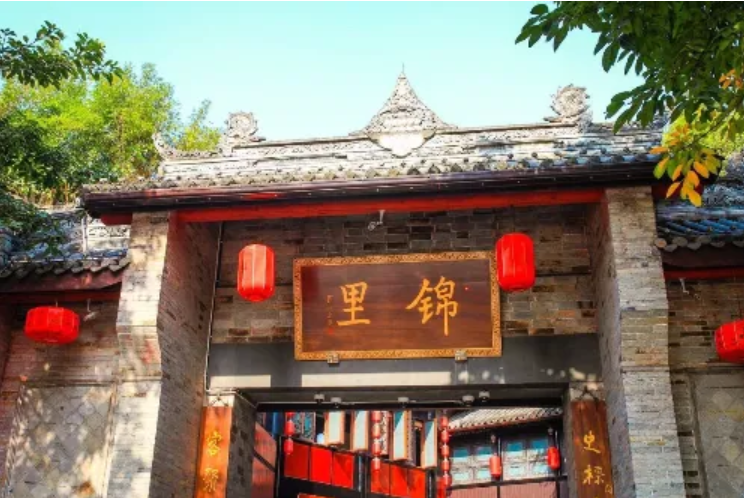
Jinli Ancient Street is located at No. 231 Wuhouci Street, Wuhou District, Chengdu, Sichuan Province, and is an important component of the Chengdu Wuhou Shrine Museum. It covers an area of more than 30,000 square meters, with a building area of more than 14,000 square meters and a total street length of 550 meters. The architecture is modeled on the style of Sichuan folk houses in the late Qing Dynasty and early Republic of China, with Three Kingdoms culture and traditional Sichuan folk culture as its connotations. It is a venue integrating tourism, shopping, leisure, and entertainment. It not only showcases the essence of Sichuan folk culture but also expands the scope of Three Kingdoms culture. It is one of Chengdu's most representative city cards and enjoys the reputation of "the First Street of Western Shu."
Historical Culture
The name "Jinli" can be traced back as early as the Qin and Han dynasties. At that time, Shu brocade occupied an important position in the economy, and Chengdu became famous because of Shu brocade. Zhuge Liang once said, "The resources for defeating the enemy depend only on brocade." To manage Shu brocade production, the government specially established the "Brocade Officer," and Chengdu was therefore called "Jinguan City," or "Jincheng" for short. The state factories producing Shu brocade were mostly concentrated on the south bank of the Jin River in Chengdu, and this area was called "Jinli" ("li" refers to a neighborhood). After rising in the Qin and Han dynasties, by the Tang and Song dynasties, "Jinli" had become synonymous with Chengdu and was one of the oldest and most commercially vibrant ancient streets and neighborhoods in the Western Shu region.
In 2001, the government carried out renovation and development of Jinli under the theme of historical culture. Jinli Ancient Street was rebuilt on the basis of an original alley called "Caoyingba." It is said that this was once a place where Shu Han troops stationed and raised horses during the Three Kingdoms period. In the 1930s, adobe houses built by local farmers and residents gradually formed this alley. Because it was close to the Southern Suburb Park and Chengdu Wuhou Shrine, in 1972 the Southern Suburb Park built a three-story staff residence here with two upper floors and one ground floor, and later additional residential buildings were added. However, this alley had no special historical or cultural background or traditional distinctive architecture, nor did it have old shops. It was about 100 meters long and about 6 meters wide, with a relatively small street scale.
On October 31, 2004, Phase I of Jinli was completed and opened. The completed section was 350 meters long, about 2–4 meters wide, covered an area of about 9,235 square meters, and had a total building area of about 6,520 square meters. With Three Kingdoms Shu Han culture and traditional Sichuan folk culture as its background, and relying on buildings in the architectural style of the late Qing Dynasty and early Republic of China, it was divided into multiple areas such as a bar and entertainment area, a Sichuan specialty dining area, a Shu brocade culture area, an inn area, and a specialty tourist handicraft area. It became Chengdu's first newly built traditional cultural tourism commercial street and was praised as Chengdu's version of "Along the River During the Qingming Festival." Before the Spring Festival in 2009, Phase II of Jinli opened to visitors. This phase introduced water features and created the new landscape of "Waterfront Jinli." After reconstruction, Jinli Ancient Street reached a total length of about 550 meters, further expanding its scale. In December 2019, Jinli was selected by the CNN Travel channel as one of the 21 most beautiful streets in the world and ranked first among the recommendations.
Main Attractions
Jinli Ancient Street
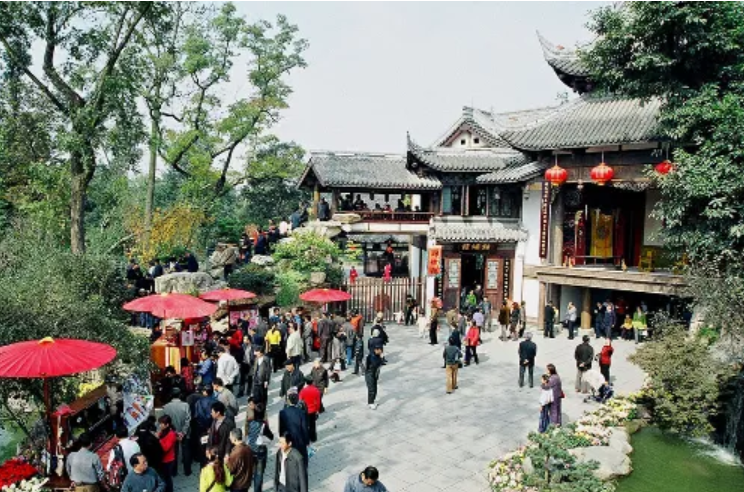
It covers an area of more than 30,000 square meters, with a building area of more than 14,000 square meters and a total street length of 550 meters. It was reconstructed and opened in 2004. It vividly presents Chengdu's leisurely lifestyle and is a leisure district for experiencing traditional western Sichuan folk culture and Three Kingdoms culture. In the ancient street, teahouses, bars, stages, specialty snack shops, handicraft shops, and various other stores are all available. The bluestone paths wind along, and antique-style buildings are arranged in picturesque disorder, making people feel as if they have traveled back in time.
Ancient Stage
As a key venue for performances by the Jinli Folk Performance Troupe and other activities, it not only preserves the basic structure of a traditional Chinese stage with "Chujiang" and "Ruxiang." In terms of building materials, it also uses ancient wood carved with Three Kingdoms stories. Here, visitors can enjoy wonderful performances such as Sichuan opera and folk music and feel the unique charm of traditional culture.
Jiupin Snack Street
The name "Jiupin" both represents the official selection system of the Three Kingdoms and Wei-Jin periods—the Nine-Rank System—and implies the rich and diverse varieties of snacks on the snack street. Here, many delicacies such as Zhangfei beef, fatty intestine rice noodles, leaf-wrapped glutinous rice cakes, Sandapao, Bobo chicken, and sugar-oil fruit are gathered together, greatly satisfying visitors' taste buds.
Zhuge Well
It is surrounded by stone railings on the south, west, and north sides. The well cover is made of stone and is hollowed out in the shape of a copper coin, appearing simple and dignified. It is said that this was a well dug by Zhuge Liang to benefit the people. Although the original well was not located here, the people of Chengdu have deep feelings for Zhuge Liang, so the Zhuge Well was established beside Jinli to express their remembrance and respect for Zhuge Liang.
Adou Well
It is said that after Liu Bei passed away, his son Liu Shan went to Hui Ling every year to pay respects to his late father and would stop by a well to rest each time. Later generations therefore called it Adou Well.
The First Archway of Western Shu
It is located in the busiest section of the ancient street block, surrounded by teahouses, inns, stages, flavor snack shops, folk handicraft shops, and more. It is the landmark archway of Jinli and also the dividing line between Phase I of Jinli and Phase II of Jinli (Waterfront Jinli).
Fushou Lane
It implies "fu" at the head of the lane and "shou" at the end of the lane. The architectural colors mainly combine dignified gray tones with modern white tones, highlighting the delicacy and elegance of Fushou Lane's overall architectural style.
Huanglong Pool
Located deep within Jinli Ancient Street, it is one of the core popular areas. The water landscape here is highly attractive and often draws visitors and residents to drink tea and rest nearby. Its name originates from the reign title used by Sun Quan of Eastern Wu. A small bridge and Fengyi Pavilion were built over Huanglong Pool. Fengyi Pavilion comes from Romance of the Three Kingdoms and tells the story of Diaochan and Lü Bu meeting secretly here, being discovered by Dong Zhuo, which led to Dong Zhuo and Lü Bu turning against each other.
Folk Memory Wall
It was completed on January 23, 2009. Inside the wall are preserved representative works of western Sichuan folk culture such as Shu brocade, Shu embroidery, porcelain-bamboo weaving trays, Chengdu lacquerware, shadow puppets, paper-cutting, eggshell painting, sugar painting, dough figurines, and old toys. The Jinli Folk Memory Wall is planned to be opened on the same day one hundred years later, in 2109. The items sealed inside the wall will become a precious gift to the future and help pass on traditional folk customs for a hundred years.
Song Dynasty Stone Carving Corridor
It is located in the middle section of Yanxi Avenue in Jinli and is about 120 meters long. On its west stone wall, 111 Song Dynasty stone carvings are displayed in sequence. These stone carvings were collected one after another from central Sichuan, southern Sichuan, and other places at the beginning of this century. Their artistic style is consistent with the Southern Song stone carvings in places such as Luzhou, and they have extremely high artistic and historical value.
Liu Xiang Tomb
The cemetery covers an area of 86,000 square meters and imitates the architectural style of Qing dynasty imperial tombs in Beijing, with symmetrical lines. The tombstone reads: "Tomb of Liu Xiang, Commander of the Seventh War Zone During the War of Resistance Against Japan and Full General of the Army."
Suggested Tour Route:
You can enter from the main gate of Jinli Ancient Street and first visit the First Archway of Western Shu to experience its ancient charm. Then stroll along the ancient street, admire the antique-style buildings, and visit attractions such as Fushou Lane and Huanglong Pool in sequence. Come to Jiupin Snack Street and enjoy the specialty foods to your heart's content. After that, go to the Ancient Stage, and if there happens to be a performance, you can sit down and enjoy it. Then go to Zhuge Well to learn about the historical story behind it. Finally, you can go to the Folk Memory Wall and the Song Dynasty Stone Carving Corridor to feel the charm of culture. If time permits, you can sit in a teahouse by the street and experience Chengdu's slow lifestyle. If you want to enjoy the night view, you can enter in the evening and appreciate the unique atmosphere of the ancient street under the glow of red lanterns. If you also plan to visit Wuhou Shrine, it is recommended to visit Wuhou Shrine in the afternoon and go to Jinli in the evening. The two are separated by only one wall.
Travel Tips:
Go to Jinli in the evening, when the red lanterns are lit. The lights and the ancient street architecture complement each other, creating a strong atmosphere and excellent photo effects.
You can check the performance times of the Ancient Stage online in advance and arrange your itinerary reasonably so as not to miss wonderful performances.
Wear comfortable shoes, because touring the ancient street requires a long walk.
When tasting food, you can try several specialty snacks to experience different flavors. However, the snacks in Jinli generally tend to be spicy, so visitors who cannot eat spicy food should inform the shop in advance.
If you are interested in Three Kingdoms culture, you can learn relevant knowledge before your visit to better appreciate the cultural connotations of Jinli.
Notes:
Jinli Ancient Street has many visitors, especially on holidays and in the evening, so take care to keep your personal belongings safe.
Some shops in the ancient street may have relatively high prices. Before buying goods or tasting food, you can ask about the price first.
When enjoying folk performances, observe on-site order and do not make loud noises.
Respect local customs and habits. If participating in some folk activities, follow the relevant rules.
There are some ancient buildings and cultural facilities in the ancient street. Do not touch or carve on them at will, and jointly protect the scenic environment and cultural heritage.
Transportation:
Bus: There are three bus stops at the entrance of Jinli Street, with nearly 20 bus routes passing through. You can choose a suitable bus route according to your starting point.
Subway: You can take Subway Line 3 or Line 5, get off at Gaoshengqiao Station, exit from Exit D or Exit E, and walk to Jinli Ancient Street.
Self-driving: Visitors traveling by car will find parking lots around Jinli, but during peak periods such as holidays, parking spaces may be tight. It is necessary to plan your itinerary and parking arrangements in advance.
Opening Hours:
Open all day, but the main lighting groups will gradually be turned off at 22:00.
Tickets:
Free and open to the public. Some attractions and experience projects require separate charges.