Bipenggou Scenic Area is located in Putou Town, Li County, Aba Tibetan and Qiang Autonomous Prefecture, Sichuan Province. It borders the G4217 Chengdu-Tibet North Line Expressway to the north and is adjacent to Siguniangshan Town to the south. It is a core component of the Miyaluo Nature Reserve, a national-level man-and-biosphere reserve, and enjoys the reputation of "Little Switzerland of Western Sichuan." The scenic area is rated as a national 4A-level attraction. It covers an area of about 172 square kilometers, with an elevation ranging from 2,015 meters to 5,922 meters. The scenic area brings together glaciers, snow peaks, waterfalls, wetlands, hot springs, and other landforms, and is extremely rich in biodiversity. It is home to 1,010 species of higher plants, accounting for about one-fifth of the plant species in China, and also provides habitat for many rare animals such as the giant panda, a national first-class protected animal.
Historical Culture
Li County, where Bipenggou is located, is inhabited by three main ethnic groups: Tibetan, Qiang, and Han. According to historical records, the Jiarong Tibetans of Li County migrated from Tibet in the 4th century AD and have a history of more than 1,300 years. The Qiang people have long been known as a living fossil of ethnic culture and were already active in the upper reaches of the Minjiang River as early as the 4th century BC.
Over the long term, all ethnic groups have not only fully preserved and continued their own languages, religious beliefs, cultural customs, and ways of life, but have also formed a unique culture of coexistence. The Tibetan and Qiang ethnic Guozhuang dance is a classic representative of this unique culture of coexistence. Whether young or old, and whether Tibetan, Qiang, or Han who have lived there for generations, all are very fond of it. During festivals, weddings, and gatherings, people light bonfires, slaughter sheep and roast meat, wave bells and leather drums, and sing and dance around barley wine, often all night long, fully demonstrating rich ethnic connotations.
Main Attractions
Red Leaf Valley
Red Leaf Valley is 11 kilometers long, with an elevation between 2,200 and 2,900 meters. The area is densely vegetated, with tall trees, subalpine dark coniferous forests, mixed broadleaf-conifer forests, and stretches of arrow bamboo, red birch, and sea buckthorn. The valley is home to national first- and second-class protected animals such as the Sichuan golden monkey and the red panda. Water pours down through the gorge, forming spectacular cascading waterfalls. In autumn, the forest sea is tinted by autumn colors, with distinct layers of red, yellow, and green. The fiery red autumn leaves are a unique sight in Bipenggou, and October to November is the best viewing period.
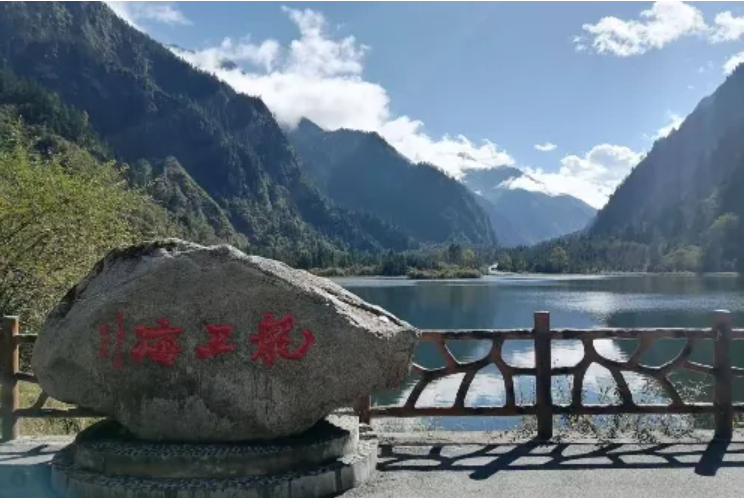
Longwang Lake
Longwang Lake is about 2,950 meters above sea level, with a water accumulation area of 334,000 square meters. It is an alpine lake about 11 kilometers from the visitor center. The area includes landscapes such as Jinghai, Qingquan Lake, an ecological trail, and flying waterfalls. As one of Sichuan's 100 best viewing spots, Longwang Lake has different scenery in each season. In spring and summer, the mountain forests are verdant; in late autumn, red leaves cover the mountains; and in winter, the snow mountains are magnificent.
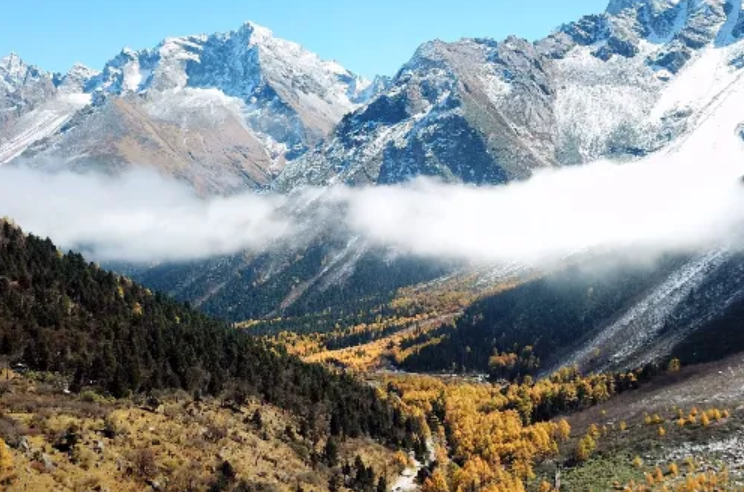
Banji Peak
On May 4, 2004, seven climbers successfully reached the top of the Banji Peak Glacier in Bipenggou and measured the summit elevation at 5,430 meters. Banji Peak has a unique shape and connects to Yaomei Peak of Siguniang Mountain, the second-highest peak in Aba Prefecture. Not far to the northeast is Dahuang Peak, which is 5,922 meters above sea level. The route from Changping Valley of Siguniang Mountain to Bipenggou was selected by Chinese National Geography magazine as one of "China's Top Ten Classic Hiking Routes," ranking sixth, and attracts a large number of Chinese and foreign outdoor sports enthusiasts every year. Bipenggou has ancient glaciers of enormous scale rarely seen in China or abroad, and has now developed five glacier attractions: Banji Peak, Daogou, Chazigou, Yanzhiyan, and Daxuetang.
Zhuoma Lake
Zhuoma Lake is about 3,612 meters above sea level, with a storage area of 40,000 cubic meters, an average depth of 5 meters, and a maximum depth of 10 meters. The lake water is formed by the convergence of upstream water, snow and ice meltwater, and precipitation. Because the lake surface is clear and the water flows gently, it is as beautiful as the Tibetan girl "Zhuoma," and thus got its name. On Zhuoma Beach by Zhuoma Lake, there are entertainment projects such as beach motorcycles and racing boats.
Zhuoma Beach Ski Resort
Zhuoma Beach Ski Resort and Panyang Lake Ice and Snow Entertainment Area are the two major ski areas in Bipenggou Scenic Area. The ski resort was originally formed by a natural ski run scoured by a debris flow and was relocated to a larger site in November 2020. The snow quality here is excellent, and visitors can also enjoy beautiful scenery. The resort has beginner ski runs, children's dedicated ski runs, and a dedicated snow boat lane, as well as a snow amusement park with entertainment items such as double boards, single boards, snow boats, and snow tubes. The expanded area outside the ski resort also offers rich entertainment projects such as snowmobiles, children's snow carts, and all-terrain off-road motorcycles.
White Dragon Waterfall
White Dragon Waterfall is about 3,671 meters above sea level, 10 meters wide, and has a drop of about 100 meters, making it one of the largest waterfalls in Bipenggou Scenic Area. Because of its terrain, elevation, and drop characteristics, the water pours down from the mountain top with great momentum, resembling a white dragon in form, and thus it got its name.
Panyang Lake
Panyang Lake is about 3,676 meters above sea level, with a water accumulation area of 450,000 square meters and a water depth of 2-6 meters. It is an alpine lake. The lake water mainly comes from glacier meltwater, mountain springs, and groundwater. The water volume changes with the seasons, and the river flow is gentle. The lake is surrounded by mountains, and the lake contains cold-water fish, rock fish, and others. The aquatic plants and shrubs around the lake are lush, and flying birds such as wild ducks often perch there. Because this is the area where Panyang are most frequently active, it is named "Panyang Lake." Around the lake, the trees are luxuriant and grotesque peaks and rocks stand in great numbers, and visitors can also view the famous pyramid-shaped snow mountains surrounding it in layers. Next to Panyang Lake is Moon Bay, which can be reached by passing through a red wooden plank road.
Hongshan Lake
The Hongshan Lake viewing area is about 3,750 meters above sea level and is a concentrated viewing place for colorful forests, red stones, lakes, and alpine azaleas. On the red stone slope at the upper end of the lake, patches of red stones are dotted like agate, surrounded by redwood trees and rhododendron forests.
Yanzhiyanwo
Yanzhiyanwo backs onto Siguniang Mountain and is 3,837 meters above sea level. It has the reputation of "the back view of Siguniang." It is surrounded on three sides by Chazigou Glacier, General Peak, and Empress Peak. The scenic area has rich and diverse ecological landscapes, including primeval forests, alpine lakes, alpine meadows, alpine azaleas, flying waterfalls, and strange peaks and rocks, as well as famous sites such as Niangzi Peak, Twelve Talented Women Peaks, and Monkey Head Peak. On the cliff of Yanzhiyanwo is the "Flying Dragon Waterfall," about 500 meters high and about 12 meters wide. The surrounding mountains are covered with alpine azaleas, dyeing the mountain tops red, and therefore alpine azalea flowers are also called yingshanhong. Yanzhiyanwo is embraced by ancient Minjiang cypresses and redwood trees, with verdant peaks and lush vegetation. It is also the earliest place in the scenic area where red leaves turn red, and can be viewed as early as late September.
Tour Routes:
Easy Route: Suitable for family outings or first-time visitors. In the morning, depart from the scenic area gate and take the sightseeing bus to Longwang Lake to enjoy the beauty of the alpine lake; then go to Zhuoma Lake to experience its clear lake water and surrounding scenery; after lunch in the scenic area, go to Panyang Lake to enjoy the lake and mountain scenery; in the afternoon, go to Hongshan Lake to view colorful forests, red stones, and other landscapes, and then take the sightseeing bus back.
Challenging Route: Suitable for tourists who like adventure and challenge. In the morning, take the sightseeing bus from the scenic area gate to Shanghaizi Reception Center, then begin hiking along the trail in the primeval forest, passing successively through White Dragon Waterfall and Panyang Lake to feel the magnificence of nature; then go to Yanzhiyanwo to enjoy the surrounding strange peaks and rocks, alpine azaleas, and other landscapes; afterward, hike downhill and return to Shanghaizi Reception Center, then take the sightseeing bus to leave the scenic area. This route has many uphill sections and has certain physical fitness requirements.
Travel Suggestions:
The scenic area is at a high altitude. Visitors new to the plateau should pay attention to adapting slowly and avoid strenuous exercise to prevent altitude sickness.
In winter, the snow in the scenic area can be more than 60 centimeters deep, so anti-slip and warm shoes and clothing are needed.
If time permits, you can choose to hike part of the route to experience natural scenery such as the primeval forest up close, but you should reasonably distribute your physical strength.
Check the weather forecast in advance and choose to go when the weather is clear, so you can better enjoy the scenery.
Precautions:
Respect the local ethnic culture and customs and avoid causing unnecessary conflicts.
Open flames are strictly prohibited in the scenic area. Protect forest resources and the ecological environment and prevent forest fires.
When taking sightseeing buses and electric vehicles in the scenic area, obey order, pay attention to safety, and do not walk around or play in the vehicle at will.
Carry some commonly used medicines, such as cold medicine, stomach medicine, and anti-altitude sickness medicine, to cope with possible physical discomfort.
The temperature difference between morning and evening in the scenic area is large. Even in summer, it is recommended to carry warm clothing.
When touring the scenic area, do not climb trees or rocks, and do not view scenery or take photos at the edge of lakes without guardrails, to prevent accidents.
In accordance with relevant regulations, measures suspending the reception of personnel for outdoor activities such as mountaineering and traversing in the area shall be strictly implemented. Visitors are requested to comply with the regulations.
When visiting scenic spots or getting on and off vehicles, be sure to bring your personal belongings. If anything is lost, please contact the staff promptly.
Transportation:
Self-driving:Depart from Chengdu, take the Chengdu-Guanxian Expressway and the Dujiangyan-Wenchuan Expressway to Wenchuan, then drive along National Highway 317 to Li County, and finally follow the scenic area road to Bipenggou. The total distance is about 210 kilometers, and the drive takes about 3.5 hours.
Public Transportation:
Chengdu Chadianzi Passenger Station has direct buses to Li County (multiple departures daily, about 4 hours), and after arriving in Li County, you can hire a car or share a car to Bipenggou.
Chengdu Xinnanmen Station has direct buses to Bipenggou Scenic Area.
Li County Passenger Station has buses to Bipenggou Scenic Area, about 30 minutes.
Opening Hours:
Ticket sales hours are 8:00-15:30 on weekdays and 7:30-15:30 on non-weekdays. The last return trip of the scenic area sightseeing bus is at 6:00 p.m. The actual opening hours of the scenic area shall prevail.
Tickets:
The ticket price (including the scenic area shuttle bus) is 130 yuan per person.