The Chengdu Wuhou Shrine Museum is located at No. 231 Wuhou Shrine Street, Wuhou District, Chengdu, Sichuan Province. It is the only shrine in China dedicated to both a ruler and his minister, as well as a Major Historical and Cultural Site Protected at the National Level and a National 4A Tourist Attraction. The scenic area covers approximately 150,000 square meters and consists of three parts: the Three Kingdoms Cultural Heritage Protection Zone, the Three Kingdoms Cultural Experience Zone, and the Jinli Folk Custom Zone. The existing buildings were reconstructed in the eleventh year of the Kangxi reign of the Qing Dynasty (1672), retaining the architectural style of the late Ming and early Qing dynasties. With red walls, bamboo shadows, and ancient cypresses, the site possesses extremely high historical, cultural, and artistic value.
History and Culture
Wuhou Shrine was first built in the third year of the Zhangwu era (223 AD) to commemorate Liu Bei, Emperor Zhaolie of Shu Han, and his chancellor Zhuge Liang. It was originally adjacent to Liu Bei's Hui Mausoleum. During the Tang Dynasty, Wuhou Shrine had already become a famous tourist destination. Du Fu once wrote the verse, "Where can the Chancellor's Shrine be found? Outside the City of Brocade, where cypresses grow dense." In the early Ming Dynasty, Wuhou Shrine was merged into the Temple of Liu Bei, forming the layout of joint worship of ruler and minister. At the end of the Ming Dynasty, the shrine was destroyed in war and was rebuilt in the eleventh year of the Kangxi reign of the Qing Dynasty (1672), forming the existing architectural scale.
In 1961, Wuhou Shrine was announced by the State Council as one of the first batch of Major Historical and Cultural Sites Protected at the National Level. In 1984, the Chengdu Wuhou Shrine Museum was established, and in 2008 it was rated as a National 4A Tourist Attraction. The scenic area preserves a large number of cultural relics of Shu Han culture, such as the Liu Bei Hall, the Zhuge Liang Hall, and Hui Mausoleum, as well as numerous inscriptions, plaques, and couplets. It is an important site for the study of Three Kingdoms culture.
Main Attractions
Liu Bei Hall
The Liu Bei Hall is one of the main buildings of Wuhou Shrine. Inside the hall is a gilded statue of Liu Bei, 3 meters tall, wearing a dragon robe and holding a jade tablet, with a solemn expression. On both sides of the hall are statues of Guan Yu, Zhang Fei, and other famous generals of Shu Han, 28 in total, each with a different expression and lifelike appearance. Hanging in the hall is the plaque "Ye Shao Gao Guang," meaning that Liu Bei's achievements inherited those of Emperor Gaozu Liu Bang and Emperor Guangwu Liu Xiu of the Han Dynasty.
Zhuge Liang Hall
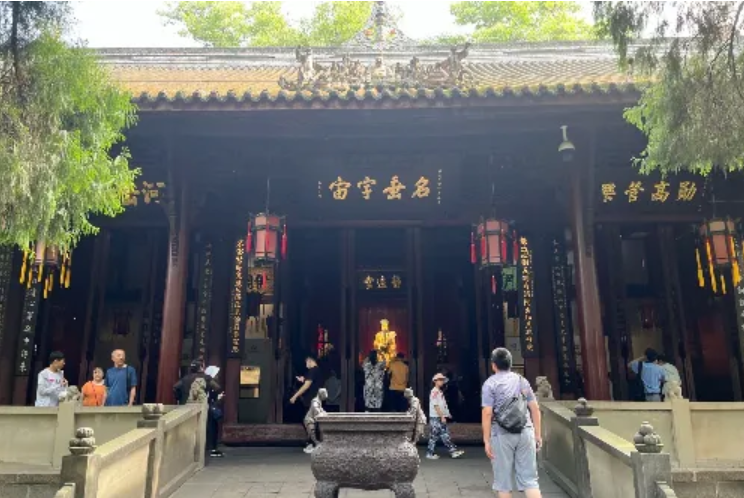
The Zhuge Liang Hall, also known as Wuhou Shrine, is located behind the Liu Bei Hall and is the main place for worshipping Zhuge Liang. Inside the hall is a gilded statue of Zhuge Liang, 2.8 meters tall, holding a feather fan and appearing elegant and scholarly. On both sides of the hall are statues of his son Zhuge Zhan and his grandson Zhuge Shang. Hanging in the hall is the plaque "Ming Chui Yu Zhou," and on both sides is the couplet "Three visits frequent, the world's strategy; two reigns, the old minister's heart," which highly summarizes Zhuge Liang's life.
Hui Mausoleum
Hui Mausoleum is the tomb of Liu Bei, located on the west side of Wuhou Shrine. It is the only imperial tomb from the Three Kingdoms period that has been preserved to this day. The tomb is 12 meters high and 180 meters in circumference, in the shape of a truncated pyramid, surrounded by a wall. In front of the tomb is the stele "Tomb of Emperor Zhaolie of Han," erected in the fifty-third year of the Qianlong reign of the Qing Dynasty (1788). Hui Mausoleum is adjacent to Wuhou Shrine, forming a "shrine-tomb integrated" layout.
Sanyi Temple
Sanyi Temple was originally located on Tidu Street in Chengdu and was built to commemorate the Peach Garden Oath of Liu Bei, Guan Yu, and Zhang Fei. In 2003, it was relocated as a whole into Wuhou Shrine. The temple enshrines statues of Liu Bei, Guan Yu, and Zhang Fei, as well as statues of Zhao Yun, Ma Chao, and other famous generals of Shu Han. The architectural style of Sanyi Temple is a typical western Sichuan folk dwelling style, with gray tiles, white walls, and carved beams and painted rafters.
Red Wall Corridor
It surrounds both sides in front of the gate of Hui Mausoleum. The corridor of red walls and bluestone paths leads to the ruler who has slept for more than 1,700 years. Along the corridor, one can see red courtyard walls on both sides, with dense tall bamboo growing outside.
Han Zhaolie Temple
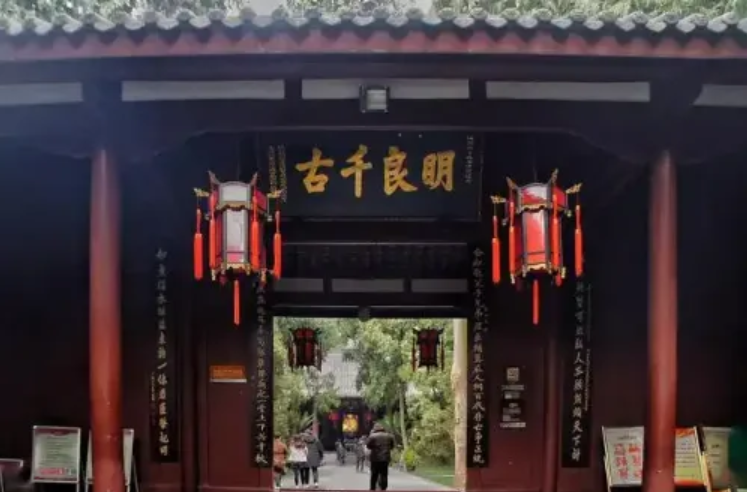
The main gate opens in the center. Looking up, the four golden characters "Han Zhaolie Temple" on the vermilion plaque come into view, inspiring solemn respect. On the left and right sides in front of the main gate stand a pair of Ming Dynasty stone lions, adding much majestic atmosphere to the shrine. Outside the central axis of the main gate is a screen wall, simple and elegant.
Tang Stele
Its full name is The Stele of the Shrine of Prime Minister Zhuge Wuhou of Shu. It has a history of more than 1,200 years. In the fourth year of the Yuanhe reign of Emperor Xianzong of Tang (809), Wu Yuanheng, then Jiedushi of Jiannan Xichuan, led 27 subordinates to pay homage at Wuhou Shrine. He ordered Pei Du, secretary of the Jiedushi office, to compose an inscription to express admiration for Zhuge Liang and to encourage later generations. After the article was written, it was calligraphed by Liu Gongchuo and carved by Lu Jian. Because the article, calligraphy, and carving are all exquisite, the Tang Stele is called the "Three Excellences Stele."
Corridors of Civil Officials and Military Generals
In the east and west corridors in front of the Liu Bei Hall, there are 28 statues of civil officials and military generals of Shu Han. The east corridor is called the Corridor of Civil Officials, headed by Pang Tong, known as Fledgling Phoenix, with 14 figures in total. The west corridor is the Corridor of Military Generals, led by the wise and brave Zhao Yun, also with 14 figures. In front of each statue stands a stone tablet introducing his life and deeds.
Recommended Tour Route:
Recommended tour route: Main Gate → Hui Mausoleum → Liu Bei Hall → Zhuge Liang Hall → Sanyi Temple → Jieyi Tower → Jinli Ancient Street. This route enters from the main gate of the scenic area, first visiting Liu Bei's tomb, Hui Mausoleum, then following the central axis to visit the Liu Bei Hall and Zhuge Liang Hall in sequence to learn about the historical deeds of the rulers and ministers of Shu Han. Then proceed to Sanyi Temple to experience the bond of sworn brotherhood among Liu Bei, Guan Yu, and Zhang Fei. Finally, go to Jieyi Tower to watch Sichuan opera performances and tour Jinli Ancient Street to experience western Sichuan folk culture. The whole journey takes about 2–3 hours, allowing visitors to fully appreciate the historical and cultural charm of Wuhou Shrine and the folk customs of Jinli.
Visiting Suggestions:
It is recommended to visit in spring (March–May) or autumn (September–November), when the climate in Chengdu is mild and suitable for outdoor activities.
Book tickets in advance through the official WeChat public account of the scenic area to avoid queuing during holidays.
Hire a scenic area guide (about 100 yuan per time) or rent an audio guide (20 yuan per device) to gain a deeper understanding of Three Kingdoms culture and the history of Wuhou Shrine.
After visiting Wuhou Shrine, you can go to Jinli Ancient Street to taste Chengdu specialty snacks and buy handicrafts as souvenirs.
Jinli Ancient Street is brilliantly lit at night. You may arrange to visit in the evening to experience the charm of the ancient street's night view.
Notes:
Smoking and littering are prohibited in the scenic area. Please keep the environment clean.
When visiting cultural relics and historical sites, please do not touch or climb on them to avoid damaging the relics.
There are many tourists during holidays. Please take care of your personal belongings and look after the elderly and children.
Jinli Ancient Street has a large flow of people and slippery ground. It is recommended to wear non-slip shoes.
Please do not use flash when taking photos to avoid damaging cultural relics.
Transportation:
Bus: Take buses such as No. 1, No. 57, No. 334, No. 335, and G74, and get off at "Wuhou Shrine Station."
Metro: Take Metro Line 3, get off at "Gaoshengqiao Station," and walk about 10 minutes to arrive.
Self-driving: The scenic area has a parking lot at No. 231 Wuhou Shrine Street. The parking fee is about 10 yuan per hour.
Opening Hours:
Open all year round from 08:00 to 20:00 (last entry at 19:30). During statutory holidays and major events, opening hours may be adjusted. Please refer to the official announcement of the scenic area for details. Jinli Ancient Street is open all day and can be visited for free.
Tickets:
The ticket price is 50 yuan per person.