Jingting Mountain Scenic Area is located in Xuanzhou District, Xuancheng City, Anhui Province, China. It is a national AAAA-level tourist attraction, a national forest park, a provincial-level scenic area, and a renowned historical and cultural mountain in China, famously known as the "Poetic Mountain of Jiangnan" (south of the Yangtze River). The core planned area of the scenic area is 53.1 square kilometers, comprising Jingting Mountain, Magu Mountain, and the Twin Pagodas area. Its main peak, Yifeng, rises to an elevation of 317 meters, and the forest coverage rate within the scenic area exceeds 95%, offering excellent ecological conditions. Jingting Mountain integrates natural scenery, cultural landscapes, religious culture, and poetic heritage. Its core features include beautiful mountains and waters, a long cultural lineage, and numerous historical sites. Over a hundred cultural relics—ancient buildings, ruins, cliff inscriptions, and more—remain on site, making it a highly representative cultural and eco-tourism destination in southern Anhui.
History and Culture
The humanistic history of Jingting Mountain dates back to the Wei and Jin periods. During the Southern Qi Dynasty, the poet Xie Tiao, while serving as the governor of Xuancheng, composed famous works such as A Visit to Jingting Mountain, which first enshrined the mountain in literary history and laid its cultural foundation. In the Tang Dynasty, the poet Li Bai visited Jingting Mountain seven times and wrote the immortal quatrain: "All birds have flown high away; a lonely cloud drifts idly by. We never tire of each other, only Jingting Mountain and I." This poem made Jingting Mountain renowned throughout China. Thereafter, successive generations of literati—including Bai Juyi, Du Mu, Han Yu, Liu Yuxi, Su Shi, and Huang Tingjian—visited and composed thousands of poems eulogizing Jingting Mountain, solidifying its core cultural status as the "Poetic Mountain of Jiangnan."
Jingting Mountain also has a long tradition of religious culture. Since the Tang Dynasty, it has been a mountain shared by Buddhism and Taoism. The Guangjiao Temple on the mountain, first built during the Dazhong reign of the Tang Dynasty, was a renowned Buddhist temple in Jiangnan and one of the ancestral sites of the Huangbo school. After centuries of rise and fall, it has been reconstructed and now serves as the core religious cultural attraction of the scenic area. Historically, dozens of pavilions, towers, academies, and temples were built on the mountain, with successive dynastic governments and scholars continually restoring and expanding them, creating a rich legacy of ancient architecture and cultural accumulation. In modern times, Jingting Mountain has received systematic protection and development. It was designated a provincial-level scenic area in 1987, and in 2009 it became a national AAAA-level tourist attraction, serving as an important vehicle for preserving Chinese poetic culture and integrating eco-tourism with cultural heritage.
Major Attractions
Guangjiao Temple
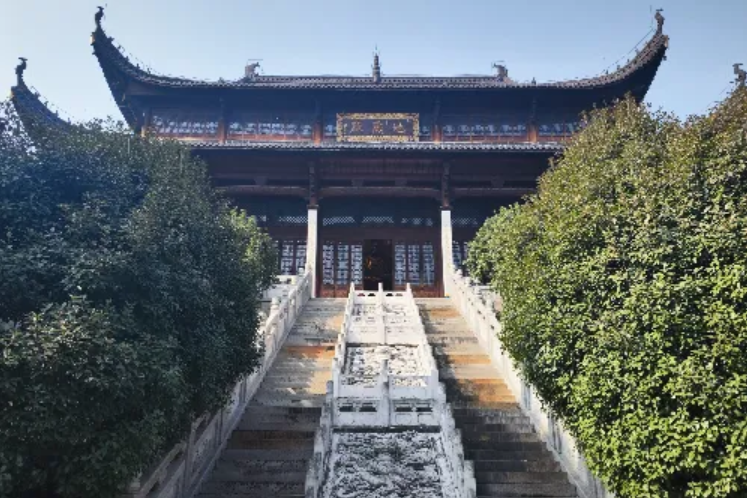
Located at the southern foot of Jingting Mountain, Guangjiao Temple was originally built in the second year of the Dazhong reign of the Tang Dynasty (848 CE) by the eminent monk Huangbo Xiyun. It is a famous Buddhist temple in Jiangnan and an ancestral site of the Huangbo school, historically comparable to renowned temples such as those on Mount Jiuhua and Mount Putuo. The temple underwent multiple renovations and expansions during the Tang, Song, Yuan, Ming, and Qing dynasties. The existing buildings were reconstructed in 2005 in the Tang architectural style, covering an area of over 100 mu (about 6.7 hectares). The complex includes the Mountain Gate, Heavenly King Hall, Great Hero Hall, Sutra Depository, and Guanyin Hall, presenting a magnificent appearance. It also preserves ancient steles, Buddhist statues, and other cultural relics, serving as the core religious cultural site of Jingting Mountain.
Jingting Lake
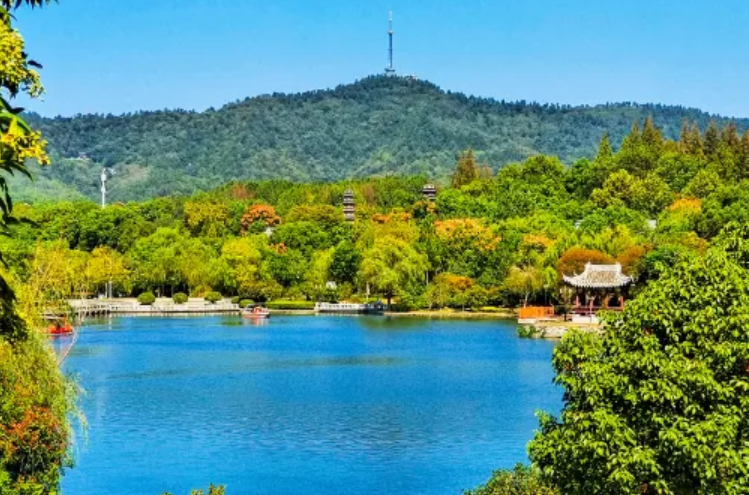
Jingting Lake is the central water feature of the scenic area, with a water surface of about 80 mu (5.3 hectares), nestled at the foot of Jingting Mountain. The lake water is clear and emerald green, beautifully complementing the surrounding green hills. Along the lake, there are waterside walkways, viewing platforms, and trestle bridges, totaling about 1.2 kilometers in length, allowing visitors to stroll around the lake and enjoy the scenery. It is a popular spot for leisure sightseeing and photography, and a landmark area combining ecological landscape with recreational amenities.
Taibai Duzuo Tower (Li Bai's Solitary Sitting Tower)
Situated on the mountainside of the main peak, Taibai Duzuo Tower was built in memory of Li Bai's visits to Jingting Mountain. It was originally constructed in the Tang Dynasty; the current structure was rebuilt in 2014 and is 31.7 meters high with five stories, in the Tang architectural style. The tower displays Li Bai's poems, his life stories, and calligraphic and pictorial works related to the mountain. From the top, visitors can enjoy a panoramic view of Xuancheng city and the entire Jingting Mountain area. It is a landmark cultural building and a core site for experiencing the poetic culture of the mountain.
Jingting Mountain Twin Pagodas (Guangjiao Temple Twin Pagodas)
Located beside the former site of Guangjiao Temple, the Twin Pagodas were originally built in the third year of the Shaosheng reign of the Northern Song Dynasty (1096 CE) and are a national key cultural relic protection unit. They are brick pagodas of pavilion style with imitation wood construction, standing opposite each other in the east-west direction. Both have seven stories and are about 17 meters high, with Buddhist figures and scriptures carved on their bodies. They are the most complete Song?period ancient pagodas in southern Anhui, holding high historical and architectural value.
Xiangsi Spring (Yearning Spring)
Located in the central part of Jingting Mountain, Xiangsi Spring is a natural mountain spring with clear, sweet water that never dries up. Legend has it that the spring was named after Li Bai's parting sentiment with a friend. Beside the spring are stone railings and inscribed steles, surrounded by bamboo groves, creating a tranquil atmosphere. It is a featured spot combining natural scenery with cultural lore, and a pleasant place for rest and refreshing water.
Statue of Princess Yuzhen
The Statue of Princess Yuzhen stands in the core sightseeing area of Jingting Mountain. Made of white marble and 3.8 meters tall, it was erected to commemorate Princess Yuzhen of the Tang Dynasty, who lived in seclusion on Jingting Mountain in her later years. Princess Yuzhen had a close friendship with Li Bai, and her story is an integral part of the mountain's cultural history. The statue is surrounded by greenery, blending harmoniously with the natural landscape.
Jingting Mountain Tea Garden
Located on the southeast side of the scenic area, the tea garden covers about 200 mu (13.3 hectares) and is the core planting area for Jingting Lüxue tea, a famous historical Chinese tea that was once a tribute tea during the Ming and Qing dynasties. The terraced tea fields are built along the mountain slopes, offering visitors views of tea cultivation and insights into tea culture, making it a distinctive attraction that integrates ecological agriculture with tourism.
Suggested Tour Routes:
Classic Panoramic Route: About 5 kilometers, approximately 3.5 hours on foot. Route: Scenic Area Gate → Jingting Lake → Guangjiao Temple → Twin Pagodas → Xiangsi Spring → Statue of Princess Yuzhen → Taibai Duzuo Tower → Main Peak Observation Deck → Tea Garden → Exit.
Leisure Light Route: About 2.5 kilometers, approximately 1.5 hours on foot, suitable for seniors and children. Route: Scenic Area Gate → Jingting Lake → Guangjiao Temple → Xiangsi Spring → Statue of Princess Yuzhen → Return to Gate.
In-depth Hiking Route: About 6 kilometers, approximately 4 hours on foot, reaching the main peak for a full view of natural and cultural landscapes.
Tourist Tips:
Recommended visit duration: Panoramic tour 3–4 hours; leisure tour 1.5–2 hours; hiking tour 4–5 hours.
Best seasons: Spring (March–May) for flower viewing and hiking; autumn (September–November) for pleasant weather and the best scenery.
Transport within the area: On foot or by sightseeing shuttle bus.
Cultural experiences: Focus on Taibai Duzuo Tower and Guangjiao Temple to appreciate poetic and Buddhist culture.
Leisure extras: After visiting, enjoy Jingting Lüxue tea culture and taste local Xuancheng specialties.
Photo spots: Jingting Lake trestle bridge, top floor of Taibai Duzuo Tower, Twin Pagodas Plaza, and Xiangsi Spring.
Important Notices:
Flammable, explosive, or controlled items are prohibited.
Smoking, camping fires, and burning debris are strictly forbidden; comply with forest fire prevention regulations.
Some hiking trails are steep; seniors and children should be accompanied by family and watch their step.
Do not climb or deface cultural relics or ancient buildings; protect historical structures and natural vegetation.
Swimming and fishing are prohibited; keep away from hazardous water areas.
Do not feed wild animals; maintain a safe distance and protect the ecological environment.
During holidays, visitor numbers are high; it is advisable to avoid peak times and follow orderly tour procedures.
Transportation:
Public bus: In Xuancheng city, take bus No. 1, 3, 4, or 6 directly to the Jingting Mountain Scenic Area Gate.
High-speed train: Arrive at Xuancheng Railway Station, then take a taxi about 10 minutes (3 km) to the scenic area; or from Xuancheng High-Speed Railway Station, take a taxi about 15 minutes (5 km).
Self-driving: Search "Jingting Mountain Scenic Area" on navigation; the site has a large parking lot with about 500 spaces.
Long-distance bus: From Xuancheng Bus Terminal, take bus No. 3 directly to the scenic area, or take a taxi about 8 minutes.
Opening Hours:
Peak season (March 1 – November 30): 8:00–17:30, last entry at 17:00.
Low season (December 1 – February 28): 8:00–17:00, last entry at 16:30.
Guangjiao Temple follows the same hours; Taibai Duzuo Tower is open 8:30–17:00.
Ticket Price:
Admission: 50 RMB per person.