Xiaonanhai is located in Qianjiang District, Chongqing, and is a national 4A-level tourist attraction. It is an alpine freshwater barrier lake scenic area integrating mountains, water, islands, and gorges, covering an area of about 30 km2, with a water area of 2.87 km2. The lake within the scenic area is over 5,000 meters long, up to 2 kilometers wide at its broadest point, with an average depth of 30 meters and a maximum depth of 60 meters. Its maximum storage capacity reaches 67 million m3. The area is rich in forest resources, with over 140 species of trees and more than 50 species of fish, serving as a habitat for many rare species. The scenic area also hosts the first Tujia ethnic folk ecology museum in the Wuling Mountain area—the Qianjiang Folk Museum, which consists of an exhibition center and 13 Tujia villages along Banjixi.
History and Culture
Xiaonanhai is a canyon lake formed by a major earthquake in the sixth year of the Xianfeng reign of the Qing Dynasty (1856 AD). It is the best-preserved ancient earthquake site in China. The earthquake created a natural dam of rolling stones, measuring 1,170 meters from north to south, 1,040 meters wide at the base, 67.5 meters high, and with a 70-meter-wide spillway, blocking the Banjixi stream to form the natural lake. The area around Xiaonanhai is home to Tujia and Miao ethnic groups, with stilted houses as the dominant architectural style, offering rich ethnic cultural experiences. It was also an early cradle of revolution, with significant revolutionary activities occurring both on the eve of the 1911 Revolution and during the Second Revolutionary Civil War.
Major Attractions
Xiaonanhai Lake
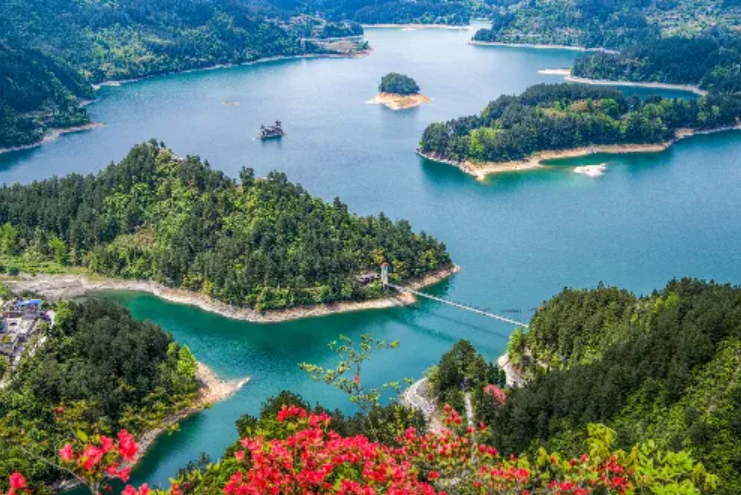
The core natural landscape of the scenic area, this barrier lake formed by the 1856 earthquake has a water area of 2.87 km2. The lake is irregularly oval, about 1.8 km from east to west and 1.5 km from north to south. The lake surface is at an elevation of 670.5 meters, with an average depth of 30 meters and a maximum depth of 52.7 meters in the northwest. The water is clear and transparent, with visibility up to 3–5 meters. The lake hosts various freshwater fish such as carp, crucian carp, and silver fish, and is one of the important freshwater fishery bases in southeastern Chongqing.
Chaoyang Temple Island
Located within the Xiaonanhai Geopark, it is named after the Chaoyang Temple on the island. Due to its butterfly-like shape, it is also called "Butterfly Island," covering an area of 6.46 hectares. The temple was rebuilt in the 29th year of the Qianlong reign (1764 AD) by Yang Yuncai, a local magistrate of Qianjiang. The original temple was a large courtyard with 60 rooms, enshrining Guanyin of the South Sea, the 24 celestial deities, and the 18 Arhats. The temple was destroyed in the earthquake.
Niubei Island
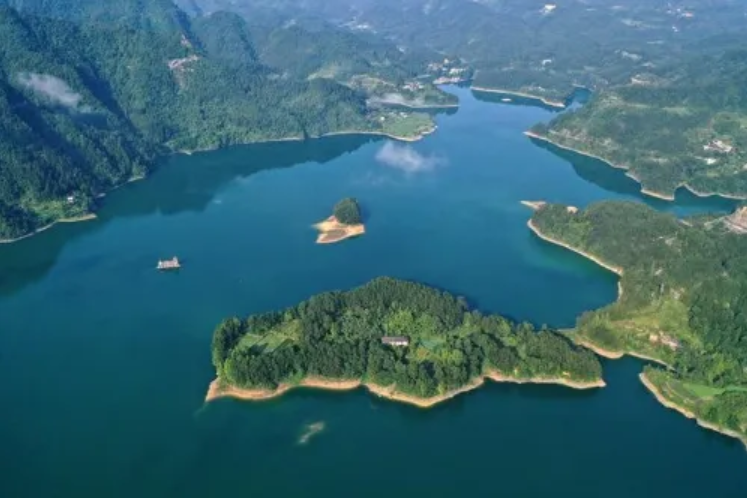
The largest island in Xiaonanhai, covering about 8.33 hectares. Its right side resembles a reclining head, while the middle part looks like a broad ox back bathing in the water, with the ox head turning to gaze at the small crescent-shaped islet—forming the "Rhino Gazing at the Moon" view.
Laoguanping Island
The smallest island in the area, covering 0.57 hectares. It is named after the long-billed, grey-white herons that often perch there, resembling a green snail in the vast blue waves.
Dakua Rock and Xiaokua Rock
Dakua Rock consists of Silurian Luoreping Formation siltstone and shale, forming an equilateral triangle, about 200 meters wide at the base and 120 meters high, with a cross-section of about 5,000 m2. It is the most typical and largest cliff face in the geopark, grand and imposing. Xiaokua Rock, also of the same formation, is irregularly shaped, about 80 meters wide at the base and 60 meters high, with a cross-section of about 2,000 m2.
Qianjiang Folk Museum
An investment of 20 million yuan built a 3,000 m2 exhibition center that showcases architectural culture, agricultural culture, ethnic culture, and natural and human resources in an authentic manner. An additional investment of 5 million yuan was made to renovate the original 13 villages along Banjixi, preserving the characteristics of Tujia stilted-house villages and courtyards.
Suggested Tour Route:
Morning: Climb Fengming Mountain for a panoramic view of Xiaonanhai, then take a boat tour across the lake to view the earthquake ruins, followed by visits to Niubei Island, Chaoyang Temple Island, and Laoguanping Island.
Afternoon: Visit the Qianjiang Folk Museum to learn about local Tujia culture.
Travel Tips:
The best seasons to visit are spring and autumn, when the weather is pleasant, the scenery is beautiful, and there are relatively fewer tourists, allowing for a more peaceful experience.
Enjoy local Tujia cuisine at farmhouse restaurants within the scenic area.
If time permits, stay overnight near the scenic area to enjoy the night views and the morning lake scenery.
Important Notes:
As Xiaonanhai is in a mountainous area with changeable weather, please bring rain gear and warm clothing.
Pay attention to personal safety; do not climb dangerous areas and follow all scenic area regulations.
Do not litter; help maintain the environmental cleanliness and preserve this pristine area.
When visiting historical and cultural sites, please respect local customs and do not touch or damage cultural relics.
Due to strong sunlight in the mountainous area, it is recommended to bring sunscreen, hats, and other sun protection.
When trying local food, ensure freshness and hygiene to avoid food poisoning.
Keep your mobile phone charged and download offline maps in advance for use in areas with poor signal.
Transportation:
Self-driving: Depart from Chongqing via the Yu-Xiang Expressway, get off at the Qianjiang exit, and follow the road to Xiaonanhai. The road conditions are good and the roads are wide.
Public transportation: Take a bus from Qianjiang Bus Station to Xiaonanhai Town, then transfer to local transport to reach the scenic area.
Opening Hours:
Open daily from 8:30 AM to 6:00 PM. (Please check the actual opening hours at the scenic area.)
Tickets:
Ticket price starts from 60 yuan. (Please refer to the actual price at the scenic area.)