Address: No. 185, Section 2, Binjiang Avenue, Fuling District, Chongqing, China.It is the world's first underwater museum accessible without diving, and a branch of the Chongqing Three Gorges Museum. It is a local history museum. Construction officially began in 2003, and it opened to the public on May 18, 2009. The museum covers an area of about 11,300 square meters, with a building area of 8,433 square meters.
History and Culture
White Crane Ridge, anciently called "Bazi Ridge," is a natural stone ridge about 1,600 meters long and 15 meters wide on average. Due to erosion by the Yangtze River, it is divided into upper, middle, and lower sections. It was renamed White Crane Ridge after the Qing Dynasty. As early as the Tang Dynasty or earlier, stone-fish water-level markers already existed on the ridge. In the late Tang Dynasty, inscriptions and poems began to appear near the stone-fish markers, including a "scale-and-dou" (measuring instrument) carved in the first year of Dashun (890 AD) to record water levels. During the Northern Song Dynasty, the stone-fish and ancient inscriptions on the mid-river ridge became a famous scenic spot in Fuling, and many inscriptions recording the relationship between the stone-fish and water levels, along with related poems, were carved on the ridge. After the Yuan Dynasty overthrew the Southern Song, local Yuan officials continued to observe the stone-fish, record water levels, and carve inscriptions on the ridge. During the Ming and Qing dynasties, the inscriptions at White Crane Ridge continued to grow in number, exceeding those of the Yuan but far fewer than those of the Song. In modern times, a total of 14 inscriptions were added. After the founding of the People's Republic of China, the practice of carving new inscriptions on the ridge largely ceased for protection and research reasons. In 1992, the Three Gorges Project was initiated, and White Crane Ridge was to be submerged. In 2002, the "non-pressure container" protection scheme was adopted. Construction of the protection project began in 2003, and the museum was completed and opened in 2009.
Major Attractions
Underwater Inscriptions
The museum houses 165 inscribed segments, 18 stone fish, 2 Guanyin statues, and 1 white crane. These inscriptions record poems, prose, and various stone carvings from the second year of the Guangde reign of the Tang Dynasty (764 AD) onwards, holding significant scientific, historical, and artistic value.
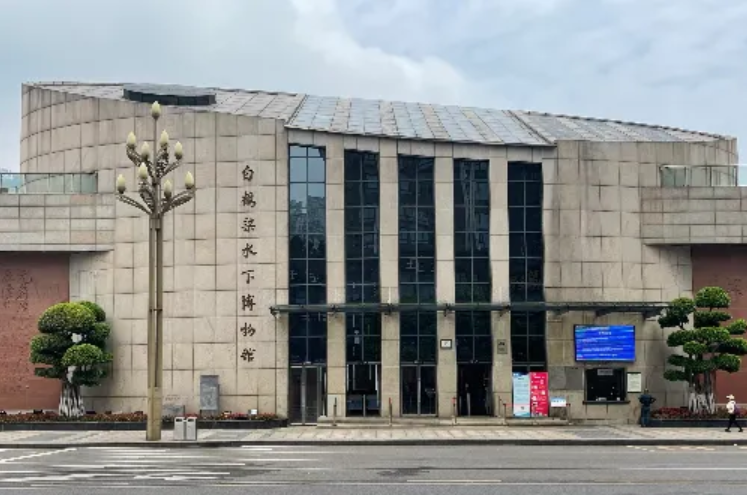
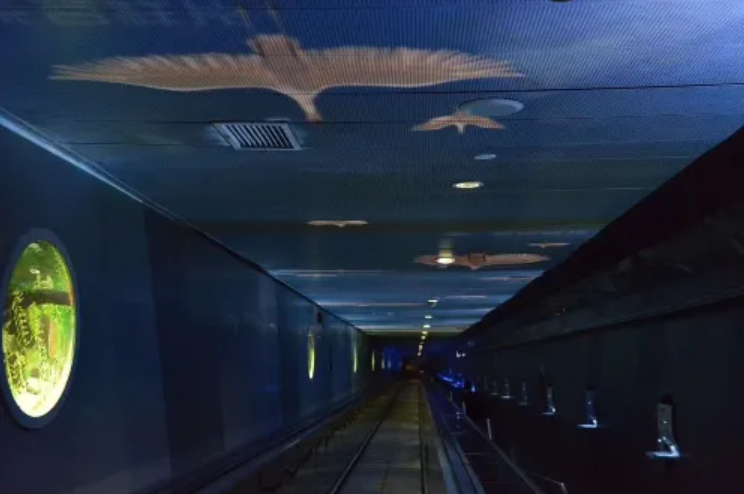
Sloping Corridor
The sloping corridor is 91 meters long and descends 40 meters below the Yangtze River's surface. It uses audio-visual and lighting effects to create a "sky dome," simulating the original scene of White Crane Ridge, allowing visitors to experience the riverside scenery as they gradually descend underwater.
Horizontal Corridor
The horizontal corridor is 146 meters long. Through videos, display panels, and 3D paintings, it introduces knowledge about the "Ecological Yangtze" fish species and the "Shipping Yangtze" vessels.
Observation Corridor
The observation corridor surrounds the protected structure and features 23 circular glass portholes through which visitors can view the inscriptions. Important inscriptions are additionally illustrated with projected rubbings.
Ground Exhibition Hall
The ground exhibition hall features a permanent special exhibition on the White Crane Ridge inscriptions, themed around "Water, Stone, Poetry, and Museum." It is divided into four units: "Water of Life – Hydrological Observations in Great River Civilizations," "Ruler of the Yangtze – Scientific Value of the White Crane Ridge Inscriptions," "Underwater Forest of Steles – Humanistic Value of the White Crane Ridge Inscriptions," and "Pearl of the Three Gorges – The World's First In-situ Underwater Museum."
Suggested Tour Route:
Ground Exhibition Hall → Sloping Corridor → Horizontal Corridor → Observation Corridor → Underwater Inscriptions.
Visitor Tips:
Check the museum's opening hours and ticket information in advance to plan your visit accordingly.
Consider hiring a guide or audio guide to gain a deeper understanding of the history and culture of White Crane Ridge.
Follow museum regulations: do not touch the artifacts, and refrain from unauthorized photography or recording.
If time permits, visit nearby attractions such as the Fuling Pickled Mustard Museum to gain a more comprehensive understanding of Fuling's history and culture.
Important Notices:
Observe order inside the museum; do not make loud noises or run around.
Follow the designated route and do not leave the specified areas without permission.
Protect the cultural relics: do not touch or scratch the inscriptions.
Keep your personal belongings safe to avoid loss.
Transportation:
Take city bus routes 113, 119, 302, 306, or 307 to reach White Crane Ridge directly.
Opening Hours:
Open year-round from Tuesday to Sunday, 09:00–17:00 (ticket sales stop at 16:30). Closed on Mondays.
Admission:
Adult ticket: 50 RMB/person.