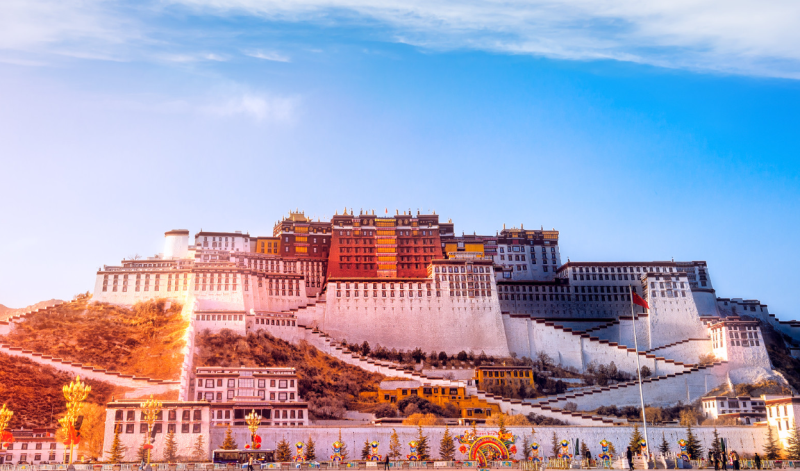
The Lhasa Potala Palace Scenic Area is located in Chengguan District, Lhasa, Tibet Autonomous Region. It is a World Cultural Heritage site and a national 5A-level tourist attraction. The Potala Palace sits atop Red Hill at an altitude of over 3,700 meters, covering a total area of 360,000 square meters, with a total building area of 130,000 square meters. The scenic area has distinctive features. The Potala Palace is a palace-fortress architectural complex and is also a holy site of Tibetan Buddhism (Gelug sect). It was originally built by Songtsen Gampo, the king of the Tubo Dynasty, to marry Princess Bhrikuti and Princess Wencheng. The main buildings are divided into two parts: the White Palace and the Red Palace. The White Palace was the winter palace of the Dalai Lama, while the Red Palace mainly consists of stupa halls and Buddha halls. Its interior is magnificently decorated and houses a large number of precious cultural relics such as murals, Buddha statues, and thangkas, demonstrating the profoundness of Tibetan Buddhist culture and the superb level of Tibetan architectural art.
Historical Culture
The Potala Palace was first built in the 7th century AD. After Songtsen Gampo unified Tubo, in order to consolidate political power and promote cultural exchange, he decided to build a palace on Red Hill in Lhasa. This was the prototype of the Potala Palace. At that time, the Potala Palace was grand in scale, with buildings such as palaces and Buddhist halls, and was the political and religious center of the Tubo Dynasty.
Later, with the decline of the Tubo Dynasty, the Potala Palace also suffered severe damage. It was not until the 17th century, during the time of the Fifth Dalai Lama, that large-scale reconstruction and expansion were carried out on the original foundation, forming the basic layout of the Potala Palace we see today. After that, successive Dalai Lamas continued to repair and expand it.
The Potala Palace has witnessed many important events and changes in Tibetan history. It is not only a holy site of Tibetan Buddhism but also a historical witness to the relationship between the local Tibetan government and the central government. In the long course of history, the Potala Palace has accumulated rich cultural connotations and become a treasure of Tibetan culture, attracting countless believers and tourists to come and worship and visit.
Main Attractions
White Palace
The White Palace is an important part of the Potala Palace. It is located in the eastern part of the Potala Palace and was the winter palace of the Dalai Lama, as well as the location of the former local government offices of Tibet. The White Palace is 7 stories high. At the top is the Dalai Lama's living quarters, the "Sunlight Hall," which is divided into the East Sunlight Hall and the West Sunlight Hall. It gets its name because it is the first place to receive sunlight every day. The hall is luxuriously furnished, with exquisite carpets, murals, and various precious cultural relics. Other floors of the White Palace contain scripture halls, meeting rooms, and monastic official schools, where visitors can learn about the operation of the former Tibetan local government and the development of religious activities.
Red Palace
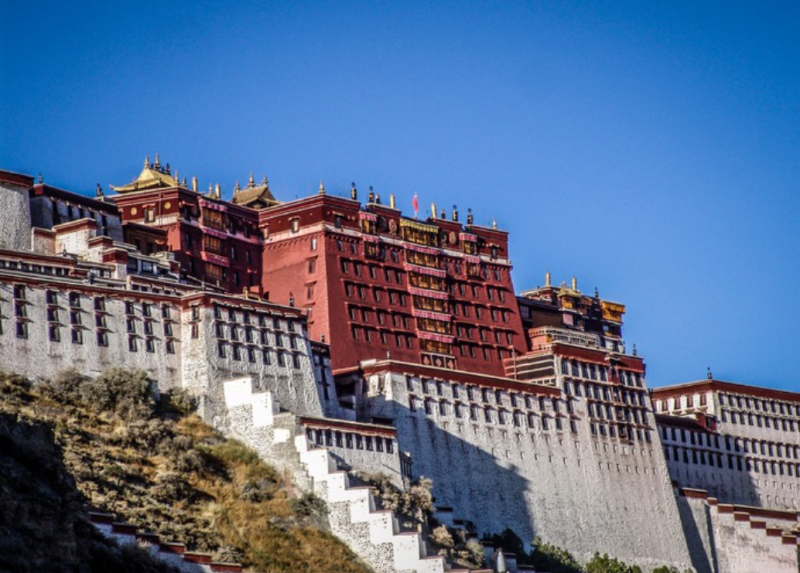
The Red Palace is located in the central part of the Potala Palace and is named for the red color of its outer walls. The Red Palace mainly consists of stupa halls and Buddha halls and is the place where the stupas of successive Dalai Lamas are enshrined. Among them, the stupa of the Fifth Dalai Lama is the most magnificent, with a height of 14.85 meters. The body of the stupa is wrapped in gold leaf and inlaid with countless jewels and precious stones, making it priceless. The Red Palace also contains many Buddha halls, such as the Hall of the Three Realms and the Hall of Long Life and Happiness. Various Buddha statues and thangkas are enshrined in the halls, and the murals are rich in content, depicting Buddhist stories and historical figures, displaying the exquisite skills of Tibetan Buddhist art.
Potala Palace Square
Potala Palace Square is located in front of the Potala Palace. It is the highest urban square in the world, with a total area of 180,000 square meters. In the square stands the Monument to the Peaceful Liberation of Tibet. The shape of the monument is unique and symbolizes the great historical event of Tibet's peaceful liberation. Various flowers and trees are also planted in the square, surrounded by fountains and lighting facilities. It is a good place for tourists to take photos and relax. Here, visitors can appreciate the majestic posture of the Potala Palace from different angles and feel its solemnity and sanctity.
Zongjiao Lukang Park
Zongjiao Lukang Park is located behind the Potala Palace and is also known as the "Dragon King Pool." There is a body of water in the park. It is said that it was a large pit left when earth was taken from Red Hill during the construction of the Potala Palace, and later accumulated water formed a pool. There is a Dragon King Temple in the park, where the Dragon King and other deities are worshipped. It is a place where local residents pray for blessings. The park has beautiful scenery, with green trees shading the area and small boats rippling on the lake. It is a good place for tourists to relax after visiting the Potala Palace, and they can also learn about local folk culture and religious beliefs.
Food
Butter Tea
Butter tea is a traditional Tibetan drink and also a common food around the Potala Palace Scenic Area. It is made by mixing butter, brick tea, and salt. When making it, brick tea is first boiled into a strong tea liquid, then butter and salt are added and stirred evenly. Butter tea has a rich taste and is extremely high in calories. It can help people resist the cold of the plateau and is also an indispensable drink in the daily life of Tibetan people. In teahouses or restaurants around the Potala Palace, tourists can taste authentic butter tea.
Tibetan Noodles
Tibetan noodles are a specialty noodle dish of Lhasa. Its noodles are thin and long, with a chewy texture, and are usually eaten with beef soup and beef chunks. The beef soup is made by simmering yak beef for a long time, and it tastes fresh and delicious with an appealing aroma. The way of eating Tibetan noodles is also distinctive. Usually a small dish of chili oil and vinegar is served, and tourists can add them according to their own taste. In Tibetan-style restaurants or small street shops near the Potala Palace, delicious Tibetan noodles can be tasted.
Yak Beef Jerky
Yak beef jerky is one of the specialty foods of Tibet. It is made from yak beef unique to the plateau and undergoes multiple processes such as curing, air-drying, and baking. Yak beef jerky has a firm texture, a delicious taste, and is chewy, and it is rich in protein. It is not only a favorite snack of local people but also one of the specialties tourists often buy. In specialty shops or markets around the Potala Palace, yak beef jerky of different flavors can be purchased.
Tsampa
Tsampa is one of the staple foods of Tibetan people. It is made by roasting highland barley and grinding it into flour. When eating, it is mixed with butter tea or highland barley wine and kneaded into small balls. Tsampa is easy to carry and preserve and is the main food of Tibetan people when herding or working. In restaurants around the Potala Palace or in Tibetan homes, tourists can taste authentic tsampa and experience Tibetan food culture.
Tickets:
The visiting routes are as follows: Route 1 tickets are 200 yuan per person, and Route 2 tickets are 100 yuan per person.
You can search for the official public account "Potala Palace Official" on WeChat to get the latest updates or buy tickets online. Note that the scenic area does not sell same-day tickets, so please book tickets online in advance.
Opening Hours:
The Potala Palace Scenic Area is open all year round. Opening hours are 09:30 - 16:00 (ticket checking stops at 15:30). During special festivals or activities, opening hours may be adjusted. Tourists can pay attention in advance to the official website of the Potala Palace or related announcements so as to arrange their itinerary reasonably.
Recommended Tour Route:
Recommended tour route: Tourists can first come to Potala Palace Square, enjoy the panoramic view of the Potala Palace, take photos, and visit the Monument to the Peaceful Liberation of Tibet. Then enter through the main gate of the Potala Palace and visit the White Palace and the Red Palace in order according to the visiting route. During the tour, pay attention to following the guide's explanation to learn about the historical culture and architectural features of the Potala Palace. After visiting the interior of the Potala Palace, exit from the back mountain and go to Zongjiao Lukang Park to enjoy the beautiful scenery of the park and learn about local folk culture. The entire tour takes about 3 to 4 hours. Tourists can appropriately adjust the route and停留 time according to their own time and interests.
Transportation:
Public transportation: In Lhasa, you can take buses such as Route 8, Route 24, and Route 25 to reach the Potala Palace stop. The fare is 1 to 2 yuan. In addition, you can also choose to take a tricycle to the Potala Palace. The price is generally around 10 to 20 yuan, and the specific price can be negotiated with the driver.
Taxi: Taking a taxi to the Potala Palace in downtown Lhasa is relatively convenient. The starting fare for taxis in the city is 10 yuan (including 2 kilometers), and about 2 yuan per kilometer after that. The cost from other places in the city to the Potala Palace is generally 10 to 30 yuan, depending on the driving distance.
Walking: If tourists stay in hotels or guesthouses near the Potala Palace, they can also choose to walk there. They can not only enjoy the scenery along the way but also better feel the urban atmosphere of Lhasa.
Must-Visit Attractions:
White Palace: The winter palace of the Dalai Lama, 7 stories high. The Sunlight Hall at the top is luxuriously furnished. Other floors contain scripture halls, meeting rooms, and so on, where visitors can learn about the operation of the Tibetan local government and religious activities.
Red Palace: Mainly stupa halls and Buddha halls. The stupa of the Fifth Dalai Lama is 14.85 meters high, wrapped in gold leaf and inlaid with jewels. There are many Buddha halls in the Red Palace, with exquisite murals and Buddha statues, displaying Tibetan Buddhist art.
Potala Palace Square: The highest urban square in the world, with an area of 180,000 square meters. It has the Monument to the Peaceful Liberation of Tibet, and visitors can appreciate the Potala Palace from different angles.
Travel Suggestions:
Because the Potala Palace is located in a plateau area, tourists should prepare to prevent altitude sickness before traveling, such as taking anti-altitude sickness medicine in advance and avoiding strenuous exercise.
The visiting route inside the Potala Palace is fixed. Tourists should visit according to the prescribed route and should not leave the group without permission or enter unopened areas.
When visiting the interior of the Potala Palace, keep quiet, respect religious beliefs and cultural customs, and do not make loud noises or touch cultural relics and Buddha statues.
It is recommended that tourists understand the historical culture and religious background of the Potala Palace in advance, so that they can better understand and appreciate its architecture and cultural relics. This can be done by reading related books and watching documentaries.
When tasting local food, pay attention to food hygiene and avoid eating too much cold or raw food to prevent gastrointestinal discomfort.
Notes:
When entering the Potala Palace, it is strictly prohibited to carry flammable and explosive items, controlled knives, and other dangerous goods. Liquids are also prohibited, including water and drinks.
Photography and video recording are prohibited inside the Potala Palace. Tourists must obey this regulation and respect the protection of cultural relics and the regulations of religious sites.
When visiting the Potala Palace, dress appropriately. Do not wear overly revealing or casual clothing, especially when entering religious places such as Buddha halls. It is best to wear long sleeves and long pants.
When shopping around the Potala Palace, pay attention to the price and quality of goods and avoid being cheated by dishonest merchants. You can compare several shops and choose reputable merchants to buy specialties and souvenirs.
If you feel unwell or encounter other emergencies during the tour, promptly seek help from scenic area staff or go to a nearby hospital for medical treatment.