Jianmen Pass Tourist Area is located in Jiange County, Guangyuan City, Sichuan Province. It is a national forest park and a national 5A-level tourist attraction. The overall planned area of the scenic area is 84 square kilometers, with a core area of 6 square kilometers. It belongs to a subtropical humid climate zone and features the unique peak-cluster Danxia landform wonder. It is renowned for honors such as "Jianmen is the most perilous under heaven," "the number one pass under heaven," and "the gateway to Shu."
Historical Culture
The Jianmen Shu Road has a history of more than 3,070 years. During the Xia, Shang, and Zhou dynasties, Jianmen Pass belonged to the ancient Liangzhou and Yongzhou respectively. During the Spring and Autumn and Warring States periods, it belonged to the ancient Shu State. After Qin unified the realm, it became part of Qin territory. In the 22nd year of Jian'an in the Eastern Han Dynasty, Liu Bei entered Sichuan, and Jianmen Pass became an important stronghold of Shu Han. Zhuge Liang built plank roads here to defend against the enemy, and Jiang Wei also won a battle here against greater odds with fewer troops. Over the years that followed, more than one hundred large and small battles took place at Jianmen Pass. Zhong Hui of the Three Kingdoms, Wang Jing of the Later Zhou, and Wang Quanbin of the Northern Song all faced Shu forces at Jianmen. Many famous figures also left their footprints and poems here. Li Bai, Du Fu, Lu You, and others all left widely recited masterpieces here.
Main Attractions
Jianmen Pass Tower
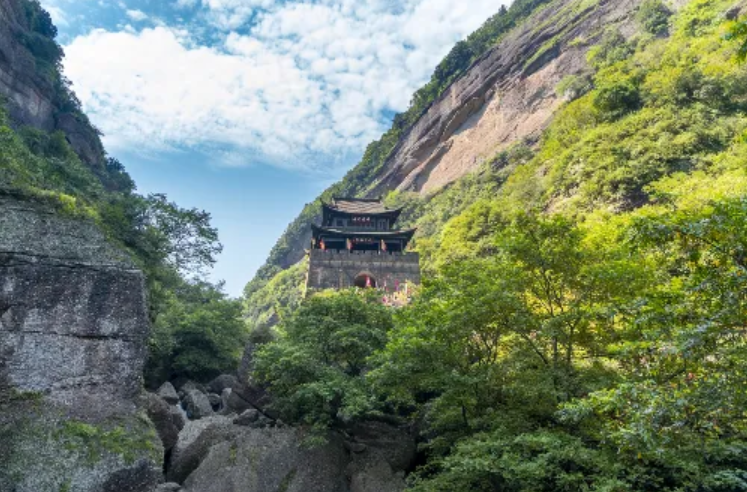
Located at the southernmost end of the scenic area, it was built at the break in the Great Jian Mountain. The pass tower was reconstructed in imitation of the ancient style in early 1992 and was rebuilt after the earthquake in April 2010, expanding to twice its pre-earthquake size. The tower is 19.34 meters high and 13.6 meters wide, rising 150 meters above the flat ground, fully displaying the majestic momentum of "one man guarding the pass, ten thousand men unable to open it." During the Three Kingdoms period, Zhuge Liang established a pass tower here. In the late Shu Han period, Jiang Wei once held this place to resist Wei armies.
Stone Bamboo Shoot Peak
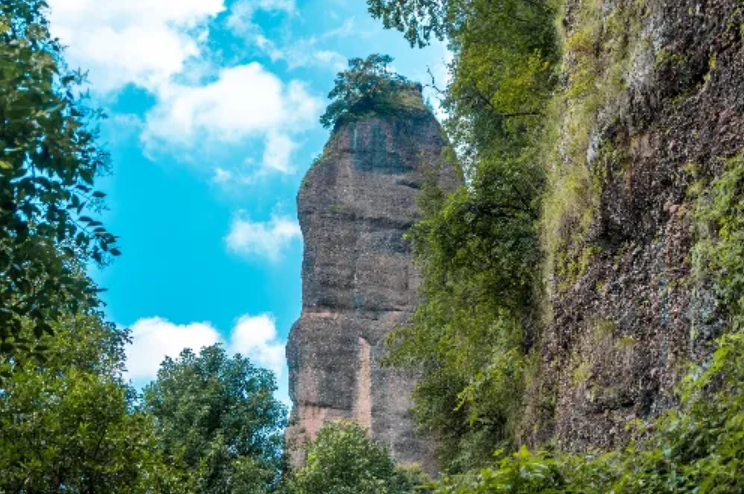
Located in the middle of the Jianmen Pass cliff, it rises 79 meters high, springing up like a bamboo shoot, with a cluster of shrubs growing at its top, like a furious general guarding the majestic Jianmen Pass. Legend has it that Han Xiangzi turned a bamboo flute into a spear here and killed a fierce tiger, and the bamboo tip turned into a stone bamboo shoot to suppress wild beasts.
Glass Landscape Platform
It mainly includes the "Hanging Glass Landscape Platform" and the "Glass Pedestrian Landscape Suspension Bridge." The "Hanging Glass Landscape Platform" is located at the highest point of the scenic area, with an elevation of 1,163 meters. The platform is about 2 meters above the square ground and has an area of about 450 square meters. The "Glass Pedestrian Landscape Suspension Bridge" spans Yixiantian and adopts a fully steel-structured bridge. The bridge deck is 3 meters wide, with a clear span of about 20 meters, and the glass deck area is about 80 square meters.
Yuanrao Road
Yuanrao Road is similar to railway-style climbing. The route is 446 meters long in total, runs in a zigzag pattern, has a vertical height of about 120 meters, and a path width of 30 cm. It is steep and thrilling, with no protective railings, full monitoring, and music. Walking the entire length takes about one hour. The maximum reception capacity is about 250 people. Yuanrao Road has magical and beautiful natural scenery, offering different experiences in different weather, and every day's climb brings a different feeling.
Tianti Gorge
Tianti Gorge was originally called "Houguammen" and "Yinniu Gorge." Li Bai said in "The Difficulty of the Shu Road," "The earth collapsed and the mountains shattered, strong men died, and then heaven's ladders and stone plank roads were linked together." Therefore, since ancient times, plank roads have also been called heaven's ladders. Here, plank road heaven's ladders and high-altitude zip lines connecting the two cliffs have been built, so people renamed it "Tianti Gorge."
Liangshan Temple
Located on the "Sheshen Cliff" between Taohua Peak and Xiaoyao Peak of the seventy-two peaks of Jianmen at an elevation of 1,180 meters, Liangshan Temple was first built in the Tang Dynasty. In the 1980s, after the Liangshan Temple architectural complex was surveyed and listed as a county-level cultural relic protection unit, it came under the management of the Jiange local government. In the late 1990s, it opened as an official religious site.
Yixiantian
Baobao Rock, also known as Yixiantian, is named because the two cliffs face each other and leave only enough space for one person to pass sideways, making it even harder for heavier people to pass. The gap left by the two rocks looks like a treasured sword, with the hilt pointing downward and the blade pointing straight to the blue sky. If photographed, under backlight effects, the sword body can be seen gleaming.
Recommended Tour Route:
Recommended route: enter from the north and exit from the south: North Gate - No. 1 Cableway one-way up - walk to the entrance of Yuanrao Road/Niaodao - after completing the challenge, climb to the mountain-top Glass Observation Platform - Liangshan Temple - No. 2 Cableway one-way down - scenic area shuttle bus to Stone Bamboo Shoot Peak - Cliff Corridor - slide - Pass Tower - exit from the South Gate. This route is suitable for tourists who want to challenge Yuanrao Road/Niaodao and also want to tour the classic attractions. The entire tour takes about 6 hours, depending on how long you stay at each attraction.
Tour Suggestions:
Bring sun protection items. The route in the scenic area is long, with strong sunlight and high physical exertion.
You may bring an appropriate amount of food. Water is sold in the scenic area, but food can be prepared according to personal taste and needs.
Pay attention to the route map on the back of the scenic area ticket and plan your tour route reasonably.
If time is sufficient, you can choose a south-in, south-out route or walk both Yuanrao Road and Niaodao once for a more in-depth tour of the scenic area.
Precautions:
The scenic area is extensive and the itinerary is long. Make full preparations before walking and plan comprehensively.
The whole tour is relatively strenuous. You should prepare yourself psychologically and for the trip in advance and should not rush.
Pay attention to personal and property safety and take good care of accompanying elderly people and children.
Yuanrao Road is restricted to ages 7 to 59. ID information must be filled in. Children must be over 1.2 m tall. At the entrance, blood pressure is measured, a waiver must be signed, and equipment must be worn.
Transportation:
Chengdu - Guangyuan - Jianmen Pass: There are scheduled buses from Chengdu Zhaojuesi Station to Guangyuan, and from Guangyuan Nanhe Bus Station to Jianmen Pass Scenic Area.
Chengdu - New Jiange County Town - Jianmen Pass: There are scheduled buses from Chengdu Zhaojuesi Bus Station to the new Jiange county town (Xiashi), and minibuses from the new Jiange county town to Jianmen Pass.
High-speed rail: After arriving at Jianmen Pass High-speed Railway Station, transfer to the shuttle vehicle on the second basement floor of the station square. There is a direct bus from Jianmen Pass High-speed Railway Station to the South Gate of Jianmen Pass Scenic Area, passing through Jianmen Pass Bus Passenger Station and Jianmen Pass Visitor Center (North Gate). The fare is 6 yuan per person. Departure times are 8:00 - 19:30, every half hour, and during peak passenger flow, the bus departs as soon as it is full.
Opening Hours:
Summer: 08:00 - 17:00
Winter: 08:30 - 16:30
For reference only. Subject to the actual opening hours of the scenic area.
Tickets:
Full price 105 yuan per person, half price 50 yuan per person.