Zhengding Longxing Temple is located in Zhengding County, Shijiazhuang City, Hebei Province. It is one of the larger and better-preserved Buddhist temples surviving in China. It is currently a national 4A-level tourist attraction and also a Major Historical and Cultural Site Protected at the National Level. The scenic area is renowned for its profound historical and cultural heritage, unique architectural style, and rich treasures of Buddhist art, and has long been known as "the first ancient temple south of the capital."
Longxing Temple covers an area of about 82,500 square meters. The buildings within the temple are laid out rigorously and present a magnificent momentum, preserving numerous architectural remains from the Song, Yuan, Ming, and Qing dynasties. Among them, Song dynasty architecture occupies an important position in the temple, reflecting the superb skills and unique style of Song dynasty architecture and serving as important physical materials for the study of the history of ancient Chinese architecture. The temple not only has tall and majestic halls, but also exquisite sculptures, murals, and other works of art, integrating cultural elements of Confucianism, Buddhism, and Daoism, and possessing extremely high historical, artistic, and scientific value.
Historical Culture
The history of Longxing Temple can be traced back to the sixth year of the Kaihuang era of the Sui dynasty (586 AD), when it was first named "Longzang Temple." In the early Tang dynasty, it was renamed "Longxing Temple." In the fourth year of the Kaibao era of the Song dynasty (971 AD), Emperor Taizu Zhao Kuangyin ordered its expansion and had the famous Thousand-Hand Thousand-Eye Guanyin Bodhisattva bronze statue cast in the temple. Thereafter, the scale of the temple continued to expand, and it gradually became an important Buddhist temple in the north.
Over the long course of history, Longxing Temple underwent repeated repairs and reconstructions. The Jin, Yuan, Ming, and Qing dynasties all carried out repairs of varying degrees, allowing the temple to incorporate the architectural characteristics of each dynasty while retaining its original architectural style. During the Ming dynasty, the temple was renamed "Longxing Temple," and this name has been used ever since.
Longxing Temple was not only a place for Buddhist activities, but also closely connected with ancient Chinese politics and culture. Emperor Taizu Zhao Kuangyin of the Song dynasty once visited the temple in person, and later emperors also bestowed gifts and support upon it, giving Longxing Temple an exalted status in history. The "Longzang Temple Stele" preserved in the temple is an important calligraphic inscription from the Sui dynasty. The inscription was written by the Sui dynasty calligrapher Zhang Gongli. The font is dignified and graceful, and it is a treasure of Chinese calligraphic art, of great significance for the study of Sui dynasty calligraphy.
Main Attractions
Hall of the Heavenly Kings
The Hall of the Heavenly Kings is the front gate hall of Longxing Temple. It was first built in the Song dynasty, and the existing building was reconstructed in the Ming dynasty. The hall enshrines the statues of the Four Heavenly Kings, namely Dhrtarastra of the East, Virudhaka of the South, Virupaksa of the West, and Vaisravana of the North. The statues of the Four Heavenly Kings are mighty in appearance and each has a different expression, standing about 4.5 meters tall, reflecting the exquisite level of Ming dynasty sculpture. The hall also contains a seated statue of Maitreya Buddha and a standing statue of Skanda. Maitreya Buddha has a cheerful smile, while Skanda is heroic and dashing, guarding the peace of the temple.
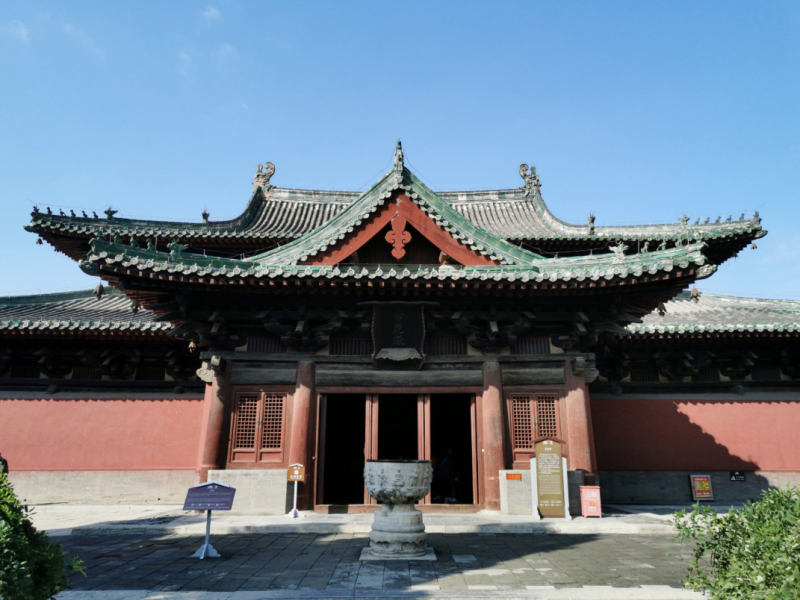
Moni Hall
Moni Hall is one of the landmark buildings of Longxing Temple. It was built in the fourth year of the Huangyou era of the Northern Song dynasty (1052 AD) and is the only surviving Song dynasty building in China with a cross-shaped plan. The layout of the hall is unique, consisting of a central main hall and four side annexes. Its roof is a double-eaved xieshan roof covered with glazed tiles, presenting a magnificent momentum. The hall enshrines statues of Shakyamuni Buddha, the two disciples Ananda and Mahakashyapa, and the two bodhisattvas Manjushri and Samantabhadra. The sculptures are exquisite in craftsmanship. The four walls of the hall also preserve Ming dynasty murals depicting Buddhist stories and figures, with bright colors and smooth lines, possessing high artistic value. With its unique architectural structure and exquisite interior decoration, Moni Hall is praised as "a masterpiece of Song dynasty architecture."
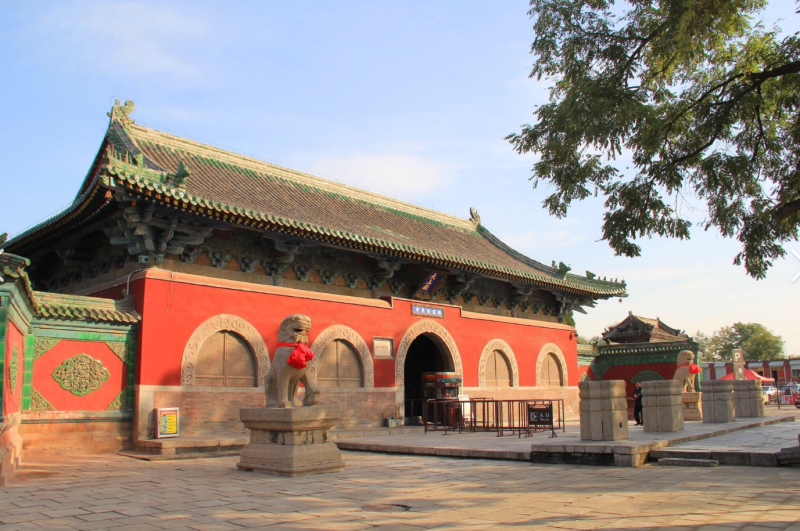
Ordination Platform
The Ordination Platform is located north of Moni Hall and was the place where monks received ordination. It was built in the Ming dynasty. The ordination platform is an octagonal building, 17 meters high, divided into three levels, each with exquisite railings and carvings. Inside the platform is a Ming dynasty bronze statue of Amitabha Buddha, 3.4 meters high. The Buddha statue has a serene expression and fine craftsmanship. The architectural style of the ordination platform is unique, reflecting the characteristics of Ming dynasty architecture, and it is one of the relatively complete Ming dynasty ordination platforms surviving in China.
Hall of the Revolving Scripture Repository
The Hall of the Revolving Scripture Repository was first built in the Northern Song dynasty and was specially constructed to house a revolving scripture repository. The revolving scripture repository is a wooden rotating scripture rack about 7 meters in diameter and 10 meters high. It adopts a central-pillar structure, is ingeniously designed, and rotates flexibly. It is the earliest and largest surviving revolving scripture repository in China. The wooden structure inside the hall uses various complex mortise-and-tenon joints, reflecting the advanced architectural technology of the Song dynasty.
Cishi Hall
Cishi Hall stands opposite the Hall of the Revolving Scripture Repository and was also built during the Northern Song dynasty. The hall enshrines a 7.4-meter-tall standing statue of Maitreya Bodhisattva, a wooden sculpture from the Song dynasty. The statue has smooth lines and a solemn expression. The architectural style of Cishi Hall is similar to that of the Hall of the Revolving Scripture Repository. Both are two-story pavilion-style buildings with ingenious internal structures and important architectural research value.
Thousand-Hand Thousand-Eye Guanyin Pavilion (Dabei Pavilion)
The Thousand-Hand Thousand-Eye Guanyin Pavilion, also known as Dabei Pavilion, is the main building of Longxing Temple. It was built in the fourth year of the Kaibao era of the Northern Song dynasty (971 AD), and the existing building was reconstructed in the Qing dynasty. The pavilion is 33 meters high and has three stories, magnificent in momentum. The pavilion enshrines a 21.3-meter-tall bronze statue of Thousand-Hand Thousand-Eye Guanyin Bodhisattva, which is the largest surviving bronze Guanyin statue in China. The casting technique of the bronze statue is exquisite. Guanyin Bodhisattva has a kind face, and the thousand-hand thousand-eye form is unique, reflecting the superb level of Song dynasty casting technology. Around Dabei Pavilion there are also surrounding corridors, within which Song dynasty murals and inscriptions are preserved, possessing high artistic value.
Longzang Temple Stele
The Longzang Temple Stele is located within Longxing Temple and was carved in the sixth year of the Kaihuang era of the Sui dynasty (586 AD). It is the earliest surviving stele in Longxing Temple. The stele is 2.6 meters high and 1.3 meters wide. The inscription records the process of building Longzang Temple and its historical evolution, and was written by the famous calligrapher of the time, Zhang Gongli. The calligraphy of the inscription combines the characteristics of clerical script and regular script. The font is dignified and graceful, and the brushwork is smooth. It is a representative work of the important transitional period in Chinese calligraphy history from clerical script to regular script, and is praised as "the first Sui stele." It has extremely high calligraphic artistic value and historical documentary value.
Food
Zhengding Majia Chicken
Zhengding Majia Chicken is a traditional famous food of Zhengding County with a history of more than 100 years. It uses high-quality free-range local chickens as raw materials and is braised with various spices and a unique production process. Majia Chicken is characterized by a golden color, tender meat, tender but not falling apart, rich aroma, and fat but not greasy. Authentic Majia Chicken can be tasted in many restaurants and snack shops around Longxing Temple, and it is one of the foods not to be missed when traveling to Zhengding.
Zhengding Benggan
Zhengding Benggan is a specialty snack of Zhengding with a long history. It uses pork liver as its raw material and is made through multiple processes such as cleaning, shredding, pickling, air-drying, and steaming. The finished Benggan is red and glossy, chewy in texture, salty and fragrant in taste, and has a unique flavor. It can be bought in markets and snack stalls near Longxing Temple, and it is a favorite dish to go with alcohol and a side food among local residents.
Zhengding Eight Great Bowls
Zhengding Eight Great Bowls is a traditional banquet dish of the Zhengding area, consisting of eight stewed dishes, including four meat dishes and four vegetarian dishes. The meat dishes usually include stewed chicken, stewed fish, stewed meat, and stewed meatballs, while the vegetarian dishes include stewed tofu, stewed vermicelli, stewed cabbage, and stewed kelp. The preparation of the Eight Great Bowls emphasizes heat control and seasoning. The dishes are rich in flavor and nutritious, reflecting the characteristics of northern cuisine. Authentic Zhengding Eight Great Bowls can be tasted in some time-honored restaurants around Longxing Temple, and it is suitable for group dining.
Tickets:
As of August 11, 2025, the ticket price is 50 yuan per person.
You can search for the official public account "Zhengding County Longxing Temple Scenic Area" on WeChat to obtain the latest updates; you can search for the official service account "Zhengding Longxing Temple Scenic Area" on WeChat to purchase tickets online.
Opening Hours:
Opening hours are adjusted according to the seasons. In summer (April 1-October 31), the opening hours are 8:00-18:00, with entry stopping at 17:30; in winter (November 1-March 31 of the following year), the opening hours are 8:30-17:00, with entry stopping at 16:30. The scenic area will appropriately adjust opening hours according to visitor numbers during statutory holidays. Visitors are advised to check the latest opening hours through official channels before traveling so as not to affect their itinerary.
Tour Route:
After entering Longxing Temple, visitors can tour according to the following route: first enter through the main gate and visit the Hall of the Heavenly Kings to admire the statues of the Four Heavenly Kings and the statues of Maitreya Buddha and Skanda; then head north to Moni Hall to experience its unique cross-shaped architectural structure and view the Buddha statues and murals inside; after leaving Moni Hall, go west to the Hall of the Revolving Scripture Repository to see China's earliest and largest surviving revolving scripture repository; then go east to Cishi Hall to admire the Song dynasty wooden statue of Maitreya Bodhisattva; afterward head north to the Ordination Platform to learn about the place where monks received ordination and the Ming dynasty bronze Amitabha Buddha statue; continuing north is the core building of the scenic area, Dabei Pavilion, where you can closely admire the huge bronze statue of Thousand-Hand Thousand-Eye Guanyin; finally, stroll within the temple and look for other historical relics and landscapes such as the Longzang Temple Stele. This route is about 2-3 kilometers in total, and the suggested touring time is 3-4 hours, allowing a comprehensive appreciation of Longxing Temple's main attractions and historical culture.
Transportation:
Public transportation: From downtown Shijiazhuang, take Metro Line 1 to the "Zhengding Ancient City" station, then transfer to Zhengding County buses such as No. 137 and No. 143 and get off at the "Longxing Temple" station. There are also long-distance buses from downtown Shijiazhuang to Zhengding County. After getting off at Zhengding Bus Station, you can take a taxi or bus to Longxing Temple. The taxi fare is about 10 yuan.
Self-driving: Starting from downtown Shijiazhuang, drive north along Tiyu North Street, enter Zhengding County after passing Zilong Bridge, and follow navigation instructions to Longxing Temple. There is a parking lot in the scenic area, and the parking fee is 5 yuan per hour.
Taxi/ride-hailing: Taking a taxi from downtown Shijiazhuang to Longxing Temple is about 30 kilometers in total, costing about 60-80 yuan; taking a taxi within Zhengding County to Longxing Temple costs generally 5-15 yuan depending on the starting point.
Must-Visit Attractions:
Moni Hall: China's only surviving cross-shaped Song dynasty building, with exquisite Buddha statues and Ming dynasty murals inside. Its architectural structure is unique, and it is an outstanding representative of Song dynasty architecture. It must not be missed.
Thousand-Hand Thousand-Eye Guanyin Pavilion (Dabei Pavilion): Inside is China's largest surviving bronze statue of Thousand-Hand Thousand-Eye Guanyin, 21.3 meters high. It is majestic and exquisitely cast, and is a landmark attraction of Longxing Temple.
Hall of the Revolving Scripture Repository: It houses China's earliest and largest surviving wooden revolving scripture repository, about 7 meters in diameter and 10 meters high. It is ingeniously designed and reflects the advanced architectural technology of the Song dynasty.
Longzang Temple Stele: An important calligraphic stele from the Sui dynasty, praised as "the first Sui stele." The calligraphic value of the inscription is extremely high, and it is an important physical object for the study of Chinese calligraphy history.
Travel Suggestions:
Longxing Temple has many attractions and rich historical culture. It is recommended to arrange 3-4 hours for the visit so as to fully appreciate the characteristics of each attraction.
Spring and autumn are the best seasons to visit Longxing Temple. At this time, the weather is suitable and the temperature is moderate, making it suitable for outdoor activities. The temple is also rich in vegetation, and the scenery in spring and autumn is beautiful.
The scenic area has professional tour guides providing explanation services, costing about 50-100 yuan per time. Hiring a guide can help you gain a deeper understanding of Longxing Temple's historical culture and the background stories of each attraction, enhancing the travel experience. Electronic audio guides can also be rented for about 30 yuan per device.
Zhengding County also has other historical attractions such as Zhengding Ancient City Wall, Kaiyuan Temple, and Linji Temple. Visitors can combine Longxing Temple with these attractions to experience Zhengding's profound historical and cultural heritage.
Notes:
The temple is a Buddhist site. Visitors should abide by relevant regulations, keep quiet, respect religious beliefs and customs, not touch Buddha statues, murals, and other cultural relics at will, and not make loud noises or chase and play in the temple.
Please protect cultural relics and the environment, do not spit or litter, and do not damage buildings, vegetation, or other facilities in the scenic area.
When entering the scenic area, visitors must consciously accept security checks. Flammable, explosive, dangerous, and other prohibited items are not allowed into the scenic area.
Some buildings in the scenic area are of great age, and the ground may be slippery. Please pay attention to safety when touring, especially on rainy days and in winter.
When taking photos, please abide by the regulations of the scenic area. Some attractions may prohibit photography or the use of flash, and you should follow the guidance of staff.
The scenic area has dining and rest facilities, which visitors can use as needed, but prices are relatively high. You may also bring an appropriate amount of food and water.