Huanglong Scenic and Historic Interest Area is located in Songpan County, Aba Tibetan and Qiang Autonomous Prefecture, Sichuan Province. It is a national 5A-level tourist attraction, a World Natural Heritage site, and a World Biosphere Reserve. The scenic area covers a total area of about 1,340 square kilometers, with a core scenic area of 700 square kilometers. At an altitude of over 3,000 meters, it features the "Seven Wonders" of colored ponds, snow-capped mountains, gorges, forests, travertine shoals, ancient temples, and folk customs. It boasts the world's rare travertine terrace landscape and is China's only well-preserved alpine wetland. Huanglong Scenic and Historic Interest Area mainly consists of Huanglong Valley Scenic Area, Munigou Scenic Area, Xuebaoding Scenic Area, and Danyunxia Scenic Area.
History and Culture
The name Huanglong (Yellow Dragon) originates from the legend of Yu the Great controlling floods: it is said that the leader of the Di and Qiang peoples transformed into a yellow dragon to help Yu the Great control the floods, carrying his boat to dredge the Min River, and eventually stayed at Xuebaoding to cultivate himself. Later generations built Huanglong Temple in his memory. Another account says that the Immortal Huanglong attained enlightenment here. According to the Songpan County Annals, "Huanglong Temple... it is said that the Immortal Huanglong cultivated the Dao here." The temple is divided into the Front, Middle, and Rear temples, with halls and pavilions facing one another.
The scenic area is a multi-ethnic settlement, mainly inhabited by Tibetan and Qiang people, who have preserved their original religious beliefs and unique folk customs. Xuebaoding is regarded as a sacred mountain by the Tibetan and Qiang peoples, known as "Dongri" in Tibetan and "Duru" in Qiang. Religious activities such as the mountain-worshipping festival are held every year. Huanglong Temple is an important site where Tibetan Buddhism and local religions have merged, and it preserves religious relics dating back to the Qing Dynasty and earlier.
Main Attractions
Huanglong Valley
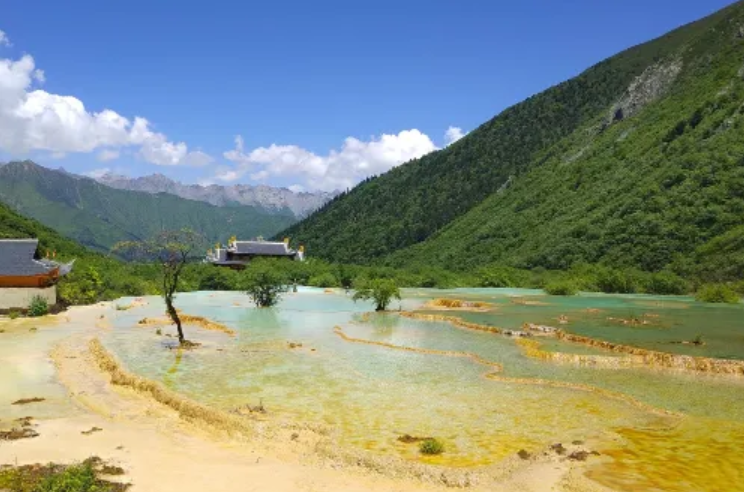
Huanglong Valley is the core scenic area of Huanglong Scenic and Historic Interest Area, about 3.6 kilometers long, with more than 3,400 travertine colored ponds. It is represented by the "Golden Sand Spread on the Ground" travertine shoal, the "Xishen Cave" travertine waterfall, and the "Five-Color Pond" alpine travertine pond group. The pond water displays colors such as blue, green, and purple depending on the light, and is praised as the "Jade Pool of the Human World."
Munigou
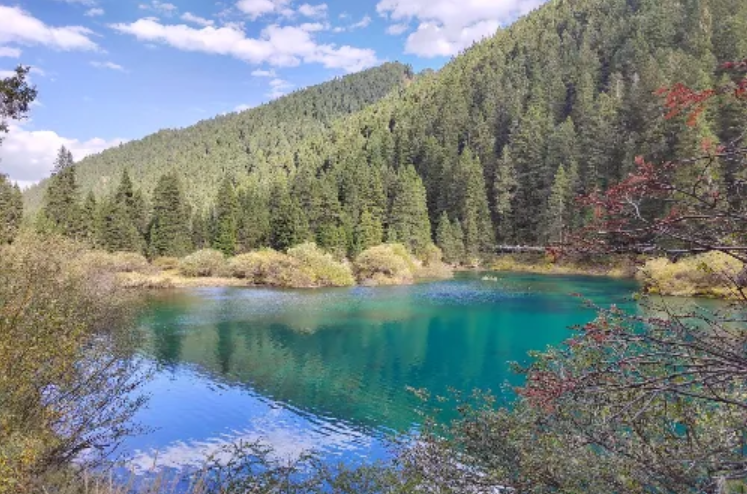
Composed of Zhaga Waterfall and Erdaohai, Zhaga Waterfall is 93.2 meters high and 35 meters wide, making it China's tallest travertine waterfall. Erdaohai features a group of alpine lakes (haizi), with the largest lake, Swan Lake, covering about 1.2 square kilometers. The water is crystal clear, surrounded by dense forests.
Xuebaoding
The main peak of the Minshan Mountains, at an altitude of 5,588 meters, is a famous mountaineering destination in Sichuan. The summit is covered with snow year-round, with developed glaciers. Alpine meadows and glacial lakes such as Yuanhai and Fanghai are distributed at the foot of the mountain.
Huanglong Ancient Temple
Huanglong Ancient Temple has a history of more than 600 years. According to the Songpan County Annals, "Huanglong Temple was built by Ma Chaojin, Deputy Military Commissioner of the Ming Dynasty, and is also called Xueshan Temple." It is said that the Immortal Huanglong cultivated the Dao here, hence the name. Huanglong Ancient Temple is an important site for studying the evolution of religious culture in ethnic minority areas and an important piece of evidence for tracing the historical relics of Yu the Great's flood control at the source of the Min River.
Danyunxia
Danyunxia, with its elegant gorge scenery, has become one of the "Five Wonders" of Huanglong. Danyunxia Scenic Area starts from Yusun Peak Group and ends at Shanzidong, stretching 18.5 kilometers with a drop of 1,300 meters. The height difference between peaks and valleys ranges from 1,000 to 2,000 meters.
Tour Routes:
One-day tour route: Scenic area entrance → take the sightseeing bus to the lower station of the cableway → take the cableway (or walk) to Wanglongping → walk through Jinsha Pudi → Xishen Cave → Huanglong Ancient Temple → Five-Color Pond → return by the same route or walk down the mountain
Two-day tour route: On the first day, visit the core area of Huanglong Valley; on the second day, go to Munigou, visit Zhaga Waterfall in the morning and Erdaohai in the afternoon
Travel Tips:
In high-altitude areas, the temperature difference between day and night is large, so warm clothing such as down jackets and scarves should be prepared.
The ultraviolet rays are strong, so sunscreen (SPF50 ), sunglasses, and sun hats should be brought.
It is recommended to walk slowly and avoid strenuous exercise. Take rhodiola in advance to prevent altitude sickness.
There are few dining options in the scenic area, so portable foods such as chocolate and energy bars can be carried.
Respect local religious customs. Remove hats when entering temples, and photography is prohibited.
Precautions:
The scenic area is at a high altitude (3,000-4,000 meters). People with high blood pressure or heart disease should travel with caution.
In winter, roads may be icy, so non-slip shoes are needed, and some sections may be closed.
Smoking and littering are strictly prohibited in the scenic area to protect the alpine ecological environment.
Follow the arrangements of tour guides or scenic area staff, and do not enter unopened areas without authorization.
Check the weather forecast in advance and avoid visiting on rainy days (which may cause mudslides).
Transportation:
By plane: About a 1-hour drive from Jiuzhaigou Huanglong Airport. There are direct buses from the airport to the scenic area (fare about 22 yuan).
By bus: Chengdu Chadianzi Bus Station has daily direct buses to Songpan County (fare about 100-150 yuan, travel time 6-8 hours). From Songpan County to the scenic area takes about 1 hour (shuttle bus 15 yuan/person or carpooling 50 yuan/vehicle).
By self-driving: Chengdu → Dujiangyan → Wenchuan → Maoxian → Songpan → Huanglong (about 350 kilometers in total, travel time 5-6 hours; pay attention to plateau mountain road safety).
Opening Hours:
Peak season (April 1-November 15): 08:00-18:00
Off-season (November 16-March 31 of the following year): 08:30-17:00
Note: The Xuebaoding area is a high-altitude region, and some sections are closed in winter. It is recommended to consult the scenic area in advance.
Tickets:
Peak season (April 1-November 15): 170 yuan/person
Off-season (November 16-March 31 of the following year): 60 yuan/person
Note: Munigou Scenic Area is ticketed separately. Zhaga Waterfall is 70 yuan/person, and Erdaohai is 70 yuan/person. Sightseeing bus and cableway are charged separately: upward 80 yuan, downward 40 yuan.