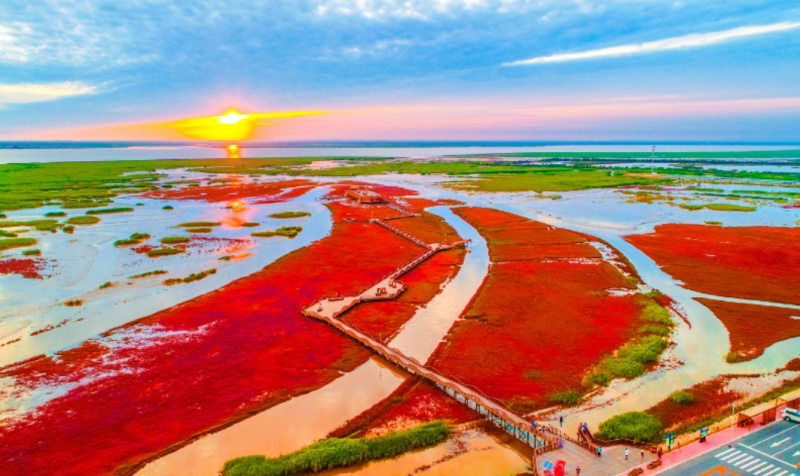
The Red Beach Scenic Corridor is located in Zhaoquanhe Town, Dawa District, Panjin City, Liaoning Province. It is a national 5A-level tourist attraction. Relying on the world's best-preserved and largest wetland resources, and featuring the world's rare red beach and the world's largest reed marsh, it is an ecological tourist attraction that perfectly combines the natural environment with cultural landscapes. The scenic area is about 18 kilometers long in total, with a total area of more than 20 square kilometers, of which the core landscape area is about 10 square kilometers. The red beach here is formed by a unique herbaceous plant called suaeda salsa. Every autumn, suaeda salsa turns bright red, spreading across the tidal flats along the coast of Bohai Bay and forming a red sea. Together with the blue seawater and green reed marshes, it creates a unique natural landscape. The scenic area has multiple viewing platforms, viewing bridges, parking lots, and other facilities with complete supporting services. It is an ecological tourism destination integrating leisure sightseeing, scientific investigation, and science education, attracting a large number of tourists every year.
Historical Culture
The Panjin wetland area where Red Beach is located was historically an important fishing and hunting area at the mouth of the Liao River. Traces of human activity date back to the Neolithic Age. The ancestors of the area made a living by fishing, hunting, and boiling salt, and formed a unique wetland culture over the long course of production and life.
During the Ming and Qing dynasties, this place was an important coastal defense fortress in the Liaodong Bay area. Some military defense ruins remain, bearing witness to the frontier defense history of that time. At the same time, with the influx of migrants, agriculture and fisheries gradually developed, forming a production mode centered on the utilization of wetland resources, such as rice-field aquaculture and reed weaving. These traditional skills are still passed down locally today.
Since the 1980s, the local area began to attach importance to wetland ecological protection, and the unique landscape of Red Beach gradually became known to the outside world. In 2013, the Red Beach Scenic Corridor was officially opened to the public. After years of construction and improvement, it has become an important window for displaying wetland ecological culture. Elements such as "rice farming culture" and "fishing and wild goose culture" in the scenic area are presented through exhibition halls, sculptures, and other forms, allowing tourists to understand the history of harmonious coexistence between local people and nature while enjoying the natural landscape.
Main Attractions
Love Declaration Corridor
The Love Declaration Corridor is one of the landmark viewing platforms of Red Beach. It is located in the middle section of the scenic area, with a total length of about 100 meters. It is built with a wooden structure and winds above the red beach. This is an excellent location for viewing the panoramic view of Red Beach. With a wide field of vision, visitors can take in the red tidal flats, green reeds, and the oilfield pumpjacks (nodding donkeys) in the distance. On both sides of the viewing platform are heart-shaped hollow sculptures. Many tourists hang love locks here to express beautiful emotions, hence the name "Love Declaration Corridor." In autumn, suaeda salsa is at its most intense red, contrasting beautifully with the blue sky and white clouds, making it a popular spot for photos.
Rice Dream Space
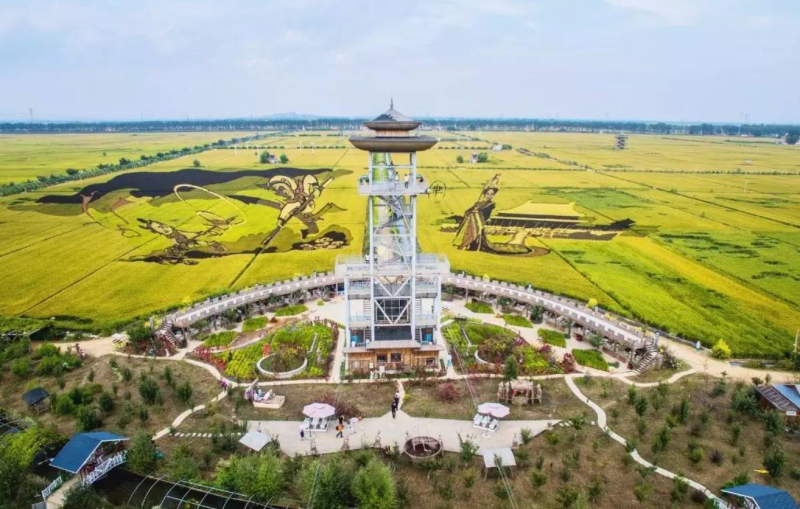
Rice Dream Space features rice-field art and covers an area of about 2,000 mu. It is a representative attraction in the scenic area that combines culture and nature. Here, different varieties of rice are planted to outline huge patterns in the fields, such as "Dragon Soaring in a Prosperous Age" and "Red-Crowned Crane," which are spectacular when viewed from above. The scenic area has a 30-meter-high viewing tower. Climbing to the top allows visitors to view the complete rice-field paintings. In addition, there are rice-field boardwalks, farming culture exhibition areas, and other facilities. Tourists can experience activities such as catching crabs in rice fields and picking, and feel the charm of rice farming culture. The best period for viewing rice-field paintings is from summer to autumn, and the patterns are changed in different seasons.
Red Beach Wetland Science Museum
The Red Beach Wetland Science Museum is located near the entrance of the scenic area, with a building area of about 3,000 square meters. It is a professional exhibition hall integrating wetland ecological display, science education, and scientific research. Through multimedia presentations, physical specimens, scene simulations, and other methods, the museum systematically introduces the composition of the wetland ecosystem, the formation principle of Red Beach, the growth characteristics of suaeda salsa, and the biodiversity of the Liao River Estuary wetland. The museum displays specimens of rare birds such as red-crowned cranes and Saunders's gulls, as well as hundreds of wetland plant specimens, helping tourists gain a deeper understanding of the importance of wetland ecological protection. The museum also has an interactive experience area, suitable for family visitors.
Wolong Lake
Wolong Lake is a natural lake in the scenic area, covering an area of about 500 mu. The lake surface is open, surrounded by reed marshes and red beach. A variety of water birds inhabit the lake, such as wild ducks and egrets, making it a good place for birdwatching. The scenic area has built wooden boardwalks and viewing platforms by the lake, about 1.5 kilometers long. Tourists can stroll along the boardwalk and enjoy the lake and mountain scenery and wetland landscape. In the early morning, the lake surface is often covered with mist, and the reeds sway in the wind, making the scenery look like a fairyland; in the evening, the setting sun falls on the lake, shimmering beautifully.
Corridor Bridge Love Dream
Corridor Bridge Love Dream is a wooden corridor bridge spanning between the red beach and the reed marsh, with a total length of about 500 meters. The bridge surface winds and turns, with multiple rest pavilions. The landscapes on both sides of the bridge are different: one side is the red suaeda salsa tidal flat, and the other side is the green reed marsh. Walking on the bridge, visitors can enjoy two completely different wetland scenery at the same time. In autumn, the red tidal flats and golden reeds set each other off, making the scenery especially beautiful. At the end of the bridge is a large viewing platform, an excellent place to watch the sunset.
Food
Panjin River Crab
Panjin River Crab is one of the most distinctive local foods. Because it grows in the wetland rice fields at the mouth of the Liao River, its meat is tender, the roe is full, and the taste is delicious. September to October is the season when river crabs mature. Restaurants around the scenic area offer dishes such as steamed river crab and spicy river crab. Steamed river crab best reflects its original flavor. Each crab weighs about 100-150 grams, and the price depends on size, about 50-100 yuan each. It is recommended to eat it with ginger vinegar sauce, which can remove the fishy smell and enhance the freshness.
Reed Leaf Wrapped Rice
Reed leaf wrapped rice is a traditional food of the Panjin wetland. Fresh reed leaves are used to wrap glutinous rice, rice, or millet, with fillings such as red dates and red bean paste, and then steamed. The fragrance of the reed leaves blends into the rice, making it soft, glutinous, sweet, and fragrant. At farmhouses in the scenic area, each portion is priced at about 15 yuan, with a generous portion. It is a must-try food for tourists experiencing local characteristics. In addition, there are reed leaf wrapped zongzi, which are more common around the Dragon Boat Festival and have a unique taste.
Wetland Mixed Fish
Wetland mixed fish uses a variety of wild small fish from the waters of the Liao River Estuary wetland, such as crucian carp, snakehead, and Amur sleeper. After being cleaned, they are braised with local bean paste, chili, and other seasonings. The soup is rich, and the fish is tender and flavorful. At "fisherman's restaurants" around the scenic area, each portion is priced at about 68 yuan. It tastes even better when eaten with corn pancakes dipped in the soup, reflecting the dietary characteristics of local fishermen.
Nearby Food
About 20 kilometers from the scenic area, Panjin city proper has many specialty restaurants. "Old Panjin Restaurant" is recommended, focusing on local home-style dishes. Signature dishes include pickled cabbage and white meat hot pot (48 yuan per portion) and braised sea hare in soy sauce (58 yuan per portion), with authentic flavors; "River Fresh Restaurant" focuses on seafood, such as salted prawns (88 yuan per portion) and stir-fried clams (38 yuan per portion). The ingredients are fresh, and the per capita consumption is about 80 yuan. In addition, the night market in the city also has special snacks such as grilled river crab and fried reed worms, allowing visitors to experience different flavors.
Tickets:
Tickets are 85 yuan per person.
You can search for the official public account "Red Beach Scenic Corridor" on WeChat to get the latest updates. As of July 15, 2025, the official WeChat public account does not provide online ticket purchasing.
Opening Hours:
The opening hours of the scenic area are adjusted according to the seasons:
April 1-October 31 (peak season): 8:00-17:30 (last entry at 17:00);
November 1-March 31 of the following year (off season): 9:00-16:00 (last entry at 15:30).
Among them, the best viewing period for Red Beach is from mid-September to late October, when the color of suaeda salsa is the most vivid; the viewing period for the rice-field paintings in Rice Dream Space is from July to October. In the off season, some attractions may be closed or have shortened opening hours. It is recommended to check official notices before traveling.
Tour Route:
Recommended one-day tour route: arrive at the scenic area entrance at 8:30 a.m., purchase tickets and sightseeing bus tickets, then take the sightseeing bus to the first attraction, the Red Beach Wetland Science Museum (about 15 minutes), and visit the museum to learn about wetland ecology (about 1 hour); at 10:00, take the sightseeing bus to Corridor Bridge Love Dream, stroll along the bridge, and enjoy the red beach and reed marsh scenery (about 1.5 hours); at 11:30, go to Wolong Lake and walk along the lakeside boardwalk to watch birds (about 1 hour); at 12:30, dine at a farmhouse near Wolong Lake and taste specialty foods such as Panjin river crab (about 1 hour); at 13:30, take the sightseeing bus to Love Declaration Corridor, view the panoramic view of Red Beach, and take photos (about 1 hour); at 14:30, go to Rice Dream Space, climb the viewing tower to see the rice-field paintings, and experience field activities (about 1.5 hours); at 16:00, take the sightseeing bus back to the scenic area entrance, and on the way you can buy souvenirs such as river crabs and reed paintings at the specialty store; at 17:00, end the trip. The whole journey combines sightseeing bus travel and walking, with a total walking distance of about 3-4 kilometers, making it relatively easy.
Transportation:
Bus: In Panjin city proper, you can take the special tourist bus (Route 30) directly to the Red Beach Scenic Corridor. The starting point is Panjin Railway Station. The journey takes about 1 hour, the fare is 10 yuan, and there is one bus every 30 minutes;
Self-driving: From Panjin city proper, drive south along Xianghai Avenue for about 30 kilometers, then turn into Zhaoquanhe Street to reach the scenic area. The whole journey takes about 40 minutes; the scenic area parking lot charges 20 yuan per time for small vehicles and 30 yuan per time for large vehicles, with sufficient parking spaces;
Tourist special line: Cities such as Shenyang and Dalian have one-day tour special lines to Red Beach, including round-trip transportation and tickets, priced at about 200-260 yuan per person. You can register at local travel agencies;
Taxi: Taking a taxi from Panjin city proper to the scenic area costs about 80-100 yuan, and the journey takes about 40 minutes. It is suitable for multiple people traveling together to share the cost.
Must-Visit Attractions:
Love Declaration Corridor: A 100-meter-long wooden viewing platform where you can overlook Red Beach, reed marshes, and oilfield scenery. The red color is most intense in autumn, and it is a landmark check-in point;
Rice Dream Space: A 2,000-mu rice-field art area. The 30-meter-high viewing tower allows visitors to view huge rice-field paintings and also experience farming activities, suitable for family visits;
Corridor Bridge Love Dream: A 500-meter-long wooden corridor bridge. The two sides are respectively Red Beach and reed marsh, allowing visitors to enjoy two kinds of scenery at the same time. The scenery is stunning at sunset;
Red Beach Wetland Science Museum: A 3,000-square-meter science exhibition hall that displays wetland ecology through various methods and is an important window for understanding the formation of Red Beach.
Travel Suggestions:
The best season to visit is September-October, when suaeda salsa is bright red and the rice-field paintings are also at their best viewing period; in summer, visitors can enjoy green wetlands and water birds, while in winter it is quieter with fewer people, allowing visitors to experience a different kind of wetland charm;
The ultraviolet rays in the scenic area are relatively strong. It is recommended to bring sunscreen, a sun hat, sunglasses, and other sun protection items; it is windy in autumn, so a light jacket is needed;
Food in the scenic area is relatively expensive. You can bring snacks and water, or choose to dine in Zhaoquanhe Town outside the scenic area for better value;
It is recommended to take the scenic area sightseeing bus to save energy. The distances between attractions are relatively long, and walking takes a long time;
Photography enthusiasts are advised to bring telephoto lenses to photograph distant birds and the panoramic view of Red Beach; light is soft in the early morning and evening, making it the best time for photography;
If you want to taste fresh river crabs, you can go in September-October. There are many river crab farms around the scenic area where you can buy on site and have them processed.
Precautions:
Trampling on suaeda salsa and picking reeds are prohibited in the scenic area. Violators will face fines. Protecting the wetland ecology is the responsibility of every tourist;
When birdwatching, please do not make loud noises, do not feed birds at will, and keep a safe distance to avoid disturbing their normal lives;
Some viewing platforms and boardwalks in the scenic area are wooden structures and may be slippery on rainy days or in winter. Please pay attention to safety when walking;
There are many mosquitoes in the wetland in summer. It is recommended to bring mosquito repellent; in autumn there may be autumn winds, so attention should be paid to wind protection and warmth;
Self-driving tourists should not drive vehicles into non-designated areas and should park in the parking lot as required;
There is a medical point in the scenic area (located near the Red Beach Wetland Science Museum). If you feel unwell, you can go there promptly for help.