Ciqikou Ancient Town is located on the banks of the Jialing River in Shapingba District, Chongqing. It is a national 4A-level tourist attraction and a China Historical and Cultural Street. Founded in the Song Dynasty, the town features a unique topography of "one river, two streams, three hills, and four streets," covering an area of approximately 1.5 square kilometers, with a core protection area of 0.7 square kilometers. Its distinctiveness lies in the preservation of 12 ancient streets in the mountain style from the Ming and Qing dynasties. The architecture is mainly in the Sichuan-Chongqing residential style, with blue tiles, white walls, and brick-and-wood structures. The street layout is "T"-shaped, and most of the extant ancient buildings date from the Ming and Qing dynasties to the Republic of China period. The town integrates Ba-Yu culture, religious culture, Sha-Mu culture, Hongyan culture, and folk culture, earning it the nickname "Little Chongqing."
History and Culture
Ciqikou was formerly known as "Baiyanchang" (White Rock Field), named after Emperor Jianwen of the Ming Dynasty, Zhu Yunwen, who lived in seclusion here and inscribed the characters "Baiyan." In the Song Dynasty, it became a center for porcelain production. By the Ming and Qing dynasties, due to the flourishing shipping on the Jialing River, it became a distribution center for goods in eastern Sichuan, and the name "Ciqikou" (Porcelain Port) replaced the old name because of the thriving porcelain industry.
During the War of Resistance against Japan, Ciqikou served as an important rear area of the wartime capital Chongqing. Institutions such as the National Central University and Chongqing University moved here, and cultural figures like Xu Beihong and Fu Baoshi resided here, leaving behind numerous cultural relics. At the same time, it is also an important carrier of Hongyan culture; the New Fourth Army's Chongqing office was once established within the town.
The town preserves traditional folk customs such as Sichuan opera seated singing, fire dragon performances, and night watch calls. Among them, the "Ciqikou Fire Dragon" is listed in the Chongqing Municipal Intangible Cultural Heritage. The annual Fire Dragon Lantern Festival during the Spring Festival attracts tens of thousands of visitors.
Major Attractions
Ci Main Street
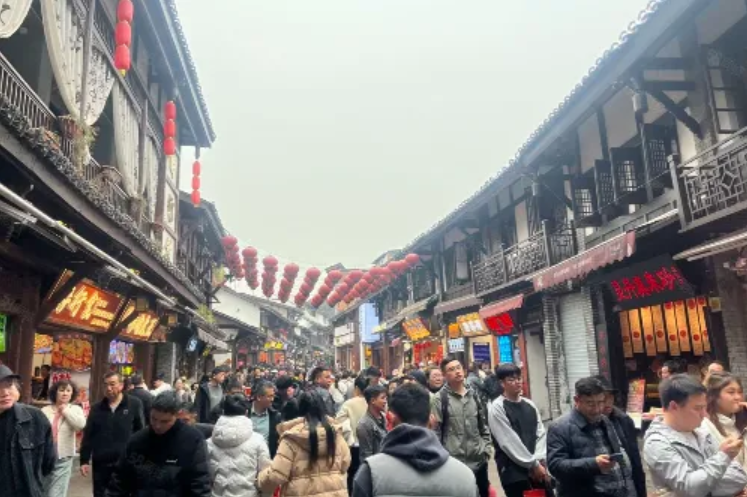
Ci Main Street is the town's main thoroughfare, 1,278 meters long and 3–5 meters wide, paved with bluestone slabs and lined with Ming-Qing-style stilted buildings and shops. Along the street are historic sites such as the Hanlin Academy, Baolun Temple, and Zhongjia Courtyard. The Hanlin Academy is a former private school site from the Qing Dynasty, with extant buildings in a typical courtyard style, covering about 800 square meters.
Baolun Temple
Baolun Temple was first built in the Tang Dynasty (Zhenguan period) and has a history of over 1,400 years, making it one of the oldest temples in Chongqing. Located on Jinbi Mountain in Ciqikou, the temple covers about 3,000 square meters. It preserves the Ming Dynasty Great Hall and Qing Dynasty Sutra Depository. The Great Hall's wooden structure uses full mortise-and-tenon joinery without a single iron nail.

Zhongjia Courtyard
Zhongjia Courtyard is a residential compound from the late Qing to early Republic period, originally the home of the wealthy merchant Zhong Yunting. Covering about 1,500 square meters, it is a typical eastern Sichuan-style residence, consisting of a main hall, side rooms, and a courtyard. It preserves carved doors and windows, bluestone-paved courtyards, and other features that showcase traditional residential architecture.
Hanlin Academy
Originally named Lishi Caotang (or Lishi Academy), it is one of the only surviving ancient private schools in the Chongqing urban area. During the Qianlong reign of the Qing Dynasty, the Sun family ran a school here and cultivated many successful imperial examination candidates. Hence, the saying goes, "One family produced three juren, and within five li two hanlin." Today, the Hanlin Academy has been converted into a teahouse.
Wenchang Palace
Wenchang Palace was first built in the Ming Dynasty as a temple to worship Wenchang Dijun (the God of Literature). It covers about 1,200 square meters, and the existing structures date from a Qing Dynasty reconstruction. Inside are the Wenchang Hall and Kuixing Pavilion, with exquisite wood and stone carvings. Historically, it was a place where local scholars prayed for academic success. Today, it serves as an important venue displaying the town's folk culture, often hosting calligraphy and painting events.
Baoshan Palace
Baoshan Palace was first built in the Qing Dynasty as a Taoist temple, covering about 1,000 square meters. The surviving buildings are brick-and-wood structures, consisting of a front hall, rear hall, and side chambers. It once housed Taoist deities but has now been converted into the Ciqikou Folk Museum, displaying daily utensils, costumes, festival items, and other artifacts that systematically present Ba-Yu folk culture.
Ciqikou Wharf
Ciqikou Wharf was an important water and land dock on the Jialing River. The existing wharf was rebuilt in the Qing Dynasty, about 200 meters long and 15 meters wide. It retains stone steps, mooring stones, and other relics. On the bank, there is an "Old Teahouse" where visitors can experience traditional covered-bowl tea and Sichuan opera performances.
Ciqikou Back Street
Ciqikou Back Street lies adjacent to the ancient town, covering a total area of 83,700 square meters with a planned construction area of about 154,000 square meters and a total investment of approximately 1.8 billion yuan. It is built around three cultural themes: climbing the mountain city, strolling through old streets, and experiencing creativity. It combines a "centralized commercial center open independent blocks." Three ancient buildings from the Ming and Qing dynasties have been preserved here, continuing the historical context of Ciqikou.
Suggested Tour Route:
Recommended itinerary: Arrive at the town at 9:30 a.m., enter through the main gate and walk along Ci Main Street. Visit Hanlin Academy (30 min) → walk to Baolun Temple (1 hour), climb Jinbi Mountain for a panoramic view of the ancient town. At noon, sample spicy blood curd or Chen Mahua (fried twisted dough sticks) on Ci Main Street. In the afternoon, visit Zhongjia Courtyard (40 min) → stroll to Ciqikou Wharf (30 min) and enjoy covered-bowl tea at the old teahouse. In the evening, watch the sunset over the Jialing River by the riverside to conclude the trip.
Transportation:
Metro: Take Line 1 to Ciqikou Station, exit from Gate 1, and walk 5 minutes to the town entrance.
Bus: Take buses 202, 220, 237, 503, etc., to Ciqikou Station.
Self-driving: Navigate to "Ciqikou Ancient Town Parking Lot." From downtown Chongqing, take the Inner Ring Expressway to Shasha Avenue; the drive takes about 30 minutes. Parking fees are about 5–10 yuan/hour.
Travel Tips:
The best seasons to visit are spring and autumn (March–May and September–November), when temperatures are pleasant (average 15–22°C), suitable for outdoor activities. Summer is hot (average 28–35°C) – take precautions against heatstroke.
Recommended visit duration: half a day to a full day. If only visiting major attractions, 3–4 hours suffice; for folk activities or an overnight stay, plan one day and one night.
The town has many bluestone-paved roads, some with steep sections, so comfortable flat shoes are recommended. Daily walking distance is about 3–4 km.
On weekends and public holidays, crowds are heavy; consider off-peak visits.
For Chen Mahua and other snacks, compare prices at multiple shops – some offer free samples. Souvenirs are cheaper at shops on the town's outskirts.
In summer, it is hot inside the town; bring a small fan and stay hydrated. In winter, it is windy by the river – bring a windproof jacket.
For a traditional teahouse experience, we recommend "Baoshan Palace" – cost about 20–30 yuan/person, including Sichuan opera face-changing and rolling lantern performances.
During the Spring Festival (from the 1st to the 15th of the first lunar month), the town holds a temple fair with dragon dances, lion dances, Sichuan opera, and other activities – an interesting time to visit.
Important Notes:
When visiting religious sites like Baolun Temple, keep quiet, respect religious customs, and do not make loud noises or take photos.
Self-driving visitors should pay attention to parking lot signs and avoid one-way streets. On holidays, parking lots fill up quickly; arrive early or use public transport.
Some sections of the town have poor lighting at night; stay safe when walking in the evening and go in groups.
The town is crowded – keep an eye on personal belongings, especially phones and wallets, to guard against pickpockets.
Some local snacks are spicy; those with sensitive stomachs can ask for less chili.
Smoking is prohibited inside the town; designated smoking areas are provided – strictly follow this to prevent fire hazards.
On rainy days, bluestone roads become slippery – walk carefully. In summer, protect against sunburn with hats and sunscreen.
Some lanes are narrow; avoid using skateboards, scooters, or other mobility devices to prevent collisions.
Respect the local residents' lives; do not enter private courtyards without permission, and ask for consent before taking photos of people.
There are public restrooms and rest areas throughout the town – follow signs and keep the environment clean.
Opening Hours:
The town is open all day.
Shop hours on the main street are generally 09:00–22:00.
Individual attractions are open 09:30–18:00 (winter) to 19:00 (summer).
Admission:
Ciqikou Ancient Town is free to enter.
Some small attractions require separate tickets:
Zhongjia Courtyard: 10 yuan/person
Baolun Temple: 5 yuan/person