Sanqingshan Scenic Area is located at the border between Yushan County and Dexing City in Shangrao City, Jiangxi Province. It is a World Natural Heritage Site, a Global Geopark, and a National 5A-level Tourist Attraction. The scenic area is known for its unique granite peak forest landforms and combines the five major characteristics of "majestic, wondrous, steep, beautiful, and secluded." It is praised as the "Oriental Alps" and "the most beautiful granite on the western Pacific Rim." The total area of the scenic area is 229.5 square kilometers, with the core scenic area covering about 76 square kilometers. The main peak, Yujing Peak, has an elevation of 1,819.9 meters, making it the fifth-highest peak in Jiangxi. The area preserves a large number of Quaternary glacial relics, has complex geological structures, and is rich in biodiversity, with 2,373 species of higher plants and 401 species of wild animals, including nationally key protected animals and plants such as the Chinese yew and Elliot's pheasant. The scenic area also has a profound Taoist cultural heritage, with surviving Taoist architectural sites such as Sanqing Palace. It is one of China's famous Taoist mountains, where natural landscapes and cultural landscapes complement each other.
Historical Culture
Sanqingshan gets its name because the three peaks of Yujing, Yuxu, and Yuhua resemble the three Taoist deities of the Three Purities (the Jade Pure Original Heavenly Worthy, the Supreme Pure Numinous Treasure Heavenly Worthy, and the Grand Pure Way and Virtue Heavenly Worthy) seated atop the mountain. Taoist culture has been passed down here for more than 1,600 years. During the Eastern Jin Dynasty, the famous Taoist theorist Ge Hong once practiced alchemy and cultivated the Way here, laying the foundation for Sanqingshan's Taoist culture. During the Tang and Song dynasties, Taoist activities gradually flourished, and a Taoist architectural system centered on Sanqing Palace was gradually formed.
During the Ming and Qing dynasties, Taoism at Sanqingshan reached its peak, and a large number of palaces, temples, pavilions, and stone carvings were built. More than 50 ancient buildings and over 230 inscriptions still survive. Among them, Sanqing Palace was first built in the Western Jin Dynasty and rebuilt in the Ming Dynasty, with a building area of about 500 square meters. It is one of the best-preserved ancient Taoist architectural complexes in the Jiangnan region. These buildings follow the terrain and blend ingeniously with the natural landscape, embodying the Taoist concept of "the unity of heaven and humanity." In addition, the cliff inscriptions and Taoist myths and legends in the scenic area together constitute a rich Taoist cultural heritage, making it an important carrier for the study of Chinese Taoist culture.
Main Attractions
Yujing Peak
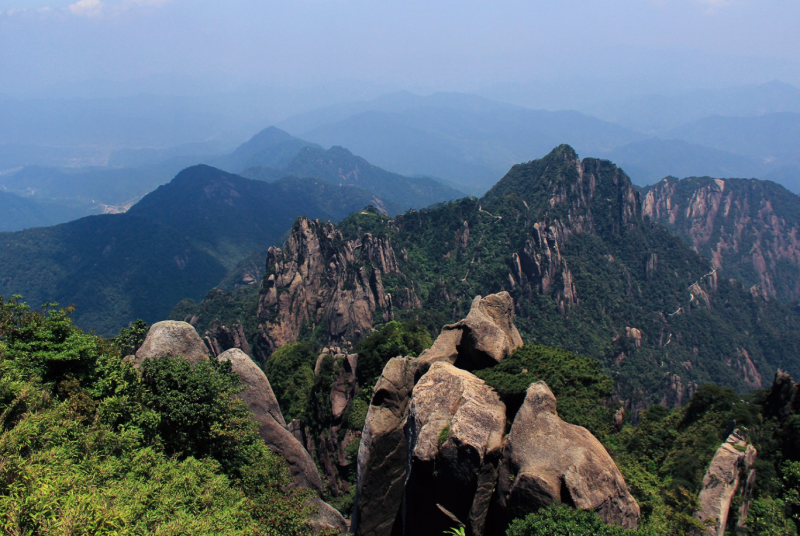
Yujing Peak is the main peak of Sanqingshan, with an elevation of 1,819.9 meters, the highest point in Sanqingshan. At the summit there is an observation platform where visitors can enjoy a 360-degree panoramic view of the surrounding peaks and sea of clouds. At dawn, magnificent sunrise and sea-of-clouds wonders can often be seen, making it one of the best places in Sanqingshan to watch the sunrise and enjoy the sea of clouds. Reaching the summit requires about a 2-hour hike. Along the way, visitors can see landscapes such as granite peak forests and ancient pines, among which natural formations such as "Divine Cat Waiting for Mouse" and "Mother-Child Pines" are especially peculiar.
Nanqingyuan Scenic Area
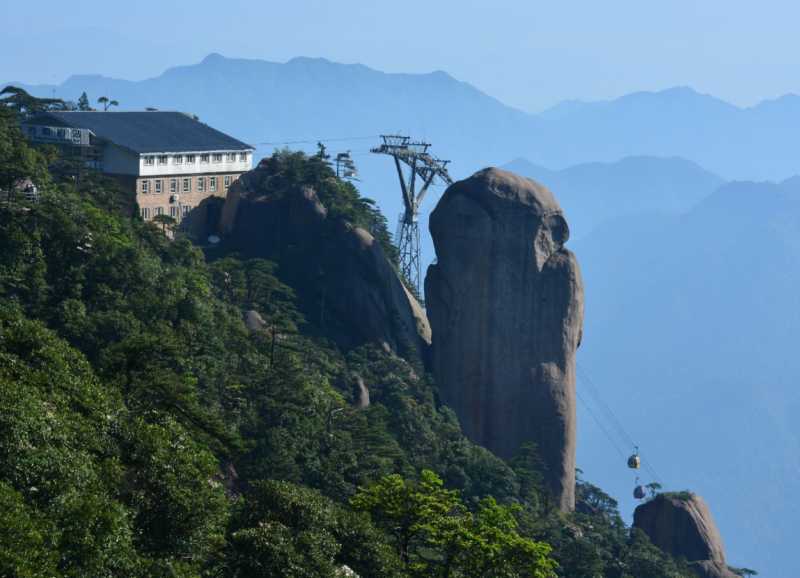
Nanqingyuan Scenic Area is the area with the most concentrated natural landscapes in Sanqingshan, covering about 5 square kilometers. It is centered on granite peak forest landforms and brings together famous attractions such as "Giant Python Emerging from the Mountain," "Divine Dragon Valley," and "Guanyin Appreciating Music." "Giant Python Emerging from the Mountain" is a giant granite pillar 128 meters high, with a large, flat head and a slightly narrower middle, resembling a giant python raising its head and about to fly. It is one of the iconic landscapes of the World Natural Heritage Site. "Divine Dragon Valley" is about 300 meters deep, with murmuring streams in the valley, steep rock walls on both sides, and dense vegetation. It is cool and pleasant in summer.
Sanqing Palace Scenic Area
Sanqing Palace Scenic Area is the core area of Taoist culture in Sanqingshan, covering about 3 square kilometers. With Sanqing Palace at its center, Taoist buildings such as Yanjiao Hall, Jiucha Mansion, and Longhu Hall are distributed nearby. Sanqing Palace is located at the Jiulong Mountain Pass at an elevation of 1,530 meters. Its architectural style features Ming Dynasty Taoist temple characteristics. The main hall enshrines the Three Purities deities, and ancient pines surround the halls, with stone carvings found throughout. The "Pre-Heaven Eight Trigrams" layout architectural system in the scenic area perfectly combines natural landscapes with Taoist culture and is a model in the history of Chinese Taoist architecture.
West Coast Scenic Area
The West Coast Scenic Area is famous for its cliffside walkways. The walkway is about 4 kilometers long and at an elevation of about 1,600 meters. Some sections are glass walkways suspended on cliffs, extending outward 2-5 meters. Walking on them feels like treading on clouds, hence the name "West Coast." Along the walkway, visitors can see landscapes such as "Monkey King Viewing Treasures" and "Guanyin Sending a Child." In the evening, the setting sun shines on the peaks, making the scenery especially magnificent. The full hike takes about 2 hours, making it one of the most thrilling and scenic touring routes in Sanqingshan.
Sunshine Coast Scenic Area
The Sunshine Coast Scenic Area is connected to the West Coast Scenic Area. It is about 3 kilometers long and at an elevation of 1,600-1,700 meters. It gets its name because it receives sunlight all year round. The walkway is built along the mountain and offers a broad field of vision, allowing visitors to enjoy landscapes such as the sea of clouds, sunrise, and pine forests. Among them, "Five Elders Worshipping the Three Purities" is a group of granite peaks shaped like five old men worshipping the Three Purities deities, with vivid forms. The "Qiankun Platform" in the scenic area is an excellent viewing point. From the platform, visitors can look far into the distance at Yujing Peak and the surrounding peaks.
Food
Sanqingshan Specialty Dishes
Stone Ear Stewed Chicken
Stone ear is a wild fungus unique to Sanqingshan, growing on cliff faces and rich in various minerals. Stone Ear Stewed Chicken uses locally free-range native chicken stewed together with stone ear. The chicken is tender, and the broth is rich, with the effect of nourishing yin and moistening the lungs. It is one of Sanqingshan's signature dishes.
Stir-Fried Kudzu Powder
Kudzu powder is made from kudzu root, a specialty of Sanqingshan, and is rich in starch and dietary fiber. When making stir-fried kudzu powder, the powder is first mixed with water into a paste, then stir-fried in a pan until transparent, and ingredients such as eggs and green vegetables are added. The texture is smooth and refreshing, combining nutrition and deliciousness. It is a common home-style dish in local farmhouses.
Nearby Foods
Yushan Stir-Fried Rice Noodles
Yushan County around Sanqingshan is famous for its stir-fried rice noodles. Yushan stir-fried rice noodles use locally specialty indica rice noodles, paired with ingredients such as eggs, green vegetables, and shredded meat, and are quickly stir-fried over high heat. The rice noodles are smooth and chewy, with a tempting aroma, making them a popular choice for local breakfast and late-night snacks.
Dexing Wulao Guo
Wulao Guo from Dexing City is a traditional snack. It uses glutinous rice flour as the skin, wraps fillings such as shredded radish, dried shrimp, and tofu, is shaped into a half-moon form, and then steamed. It is eaten dipped in vinegar. The texture is soft and glutinous, and the taste is fresh and fragrant. It is a specialty food for local festivals.
Tickets:
Tickets are 120 yuan per person, and the round-trip cableway is 140 yuan per person.
You can search for the official WeChat public account "Sanqingshan Tourism" to get the latest updates or buy tickets online.
Opening Hours:
Open all year round, with daily opening hours adjusted according to the season. In peak season (April-October), opening hours are 6:30-18:00; in off-season (November-next March), opening hours are 7:30-17:00. Cableway operating hours are basically consistent with the scenic area's opening hours, subject to the announcement of the day. In case of severe weather (such as heavy rain, heavy snow, typhoons, etc.), the scenic area may temporarily close some areas or the cableway. It is recommended to check the scenic area's official information before traveling.
Tour Routes:
Recommended Two-Day Tour Route
Day 1: In the morning, take the Waishuangxi Cableway up the mountain and go to Nanqingyuan Scenic Area to visit attractions such as "Giant Python Emerging from the Mountain" and "Divine Dragon Valley." Have lunch at the Nanqingyuan service area. In the afternoon, go to Sanqing Palace Scenic Area to visit Taoist buildings such as Sanqing Palace and Yanjiao Hall and experience Taoist culture. In the evening, go to the West Coast Scenic Area to enjoy the sunset and sea of clouds. Stay overnight at a hotel on the mountain.
Day 2: In the early morning, go to Yujing Peak to watch the sunrise. Then visit the Sunshine Coast Scenic Area, hike the cliffside walkway, and admire landscapes such as "Five Elders Worshipping the Three Purities." At noon, go down the mountain and dine near the upper cableway station. In the afternoon, take the Jinsha Cableway down the mountain and end the trip. This route comprehensively covers Sanqingshan's core landscapes and balances natural and cultural landscapes, making it suitable for tourists with ample time.
Transportation:
Public transportation: From Shangrao City Bus Station, take a shuttle bus to the southern part of Sanqingshan (Waishuangxi) or the eastern part (Jinsha). The southern shuttle runs every hour from 7:30 to 17:30 daily, takes about 1.5 hours, and costs 27 yuan per person; the eastern shuttle runs every 2 hours from 8:00 to 16:00 daily, takes about 2 hours, and costs 32 yuan per person.
Self-driving: From Nanchang, drive along the Shanghai-Kunming Expressway to the Yushan exit, then turn onto the Sanqingshan Tourism Highway. The total distance is about 300 kilometers, taking 4 hours. From Hangzhou, drive along the Hangzhou-Changsha Expressway to the Jiangshan exit, then turn onto a provincial road to Sanqingshan. The total distance is about 350 kilometers, taking 4.5 hours. There are parking lots in both the southern and eastern parts of the scenic area, with a charging standard of 20 yuan per vehicle per day.
High-speed rail connection: Take the high-speed rail to Yushan South Station. After leaving the station, transfer to the tourist shuttle to Sanqingshan. The ride takes about 1 hour, and the ticket price is 20 yuan per person. The shuttle runs every hour from 8:00 to 18:00 daily.
Must-Visit Attractions:
Yujing Peak: The main peak of Sanqingshan, with an elevation of 1,819.9 meters. It is an excellent place to watch the sunrise and sea of clouds, and reaching the summit offers a panoramic view.
Giant Python Emerging from the Mountain: A 128-meter-high granite pillar shaped like a giant python. It is an iconic landscape of the World Natural Heritage Site and can be called a geological wonder.
West Coast Walkway: A 4-kilometer-long cliffside walkway, partly made of glass. Walking on it allows visitors to experience the thrill and magnificence of high-altitude sightseeing.
Sanqing Palace: The core of the Ming Dynasty Taoist architectural complex, with a building area of about 500 square meters. It embodies the Taoist concept of "the unity of heaven and humanity" and is an important relic for studying Taoist culture.
Travel Suggestions:
Sanqingshan has a relatively high altitude, with large temperature differences between morning and evening. Even in summer, it is necessary to bring a light jacket; in winter, temperatures are low, so cold and warm protection measures should be taken.
Hiking routes are relatively long. It is recommended to wear comfortable hiking shoes and carry trekking poles to save energy. Some sections in the scenic area are steep, so attention should be paid to safety.
Dining on the mountain is relatively expensive. You may bring a small amount of dry food and water, but attention should be paid to environmental protection and not littering.
There are many tourists in peak season. It is recommended to book accommodation and tickets in advance and avoid holiday peak periods to improve the travel experience.
To watch the sunrise and sea of clouds, pay attention to the weather forecast. Early morning with a high probability of clear weather (5:30-6:30) is the best time.
Precautions:
Smoking and open fires are prohibited in the scenic area. Picking plants and catching wild animals are strictly prohibited, and ecological protection regulations must be observed.
The walkways are narrow, and some sections allow only one person to pass. When walking, keep to the inner side, do not chase or play, and do not climb over guardrails without authorization.
Mobile phone signal on the mountain is unstable. It is recommended to download offline maps in advance and agree with companions on meeting times and places to avoid getting separated.
In thunderstorms, stay away from open areas such as mountain tops and cliffs, do not use electronic devices such as mobile phones, and take shelter nearby in indoor safe areas.
Cableway operation is greatly affected by weather and may be suspended in strong winds, thunderstorms, and other weather conditions. It is recommended to confirm the cableway operating status before going down the mountain to avoid being stranded on the mountain.