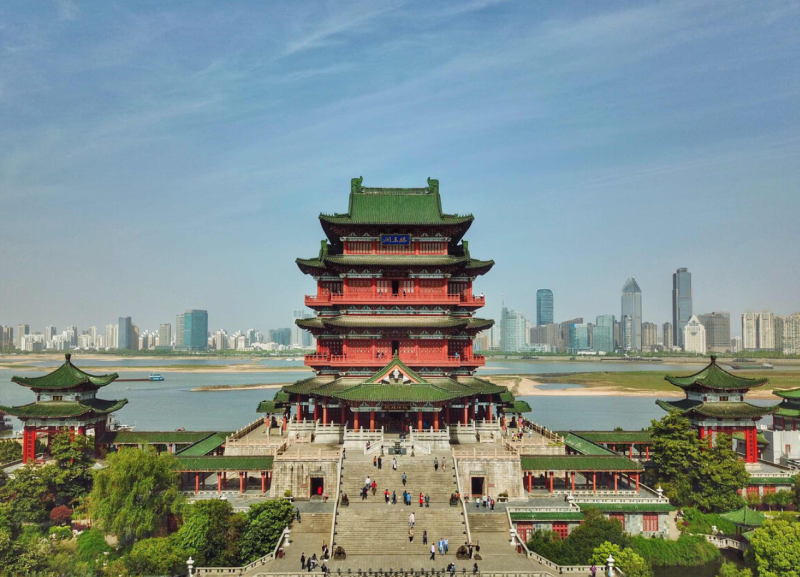
The Tengwang Pavilion Tourist Area is located in Donghu District, Nanchang City, Jiangxi Province, on the east bank of the Gan River. It is a national 5A-level tourist attraction and, together with the Yellow Crane Tower in Wuhan, Hubei, and the Yueyang Tower in Yueyang, Hunan, is known as one of the "Three Great Towers of Jiangnan." It is also honored as "the First Tower of Xijiang." The scenic area covers a total area of about 13.1 hectares. Its core building, Tengwang Pavilion, is a pseudo-Song-style ancient structure with a floor area of 4,700 square meters and a total height of 57.5 meters. It has nine stories in total, with the main pavilion being three stories visible on the outside and seven stories hidden within, adopting the traditional architectural form of "three visible and seven hidden," which demonstrates the exquisite craftsmanship of ancient Chinese pavilion architecture. Tengwang Pavilion is renowned throughout the world because of Wang Bo's "Preface to the Pavilion of Prince Teng." In addition to the main pavilion, the scenic area also includes supporting landscapes such as the Antique Street, Nanpu Garden, and garden areas. It integrates historical culture, architectural art, and garden landscapes, and is a cultural landmark of Nanchang and even Jiangxi.
Historical Culture
The history of Tengwang Pavilion can be traced back to the fourth year of the Yonghui era of the Tang Dynasty (653 AD), when Li Yuanying, Prince Teng, younger brother of Emperor Taizong of Tang, built it while serving as the governor of Hongzhou (present-day Nanchang). It was originally a place for banquets and amusement. Because Li Yuanying's title was "Prince Teng," it was named "Tengwang Pavilion."
Historically, Tengwang Pavilion underwent repeated rises and declines and was rebuilt as many as 29 times. The existing building was reconstructed in 1985 in accordance with Song Dynasty style. Its widespread fame is mainly due to the "Preface to the Pavilion of Prince Teng" by the early Tang poet Wang Bo. In the second year of the Shangyuan era of the Tang Dynasty (675 AD), Wang Bo passed through Hongzhou and happened to encounter the completion of the renovated Tengwang Pavilion. He was invited to attend a banquet and wrote on the spot the "Preface to the Farewell Banquet at Tengwang Pavilion in Hongzhou on an Autumn Day" (abbreviated as "Preface to the Pavilion of Prince Teng"). Famous lines such as "The setting clouds and the solitary wild duck fly together; the autumn waters and the vast sky share one color" have been recited through the ages, making Tengwang Pavilion famous throughout the world.
Literati and poets of successive dynasties, such as Bai Juyi, Du Mu, Su Shi, and Xin Qiji, all ascended Tengwang Pavilion and left behind numerous poems, lyrics, and fu, forming a profound cultural accumulation. The scenic area preserves a large number of historical documents, inscriptions, paintings, and other cultural relics related to Tengwang Pavilion, systematically displaying its historical evolution and cultural value. Today, Tengwang Pavilion has become an important carrier for inheriting traditional Chinese culture, and its "banquet culture" and "poetry and fu culture" have been listed as local intangible cultural heritage.
Main Attractions
Tengwang Pavilion Main Pavilion
The Tengwang Pavilion Main Pavilion is the core building of the scenic area, with a total height of 57.5 meters and a building area of 13,000 square meters. It adopts a reinforced concrete imitation-wood structure and strictly follows the Song Dynasty's "Yingzao Fashi" in its construction. The main pavilion is divided into three parts: the base, the pavilion body, and the roof. The base is 12 meters high, symbolizing the historical foundation of Tengwang Pavilion; the pavilion body is three stories visible on the outside and seven hidden within, with corridors on each level where visitors can lean on the railings and gaze into the distance at the Gan River scenery; the roof is a double-eaved hip-and-gable roof covered with peacock-blue glazed tiles, with chiwen ornaments at both ends of the main ridge, making the appearance solemn and elegant. Inside the pavilion are displayed the inscription of "Preface to the Pavilion of Prince Teng," models of Tengwang Pavilion from successive dynasties, and plaques with inscriptions by famous people. Among them, the wooden screen of "Preface to the Pavilion of Prince Teng" in the first-floor hall is 13.5 meters long, which is rare nationwide. From the top floor, visitors can overlook the cityscape of Nanchang and the scenery on both banks of the Gan River, experiencing the magnificent artistic conception of "embracing the Three Rivers and girdling the Five Lakes."
Antique Street
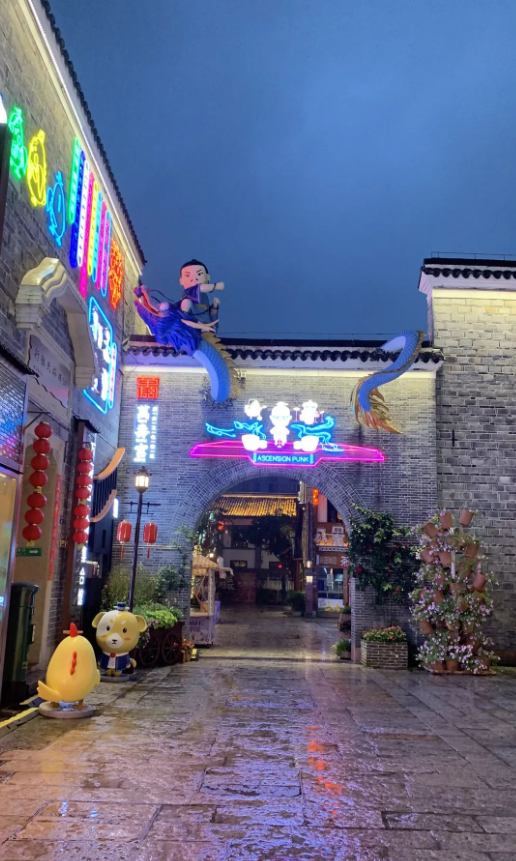
The Antique Street is located on the south side of the Tengwang Pavilion Main Pavilion, with a total length of 300 meters. It adopts Song Dynasty architectural style, paved with bluestone slabs, and flanked by imitation Song shops, with a total area of about 8,000 square meters. The street gathers shops selling Jiangxi specialty handicrafts, traditional snacks, and cultural creative products, such as shops selling the Four Treasures of the Study, Jingdezhen porcelain, and paper-cutting artworks, as well as restaurants offering clay pot soup, fried rice noodles, and other snacks. The Antique Street restores the marketplace appearance of the Song Dynasty. Visitors can buy souvenirs here, experience traditional handicraft making, and feel the atmosphere of an ancient commercial street.
Nanpu Garden
Nanpu Garden is located on the north side of Tengwang Pavilion, built along the Gan River, covering an area of about 2 hectares. It is named after "Nanpu" in the line "The painted beams at dawn fly up with the clouds of Nanpu" from "Preface to the Pavilion of Prince Teng." The garden is mainly a landscape garden, planted with willow, peach, camphor, and other plants, and features landscape elements such as winding bridges, waterside pavilions, and rockeries, reproducing the refinement and elegance of Jiangnan gardens. In the garden there is a model of "Tongque Terrace," forming a "dialogue between ancient and modern" with Tengwang Pavilion; by the river there is an observation platform, an excellent location for viewing the sunset over the Gan River and gazing at the Nanchang Bridge in the distance. In the evening, the artistic conception of "The setting clouds and the solitary wild duck fly together" is reproduced here.
Tengwang Pavilion Museum
The Tengwang Pavilion Museum is located on the west side of the main pavilion, with a building area of 2,000 square meters. It is a thematic museum displaying the history and culture of Tengwang Pavilion. The museum is divided into exhibition areas such as "The Evolution of Tengwang Pavilion," "Celebrities and Tengwang Pavilion," and "The Culture of 'Preface to the Pavilion of Prince Teng'." Through cultural relics, pictures, multimedia, and other forms, it systematically introduces the 29 reconstruction processes of Tengwang Pavilion, the stories of inscriptions and poems by celebrities of successive dynasties, and the creative background and influence of "Preface to the Pavilion of Prince Teng." The museum houses precious cultural relics such as a Ming Dynasty model of Tengwang Pavilion, a Qing Dynasty plaque of Tengwang Pavilion, and various editions of Wang Bo's "Preface to the Pavilion of Prince Teng" from successive dynasties. Among them, the "Painting of Tengwang Pavilion" by the Qing Dynasty painter Leng Mei is the treasure of the museum.
Food
Clay Pot Soup
Clay pot soup is a traditional specialty snack of Nanchang, sold in restaurants and breakfast shops around the Tengwang Pavilion Tourist Area. It uses clay pots as containers, layering ingredients (such as pork ribs, meat patties, black-bone chicken, white fungus, etc.) with Chinese medicinal herbs (such as goji berries, codonopsis, angelica, etc.), placing them in specially made clay pots, and simmering them over charcoal fire for 3-4 hours. Clay pot soup is original in flavor and rich in nutrition. Common varieties include clay pot pork rib soup and clay pot meat patty soup, priced from 5 to 15 yuan. It is a must-try for visitors experiencing Nanchang's food culture.
Fried Rice Noodles
Nanchang fried rice noodles are a classic local snack, found everywhere in snack stalls and restaurants near Tengwang Pavilion. It uses Jiangxi's unique indica rice noodles, softened in boiling water and then drained, and quickly stir-fried over high heat with eggs, green vegetables, shredded pork, bean sprouts, chili, and other ingredients. The texture is smooth and chewy, savory, fragrant, and slightly spicy. Fried rice noodles are quick to make and generous in portion, priced at about 8-15 yuan. They are a convenient choice for visitors to satisfy hunger. Eaten with clay pot soup, they can be called the "golden pair" of Nanchang breakfast.
Stir-Fried Artemisia Selengensis with Cured Meat
Stir-fried Artemisia selengensis with cured meat is one of the ten classic famous dishes of Jiangxi, and many Jiangxi cuisine restaurants around Tengwang Pavilion offer it. Artemisia selengensis is a wild vegetable specialty of Poyang Lake, with a fresh and tender texture and delicate fragrance. Stir-fried with cured meat, the salty fragrance of the cured meat and the delicate fragrance of the Artemisia selengensis blend together, creating a unique flavor. This dish is strongly seasonal (best in spring), priced at about 30-50 yuan, and reflects the "fresh, spicy, and rich" dietary characteristics of Jiangxi. It is a representative dish for tasting Jiangxi cuisine.
Scenic Area Restaurant
Inside the Tengwang Pavilion Tourist Area there is a "Tengwang Pavilion Banquet" themed restaurant, located in the middle section of the Antique Street, with a building area of about 1,000 square meters. It specializes in Jiangxi cuisine and antique banquet feasts. The restaurant offers special set meals such as the "Preface to the Pavilion of Prince Teng Banquet" and the "Tengwang Banquet." Many dish names are derived from famous lines in "Preface to the Pavilion of Prince Teng," such as "Setting Clouds Reflect the Solitary Duck" (roast duck) and "Autumn Waters Share the Vast Sky" (steamed fish), which are both delicious and culturally rich. The per capita consumption is about 80-150 yuan. Visitors can experience ancient banquet culture here and feel the atmosphere of "guests and hosts all being the finest of the southeast."
Tickets:
Tickets are 50 yuan per person.
You can search for the official public account "Tengwang Pavilion Tourist Area" on WeChat to obtain the latest updates or buy tickets online.
Opening Hours:
Opening hours are 8:00-18:30 daily (April 1-October 31), and 8:00-18:00 (November 1-March 31 of the following year). The last entry time is 1 hour before closing, and the clearing time of the main pavilion is 30 minutes before closing. The live performance "Tengwang Banquet Music" in the scenic area is held every evening from 19:30-20:30 (separate ticket required, may be canceled in rainy weather), subject to the scenic area's announcement.
Tour Route:
Visitors can enter from the south gate of the scenic area and first visit the Antique Street (about 30 minutes) to buy souvenirs and experience the marketplace style of the Song Dynasty; then enter the Tengwang Pavilion Main Pavilion and visit from the first floor to the ninth floor in sequence, enjoying the cultural relic exhibitions inside the pavilion and climbing to the top to overlook the Gan River scenery (about 1.5 hours); after descending, go to the Tengwang Pavilion Museum to learn about the historical evolution of Tengwang Pavilion (about 40 minutes); at noon, dine in the Antique Street or the scenic area restaurant (about 1 hour); in the afternoon, visit Nanpu Garden, stroll and rest in the garden, and enjoy the river view at the riverside observation platform (about 40 minutes); if watching the "Tengwang Banquet Music" performance, you can enter the scenic area again in the evening to experience the night view of Tengwang Pavilion under the lights and the live performance (about 1 hour). The total tour time is about 4-5 hours. Those with sufficient time can participate in interactive activities in the scenic area such as poetry recitation and ancient costume experiences.
Transportation:
Subway: Take Nanchang Metro Line 1 to "Tengwang Pavilion" Station, exit from Exit 2, and walk about 5 minutes to reach the south gate of the scenic area. The whole journey takes about 30 minutes (starting from the city center).
Bus: You can take Nanchang buses 2, 7, 26, 38, 227, 170, 830, and other routes, get off at the "Tengwang Pavilion" stop, and walk 2-3 minutes to reach the scenic area. The fare is 2 yuan per person, and operating hours are 6:00-22:00.
Self-driving: From Nanchang Station, drive along Zhanqian Road and turn onto Fuhe North Road for about 4 kilometers to reach the Tengwang Pavilion scenic area parking lot. The drive takes about 15 minutes; from Nanchang West Station, drive along Fengsheng Expressway to Nanchang Bridge, then along Fuhe North Road for about 12 kilometers. The drive takes about 30 minutes. The scenic area parking lot charges 5 yuan per hour for small vehicles, with a daily cap of 30 yuan.
Ferry: You can take a ferry from the "Qiushui Square" pier on the west bank of the Gan River to the "Tengwang Pavilion" pier. The voyage takes about 10 minutes, the fare is 10 yuan per person, operating hours are 9:00-17:00, with one departure per hour. After getting off, walk 1 minute to reach the north gate of the scenic area.
Must-Visit Attractions:
Tengwang Pavilion Main Pavilion: 57.5 meters high, with a structure of three visible and seven hidden stories. Inside the pavilion are cultural relics related to "Preface to the Pavilion of Prince Teng." Climbing to the top allows you to overlook the Gan River scenery. It is the core attraction for experiencing the artistic conception of "The setting clouds and the solitary wild duck fly together."
Tengwang Pavilion Museum: Systematically displays the history of Tengwang Pavilion's 29 reconstructions and inscriptions and poems by celebrities of successive dynasties. It houses precious cultural relics such as the Qing Dynasty "Painting of Tengwang Pavilion" and is an important window for understanding Tengwang Pavilion culture.
Nanpu Garden: A Jiangnan garden built along the river, where you can view the sunset over the Gan River and the Nanchang cityscape. In the evening, the landscape高度契合 the artistic conception of the famous lines in "Preface to the Pavilion of Prince Teng," making it highly ornamental.
Travel Suggestions:
It is recommended to visit the main pavilion from 9:00-11:00 in the morning or 15:00-17:00 in the afternoon. At these times, the light is suitable for photography, and there are relatively fewer visitors, making it convenient for quiet appreciation.
When visiting the main pavilion, you can rent an electronic guide device (30 yuan per unit) or follow the scenic area guide (free, departing on the hour) to gain an in-depth understanding of architectural details and historical stories. The explanation lasts about 1 hour.
If you want to experience the live performance "Tengwang Banquet Music," it is recommended to buy tickets in advance through official channels (ticket price 168 yuan per person). The performance combines lighting, song and dance, and poetry to restore the Tang Dynasty banquet scene and is highly enjoyable.
The scenic area is adjacent to Nanchang August 1st Uprising Memorial Hall, Shengjin Tower, and other attractions. You can plan a one-day tour route and visit them in sequence to enrich your itinerary.
Precautions:
Smoking and loud noise are prohibited inside the main pavilion. Touching cultural relics and exhibits is prohibited. Flash photography is prohibited. Please cherish the historical building and cultural relics.
The stairs up the pavilion are relatively steep, especially the corridors on the upper floors, which are narrow. Pay attention to safety, do not chase or play, and take good care of the elderly and children.
In summer, pay attention to sun protection. The main pavilion is well ventilated, but the top floor has strong sunlight, so you may bring a sun hat; in winter, the pavilion is relatively cold, so it is recommended to wear warm clothing.
Prices in the shops on the Antique Street in the scenic area may be higher than in the city. When buying souvenirs, you can bargain appropriately; confirm prices before dining to avoid consumer disputes.
There are many visitors on holidays, so it is recommended to travel during off-peak hours; parking spaces in the scenic area are limited, so it is recommended to use public transportation during peak periods.