Wugong Mountain Scenic Area is located at the junction of Pingxiang City, Ji'an City, and Yichun City in Jiangxi Province, with the main scenic area within Luxi County, Pingxiang City. It is a National 5A-level Tourist Attraction, National Geopark, and National Forest Park. The total area of the scenic area is approximately 970 square kilometers, with the core scenic area covering 160 square kilometers. The main peak, Baihe Peak (Golden Summit), has an elevation of 1,918.3 meters, making it the third-highest peak in Jiangxi Province. Wugong Mountain is known for its core feature of "Cloud Grassland, Outdoor Paradise." It boasts 100,000 mu of alpine meadows, the highest-altitude and largest alpine meadow landscape at the same latitude. It also features natural wonders such as waterfalls, seas of clouds, sunrises, and Buddha's halo, as well as cultural landscapes including ancient altars and temples. It is a comprehensive scenic area integrating sightseeing, outdoor hiking, leisure vacations, and educational science tours.
Historical Culture
The historical culture of Wugong Mountain can be traced back to ancient times. According to historical records, in ancient times, Emperor Yan and Shennong gathered herbs and refined elixirs here, leaving behind the legend of the "Shennong Hundred Herb Garden." After the Han Dynasty, Taoism flourished here, and Wugong Mountain became a famous Taoist mountain, listed as one of the "Seventy-Two Blessed Lands." It is said that Taoist celebrities such as Ge Xuan and Ge Hong once practiced cultivation here.
During the Sui and Tang Dynasties, Buddhism was introduced to Wugong Mountain, and temples such as Jinding Temple and Jiyun Temple were successively built, forming a cultural pattern of coexistence between Buddhism and Taoism. Among them, the Jinding Ancient Altar Group is the most representative cultural relic of Wugong Mountain. It consists of four altars: Gexian Altar, Wangxian Altar, Chongying Altar, and Qiushi Altar. It was first built during the Three Kingdoms period, and the existing buildings were rebuilt in the Ming Dynasty. It is the most completely preserved and oldest ancient altar group in the Jiangnan region and has important value for the study of ancient sacrificial culture.
After the Song Dynasty, the religious culture of Wugong Mountain further developed, and literati and poets came in droves, leaving behind a large number of poems and writings. Xu Xiake, a geographer of the Ming Dynasty, traveled to Wugong Mountain and recorded its scenery and culture in detail in his "Diary of Travels in Jiangyou." In modern times, Wugong Mountain became part of a revolutionary base area, where the Red Army carried out guerrilla warfare, leaving behind many red relics. Today, the Taoist culture, Buddhist culture, sacrificial culture, and red culture of Wugong Mountain are intertwined, forming a rich historical and cultural connotation.
Main Attractions
Golden Summit (Baihe Peak)
The Golden Summit is the main peak of Wugong Mountain, with an elevation of 1,918.3 meters, and is the core landscape area of the scenic spot. The top is flat and has a large area of alpine meadows. In summer, the grass is green; in autumn, it is golden and brilliant; in winter, it is covered in silver, with different landscapes in each season. The Golden Summit area is home to cultural buildings such as the Ancient Altar Group, Jinding Temple, and Baihe Temple. Among them, the Ancient Altar Group has a history of more than 1,700 years and is the core carrier of Wugong Mountain's sacrificial culture. Ascending the Golden Summit, visitors can observe wonders such as seas of clouds, sunrises, and Buddha's halo. Especially at sunrise, when sunlight falls on the meadows and sea of clouds, the scene is extraordinarily magnificent, making it a must-visit check-in point for tourists.
Fayun Boundary
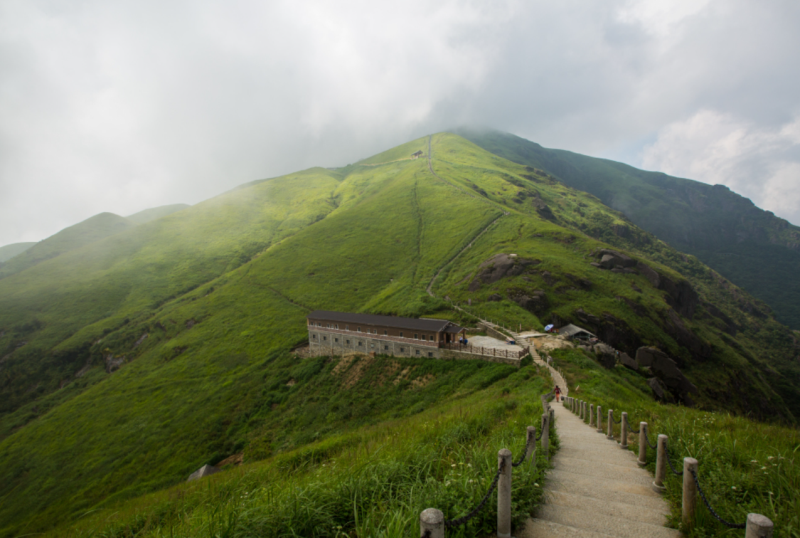
Fayun Boundary is located in the central part of Wugong Mountain, at an altitude of about 1,628 meters. It is named because it is often shrouded in clouds and mist, with cloud vapor gushing out from the valleys. The alpine meadows here cover an area of about 20,000 mu, with gently undulating terrain, making it a classic section for hiking enthusiasts. The sea of clouds at Fayun Boundary is particularly famous. In the early morning, clouds and mist flow between the valleys, and the meadows, windmills, and sea of clouds create a picturesque scene, like a fairyland. There are multiple viewing platforms and rest points in the area, where tourists can camp and observe the starry sky, enjoying the pleasure of outdoor camping.
Despair Slope
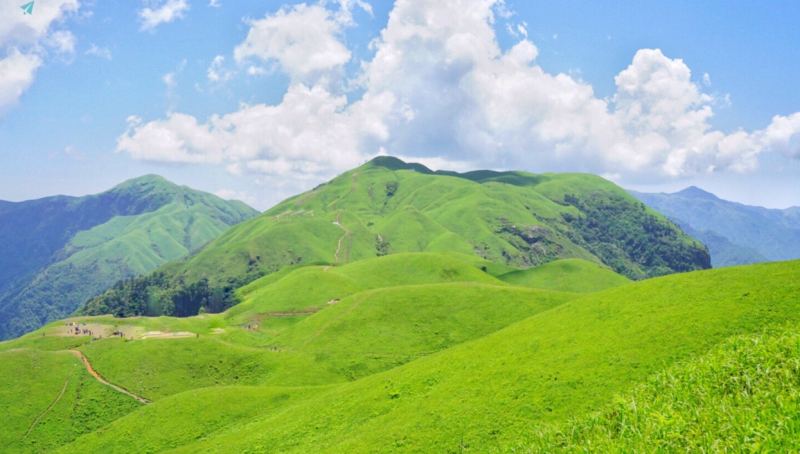
Despair Slope is an extremely challenging section of the Wugong Mountain hiking route, located between the Golden Summit and Fayun Boundary, with an elevation drop of about 300 meters and a length of about 2 kilometers. The slope is steep, with some sections approaching 70 degrees. Because it is steep and difficult to traverse, many hikers are intimidated by it, hence the name "Despair Slope." However, the scenery along the way is extremely magnificent, with rolling meadows and strange peaks on both sides, often surrounded by seas of clouds. After reaching the top, visitors can overlook the mountains, gaining a great sense of accomplishment. It is a landmark section that tests physical strength and perseverance.
Wugong Mountain Waterfall Group
The Wugong Mountain Waterfall Group is distributed in the middle and lower parts of the scenic area, with Longtan Waterfall, Jinhu Sajiu Waterfall, and Yinhe Waterfall being the most famous. Longtan Waterfall has a drop of about 40 meters. The water rushes down from the cliff, hitting the rocks and forming a deep pool. The pool water is clear to the bottom, surrounded by lush trees. Jinhu Sajiu Waterfall is named because the water disperses like wine being poured from a pot, with a drop of about 30 meters. During the rainy season when water volume is abundant, it is majestic. Yinhe Waterfall is known for being long and thin like the Milky Way hanging upside down, with a drop of about 50 meters, making it one of the most beautiful waterfalls in Wugong Mountain. The waterfall group area has humid air and high negative oxygen ion content, making it a good place for leisure and summer vacation.
Yangshimu
Yangshimu is located in the northern part of Wugong Mountain, facing the Golden Summit across a valley, with an altitude of about 1,670 meters. It is named because the mountain body resembles a sheep and a lion. This area is mainly characterized by granite peak forest landforms, with pictographic peaks such as Shisun Peak, Riyue Peak, and Guanggong Face, which are strangely shaped and lifelike. The area has high vegetation coverage, and the average summer temperature is only 23°C, making it a summer resort. The sea of clouds and sunrise scenery at Yangshimu are no less impressive than those at the Golden Summit, and there are relatively fewer tourists, making it suitable for visitors seeking tranquility.
Food
Wugong Mountain Cured Meat
Wugong Mountain cured meat is a local specialty food, made from pork belly from local mountain pigs through curing and smoking. Local villagers use traditional techniques, smoking with pine and cypress branches, giving the cured meat a unique smoky aroma, firm texture, and rich but not greasy flavor. The cured meat can be stir-fried or steamed. Common dishes include cured meat with winter bamboo shoots and steamed cured meat with glutinous rice. It can be tasted at farmhouses and restaurants around the scenic area, priced at about 40-60 yuan per portion. It is a must-try dish for tourists experiencing local flavors.
Pingxiang Spicy Snacks
Pingxiang spicy snacks are a highly representative flavor around Wugong Mountain, characterized by being numbing, spicy, fresh, and fragrant. Common ones include spicy fish, spicy tofu, and spicy duck heads. These snacks are made by pickling and braising with local chili peppers and various spices. They have a rich taste and are very spicy, fully reflecting the "heavy spiciness" characteristic of western Jiangxi cuisine. In Pingxiang city and the market towns at the foot of Wugong Mountain, there are many time-honored spicy snack shops with affordable prices. For example, spicy fish is about 25 yuan per portion. They are foods not to be missed by tourists who love spicy food.
Aimi Guo
Aimi Guo is a traditional folk snack in Jiangxi, especially common in the Wugong Mountain area in spring. It is made by mashing young mugwort leaves into a paste, mixing with glutinous rice flour to make the skin, and wrapping fillings such as dried bamboo shoots, shredded radish, and cured meat, then steaming. Aimi Guo is emerald green in color, exuding the fresh fragrance of mugwort, with a soft and glutinous texture, combining nutrition and deliciousness. It is priced at about 3-5 yuan each and can be bought at breakfast shops and farmhouse restaurants around the scenic area.
Dining in and around the Scenic Area
Dining points are available in areas such as the Golden Summit and Fayun Boundary within the Wugong Mountain Scenic Area, providing simple meals, stir-fried dishes, and noodle soups, with an average per-person consumption of about 30-50 yuan. At the foot of the mountain, Wugong Mountain market towns and farmhouses mainly serve Jiangxi cuisine. In addition to the above specialty dishes, there are also stewed native chicken, braised pork with dried bamboo shoots, and alpine vegetables. The ingredients are mostly local and fresh and natural, with an average per-person consumption of about 50-80 yuan. Some farmhouses also provide self-service barbecue and farm banquets, suitable for group tourists.
Tickets:
Tickets are 70 yuan per person.
You can search for the official WeChat public account "Wugong Mountain Scenic Area" to get the latest updates or purchase tickets online.
Opening Hours:
Opening hours are 8:00-17:30 daily (April 1-October 31) and 8:00-17:00 (November 1-next March 31). The cable car operating hours are consistent with the scenic area opening hours, and ticket sales stop one hour before closing. Tourists are advised to arrange their mountain climbing time reasonably to avoid being stranded on the mountain at night.
Tour Routes:
One-Day Tour Route (Leisure Sightseeing)
Starting from the Wugong Mountain Visitor Center, take the sightseeing bus to Shigu Temple (about 10 minutes), then transfer to the Zhong'an Cableway up the mountain (about 10 minutes) to the Zhong'an Scenic Area; walk to attractions such as Zijigong and Huiyin Valley (about 1 hour); then take the Golden Summit Cableway to the Golden Summit (about 5 minutes), tour the Golden Summit and the Ancient Altar Group, and observe the sea of clouds or sunrise (about 2 hours); when descending, you can choose to walk to Zhong'an (about 2 hours), then take the cableway or sightseeing bus back to the visitor center. The whole journey takes about 6-7 hours and is suitable for tourists with average physical strength.
Two-Day Tour Route (In-Depth Hiking)
Day 1: Visitor Center → Shigu Temple → Zhong'an Cableway → Zhong'an Scenic Area → hike to Fayun Boundary (about 3 hours), passing through sections such as Haohan Slope and Despair Slope along the way, and camp at Fayun Boundary (to enjoy sunset and starry sky); Day 2: After watching the sunrise at Fayun Boundary, hike to the Golden Summit (about 3 hours), tour the Golden Summit area, and then take the cableway or walk down the mountain. The total hike is about 25 kilometers, suitable for tourists with some outdoor experience, allowing them to fully experience the alpine meadows and the joy of hiking.
Transportation:
High-speed rail/train: Take the high-speed rail to Pingxiang North Station. After leaving the station, you can take the scenic area direct bus to the Wugong Mountain Visitor Center. The journey takes about 1 hour, the ticket price is 27 yuan per person, and the departure time is 8:00-18:00, one bus per hour. Take a regular train to Pingxiang Station. After leaving the station, transfer to a bus or taxi to Pingxiang Bus Station, then take a shuttle bus to Wugong Mountain (about one every 40 minutes, ticket price 18 yuan per person). The journey takes about 1.5 hours.
Self-driving: From Nanchang, take the Shanghai-Kunming Expressway to the Pingxiang exit, then drive about 40 kilometers along the Pingwan Highway to the Wugong Mountain Visitor Center. The whole journey takes about 3 hours. From Changsha, take the Shanghai-Kunming Expressway to the Pingxiang exit. The journey takes about 2 hours. The scenic area parking lot charges 10 yuan per day for small vehicles and 20 yuan per day for large vehicles.
Bus: Within Pingxiang city, take the Wugong Mountain Tourist Special Line (Pingxiang Bus Station → Wugong Mountain Visitor Center). The ticket price is 18 yuan per person, operating hours are 6:30-17:30, with one bus every 30-40 minutes.
Must-Visit Attractions:
Golden Summit (Baihe Peak): The main peak of Wugong Mountain, with an elevation of 1,918.3 meters. It has the Ancient Altar Group and stunning sunrise and sea of clouds. It is a landmark attraction of the scenic area, allowing visitors to fully experience the grandeur of the "Cloud Grassland."
Despair Slope: A classic hiking section with steep slopes, where challenge and beauty coexist. After reaching the top, visitors can overlook rolling meadows and seas of clouds. It is suitable for outdoor enthusiasts.
Fayun Boundary: Famous for its sea of clouds and large meadows. It is an excellent place for camping and stargazing. The scene of clouds and mist in the early morning is like a fairyland.
Travel Suggestions:
Hiking enthusiasts are advised to visit in spring and autumn, when the weather is cool and the meadow landscape is at its best. In summer, pay attention to sun protection and heat prevention. In winter, some sections may freeze, so anti-slip preparations are needed.
When hiking, prepare comfortable hiking shoes, a windbreaker, trekking poles, a backpack, and other equipment. Carry enough drinking water and dry food (supplies on the mountain are expensive). Energy bars, chocolate, and other items can be prepared to replenish strength.
If planning to camp, check the weather in advance and choose regular camping spots (such as the Golden Summit and Fayun Boundary). Rent or bring your own tent (rental is about 100-200 yuan per tent). Pay attention to keeping warm (the temperature difference in mountainous areas at night is large).
Tourists with limited physical strength can reasonably combine cableways and walking, such as taking the Zhong'an Cableway up the mountain and walking to the Golden Summit. This can save energy while enjoying the scenery along the way.
Precautions:
The terrain of Wugong Mountain is complex. When hiking, follow designated routes and do not enter undeveloped areas without authorization to avoid getting lost or dangerous situations. It is recommended to travel with companions.
Mountain weather is changeable. Check the weather forecast in advance and carry rain gear. In summer, thunderstorms may occur. Avoid staying on mountain tops or in open areas to prevent lightning strikes.
Protect the ecological environment. Do not litter, pick plants, or harm wild animals. Follow the principle of "Leave No Trace in the Outdoors."
Some sections on the mountain have weak signal. It is recommended to download offline maps in advance and keep in contact with companions. The scenic area has an emergency help phone number. Dial it promptly in case of emergency.
Accommodation and dining prices within the scenic area are relatively high. Prepare necessary items in advance according to your itinerary. When choosing farmhouses or homestays, confirm prices and service contents in advance to avoid disputes.