The Shajiabang · Yushan Shanghu Scenic Area is located in Changshu City, Suzhou, Jiangsu Province. It is a National 5A Tourist Attraction composed of three parts: the Shajiabang Scenic Area, the Yushan Scenic Area, and the Shanghu Scenic Area, with a total area of approximately 41.2 square kilometers. Among them, the Shajiabang Scenic Area covers 10.6 square kilometers and is known for its red culture and water-town ecology; the Yushan Scenic Area covers 25.1 square kilometers and is part of the remnants of the Tianmu Mountains, with a maximum elevation of 263 meters; the Shanghu Scenic Area covers 5.5 square kilometers, with water accounting for 80% of its area, and is a national-level wetland park. The scenic area integrates three major elements: red revolutionary culture, Jiangnan landscape scenery, and historical and cultural heritage. It has more than 80 landscape resources of various types, including Ming and Qing ancient architectural complexes, revolutionary sites, and natural wetlands. It receives more than 2 million visitors annually and is a comprehensive tourist area in the Yangtze River Delta region that combines educational significance and leisure functions.
History and Culture
The history of the Shajiabang Scenic Area is closely related to the War of Resistance Against Japanese Aggression. In 1939, the New Fourth Army established an anti-Japanese base area in the Shajiabang region. Local people and soldiers jointly carried out guerrilla warfare, leaving behind the revolutionary story of the "sparks in the reeds." In the 1960s, the modern Peking opera Shajiabang made this red history widely known. The Chunlai Teahouse and the Rear Hospital Site still existing in the scenic area are physical witnesses to revolutionary activities of that time.
Yushan is one of the birthplaces of Changshu culture, and literati and artists of past dynasties left relics here. Gu Kaizhi, a painter of the Eastern Jin Dynasty, once lived in seclusion here. Xiao Tong, Crown Prince Zhaoming of the Southern Dynasties, once studied at Yushan, leaving behind the "Prince Zhaoming Reading Terrace" site. Zhang Xu, a calligrapher of the Tang Dynasty, once served as the county lieutenant of Changshu, and his "Sage of Cursive Script" calligraphy style echoed the scenery of Yushan. During the Ming and Qing dynasties, the Yushan Guqin School and Painting School rose, forming unique cultural schools that are still passed down today.
Shanghu got its name from the legend that Jiang Taigong (Jiang Shang) fished here, a history of more than 3,000 years. Shen Zhou, a painter of the Ming Dynasty, visited Shanghu many times and created the handed-down painting Shanghu Tu. Scenic spots such as Taigong Island and Fishing Terrace in the scenic area are all related to this legend. The Yanzi Tomb by the lake is an important relic commemorating Yan Yan (a native of Changshu), a disciple of Confucius, and witnesses the development of Jiangnan Confucianism.
Main Attractions
Shajiabang Scenic Area
The Shajiabang Scenic Area is located in the southern part of Changshu City, with the theme of "red education and green ecology." Its core areas include the Revolutionary History Memorial Hall (with a building area of 3,000 square meters, displaying more than 200 revolutionary cultural relics), the Reed Wetland (with an area of 6.7 square kilometers and a reed coverage rate of 70%), and the Chunlai Teahouse (a reconstructed Qing Dynasty building and the performance venue for the live-action Peking opera Shajiabang). The Hengjing Old Street in the scenic area restores the appearance of a Jiangnan water town in the 1930s. It is 500 meters long in total and has more than 30 old-style shops such as a post office and a blacksmith shop, regularly performing sitcoms such as "A Qing Sao Outwits Diao Deyi." The "Reed Lotus Festival" held every summer, with thousands of mu of lotus ponds and reed marshes contrasting beautifully, is a landmark landscape.
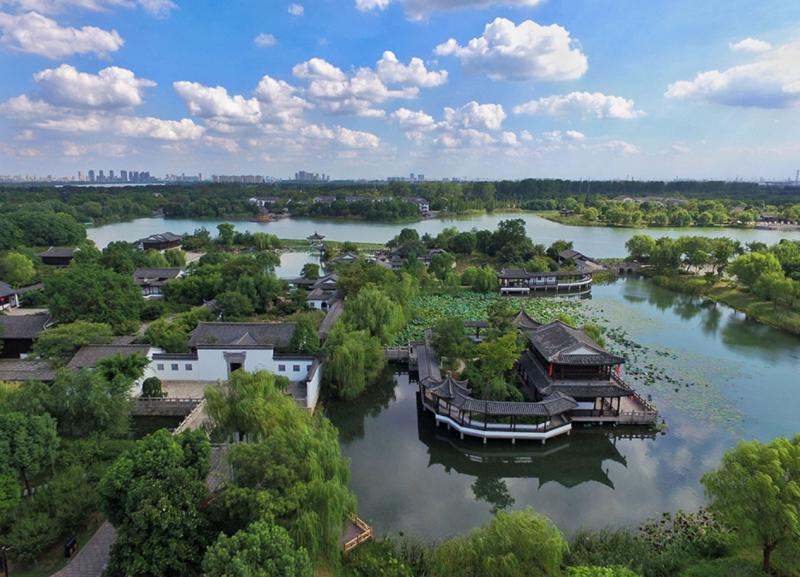
Yushan Scenic Area
The Yushan Scenic Area stretches across the northern part of Changshu's urban area and is divided into two parts: Yushan National Forest Park and Yushan Cultural Park. The main peak, Jianmen, is 261 meters above sea level and is known for its "peculiar rocks, ancient temples, and fine trees." Natural landscapes in the mountains include Jianmen Strange Rock (a naturally formed stone gate, about 5 meters wide and 20 meters high) and Lianzhu Cave (a karst cave group with a total area of about 800 square meters). Cultural attractions include Xingfu Temple (first built in the Southern Qi Dynasty; the existing buildings were rebuilt in the Qing Dynasty, and the "Empty Heart Pool" in the temple was a place inscribed and praised by literati of past dynasties), Yanzi Tomb (the tomb of Yan Yan, a disciple of Confucius; the tomb path is 300 meters long and preserves 8 pairs of Ming Dynasty stone beasts), and the tomb of Qian Qianyi and Liu Rushi (a joint burial tomb of Ming and Qing literati, witnessing the cultural history of the late Ming and early Qing). The Yushan city wall in the scenic area is a Ming Dynasty relic, with an existing length of 1.2 kilometers and 3 gate towers, offering a panoramic view of Changshu.
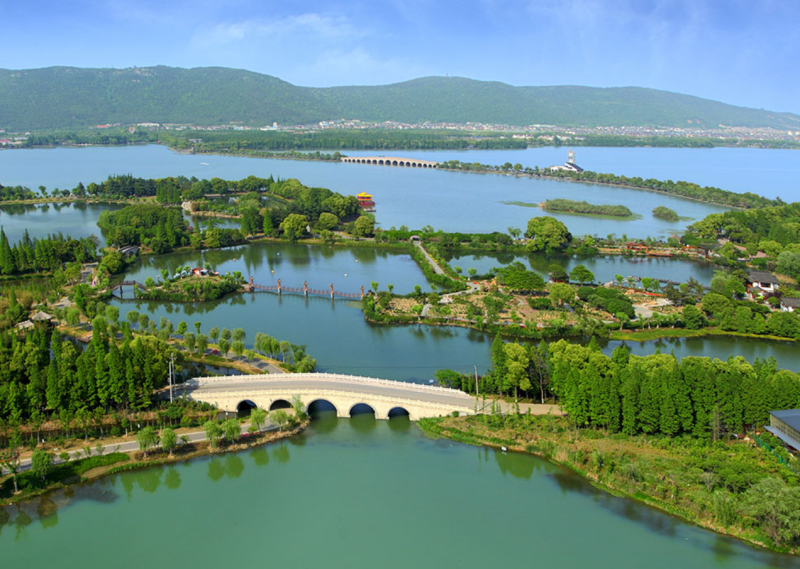
Shanghu Scenic Area
The Shanghu Scenic Area is located on the south side of Yushan and is characterized by "lake and mountain reflections and ecological wetlands." It is divided into 7 islands, including Hexiangzhou, Diaoyuzhu, and Taigong Island, connected by 11 bridges. Core landscapes include Shanghu Wetland (with an area of 4.4 square kilometers, home to more than 150 species of birds such as egrets and wild ducks), Taigong Island (with an area of 0.3 square kilometers; the Taigong Temple on the island enshrines a statue of Jiang Taigong, and the "Diaohuang Hall" in the temple recreates the scene of Jiang Taigong fishing), and the Peony Garden (with an area of 100 mu, planting more than 300 varieties of peonies, including 8 ancient peonies over a hundred years old; the "Shanghu Peony Flower Fair" is held during the spring flowering period). The total shoreline is 12 kilometers long, and visitors can take a cruise boat (one-way ticket 40 yuan per person, 40-minute voyage) to tour the lake, along the way seeing traditional scenes such as "Misty Rain over the Lake Fields."
Food
Beggar's Chicken
Beggar's Chicken is a traditional famous dish of Changshu, originating from the folk method in the Shajiabang area. A local three-yellow chicken is selected, wrapped in lotus leaves and yellow mud, and roasted over charcoal fire for 3 hours, resulting in tender and juicy meat. The signature Beggar's Chicken at the "Reed Marsh Restaurant" in the Shajiabang Scenic Area is about 88 yuan per chicken, made with traditional techniques, and requires a 2-hour advance reservation. The "Wangsi Restaurant" at the foot of Yushan (founded in 1886) improves on the tradition by adding ham, shiitake mushrooms, and other fillings. The price is about 128 yuan per chicken, and it is a China Time-Honored Brand dish.
Yushan Xunyou Noodles
Yushan Xunyou Noodles are made with pine mushroom (wild fungus) specialty of Yushan as the topping, paired with hand-pulled noodles. The "mushroom oil" made by simmering fresh mushrooms with lard is fragrant, and the noodle soup is boiled with pork bones and chicken frames for more than 6 hours. The "Xingfu Temple Vegetarian Noodle Shop" next to Xingfu Temple is a classic establishment. A bowl of Xunyou Noodles costs 35 yuan, paired with side dishes such as vegetarian chicken and braised egg. It is limited to 200 bowls per day, and the best time to taste it is during breakfast hours (6:30-9:00).
Shanghu Whole Fish Banquet
The Shanghu Whole Fish Banquet uses fresh fish from the lake as the main ingredient, including Squirrel Mandarin Fish (using Shanghu mandarin fish of about 1.5 kilograms, crispy outside and tender inside, seasoned with sweet and sour sauce), Silver Fish Scrambled Eggs (Shanghu silver fish are 5-7 centimeters long, translucent throughout, stir-fried with local eggs), and Fish Head Soup (slow-cooked for 2 hours with bighead carp fish heads of more than 5 kilograms, with a milky white soup). The "Wanghu Tower" restaurant in the Shanghu Scenic Area offers a whole fish banquet set meal. A portion for 3-4 people is about 380 yuan, and all ingredients are caught the same day.
Changshu Steamed Dishes
Changshu Steamed Dishes are representative of Jiangnan steaming techniques, using "clear steaming" to preserve the original flavor of ingredients. Representative dishes include steamed shad (Shanghu shad is steamed without removing the scales, with ham and bamboo shoots added; priced at about 168 yuan per portion) and Steamed Three Stinky Items (stinky tofu, stinky amaranth stems, and stinky winter melon steamed together, with a unique flavor, about 38 yuan per portion). The "Old Changshu Steamed Dish Restaurant" at the foot of Yushan has passed down three generations of techniques, with an average consumption of about 80 yuan per person. Steamed crab (Shanghu hairy crab) in autumn is a seasonal specialty.
Tickets:
Tickets are sold separately by attraction, and a combined ticket can also be purchased at 135 yuan per person.
Shajiabang Scenic Area: 100 yuan per person
Yushan Scenic Area: 30 yuan per person
Shanghu Scenic Area: 60 yuan per person
You can search for the official WeChat public account "Changshu Culture and Tourism Release" to get the latest updates or buy tickets online.
Opening Hours:
Opening hours vary slightly among the scenic areas:
Shajiabang Scenic Area: 8:00-17:30 (winter 8:30-17:00), Hengjing Old Street night view open until 20:00 (May-October);
Yushan Scenic Area: 8:00-16:30 (winter 8:30-16:00), Jianmen Cableway operating hours 8:30-16:00;
Shanghu Scenic Area: 8:00-17:00 (winter 8:30-16:30), last cruise at 16:00.
During the Peony Flower Fair (late March-late April), the Shanghu Scenic Area is extended to 18:00, and during the Shajiabang Lotus Festival (July-August), it is open until 21:00.
Tour Routes:
Two-Day Classic Tour
Day 1: In the morning, visit the Shajiabang Scenic Area (3 hours), visit the Revolutionary History Memorial Hall, and take a wooden boat through the reed marshes (60 yuan per boat, seating 6 people). At noon, taste Beggar's Chicken on Hengjing Old Street. In the afternoon, go to the Shanghu Scenic Area (2.5 hours), enjoy the Peony Garden (in spring), take a cruise to view the lake scenery, watch the sunset by the shore of Shanghu in the evening, and stay at Shanghu Hotel. Day 2: In the morning, climb Yushan (3 hours), starting from the Xingfu Temple entrance, passing Lianzhu Cave and Jianmen Strange Rock to the summit, and take the cableway down (one-way 30 yuan per person). At noon, eat Xunyou Noodles at the Xingfu Temple Vegetarian Noodle Shop. In the afternoon, visit Yanzi Tomb and the Yushan city wall, and end the itinerary before 16:00.
Red Culture Tour:
Day 1: Spend the full day visiting the Shajiabang Scenic Area, focusing on the Revolutionary History Memorial Hall (1.5 hours) and the Rear Hospital Site, watch the live-action performance of Shajiabang (one show each at 11:00 and 14:00, lasting 40 minutes), and participate in the "Retrace the Revolutionary Road" hiking activity (from the reed marshes to Chunlai Teahouse, 3 kilometers in total). In the evening, stay at a Shajiabang homestay and experience water-town nightlife. Day 2: In the morning, visit the Changshu Museum in the Yushan Scenic Area (free, 1 kilometer from the Yushan entrance) to learn about Changshu's revolutionary history. In the afternoon, go to the Shanghu Scenic Area and listen to the lecture "Jiang Taigong and Statecraft Strategy" on Taigong Island (starts at 10:00 on weekends), experience the wisdom in traditional culture, and return at 15:00.
Transportation:
Bus: In Changshu city, take Bus 5 or 7 to reach the Shajiabang Scenic Area directly (fare 2 yuan, operating hours 6:00-18:00); take Bus 110 or 112 to reach the Yushan Scenic Area (fare 1 yuan, operating hours 5:30-19:00); take Bus 125 to reach the Shanghu Scenic Area (fare 2 yuan, operating hours 6:30-17:30).
Self-driving: From Suzhou, take the Changtai Expressway (G15W) and exit at Changshu Shajiabang, 5 kilometers from the Shajiabang Scenic Area, about 1 hour by car; to the Yushan Scenic Area about 1.5 hours. Scenic area parking fees: Shajiabang 10 yuan per time, Yushan 15 yuan per time, Shanghu 20 yuan per time (including overnight).
High-speed rail: After taking the high-speed rail to Changshu Station, transfer to Bus 3 to the city center, then transfer to Bus 5 to Shajiabang; or take a taxi to the Shajiabang Scenic Area, costing about 30 yuan and taking 25 minutes.
Tourist line: Suzhou South Bus Station has a direct tourist line to Shajiabang, departing daily at 8:00 and 10:00, ticket 35 yuan per person, travel time 1.5 hours.
Must-Visit Attractions:
Shajiabang Reed Marshes: With an area of 6.7 square kilometers, taking a wooden boat through them allows visitors to experience the revolutionary atmosphere of "sparks in the reeds." In summer, lotus flowers and reeds grow together, and it is the core scene of the Shajiabang story.
Yushan Jianmen: A landmark landscape of Yushan's main peak. The natural stone gate is majestic, and from the top visitors can overlook Changshu City and Shanghu. Xu Xiake of the Ming Dynasty once left his footprints here.
Shanghu Peony Garden: Planting more than 300 varieties of peonies, among which famous varieties such as "Yao Huang" and "Wei Zi" were tribute products of the Tang Dynasty. During the spring flowering period, tens of thousands bloom together, and it is known as "Jiangnan peonies are the finest under heaven."
Xingfu Temple: An ancient temple from the Southern Qi Dynasty. The artistic conception in the temple of "a winding path leads to a secluded place, and the Zen chamber is deep among flowers and trees" blends with the natural landscape, making it an excellent place to experience Jiangnan Buddhist culture.
Hengjing Old Street: Restoring the water-town appearance of the 1930s, combining old-style shops with sitcom performances, allowing visitors to immersively experience Jiangnan folk customs and the atmosphere of revolutionary history.
Travel Suggestions:
Best season to visit: Spring (March-May), when Shanghu peonies bloom and Yushan turns green; autumn (September-November), when the weather is cool and suitable for mountain climbing and tasting crabs. These are the best periods of the year.
The Shajiabang Scenic Area is relatively large. It is recommended to rent a bicycle (20 yuan per hour) or take a sightseeing bus (30 yuan per person, through ticket) to save energy and tour the depths of the reed marshes.
To taste Xunyou Noodles, you need to go early. The Xingfu Temple Vegetarian Noodle Shop starts operating at 6:30 every day, and it may be sold out after 10:00. Pairing it with local "osmanthus chestnuts" (15 yuan per portion) gives a better taste.
For the Shanghu cruise, it is recommended to choose the afternoon time slot to photograph the lake and mountain reflections with the light. The "Jiang Taigong Fishing" sculpture on Taigong Island is a classic photo spot.
For the red culture experience, you can participate in Shajiabang's "A Qing Sao Training Class" (100 yuan per person), learn revolutionary history, and experience sitcom performance. It is suitable for team activities.
Notes:
The Shajiabang reed marshes have many mosquitoes in summer, so mosquito repellent is needed; in winter, the wind is strong, so windproof outerwear is recommended.
Some mountain paths in Yushan are steep. The section from Jianmen to Lianzhu Cave requires using both hands and feet. It is recommended to wear non-slip hiking shoes, and it is not suitable for elderly people to go alone.
Shanghu is an ecological protection area. Swimming and fishing in the lake are prohibited; violators will be fined 200-500 yuan.
When buying Beggar's Chicken, choose shops in the scenic area with clearly marked prices to avoid low-priced and inferior products from roadside mobile vendors.
During holidays, the scenic areas are crowded. The live-action performance at Shajiabang requires arriving 30 minutes early to get a seat; queues for Shanghu cruises may exceed 1 hour, so it is recommended to travel during off-peak times.
Drinking water in the Yushan and Shanghu scenic areas is relatively expensive (5-8 yuan per bottle). It is recommended to bring your own water bottle; the scenic areas have free direct drinking water points.