The Maoshan Scenic and Historic Interest Area stretches across Jurong City in Jiangsu Province and Jintan District in Changzhou City. It is a national 5A-level tourist attraction and one of China's famous Taoist mountains, enjoying the reputation of "the First Blessed Land, the Eighth Grotto-Heaven." With Taoist culture at its core, the scenic area integrates natural landscapes with red tourism resources, serving multiple functions such as religious pilgrimage, ecological sightseeing, and revolutionary education. The main peak, Damao Peak, has an elevation of 372.5 meters. The scenic area covers a total area of approximately 50 square kilometers, of which the core scenic area is 32 square kilometers. Within the area, there exist Taoist temple complexes such as the Jiuxiao Wanfu Palace and the Yuanfu Wanning Palace, more than 20 ancient architectural relics of various kinds, over 300 cliff inscriptions, and a vegetation coverage rate of over 90%. It possesses rich natural and cultural landscapes and is an important cultural tourism and leisure resort in the Yangtze River Delta region.
Historical Culture
Maoshan is the birthplace of the Shangqing School of Taoism, and its Taoist cultural history can be traced back to the Western Han Dynasty. According to legend, during the reign of Emperor Jing of the Western Han Dynasty, three brothers—Mao Ying, Mao Gu, and Mao Zhong—cultivated themselves here and became immortals, known as the "Three Mao Perfected Lords," from which Maoshan got its name. During the Eastern Jin Dynasty, the famous Taoist Ge Hong once practiced alchemy and cultivated himself here, leaving creative traces of Taoist classic works such as the Baopuzi, which promoted the development of Taoism at Maoshan.
During the Southern and Northern Dynasties period, Tao Hongjing lived in seclusion at Maoshan for over 40 years and founded the Shangqing School of Taoism, making Maoshan the core sacred site of Taoism at that time and forming a systematic Taoist theory and practice system. During the Tang and Song Dynasties, Taoism at Maoshan reached its peak. The imperial court repeatedly bestowed titles upon the Maoshan temples, and emperors of successive dynasties often visited, continuously expanding the scale of temple buildings, with believers spread throughout the country.
In addition, Maoshan was also a famous revolutionary base area. During the War of Resistance Against Japanese Aggression, the New Fourth Army established an anti-Japanese base area in the Maoshan region and carried out arduous guerrilla warfare, leaving behind a large number of revolutionary sites and memorial venues, such as the Maoshan New Fourth Army Memorial Hall and the New Fourth Army Southern Jiangsu Anti-Japanese Victory Monument, making Maoshan a unique scenic area that combines Taoist culture and red culture.
Main Attractions
Jiuxiao Wanfu Palace
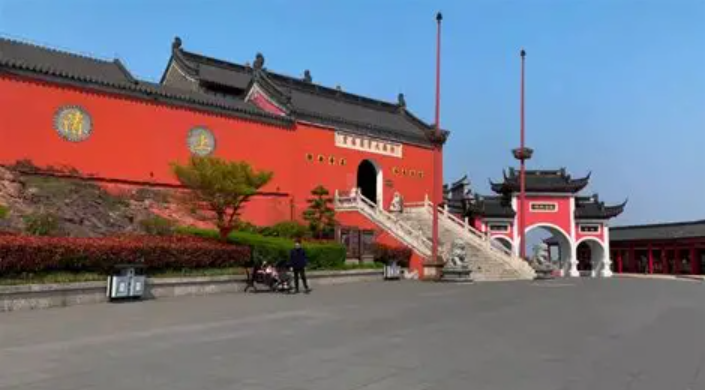
Jiuxiao Wanfu Palace, also known as Dinggong (the Summit Palace), is located at the summit of Damao Peak, the main peak of Maoshan, and is one of the most important Taoist temples at Maoshan. The palace was first built in the Western Han Dynasty and has undergone multiple reconstructions. The existing buildings are in the Ming and Qing style, covering an area of approximately 11,000 square meters, consisting of the Lingguan Hall, the Scripture Library, the Taiyuan Hall, and the Ersheng Hall. The Taiyuan Hall is the main hall, enshrining statues of the Three Mao Perfected Lords. The hall is magnificent, with carved beams and painted rafters, imposing and solemn. The palace preserves precious cultural relics such as the "Imperial Edict Stele" and the "Statues of the Three Mao Perfected Lords," which are important physical materials for studying the Taoist history of Maoshan. From the summit, one can overlook the panoramic view of Maoshan. When shrouded in mist and clouds, it feels as if one is in a fairyland, making it a must-visit place for pilgrims and sightseers.
Yuanfu Wanning Palace
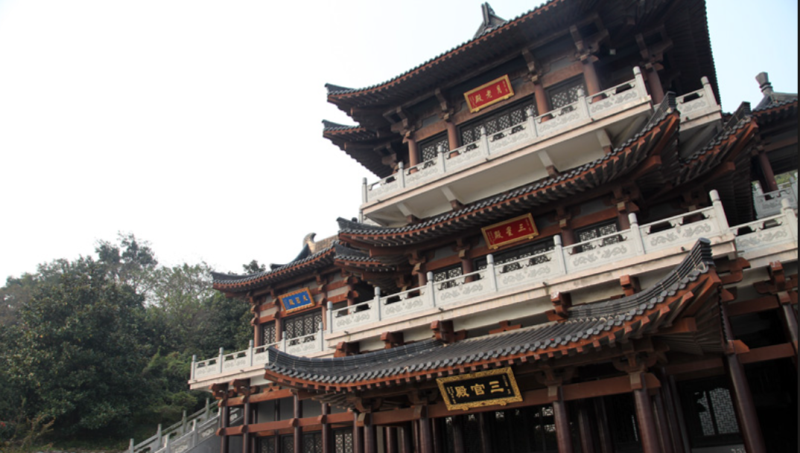
Yuanfu Wanning Palace, abbreviated as Yingong (the Seal Palace), is located at the southern foot of Jijin Peak at Maoshan. It was first built in the Tang Dynasty, and the existing buildings are in the Song Dynasty style, covering an area of approximately 8,000 square meters. The most famous landscape in the palace is the "Number One Stele Under Heaven"—the Stele of Laozi's Daodejing. The stele is 9 meters high and 1.8 meters wide, inscribed with the full text of Laozi's Daodejing in vigorous and powerful calligraphy. In addition, there are buildings such as the Lingguan Hall, the Three Great Halls, and the Three Heavenly Gates. The Three Great Halls enshrine statues of the Three Pure Ones of Taoism. Surrounding the palace are ancient cypresses reaching to the sky and dense bamboo groves. There is a thousand-year-old ancient cypress called "Bai Lao Xian Zong" (The Ancient Cypress Immortal Trace), said to have been planted by Tao Hongjing himself, possessing important historical value.
Maoshan New Fourth Army Memorial Hall
The Maoshan New Fourth Army Memorial Hall is located in Maoshan Town, Jurong City. It was built to commemorate the New Fourth Army's anti-Japanese struggle in the Maoshan region, covering an area of approximately 16,000 square meters with a building area of approximately 3,600 square meters. The hall is divided into a preface hall, main exhibition hall, film and television hall, and other sections. Through a large number of historical photographs, artifacts, sculptures, scene restorations, and other means, it vividly presents the history of the New Fourth Army's anti-Japanese guerrilla warfare in the Southern Jiangsu region. On the square outside the hall stand statues of New Fourth Army generals such as Chen Yi and Su Yu, solemn and majestic. The memorial hall is a national patriotism education demonstration base and the core attraction of Maoshan's red tourism.
New Fourth Army Southern Jiangsu Anti-Japanese Victory Monument
The New Fourth Army Southern Jiangsu Anti-Japanese Victory Monument is located on the northwest side of Damao Peak. It was completed in 1995. The monument is 28 meters high, symbolizing the 28 years of the New Fourth Army's anti-Japanese struggle in Southern Jiangsu. The monument body is made of granite, with the 11 golden characters "New Fourth Army Southern Jiangsu Anti-Japanese Victory Monument" inscribed on the front and the monument inscription on the back, recording the New Fourth Army's anti-Japanese course in the Maoshan region. There is a peculiar phenomenon at the monument square: whenever visitors set off firecrackers in front of the monument, they can hear an echo similar to a military bugle call, known as "setting off firecrackers before the monument, military bugle calls in the air," attracting many tourists to come and experience it.
Xike Spring
Xike Spring (Guest-Welcoming Spring) is a famous natural landscape at Maoshan, located on the east side of Yuanfu Wanning Palace. It is named for "guests arriving, spring gushing." The spring pool is circular, with a diameter of approximately 3 meters and a water depth of approximately 1 meter. The spring water is crystal clear and never dries up throughout the year. When tourists clap or shout by the spring, strings of bubbles emerge from the water, as if welcoming guests, hence the name "Xike Spring." Beside the spring is the "Xike Spring Pavilion" built in the Ming Dynasty, with a stone stele inscribed with records about Xike Spring, adding cultural connotations to the landscape.
Food
Maoshan Old Goose
Maoshan Old Goose is a local specialty dish, made from free-range geese raised in the Maoshan region that are over two years old, prepared through traditional curing and braising processes. During preparation, the goose is first cured with salt, Sichuan peppercorns, and other seasonings for several days, then slowly cooked in a braising broth made with star anise, cinnamon, bay leaves, and various other spices. The finished product has a bright red color, firm meat, is salty and flavorful, and rich but not greasy. It can be tasted in restaurants and farmhouses around the Maoshan Scenic Area. Vacuum-packed Maoshan Old Goose is also a popular specialty product, priced at approximately 50-80 yuan per bird.
Maoshan Wild Mushroom Casserole
Maoshan Wild Mushroom Casserole is made with various wild mushrooms abundantly produced in the Maoshan region, such as shiitake mushrooms, oyster mushrooms, enoki mushrooms, and bamboo fungus, stewed with chicken or pork ribs. The wild mushrooms are gathered from the Maoshan mountain forests, natural and pollution-free, rich in amino acids and trace elements. The broth is delicious and nutritious. This dish is relatively common in restaurants within the scenic area, with a light and refreshing taste, suitable for health preservation, priced at approximately 40-60 yuan per serving.
Jintan Sealed Jar Wine
Jintan Sealed Jar Wine is a specialty beverage around Maoshan, belonging to the sweet-type yellow wine, with a long brewing history dating back several hundred years. It uses local high-quality glutinous rice as raw material and is brewed through a traditional complex fermentation process. The wine liquid is amber-colored, with a rich aroma and a mellow, sweet taste, with an alcohol content of approximately 14 degrees. Jintan Sealed Jar Wine has won multiple national awards and is an excellent gift for banquets and presents. It can be purchased at specialty shops in the scenic area and in Jintan urban area, with prices varying according to vintage and quality, approximately 50-200 yuan per bottle.
Maoshan Roasted Green Tea
Maoshan Roasted Green Tea is a local specialty green tea, named after its production in the Maoshan region, with a cultivation history of several hundred years. The tea uses fresh leaves of one bud and one leaf or one bud and two leaves, processed through fixation, rolling, roasting, and other procedures. It has a tightly rolled appearance, emerald green color, and after brewing, the liquor is clear, with a high and fresh aroma and a refreshing taste. Maoshan Roasted Green Tea is rich in nutrients such as tea polyphenols and is a green and healthy beverage. It can be purchased at teahouses and specialty shops within the scenic area, priced at approximately 200-800 yuan per jin, varying according to picking season and quality.
Tickets:
Tickets are 80 yuan per person.
You can search for the official WeChat public account "Jurong Maoshan Scenic Area" to get the latest updates or purchase tickets online.
Opening Hours:
Opening hours are:
April 1 - October 31: 7:30-17:30 (last entry at 17:00)
November 1 - March 31 of the following year: 8:00-17:00 (last entry at 16:30)
The New Fourth Army Memorial Hall is open from 9:00-16:30 (last entry at 16:00), closed on Mondays (except statutory holidays). Visitors are advised to arrange their time reasonably to avoid missing the opening hours of attractions.
Tour Routes:
Recommended classic one-day tour route: Arrive at the scenic area at 8:30 AM, first visit Yuanfu Wanning Palace to see the Stele of Laozi's Daodejing, the thousand-year-old ancient cypress, and other landscapes (about 1.5 hours); then go to Xike Spring to experience the wonder of "guests arriving, spring gushing" (about 30 minutes); have lunch at restaurants around the scenic area to taste specialty dishes such as Maoshan Old Goose and Wild Mushroom Casserole (about 1 hour). In the afternoon at 13:30, go to Jiuxiao Wanfu Palace, climb to the top of Damao Peak, experience Taoist culture and overlook the panorama (about 2 hours); at 15:30, go to the New Fourth Army Memorial Hall to learn about the New Fourth Army's anti-Japanese history (about 1.5 hours); finally visit the New Fourth Army Southern Jiangsu Anti-Japanese Victory Monument to experience the peculiar phenomenon of "setting off firecrackers before the monument, military bugle calls in the air" (about 30 minutes), ending the itinerary at 17:00.
If time permits, a two-day tour can be arranged: the first day for Taoist cultural attractions, and the second day for an in-depth experience of red culture and visiting surrounding revolutionary sites.
Transportation:
High-speed rail/EMU: Take the high-speed rail or EMU to Jurong West Station, then transfer to Jurong Bus No. 103 directly to Maoshan Scenic Area. The journey takes about 50 minutes with a fare of 5 yuan; or take a taxi, which takes about 30 minutes and costs about 40 yuan.
Long-distance bus: Nanjing Bus Passenger Station and Changzhou Bus Station both have direct buses to Jurong Maoshan Passenger Station. The journey takes about 1.5 hours with a fare of 25-35 yuan; from Maoshan Passenger Station, walk 10 minutes to reach the scenic area entrance.
Self-driving: From Nanjing, take the Shanghai-Chengdu Expressway (G42), transfer to the Changzhou-Hefei Expressway (G15W3), exit at Maoshan, and drive straight along Maoshan Road for about 5 kilometers to reach the scenic area. The total distance is about 70 kilometers, and the drive takes 1 hour. From Changzhou, take the Changzhou-Hefei Expressway (G15W3), exit at Maoshan. The total distance is about 60 kilometers, and the drive takes 50 minutes. The scenic area parking lot charges 10 yuan per day for small vehicles and 20 yuan per day for large vehicles.
Internal transportation: The scenic area has sightseeing buses connecting major attractions. One-way tickets are 15 yuan per person, and unlimited ride passes are 40 yuan per person.
Must-Visit Attractions:
Jiuxiao Wanfu Palace: The core Taoist temple of Maoshan, located at the summit of Damao Peak, covering an area of 11,000 square meters. Visitors can worship and pray and overlook the panorama. Suggested visiting time is about 2 hours.
Yuanfu Wanning Palace: Home to the "Number One Stele Under Heaven"—the Stele of Laozi's Daodejing, with Song Dynasty-style architecture and thousand-year-old ancient cypresses as its features. It covers an area of 8,000 square meters. Suggested visiting time is about 1.5 hours.
New Fourth Army Memorial Hall: A national patriotism education demonstration base, covering an area of 16,000 square meters, systematically displaying the New Fourth Army's anti-Japanese history. Suggested visiting time is about 1.5 hours.
New Fourth Army Southern Jiangsu Anti-Japanese Victory Monument: 28 meters high, with the peculiar phenomenon of "setting off firecrackers before the monument, military bugle calls in the air." It is a landmark attraction of red culture. Suggested visiting time is about 30 minutes.
Tour Suggestions:
The best seasons to visit are spring (March-May) and autumn (September-November). In spring, mountain flowers are in full bloom; in autumn, the climate is cool, suitable for mountain climbing and outdoor activities. In summer, pay attention to sun protection; in winter, some mountain roads may freeze, so travel with caution.
Taoist temples are solemn and sacred. When visiting, observe etiquette: do not make noise, do not touch statues and cultural relics at will, dress appropriately, and do not wear slippers or shorts into the main halls.
Dining prices within the scenic area are relatively high. You can bring dry food and water, or choose to dine in Maoshan Town, where prices are affordable and you can taste authentic specialty dishes such as Maoshan Old Goose.
For purchasing specialty products, it is recommended to choose regular shops outside the scenic area, such as for Maoshan Old Goose, Jintan Sealed Jar Wine, and Maoshan Roasted Green Tea. You can bargain, and be sure to check production dates and shelf life.
Visitors with limited physical strength can take the scenic area sightseeing bus to save energy and visit core attractions; visitors with good physical strength can choose to walk and enjoy the mountain forest scenery along the way. The full walking journey takes about 5-6 hours.
Precautions:
Some mountain roads in the scenic area are steep with many steps. Wear comfortable sports shoes when visiting and pay attention to safety underfoot. Elderly people and children are advised to be accompanied by family members.
When visiting the New Fourth Army Memorial Hall, keep quiet, respect history, do not touch exhibits at will, and flash photography is prohibited.
Smoking is prohibited in Taoist temples, and bringing fire sources into forest areas is prohibited. The scenic area has designated smoking areas; please smoke only in designated areas.
Protect the scenic area environment. Do not spit, litter, pick flowers, or deface cultural relics. Protect natural and cultural landscapes.
Wild macaques may appear in the scenic area. Please do not feed or tease monkeys to avoid accidents; keep personal belongings safe to prevent them from being snatched by monkeys.
In case of severe weather (such as rainstorms, thunderstorms, strong winds, etc.), some attractions may be temporarily closed. Follow the instructions of scenic area staff and evacuate to safe areas promptly.