China Milu Park is located in Dafeng District, Yancheng City, Jiangsu Province. It is a national 5A-level tourist attraction and the largest Milu deer nature reserve in the world by land area and Milu population. With Milu deer conservation at its core, the scenic area integrates wetland ecological sightseeing, science education, and cultural experience. It features a unique coastal wetland ecosystem and rich biodiversity. The total area of the scenic area is 78,000 mu, of which the core protection area is about 2,668 hectares, and wetlands account for more than 70% of the area. The park has facilities such as the Milu Museum, Deer Viewing Platform, and wetland boardwalks. As of 2024, the Milu population has reached more than 7,000, accounting for over 60% of the global total. It is a successful example of wildlife conservation in China and an important window for domestic and international tourists to learn about Milu culture and wetland ecology.
Historical Culture
Milu, commonly known as the "four不像" (four unlikes), is a rare deer species unique to China. It gets its name because its antlers resemble those of a deer, its face resembles that of a horse, its hooves resemble those of an ox, and its tail resembles that of a donkey. It has profound cultural significance in Chinese civilization. As early as the Neolithic Age, Milu appeared in human life. Oracle bone inscriptions from the Shang and Zhou dynasties already contain records of Milu, and its image often appears in murals and bronze ware of successive dynasties, symbolizing auspiciousness and harmony.
At the end of the 19th century, due to habitat destruction and overhunting, wild Milu became extinct in China. In 1986, China reintroduced 39 Milu from the United Kingdom and established the Milu Nature Reserve in Dafeng, launching the Milu reintroduction project. After decades of protection and breeding, the Milu population has grown steadily. In 2006, the wild population was successfully restored, becoming a "Chinese miracle" in the history of global endangered species conservation. The Milu Museum in the scenic area systematically displays the rise and fall of this species and its conservation history, witnessing efforts toward harmonious coexistence between humanity and nature.
Main Attractions
Milu Viewing Area
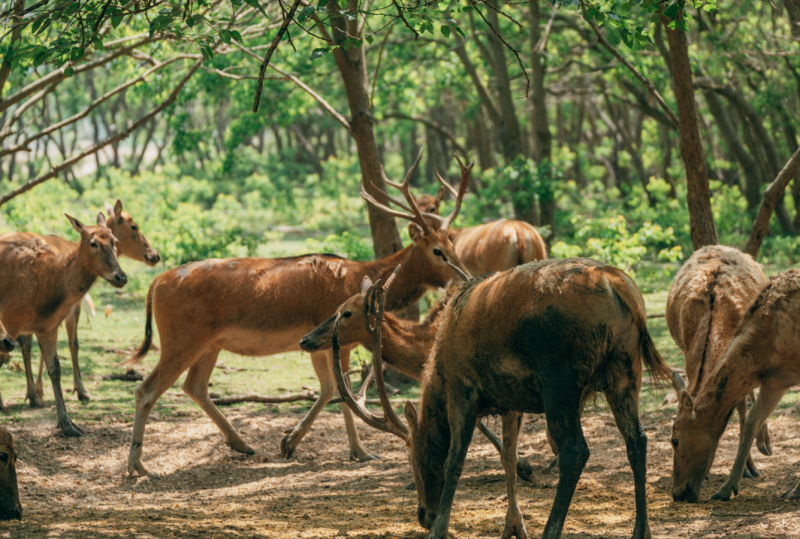
The Milu Viewing Area is the core area of the scenic spot, covering about 50,000 mu, and is divided into a semi-wild free-range area and a captive area. In the semi-wild free-range area, thousands of Milu roam freely in the reed wetlands. Tourists can enter by sightseeing bus (ticket 40 yuan/person) to observe the natural behavior of Milu up close, such as foraging, playing, and fighting. During the breeding season from May to August each year, visitors can also see male deer courting and female deer raising their young. The captive area mainly displays Milu of different ages, including fawns, adult deer, and elderly deer, making it convenient for tourists to observe the growth characteristics of Milu. There are science interpretation boards in the area introducing Milu's living habits and conservation knowledge.
Milu Museum
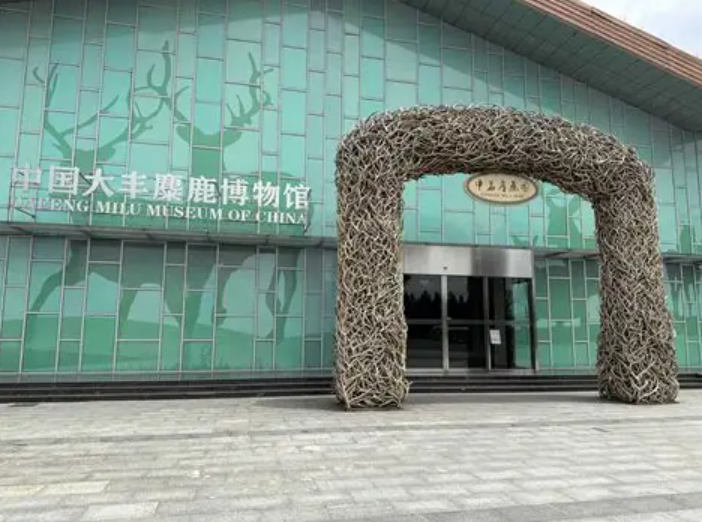
The Milu Museum is the only professional museum in China themed on Milu. It has a building area of about 2,000 square meters and is divided into four exhibition halls: "Origin of Milu," "Cultural Imprint," "Endangerment and Rebirth," and "Conservation Achievements." The museum houses more than 3,000 items, including Milu fossils, cultural relics related to Milu from successive dynasties, and precious Milu specimens from home and abroad. Through multimedia interaction and scene restoration, it systematically presents the evolutionary history, cultural significance, and conservation story of Milu. Among them, the "Reintroduction" exhibition hall records in detail the entire process of Milu's return to China since 1986 and is an important place for understanding the history of species conservation.
Deer Viewing Platform
The Deer Viewing Platform is located on a high ground in the central part of the scenic area. It is a three-story antique-style pavilion about 18 meters high and covers about 300 square meters. Climbing the platform offers a panoramic view of the vast wetland grassland. When visibility is good, groups of Milu can be seen moving in the distance, forming a natural picture with reeds and waters. The platform has a rest area and telescopes, making it convenient for tourists to observe and take photos for a long time. It is a landmark viewing facility in the scenic area.
Wetland Maze
The Wetland Maze is located in the eastern part of the scenic area, covering about 1,000 mu. It is a typical coastal wetland ecosystem composed of reed marshes, swamps, and waterways. Tourists can take wooden boats (ticket 60 yuan/person) through it to explore the secrets of the wetland. Along the way, they can not only see traces of Milu but also observe more than 300 species of birds, including red-crowned cranes, oriental storks, and black-faced spoonbills, as well as small mammals such as river deer and wild rabbits. Ecological interpretation boards are set up in the wetland to introduce the purification function of wetlands and the importance of biodiversity conservation. It is a vivid classroom for ecological science education.
Fengshen Platform
Fengshen Platform is named after the legend in Investiture of the Gods that Jiang Ziya's mount was a Milu. The platform is about 10 meters high and is a circular structure surrounded by 108 stone pillars carved with Milu patterns. Climbing the platform allows visitors to overlook the entire reserve. In the center of the platform is a "four unlikes" sculpture, symbolizing the sacred status of Milu in traditional culture. Trees such as ginkgo and pine and cypress are planted around Fengshen Platform, creating a pleasant contrast with the wetland landscape. It is a popular spot for tourists to take photos.
Food
Dafeng Fish Soup Noodles
Dafeng Fish Soup Noodles is a local specialty breakfast. It uses a rich soup made from fresh sea fish (mostly crucian carp and eel) as the base and is served with handmade pulled noodles. During preparation, the fish is pan-fried until golden, then boiling water is added and the soup is simmered over high heat for 2 hours until milky white. Then the noodles are cooked in it and garnished with chopped scallions, pepper, and other seasonings. It has a fresh, rich taste and is nutritious. It can be tasted in restaurants around the scenic area and time-honored noodle shops in Dafeng urban area. The price is about 15-25 yuan per bowl, making it a must-try food for experiencing local flavors.
Drunken Mud Snails
Drunken Mud Snails is a traditional snack in the coastal area of Yancheng. It is made from fresh mud snails produced in the Dafeng tidal flats. After cleaning and purging sand, they are pickled with baijiu, salt, sugar, Sichuan pepper, and other ingredients. The finished product has crisp and tender meat, a rich wine aroma, and no fishy smell. It is rich in protein and minerals. It can be purchased at specialty shops in the scenic area and the Dafeng seafood market. Vacuum-packed drunken mud snails cost about 30-50 yuan per bottle. They are both an appetizer on the table and a popular souvenir.
Braised Pork with Reed Shoots
Reed shoots are the tender stems of wetland reeds, picked in spring each year. They are tender, juicy, and rich in dietary fiber. Braised Pork with Reed Shoots uses locally free-range pork stewed together with reed shoots. The pork is tender and the bamboo shoot aroma is rich. It is a specialty dish of farm restaurants in the scenic area. This dish makes full use of wetland resources and reflects the close connection between local diet and nature. The price is about 40-60 yuan per serving.
Seafood Feast
Dafeng is located on the coast of the Yellow Sea and is rich in seafood. Seafood Feast is a popular local dish for banquets. It mainly uses swimming crabs, prawns, clams, razor clams, and other seafood, braised with chili, garlic, ginger, and other seasonings. It has a generous portion and a rich fresh flavor. Seafood restaurants around the scenic area can provide it. Depending on the ingredients, the price is about 150-300 yuan per serving, suitable for sharing among several people.
Tickets:
Ticket 50 yuan/person.
You can search for the official WeChat public account "China Milu Park" to get the latest updates or buy tickets online.
Opening Hours:
Opening hours are:
April 1-October 31: 8:00-18:00 (last entry at 17:00)
November 1-March 31 of the following year: 8:30-17:00 (last entry at 16:30)
The scenic area is open all year round with no closing days. Tourists are advised to avoid the high-temperature period at noon in summer and the low-temperature period in the morning and evening in winter. It is better to visit from 9:00-11:00 in the morning or 14:00-16:00 in the afternoon, when Milu are more active and the viewing effect is better.
Tour Route:
Recommended classic one-day tour route: arrive at the scenic area at 8:30 a.m. and first visit the Milu Museum (about 1.5 hours) to learn about the historical culture and conservation history of Milu; at 10:00 take the sightseeing bus into the Milu Viewing Area and tour the semi-wild free-range area and captive area (about 2 hours) to observe Milu up close; at 12:00 dine at the ecological restaurant in the scenic area and taste specialty dishes such as Braised Pork with Reed Shoots and seafood; at 13:30 go to the Deer Viewing Platform to climb high and enjoy the view (about 30 minutes), then walk to Fengshen Platform (about 30 minutes); at 14:30 take a wooden boat to tour the Wetland Maze (about 1.5 hours) and observe wetland ecology and birds; at 16:00 buy souvenirs such as drunken mud snails and Milu cultural and creative products at the scenic area specialty shop, and end the trip at 16:30.
If time permits, you can extend the trip to the hiking boardwalk in the Wetland Maze to further experience the wetland scenery. The whole trip takes about 1 extra hour.
Transportation:
High-speed rail/EMU: Take high-speed rail or EMU to Yancheng Station. After leaving the station, transfer to the Yancheng-Dafeng tourist express bus (about 1 bus per hour), which goes directly to China Milu Park. The journey takes about 1.5 hours and the ticket price is 30 yuan; or take a taxi from Yancheng Station, which takes about 1 hour and costs about 120 yuan.
Long-distance bus: Dafeng Bus Passenger Transport Station has a direct bus line to the scenic area (Dafeng No. 109), with a journey of about 30 minutes, a ticket price of 5 yuan, and one bus every 30 minutes; surrounding cities such as Nantong, Taizhou, and Yangzhou all have direct long-distance buses to Dafeng. After arriving, transfer to a bus.
Self-driving: From Yancheng, drive along the Shenhai Expressway (G15) to the Dafeng Port exit, then drive southeast along Provincial Road S226 for about 20 kilometers to reach the scenic area. The total distance is about 70 kilometers and the drive takes 1 hour; from Shanghai, drive north along the Shenhai Expressway (G15) for about 300 kilometers, get off at the Dafeng Port exit, and the drive takes about 3.5 hours; the scenic area parking lot charges 10 yuan/day for small cars and 20 yuan/day for large cars.
Internal transportation in the scenic area: sightseeing buses in the scenic area connect the main attractions, with a full journey ticket of 40 yuan/person and hop-on hop-off access; the Wetland Maze boat ticket is 60 yuan/person and must be taken at the designated pier.
Must-Visit Attractions:
Milu Viewing Area: the world's largest Milu habitat, where you can observe the natural living state of thousands of Milu up close. It covers 50,000 mu, and the visit takes about 2 hours (including sightseeing bus).
Milu Museum: China's only professional museum themed on Milu. More than 3,000 exhibits systematically present Milu culture and conservation history. The building area is 2,000 square meters, and the visit takes about 1.5 hours.
Wetland Maze: a typical coastal wetland ecosystem. A boat tour allows visitors to observe various birds and wetland landscapes. It covers 1,000 mu, and the visit takes about 1.5 hours (including boat tour).
Deer Viewing Platform: a landmark viewing facility in the scenic area. Climbing high allows visitors to overlook the wetland and Milu herds. It is 18 meters high, and the visit takes about 30 minutes.
Travel Suggestions:
The best seasons to visit are spring and autumn (April-May, September-October), when the climate is mild, Milu are active, and wetland vegetation is rich; in summer, pay attention to sun protection and insect prevention; in winter, it is colder and Milu activity decreases.
The scenic area is large. It is recommended to take the sightseeing bus to save energy. The sightseeing bus pass can be used all day, making it convenient to travel between attractions.
When observing Milu, keep a safe distance (at least 50 meters). Do not feed, make noise, or use flash photography, so as not to disturb their normal life.
There are few dining options in the scenic area. You can bring dry food and water, or go to Dafeng urban area for meals. It is recommended to try local specialties such as Dafeng Fish Soup Noodles and Seafood Feast.
For specialty purchases, you can choose seafood products such as drunken mud snails and jellyfish, as well as Milu-shaped cultural and creative products. The specialty shop at the exit of the scenic area has transparent prices, so you can buy with confidence.
Notes:
The wetland terrain in the scenic area is complex, and some areas are muddy. Wear non-slip sports shoes when visiting and avoid entering unopened areas.
There are many mosquitoes in the wetland in summer. Carry mosquito repellent, floral water, and other supplies, and wear long-sleeved clothing to prevent bites.
Protect the wetland ecological environment. Do not litter, pick plants, or disturb wild animals. Follow the principle of "leave no trace."
When taking the sightseeing bus or boat, fasten your seat belt (wear a life jacket on the boat) and follow the instructions of staff. Do not stand or lean out while moving.
The signal in the scenic area is weak. It is recommended to download offline maps in advance and keep in touch with companions to avoid getting lost.
In case of extreme weather (such as heavy rain, typhoons, etc.), the scenic area may temporarily close some areas. Pay attention to official notices and adjust your itinerary reasonably.