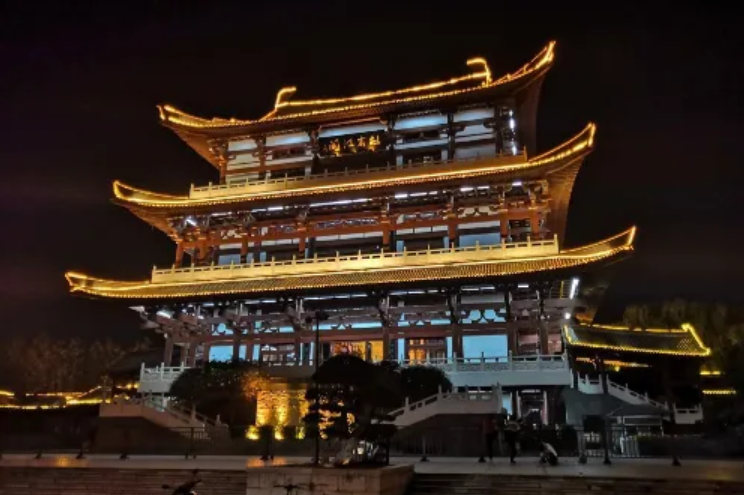
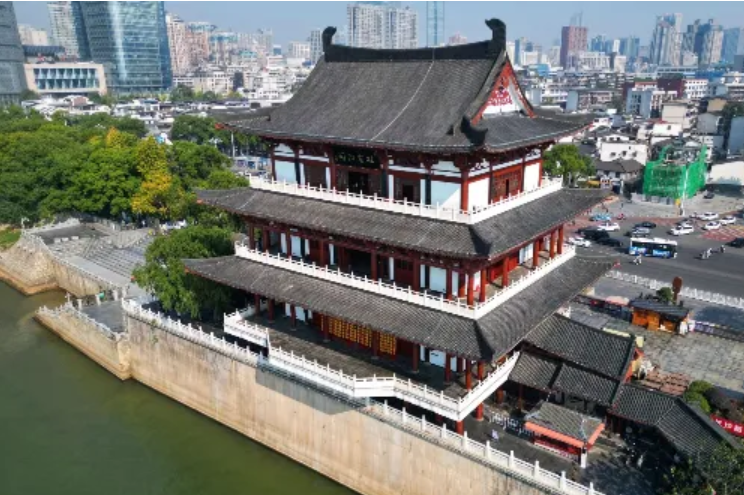
Du Fu Pavilion is located at No. 108, Section 2, Xiangjiang Middle Road, Tianxin District, Changsha City, Hunan Province. It stands on the Xiangjiang Scenic Belt where Xihu Road intersects with Xiangjiang Avenue. It is a garden-style antique architectural complex built to commemorate the Tang Dynasty poet Du Fu. The building features flying eaves, bracket sets, carved beams, and painted rafters, presenting a grand and elegant appearance. It is the largest imitation Tang-style architectural complex in Changsha City. The garden area of the pavilion covers more than 6,000 square meters, with a building area of more than 3,800 square meters. The main pavilion has four floors in total and is 18 meters high.
Historical Culture
In the third year of the Dali era of the Tang Dynasty (768), Du Fu traveled from Sichuan to Hunan to seek refuge with his old friend Wei Zhijin. However, Wei Zhijin had already died. Poor and ill, Du Fu spent the last two years of his life in Changsha. He initially lived on a boat, and later rented a building by the Xiangjiang River outside Xiaoximen, naming it "Jiangge." During his time in Changsha, Du Fu left behind more than one hundred poems, over fifty of which were composed in Changsha, such as "Meeting Li Guinian in Jiangnan" and "Departing from Tanzhou," adding luster to Huxiang culture. During the reign of Emperor Kangxi of the Qing Dynasty, literati and notable figures proposed building a pavilion, poetry steles, and a statue for Du Fu. In 2002, Changsha City decided to build Du Fu Pavilion on the bank of the Xiangjiang River. It was completed in 2005 and officially opened to the public in 2006.
Main Attractions
First Floor of Du Fu Pavilion
It is a shop for poetry, calligraphy, painting, and souvenirs.
Second Floor of Du Fu Pavilion
In the center of the hall stands a statue of Du Fu. The front of the hall features a large wooden bas-relief, "Map of Du Gongbu's Travels in Xiaoxiang," displaying Du Fu's movements during his life in Hunan. On both sides of the hall are Du Fu's poems and poetic paintings inscribed or painted by Zhang Daqian, Lin Sanzhi, and others. There are also couplets, large poetic painting vases, antique mahogany screens, flower stands, small tables, and precious potted flowers and bonsai, full of a rich cultural atmosphere.
Third Floor of Du Fu Pavilion
Through poetry and paintings, it focuses on displaying Du Fu's poems written during his three years in Hunan. The exhibition is divided into six parts: family background, travels, aspirations, poetic history, Hunan soul, and brilliance. It displays more than one hundred items, including photographs, poetic and painting works, editions of Du Fu's poems, and physical materials. The exhibition wall adopts a decorative pattern of lattice doors and windows, similar in style to the pavilion architecture.
Fourth Floor of Du Fu Pavilion
It is divided into three small areas: model display, cultural exchange, and visitor rest. In the center of the hall is a model of the pavilion. On both sides are Qing Dynasty mahogany furniture, the four treasures of the study, antiques, calligraphy and paintings, and fine Hunan embroidery and ornamental stones. The four walls feature group paintings of stories about prominent historical and cultural figures in Changsha, telling the stories of historical and cultural celebrities such as Qu Yuan and Jia Yi.
Poetry Stele Corridor
Located in the north and south connecting corridors of the pavilion, stone steles inscribed with Du Fu's poems are placed on both sides of the columns. There are fan-shaped corridors and winding corridors, with steles arranged among them.
Hexagonal Stele Pavilion
Located to the north of Du Fu Pavilion, it has a double-eaved roof. A stele stands inside the pavilion, recording the origins and process of Changsha Municipal Government's construction of Du Fu Pavilion.
Suggested Tour Route:
You may begin by visiting the Du Fu Memorial Hall on the second floor, then go to the third floor to learn about Du Fu's life, and then to the fourth floor to enjoy the fine displays and group paintings of humanistic stories. After that, stroll along the Poetry Stele Corridor to view the steles inscribed with Du Fu's poems, and finally go up to the viewing platform to overlook the beautiful scenery of the Xiangjiang River, Orange Isle, and Yuelu Mountain. You may also, according to personal interests, first visit the floors and attractions you are most interested in, and then gradually visit other places. If time permits, you can ascend the pavilion in the evening to enjoy the beautiful scene after the lights are turned on and the night view of the Xiangjiang River.
Tour Suggestions:
You may choose to visit in the evening or at night, so that you can enjoy both the illuminated night view of the pavilion and the romantic atmosphere of the Xiangjiang River.
Participate in special activities in the scenic area, such as the "Joyful Encounter" Tang-style interactive night tour, for an immersive experience of Tang Dynasty culture.
You may bring your own notebook and freely collect 8 themed stamps in the Tang-style space on the first floor.
If you are interested in Du Fu culture, you may learn in advance about Du Fu's experiences and poems in Changsha so as to better visit the scenic area.
Notes:
Observe the opening hours of the scenic area and enter and leave on time.
Please do not talk loudly during the visit, and keep quiet so as not to affect other visitors.
Please protect the environment of the scenic area. Do not litter, and do not touch the exhibits or cultural relics.
When visiting high places such as the viewing platform, pay attention to safety and do not lean on the railings.
During holidays or peak tourist seasons, there are many visitors in the scenic area, so please take good care of your personal belongings.
Transportation:
Metro: Take Line 1 to Nanmenkou Station, exit from Exit 1, and walk along Xiangjiang Middle Road for 10 minutes.
Bus: Take Bus No. 1, 123, or 406 and get off at Du Fu Pavilion Station.
Taxi/Driving: Navigate to "Du Fu Pavilion." There are paid parking lots nearby, with a fee of 10-15 yuan per hour. Parking spaces are tight during peak seasons.
Opening Hours:
The scenic area is open from 9:00 to 22:00, and ticket sales and entry stop at 21:30. The opening hours of the "Joyful Encounter" Tang-style themed space on the first floor of the pavilion are 10:30 to 21:30. In summer, the lighting period is 19:30 to 22:30.
Tickets:
The ticket price is 18 yuan per person.