Mount Emei is located in Emeishan City, Leshan City, Sichuan Province. It is one of the "Four Great Buddhist Mountains" in China and a national 5A-level scenic area. The scenic area covers a total area of about 154 square kilometers, with the highest peak, Wanfo Summit, at an altitude of 3,099 meters. It is famous for its natural landscapes of "majesty, elegance, wonder, steepness, and seclusion" and its profound Buddhist culture. The vegetation coverage rate on the mountain is over 90%, with more than 2,300 plant species and over 200 wild animal species. It is a World Cultural and Natural Heritage Site. There are currently 28 temples in the scenic area, among which Wannian Temple and Baoguo Temple are key cultural relic protection units, and buildings such as the Golden Summit Bronze Hall are treasures of Buddhist art.
Historical Culture
Buddhist culture on Mount Emei began in the Eastern Han Dynasty, flourished in the Tang and Song Dynasties, and reached its peak in the Ming and Qing Dynasties, with a history of nearly 2,000 years. In the 1st century AD, Buddhism spread into Sichuan along the Silk Road, and Mount Emei gradually became the sacred place of Samantabhadra Bodhisattva, known together with Mount Wutai in Shanxi (Manjushri), Mount Putuo in Zhejiang (Guanyin), and Mount Jiuhua in Anhui (Ksitigarbha) as the Four Great Buddhist Mountains. During the Tang and Song Dynasties, the number of temples on Mount Emei reached more than 100, and it reached its peak in the Ming Dynasty. The Song Dynasty Samantabhadra bronze statue in the existing Wannian Temple weighs 62 tons and is a nationally key protected cultural relic.
In addition to Buddhist culture, Mount Emei is also one of the birthplaces of Chinese martial arts. Emei martial arts, together with Shaolin and Wudang, are known as the three major martial arts schools in China. It was formed in the Tang and Song Dynasties and flourished in the Ming and Qing Dynasties, and is known for "combining hardness and softness and being flexible and changeable." The martial arts hall in the scenic area still retains traditional martial arts performances.
Main Attractions
Golden Summit
The Golden Summit is the iconic attraction of Mount Emei, at an altitude of 3,079 meters. It is named because most of the buildings on the summit are covered with copper tiles. Here is the world's largest golden Buddha—the 48-meter-high Ten-Direction Samantabhadra Golden Statue—as well as the Golden, Silver, and Bronze Halls. The Four Great Wonders of the Golden Summit—"sunrise, sea of clouds, Buddha's halo, and holy lamps"—are famous at home and abroad. Among them, the Buddha's halo appears about 80 times a year, mostly from 2 p.m. to 5 p.m.
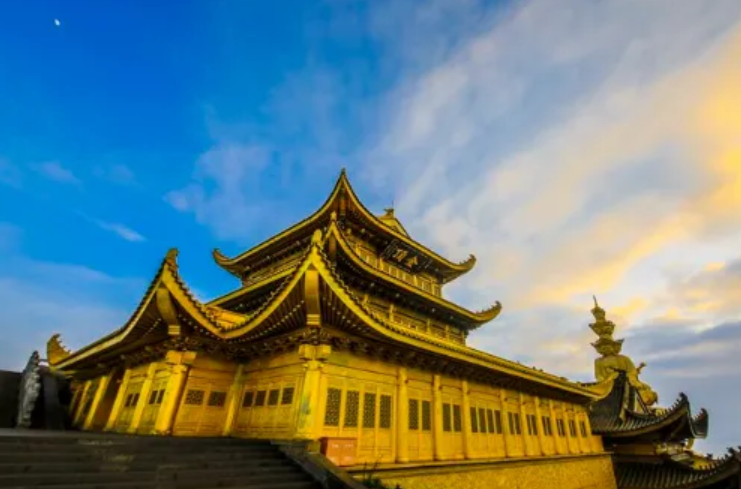
Wannian Temple
Wannian Temple is one of the oldest temples on Mount Emei. It was first built in the Eastern Jin Dynasty and was originally named Samantabhadra Temple. The Song Dynasty Samantabhadra bronze statue enshrined in the temple is 7.3 meters high and weighs 62 tons, and is a national first-class cultural relic. The negative oxygen ion concentration in the area where the temple is located is as high as 80,000 per cubic centimeter, making it a natural oxygen bar. Nearby attractions include Baishui Pond and the Beamless Brick Hall.
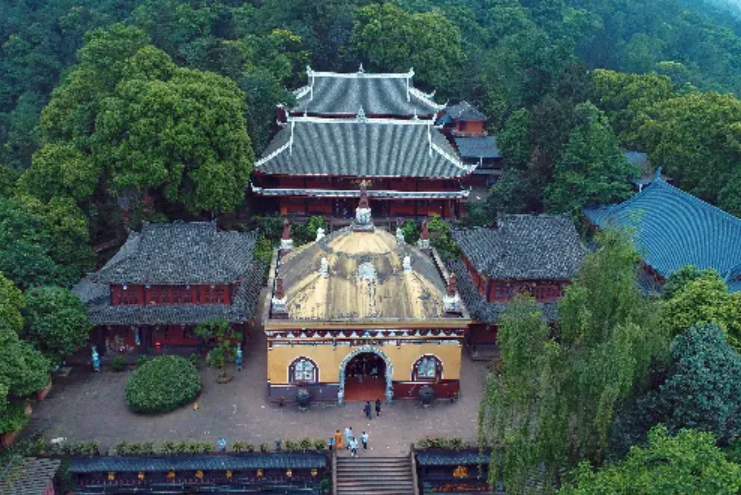
Jieyin Hall
At an altitude of 2,540 meters, the architectural layout of the hall faces east and sits west, with a courtyard-style layout and three main halls, consisting of the front hall (Maitreya Hall), the middle hall (Mahavira Hall), and the rear hall (Amitabha Hall).
Wanfo Summit
It is the highest-altitude scenic and natural ecological protection area among China's Four Great Buddhist Mountains, and also China's highest-altitude World Natural and Cultural Heritage site. From the Golden Summit westward is Qianfo Summit. There was originally a temple on the summit named Qianfo Nunnery, which no longer exists. Passing Qianfo Summit is Wanfo Summit.
Jiulao Cave
A famous karst cave on Mount Emei. Within a passage extending downward for more than 1,500 meters, it is a fully enclosed viewing space, presenting a varied spatial beauty. It is like a simple yet novel, elegant yet solemn art palace, causing people to be surprised and delighted.
Qingyin Pavilion
Qingyin Pavilion is located at the foot of Niuxin Ridge, at an altitude of 710 meters, and is an important node on the hiking route of Mount Emei. In front of the pavilion is Shuangfei Bridge, under which the black and white waters converge into Niuxin Pool, known as "the first scenery of Mount Emei." The pavilion enshrines statues of Shakyamuni, Manjushri, and Samantabhadra. The surrounding trees are lush, and monkeys often move about here.
Baoguo Temple
At an altitude of 551 meters, it is the first temple on Mount Emei and the location of the Mount Emei Buddhist Association. It is the center of Buddhist activities on Mount Emei.
Ecological Monkey Area
Located between Qingyin Pavilion, Yixiantian, and Hongchunping on Mount Emei, it is a long and narrow valley covering 25 hectares. It is currently the largest natural ecological monkey protection area in China. There are currently three family groups of wild monkeys in the ecological monkey area, totaling more than 300.
Xixiang Pool
One of the eight great temples of Mount Emei. It is located on Zuantian Slope at an altitude of 2,070 meters on Mount Emei. It is said that when Samantabhadra Bodhisattva passed by riding an elephant, the white elephant once bathed in the pool, so it was renamed Xixiang Pool, also known as Tianhua Chan Monastery.
Xianfeng Temple
One of the eight great temples of Mount Emei. It is located at the foot of Xianfeng Rock. It was originally named Ciyan Temple and is at an altitude of 1,725 meters.
Tour Routes:
One-day tour route: Baoguo Temple (1 hour) → Wuxiangang (take sightseeing bus) → Qingyin Pavilion (1.5 hours) → Wannian Temple (1 hour, take cable car) → Ecological Monkey Area (1 hour) → Leidongping (take sightseeing bus) → Golden Summit (2 hours, take cable car) → return. This route covers the core attractions and requires taking the sightseeing bus (full mountain section 90 yuan) and cable car. It is suitable for tourists with limited time.
Two-day tour route: D1 Baoguo Temple → Fuhu Temple → Leiyin Temple → Chunyang Hall → Shenshui Pavilion → Zhongfeng Temple → Guangfu Temple → Qingyin Pavilion (about 5 hours on foot), stay at Qingyin Pavilion; D2 Qingyin Pavilion → Wannian Temple → Xixinsuo → Changlaoping → Chudian → Huayan Summit → Jiulinggang → Xixiang Pool → Leidongping → Jieyin Hall → Golden Summit (about 8 hours on foot), stay at the Golden Summit to watch the sunrise.
Travel Suggestions:
Best viewing time for sunrise at the Golden Summit: 6:00-6:30 in summer, 7:00-7:30 in winter. It is recommended to arrive 1 hour in advance and bring a down jacket (the temperature at the summit is 15°C lower than at the foot of the mountain).
For hiking, wear non-slip shoes. The stone steps from Wannian Temple to Jiulinggang are steep. It is recommended to bring trekking poles (sold in the scenic area for 10-20 yuan).
When visiting the monkey area, make sure backpack zippers are closed, do not carry plastic bags, do not run when encountering monkeys, and you may hold a bamboo pole (rented or sold in the scenic area for 5 yuan each) for protection.
Vegetarian meals at temples in the scenic area are affordable. Vegetarian meals at Wannian Temple are 25 yuan per person, and at the Golden Summit 35 yuan per person. Meals are served between 11:30 and 13:00.
In winter (December-February), there is ice and snow on the section from Leidongping to the Golden Summit. Ice claws need to be purchased (10 yuan per pair). It is recommended to take the cable car to avoid slipping.
Precautions:
Smoking is prohibited in the scenic area. Violators will be fined 50-200 yuan. In temple areas such as Baoguo Temple and Wannian Temple, hats must be removed before entering.
Wild monkeys are aggressive. Do not feed them your own food, do not touch the monkeys, and if monkeys grab food, let go and abandon the item to protect yourself.
On the hiking route, there are no supply points from Xianfeng Temple to Xixiang Pool. Drinking water and dry food should be prepared in advance (it is recommended to carry compressed biscuits and chocolate).
The ultraviolet rays at the Golden Summit are strong. In summer, apply SPF50 sunscreen and wear sunglasses; in winter, the road surface may freeze, so waterproof hiking shoes are recommended.
Last sightseeing bus time in the scenic area: Leidongping to Baoguo Temple at 18:30 in peak season and 17:30 in off-season. Downhill times should be arranged reasonably to avoid walking at night.
Transportation:
High-speed rail: Take the high-speed rail from Chengdu East Station/South Station to Mount Emei Station. There are more than 30 trains daily, with a travel time of 1.5 hours and a fare of 54 yuan. Mount Emei Station is about 1.5 kilometers from the scenic area entrance (Baoguo Temple), and can be reached on foot or by taxi (5 yuan).
Bus: There are direct buses from Chengdu Xinnanmen Bus Station and Chadianzi Bus Station to Mount Emei Tourist Passenger Transport Center every day, with a travel time of 2.5 hours and a fare of 90 yuan; buses from Leshan Xiaoba Bus Station to Mount Emei Scenic Area depart every 30 minutes, with a travel time of 40 minutes and a fare of 11 yuan.
Scenic area sightseeing bus: Full mountain section 90 yuan (Baoguo Temple-Leidongping), half mountain section 40 yuan (Baoguo Temple-Wannian Temple). Tickets can be used for multiple rides.
Self-driving: Chengdu → Chengyu Expressway → Chengle Expressway → Mount Emei Exit, about 2 hours by car. Parking in the scenic area costs 20 yuan/day. In peak season (weekends and holidays), it is recommended to arrive before 9 a.m.
Opening Hours:
Mount Emei Scenic Area is open all year round. Entry time is 6:00-18:30, and in off-season (December-January) it closes early at 17:30. The Golden Summit cable car operates from 5:30-18:00 (peak season) and 6:00-17:30 (off-season). The Wannian Temple cable car operates from 6:40-18:00 (peak season) and 7:00-17:30 (off-season). Leshan Giant Buddha is open from 7:30-18:30 (peak season) and 8:00-17:30 (off-season).
Tickets:
Peak season (January 16-December 14): 160 yuan/person; off-season (December 15-January 15 of the following year): 110 yuan/person.