Jiuzhaigou is located beside Provincial Highway 301 in Zhangzha Town, Jiuzhaigou County, Aba Tibetan and Qiang Autonomous Prefecture, Sichuan Province. It is a World Natural Heritage Site, a World Biosphere Reserve, and a national 5A-level tourist attraction.
Jiuzhaigou is known for the saying "Once you have seen Jiuzhaigou, you need not see other water." It has a rich and diverse range of water landscapes, including lakes, waterfalls, and shoals. The lake waters are brilliantly colored, like a fairy-tale world. The scenic area is rich in forest resources, with a large area of primitive forest coverage, a great variety of plant species, and many rare wild animals.
In terms of architecture in the scenic area, the newly built three-dimensional visitor service center at the mouth of the valley covers 8.98 hectares, with a total floor area of about 30,000 square meters. It was designed by the Architectural Design and Research Institute of Tsinghua University and can serve up to 41,000 tourist visits per day.
The Jiuzhaigou Scenic Area has a total area of about 642.53 square kilometers, most of which is covered by forest.
History and Culture
During the early years of the Republic of China, the "Nanping County Annals" already contained written records about Jiuzhaigou. The 2008 archaeological excavation of the Ashaonao site proved that the history of human habitation in Jiuzhaigou can be traced back to around 2,000 years ago during the Han Dynasty. The Tibetan residents who have lived here for generations believe in Bon, the original religion of the Tibetan region.
In the 1950s, surveyors from the Ministry of Forestry entered Jiuzhaigou and found that its total forest reserves were 4 million cubic meters, with an exploitable area of 59,340 hectares. After that, Jiuzhaigou went through a stage of timber harvesting. Deforestation led to the drying up of lakes, frequent debris flows, and other geological disasters. It was not until the late 1970s that some people of insight and officials launched calls for protection. In 1978, Qing Jianhua, director of the Protection Department of the Ministry of Forestry, applied to the State Council to establish a nature reserve in Jiuzhaigou, and only then did Jiuzhaigou gradually embark on the path of protection and development.
Main Attractions
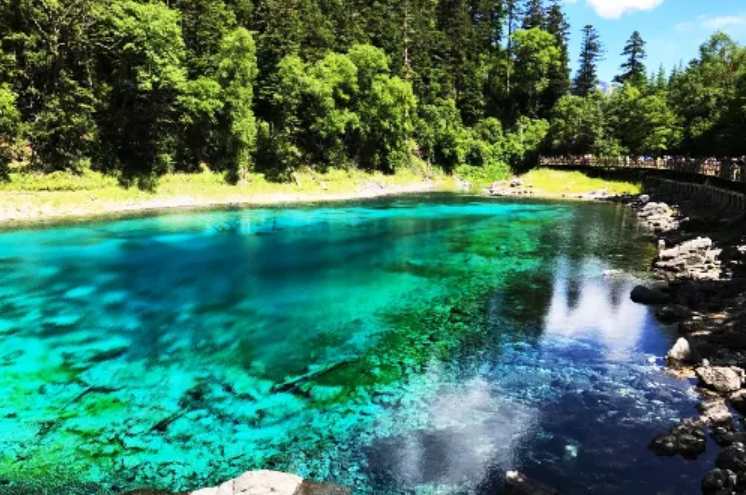
Five-Color Pond
Five-Color Pond is the smallest but most richly colored lake in Jiuzhaigou. It is located in the southern section of Zechawa Valley, at an altitude of 2,995 meters. The pond is 100.8 meters long, 56.8 meters wide, and 6.56-9.43 meters deep. Under the sunlight, the lake water is brilliantly colorful, like a gem.
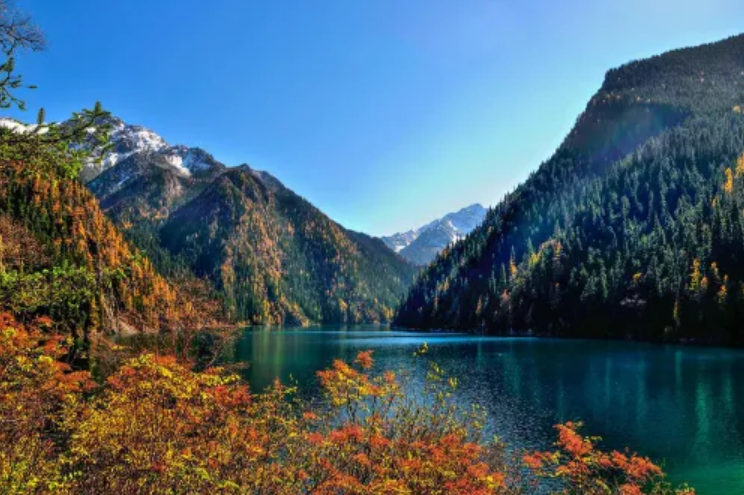
Long Lake
Long Lake is the highest and widest lake in Jiuzhaigou, at an altitude of 3,060 meters and with an area of about 2 million square meters. It is distributed in an "S" shape. The lake water is deep blue, surrounded by layered mountains, and the distant snow-capped mountains are reflected in the lake, creating a magnificent scene.
Shuzheng Lakes
Shuzheng Lakes are composed of 19 lakes of different sizes and are the gateway to the beautiful scenery of Jiuzhaigou. The water is so clear that the bottom can be seen. Depending on the angle of light and the depth of the water, it presents different colors. Between the lakes are low travertine dikes, forming stepped waterfalls and cascading water landscapes.
Nuorilang Waterfall
Nuorilang Waterfall is one of China's large travertine waterfalls. It is 270 meters wide, 24.5 meters high, and at an altitude of 2,365 meters. The top of the waterfall is flat like a platform, and water flows evenly over it. Under the sunlight, rainbows form one after another, making it very spectacular.
Five-Flower Lake
Five-Flower Lake has the reputation of being "the best of Jiuzhaigou" and "the essence of Jiuzhaigou." It is located at the end of the upper reaches of the Peacock River in Rize Valley, at an altitude of 2,472 meters, with a water depth of 5 meters. The lake water displays brilliant colors, like an oil painting. The trees on the shore are reflected in the water and set each other off beautifully.
Bonsai Shoal
Bonsai Shoal, also called "Bonsai Sea" and known in Tibetan as "Jiazhu Co," is the first shoal landscape upon entering Jiuzhaigou. On the milky white travertine shallows of Bonsai Shoal grow many kinds of plants. The river water is clear and flows over the shoal. Various trees are interspersed among them, with twisted roots and gnarled branches. Each tree forms its own scene, each with different charm, like a display of bonsai.
Reed Lake
Reed Lake is at an altitude of 2,192 meters and is about 15 meters high and 10 meters wide. It is located on the limestone cliff on the opposite side east of Reed Lake. Due to natural weathering traces on the rock and the decorative effect of plants, it forms the image of a dignified and beautiful maiden's face. Legend says it is the goddess Woluo Semo of Jiuzhaigou.
Pearl Shoal Waterfall
At an altitude of 2,433 meters, with an average height of 21 meters and a width of 270 meters. The waterfall was formed from a moraine platform left by Quaternary glaciers and then underwent calcification, making the waterfall's slope and cliff even taller and more solid. The waterfall face is concave and crescent-shaped.
Pearl Shoal
At an altitude of 2,450 meters, the shoal surface is 112.3 meters wide and 189 meters long, with an average slope of 20 degrees and a relative height difference of 15 meters. It is the widest shoal in Jiuzhaigou and a large travertine accumulation platform formed by calcium carbonate deposition. It is the place where Tang Sanzang and his disciples led the horse across the water in the opening sequence of the TV series "Journey to the West."
Tour Route:
The attractions of Jiuzhaigou are mainly distributed among the three valleys in a "Y" shape. A recommended classic tour route is: take the sightseeing bus from the valley entrance to the Primitive Forest, then visit Arrow Bamboo Lake, Panda Lake, Five-Flower Lake, Pearl Shoal Waterfall, and Nuorilang Waterfall in sequence. Next, go to Zechawa Village to see Long Lake and Five-Color Pond. Finally, go down through Shuzheng Valley and visit Shuzheng Lakes, Shuzheng Village, Reed Lake, and other attractions.
Travel Tips:
Book tickets and hotels in advance through the scenic area's official website or official platform. During peak season (May-October), book as early as possible to avoid affecting your itinerary.
Jiuzhaigou is at a relatively high altitude (up to 3,060 meters), with large temperature differences between morning and evening. Prepare warm clothing such as down jackets and scarves, and it is recommended to carry a portable oxygen canister to prevent altitude sickness.
Ultraviolet rays are strong in high-altitude areas. Bring sunscreen (SPF50 ), sunglasses, a sun hat, and other sun protection items, and also prepare rain gear for changeable weather.
Attractions in the scenic area are scattered. It is recommended to combine "sightseeing bus walking." Prefer taking the sightseeing bus to the final stop, then hike downward to save energy.
Respect local Tibetan customs. When entering temples, take off your hat and sunglasses and do not take photos casually. When encountering a mani pile, walk around it from left to right.
Precautions:
Smoking is prohibited throughout the scenic area, and bringing fire sources is strictly forbidden to avoid causing forest fires.
Do not feed or chase wild animals at will, especially avoid Tibetan macaques to prevent being scratched. Do not pick wild plants, and protect the ecological environment.
Follow scenic area signs. Do not swim, climb, or camp in non-designated areas. Keep a safe distance from dangerous areas such as Nuorilang Waterfall.
Beginners at high altitude should avoid strenuous exercise. If symptoms of altitude sickness such as headache, nausea, or difficulty breathing occur, go promptly to the scenic area medical room or descend the mountain to rest.
Keep personal belongings safe, especially in crowded areas such as when getting on and off sightseeing buses and at attraction entrances and exits. It is recommended to carry valuables with you.
Transportation:
Plane: Jiuzhai Huanglong Airport is located in Chuanzhusi Town, Songpan County, Aba Prefecture, Sichuan Province, 88 kilometers from the mouth of Jiuzhaigou Valley, about a 1.5-hour drive. It currently has direct routes to Beijing, Shanghai, Guangzhou, Xi'an, Chengdu, Chongqing, and other cities.
High-speed rail: The fastest journey from Chengdu East to Huanglong Jiuzhai Station takes 1 hour and 39 minutes. From Huanglong Jiuzhai Station to the Jiuzhaigou Scenic Area, you can take a direct scenic shuttle bus.
Bus: There are scheduled buses to Jiuzhaigou from Chengdu Chadianzi Passenger Station and Xinnanmen Passenger Station; there are daily buses from Lanzhou, Gansu to Jiuzhaigou; and there are direct buses to Jiuzhaigou from Mianyang Pingzheng Bus Station.
Self-driving:
West Ring Line of Jiuzhaigou: Chengdu → Dujiangyan → Wenchuan → Mao County → Songpan → Jiuzhaigou, about 440 kilometers in total.
East Ring Line of Jiuzhaigou: Chengdu → Mianyang → Jiangyou → Pingwu → Jiuzhaigou County Seat → Jiuzhaigou, about 480 kilometers in total.
Gansu Lanzhou Route: Lanzhou → Linxia → Hezuo → Luqu → Zoige → Chuanzhusi → Jiuzhaigou, 711 kilometers in total.
Opening Hours:
Peak season (May to October): 7:00-18:00; off-season (November to April of the following year): 8:00-17:00. Subject to the actual opening hours of the scenic area.
Tickets:
Ticket sightseeing bus: 280 yuan per person.