The Leshan Giant Buddha Scenic Area is located on Lingyun Road, south of the Min River's east bank, Shizhong District, Leshan City, Sichuan Province. It sits at the confluence of three rivers: the Min River, the Qingyi River, and the Dadu River. The scenic area is a National 5A-level Tourist Attraction. It features distinctive characteristics, including the Leshan Giant Buddha, the world's largest extant open-air cliff-carved stone statue, as well as historical sites such as Lingbao Pagoda, Lingyun Mountain, the Giant Sleeping Buddha, and Wuyou Mountain. It possesses profound cultural heritage and beautiful natural scenery. The scenic area covers 17.88 square kilometers.
History and Culture
The carving of the Leshan Giant Buddha began in the first year of the Kaiyuan era of the Tang Dynasty (713 AD) and was completed in the nineteenth year of the Zhenyuan era (803 AD), taking approximately ninety years. At that time, the waters at the confluence of the three rivers surged violently, and shipwrecks occurred frequently. The monk Haitong decided to carve a Maitreya Buddha statue to subdue the floods and protect all living beings. The construction of the Buddha statue encountered many setbacks. After Master Haitong passed away, the project was interrupted. Later, Zhangchou Jianqiong, Wei Gao, and others successively donated their salaries to continue the construction, and it was finally completed. When the Leshan Giant Buddha was first built in the Tang Dynasty, it was called the "Jiazhou Lingyun Temple Great Maitreya Stone Statue." Through the Song, Ming, Republican, and other periods, the name gradually evolved and is now collectively referred to as the "Leshan Giant Buddha." In 1996, the Leshan Giant Buddha was inscribed on the UNESCO World Cultural Heritage List.
Main Attractions
Leshan Giant Buddha
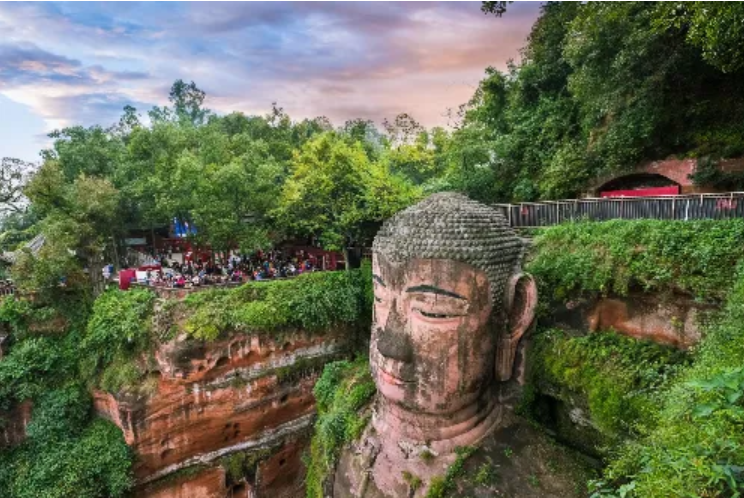
The Leshan Giant Buddha stands with its feet on the three rivers, hands resting on its knees, back against nine peaks, with a solemn expression, seated against the mountain. It has a total height of 71 meters. Its head is 14.7 meters high and 10 meters wide, with 1,051 hair buns. Its ears are 7 meters long; its eyebrows and nose are each 5.6 meters long; its mouth and eyes are each 3.3 meters long. Its neck is 3 meters high, its shoulders are 24 meters wide, and its fingers are 8.3 meters long. From the knees to the instep is about 28 meters, and the instep is 8.5 meters wide. The surface of the foot can accommodate about one hundred people sitting around it. On both sides of the Buddha statue are two stone carvings of Dharma-protecting Heavenly Kings, each over 16 meters tall. There are also hundreds of niches and over a thousand stone carvings, forming a magnificent Buddhist art cliff-carving landscape. On the left side of the Buddha statue is the nearly 500-meter-long Lingyun Plank Road, and on the right side is the Jiuqu Plank Road.
Lingbao Pagoda
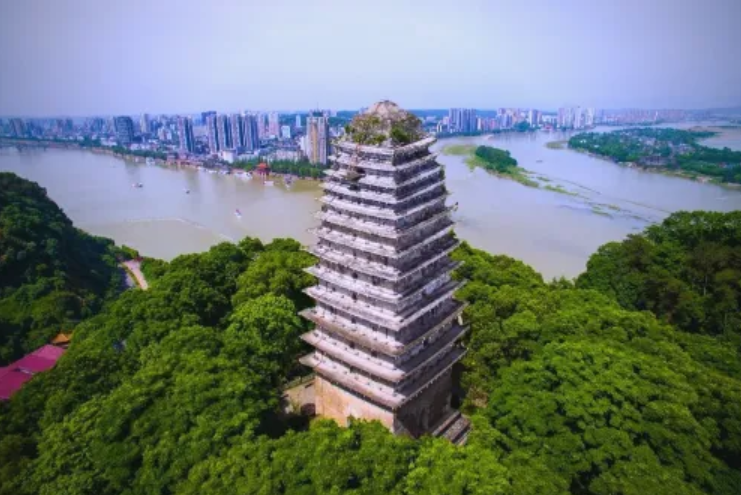
Lingbao Pagoda is a navigation marker. It is built of blue bricks, with a height of 40 meters. Its base has two levels, with a side length of 11 meters. The pagoda has five interior levels, each with arched windows for lighting, through which visitors can take in the scenery of the three rivers. It is the landmark Buddhist pagoda of Leshan Ancient City and a key cultural relic protection unit of Sichuan Province. In 2006, it was announced by the State Council as a Major Historical and Cultural Site Protected at the National Level. It is said that the relics of Monk Haitong are kept in Lingbao Pagoda.
Haishi Cave
Haishi Cave is located at the top of Lingyun Mountain behind the head of the Leshan Giant Buddha. The words "Haishi Cave" are inscribed on the cave's lintel, written by Gu Guangxu, the Sichuan Surveillance Commissioner of the Qing Dynasty, and later re-carved. According to legend, Master Haitong once lived here. In front of the cave is a Ming Dynasty bronze bell, and outside the cave is a statue of Master Haitong seated.
Giant Sleeping Buddha
The Giant Sleeping Buddha lies on the outer perimeter of the Leshan Giant Buddha, with a total length of more than 4,000 meters. Its head is formed by Wuyou Mountain, its body by Lingyun Mountain Peak, and its feet by Guicheng Mountain. The Leshan Giant Buddha sits within the Sleeping Buddha, forming a unique landscape of "a Buddha in the heart" and "the heart is the Buddha." The area around the Dongyingchunmen Wharf in Leshan Ancient City is a suitable place to view the Sleeping Buddha.
Wuyou Temple
Wuyou Temple was originally named Zhengjue Temple. It was founded in the Tang Dynasty and renamed Wuyou Temple during the Northern Song period. It is located on Wuyou Mountain on the east bank of Leshan City. In the temple are the Erya Terrace, beside which the four characters "Zhongliu Dizhu" are carved, as well as the Arhat Hall, Mahavira Hall, Mituo Hall, Guanyin Hall, Jingyun Pavilion, and a statue of Wuyou Bodhisattva. In 1983, the State Council designated Wuyou Temple as a National Key Temple in the Han Chinese Region.
Maha Cliff Tombs
The Maha Cliff Tombs are named after the Maha River. The Maha River is a flood-discharge channel between Lingyun Mountain and Wuyou Mountain. Cliff tombs were a burial form widely popular in Leshan during the Han Dynasties. Specifically, the deceased were sealed into tomb chambers within the mountain. The form of the tomb chamber completely imitated the residence of the deceased while alive. Its main purpose embodied the filial piety concept of "serving the dead as serving the living." It is a secular custom expressing the loyal and filial culture of the Han Dynasty in burial practices.
Doushuai Palace
Doushuai Palace was carved in the Ming Dynasty. Inside is a Maitreya Buddha statue about 2 meters high. Doushuai Palace is also called Doushuai Heaven. The Sanskrit meaning is translated as Miaozu Heaven, Zhizu Heaven, Xizu Heaven, Xile Heaven, and so on.
Lingyun Plank Road
The Lingyun Plank Road was begun in early 1983, completed in 1984, and opened in October of the same year. It is 500 meters long in total. Its northern end connects with the Giant Buddha, and its southern end connects with Bijin Tower. Together with the Jiuqu Plank Road on the right side of the Giant Buddha, it forms a winding circular tourist route.
Lingyun Temple
Lingyun Temple is at the top of Lingyun Mountain, surrounded by the nine peaks of Lingyun, with magnificent temple buildings. Because it is where the Giant Buddha is located, it is also called the Giant Buddha Temple. Lingyun Temple was founded in the Tang Dynasty. According to historical records, it predates the carving of the Giant Buddha and has a history of more than 1,300 years.
Thousand Buddha Cliff Carvings
The Thousand Buddha Cliff Carving group is located on the riverside cliff at the north gate of the Giant Buddha Scenic Area and was carved in the Tang Dynasty. On a cliff 70 meters long and 10 meters high, 72 square and rectangular Buddhist niches are distributed. The statues include Buddhas, Bodhisattvas, pagodas, sutra pillars, and others. The carvings are vivid in form and rich in subject matter, including Maitreya Buddha, the Three Buddhas, the Thousand Buddhas, the Western Pure Land Transformation, Sakyamuni and Prabhutaratna seated together, and the Thousand-Armed Guanyin, as well as pagodas. The combinations include one Buddha with three attendants, five attendants, seven attendants, and so on.
Stele Forest
The Stele Forest displays 195 steles of calligraphy by ancient and modern celebrities. Most were reproduced from ink rubbings in the collection of the Giant Buddha Scenic Area. Among them are many treasures, such as handwritten inscriptions and carvings by Su Dongpo, Huang Tingjian, Zheng Banqiao, as well as modern and contemporary figures such as Kang Youwei, Zhao Xi, Guo Moruo, Zhao Puchu, Li Yimang, Guan Shanyue, and Qian Jiaju.
Tour Route:
Enter from the East Gate. First, arrive at the Visitor Center, purchase tickets, and obtain scenic area information. Then walk about 800 meters to the North Gate of the Leshan Giant Buddha to view the Giant Buddha and Lingyun Temple up close. Next, follow the Jiuqu Plank Road, enjoying the scenery along the way and the full view of the Giant Buddha. Along the way, you will pass several viewing platforms. Continue onward to reach Lingbao Pagoda and climb to the top floor to overlook the scenic area. After leaving Lingbao Pagoda, you may visit the museum to gain a deeper understanding of the history and culture of the Leshan Giant Buddha.
Travel Suggestions:
From May to November, the climate is pleasant and the scenery is beautiful, making it a good time to visit, but there are many tourists, so itineraries should be planned in advance.
You may choose to take a river cruise to view the Leshan Giant Buddha and the Giant Sleeping Buddha from the river, offering a unique perspective.
There are many historical and cultural relics in the scenic area. Hiring a guide to explain them can help you better understand the relevant knowledge.
Precautions:
Some areas in the scenic area are relatively slippery, especially the Jiuqu Plank Road, so pay attention to safety when walking.
In summer, temperatures are high, so take sun protection and heatstroke prevention measures; in winter, keep warm.
Observe the regulations of the scenic area. Do not touch cultural relics at will or damage the environment.
Transportation:
You can take a bus from downtown Leshan to the scenic area.
There are direct shuttle buses from Leshan Railway Station to the Giant Buddha.
Visitors traveling by car can park in the scenic area parking lot.
Opening Hours:
From April 1 to October 7: 07:30 - 18:30, last entry at 18:30; from October 8 to March 31 of the following year: 08:00 - 17:30, last entry at 17:30. The actual opening hours of the scenic area shall prevail.
Tickets:
The ticket price is 80 yuan per person.