Chengdu Tiantai Mountain Scenic Area is located at No. 55 Tianshui Road, Sanjiao Community, Tiantai Mountain Town, Qionglai City, Chengdu, Sichuan Province. It is a peripheral protection area of the World Natural Heritage site—Sichuan Giant Panda Sanctuaries—and is also a National Forest Park, a National Scenic and Historic Area, and a National 5A Tourist Attraction. The scenic area covers a total area of 192 square kilometers, with the main peak, Yuxiao Peak, at an elevation of 1,812 meters. Its scenic features are distinctive: it is a rare box-shaped synclinal mountain in China, with rich and varied Danxia landforms. The mountain body is U-shaped, and the terrain forms three levels of platforms from low to high. It has a subtropical monsoon climate, with no extreme heat in summer, no severe cold in winter, mild weather, and abundant rainfall. Within its borders are three main rivers—Jinlong River, Wenjing River, and Baimo River. It is rich in biodiversity, with 2,573 species of vascular plants in 876 genera and 182 families, and more than 50 species of nationally rare and protected animals.
Historical Culture
In ancient times, Tiantai Mountain was a place where the ancient "Qiong" people lived and multiplied. During the Kaiming period of Ba-Shu, Bieling, the king of ancient Shu, "ascended the heights to offer sacrifices to heaven" here. In the Han Dynasty, Daoists surveyed the mountain, carved caves, and built altars to worship the gods. During the Two Jin and Northern and Southern Dynasties, traveling monks such as Fotu Cheng and Pudashaye came here and founded Tiantai Buddhist temples. During the Sui and Tang Dynasties, in the early Tang, Yuan Tiangang, magistrate of Huojing County, revered Daoism and gained the appreciation of Emperor Ming of Tang. Daoist influence became dominant at Tiantai Mountain, but later Buddhism flourished and took the leading position. In the Northern Song Dynasty, Confucianism, Buddhism, and Daoism "converged into three teachings," with as many as 108 Daoist temples, Buddhist temples, and official buildings, and a "Monks' Street" was also built, forming a massive religious mountain city. Due to conflicts among the three teachings, the local government established a "Monks' Yamen" within the temple groves. At the end of the Song and during the Yuan Dynasty, religion at Tiantai Mountain gradually declined. At the end of the Ming Dynasty, a detachment of Zhang Xianzhong's army massacred the monks throughout the mountain, and the temples and shrines were all destroyed. In the Qing Dynasty, Buddhists and Daoists tried to restore it, but the scale was far inferior to former times. During the Republic of China period, bandits and soldiers ran rampant, and pilgrimages to the mountain almost ceased. During the "Cultural Revolution," religious culture suffered enormous damage. After reform and opening up, sightseeing and tourism increasingly prospered, some temples were restored, and the official building landscape of the "Monks' Yamen" was also restored.
Main Attractions
Waterfall and Flying Rainbow Scenic Area
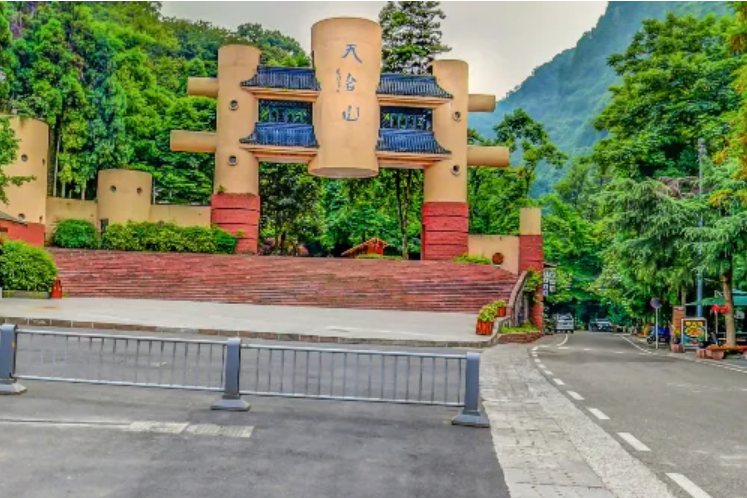
There are attractions such as the Mountain Gate, Changhong Waterfall, the No. 1 Waterfall in Western Sichuan—Xiangshuitan Waterfall, the Danxia wonder Shenfeng Cave, and the Ming Dynasty Guanyin Bridge. The Mountain Gate is 50 meters tall in total, with the three characters "Tiantai Mountain" inscribed by Mr. He Yinghui. It is built from local red sandstone strips and has a unique shape. Changhong Waterfall falls like a silver chain, and when sunlight slants across it, a rainbow can be seen spanning the valley; Xiangshuitan Waterfall has a strong flow of water, dropping in 8 tiers, with a deafening roar.
Yatan Wengu Scenic Area
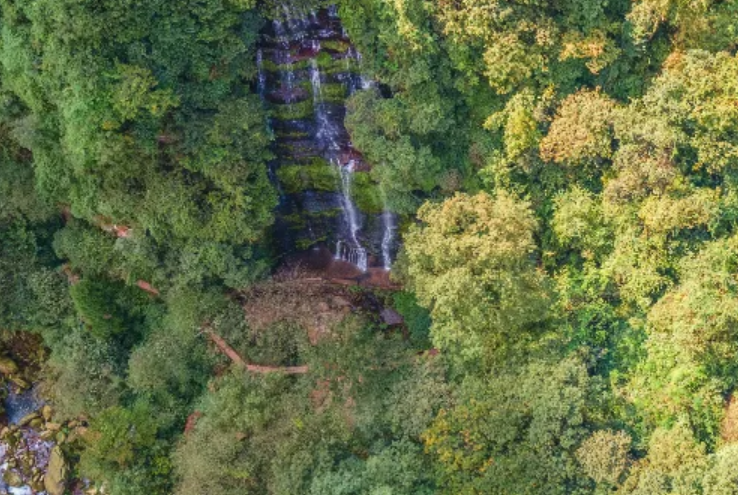
The area extends from Dengle'an to Zhengtiantai. Its main attractions include Dengle'an, Yinding Peak, Tianfeng Gorge (One-Line Sky), Downturned Boot Rock, Small Mill House, Zuishi Forest, Monks' Yamen, Huashi Forest, Huashi Lake, Sandaowan, Little Jiuzhaigou, and mountain camellias. The Tang Dynasty pilgrimage ancient road is located in this area, covered with moss, and along the way stands a large Tang Dynasty Buddha beside the road.
Yingguang Haoyue Scenic Area
The area extends from Zhengtiantai to Yuxiao Peak. Its main attractions include Leiyin Temple, the high-mountain water-play ravine—Shibali Xiangcao Gully, Xiushui Sanyun, Qintai Rock, Liuyue Beach, Xiangcao Diexi, Yuedong Flying Water, Panlong Waterfall, Yuxiao Peak, and Monks' Graves.
Tour Route:
Visitor Center → Xiaojiawan → Dengle'an. After checking in at the mountain gate stone tablet, follow the stone-paved path past Changhong Waterfall, Xiangshuitan Waterfall, Tree-Embracing Rock, and Zushi Bridge, and finally arrive at Dengle'an; Dengle'an → Small Mill House, passing the Tang Dynasty Great Buddha along the way; Small Mill House → Zhengtiantai, passing Huashi Lake, Huashi Forest, Monks' Yamen, Ten-Mile Tree Shade, and the Sandaowan Mountain Camellia Corridor; Zhengtiantai area → Panlong Waterfall, passing Leiyin Temple, the thousand-year-old red bean fir, the high-altitude fir forest boardwalk, Butterfly Beach, Bailong Ferry, and Xiushui Sanyun. Total distance is about 15 km (one-way).
Tour Suggestions:
Choose a suitable tour route according to your own physical strength and time to avoid excessive fatigue.
When visiting in summer, bring an extra set of clothes to change into after playing in the water.
If you want to see fireflies, you can go to designated areas on summer nights. Please keep quiet and do not use strong light.
Wear comfortable sports shoes or hiking shoes to make walking in the scenic area easier.
Precautions:
Open flames are strictly prohibited in the scenic area. Please do not smoke, do not bring flammable and explosive items into the scenic area, and do not bring pets into the scenic area.
Many trails have water-covered surfaces and are prone to moss and slipperiness. Special groups such as the elderly, children, and pregnant women should visit accompanied by family members.
Do not pick flowers or plants, do not litter, do not carve or paint randomly, and do not damage the animals and plants in the scenic area. Protect the ecology and visit civilly.
Please pay attention to safety during the tour, watch for warning and reminder signs, and strictly prohibit entering unopened areas.
To enter Xiangcao Gully, you need to change into straw sandals, stream-tracing shoes, or other professional non-slip shoes, and follow the guidance of staff.
Please do not play in riverbanks, river channels, flood-control channels, and other areas. Camping and sleeping outdoors are strictly prohibited.
Summer mornings and evenings have large temperature differences, and the weather changes unpredictably. It is recommended to bring a light jacket or change of clothes and keep an eye on weather conditions at all times.
Transportation:
Self-driving: Depart from Chengdu, take the Chengwen-Qiong Expressway and Qiongming Expressway, exit at Jiaguan, then follow the Tiantai Mountain Tourist Ring Road to the scenic area.
Public transportation: There are direct buses from Chengdu Xinnanmen Station and Chadianzi Station to Qionglai. After arriving in Qionglai, you can transfer at Qionglai Passenger Transport Center to the tourist shuttle bus to Tiantai Mountain.
Opening Hours:
Open from 08:30 to 18:00 in summer, from 09:00 to 17:00 in winter and spring, and from 08:30 to 18:00 in autumn. The opening hours of the walking trails are 9:00 to 17:00. Subject to scenic area announcements.
Tickets:
Adult ticket: 55 yuan per person.