The Mount Hua Scenic Area is located in Huayin City, Weinan City, Shaanxi Province, bordering the Qinling Mountains to the south and facing the Yellow River and Wei River to the north. It is a national 5A-level tourist attraction and a national key scenic spot. It is one of China's famous Five Great Mountains and is renowned for its "strangeness, steepness, ruggedness, and beauty," earning the reputation of "the most precipitous mountain under heaven." The scenic area covers a total area of about 148 square kilometers, with a core tourist area of about 120 square kilometers. It consists of five main peaks—East, West, South, North, and Central—along with surrounding ridges. The main peaks all exceed 2,000 meters in elevation, with the highest peak, the South Peak "Luoyan Peak," reaching 2,154.9 meters.
History and Culture
Mount Hua is one of the important birthplaces of Chinese national culture. The "Hua" in "Zhonghua" and "Huaxia" originates from Mount Hua, so it is honored as the "Root of Huaxia." Mount Hua is also a holy land of the Quanzhen School, the mainstream sect of Taoism, and is listed as the "Fourth Grotto-Heaven" of Taoism. There are 72 existing half-hanging caves and more than 20 Taoist temples, among which Yuquan Temple, Dulong Temple, and Zhenyue Palace are all national key Taoist temples.
The history of Mount Hua can be traced back to ancient times, and it was already recorded in ancient books such as the Book of Documents and the Tribute of Yu. Since the Qin Dynasty, emperors of successive dynasties all offered sacrifices to Mount Hua. Emperor Wu of Han initiated the sacrifice to the Western Great Mountain, and Emperor Xuanzong of Tang and Emperor Zhenzong of Song personally visited Mount Hua to hold grand ceremonies. In addition, Mount Hua attracted countless men of letters, including Li Bai, Du Fu, and Wang Wei, who all left behind enduring poems here, such as Li Bai's line, "How majestic and towering is the Western Great Mountain! The Yellow River looks like a thread from the horizon."
Main Attractions
East Peak (Chaoyang Peak)
East Peak has an elevation of 2,096.2 meters. It is named because it is located in the eastern part of Mount Hua and is the best place to watch the sunrise. The "Chaoyang Platform" at the summit is a famous sunrise-viewing spot. At the peak is the dangerous path "Yaozi Fanshen," which requires climbing along cliffs with the help of iron chains and is highly challenging.
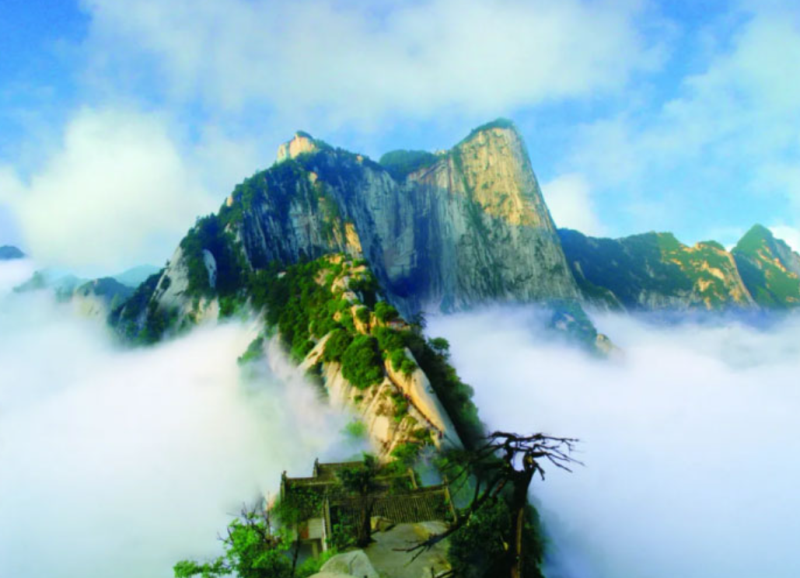
West Peak (Lotus Peak)
West Peak has an elevation of 2,082.6 meters. It is named because the huge rock at the summit resembles a lotus flower, and it is the most beautiful and precipitous peak of Mount Hua. In front of Cuiyun Palace at the summit is the "Axe-Split Rock," said to be the place where Chenxiang split the mountain to save his mother in The Magic Lotus Lantern. The West Peak cableway is 4,211 meters long with a drop of 894 meters and can reach the summit directly.
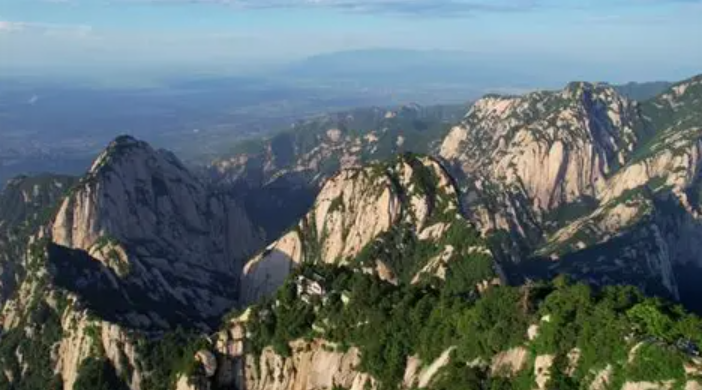
South Peak (Luoyan Peak)
South Peak is the highest peak of Mount Hua, with an elevation of 2,154.9 meters. It is named because it is said that wild geese often rest here. At the summit are landscapes such as "Yangtian Pond" and "Black Dragon Pool." On its east side is the "Chang Kong Plank Road," the most dangerous path of Mount Hua, suspended on a cliff and connected only by iron chains and wooden boards.
North Peak (Yuntai Peak)
North Peak has an elevation of 1,614.7 meters. It is called "Yuntai Peak" because it is surrounded by sheer drops and shrouded in clouds and mist. This is one of the starting points for climbing the mountain. The "Wisely Seizing Mount Hua Road" memorial pavilion is located here, commemorating the historical event during the War of Liberation when the People's Liberation Army wisely captured Mount Hua. The North Peak cableway (Sante Cableway) is 1,524.9 meters long with a drop of 755 meters, and a one-way trip takes about 8 minutes.
Central Peak (Jade Maiden Peak)
Central Peak has an elevation of 2,037.8 meters. It is located among the East, West, and South Peaks and leans against East Peak. Legend says it was the place where Nongyu, daughter of Duke Mu of Qin, played the flute to attract the phoenix, so it is also called "Jade Maiden Peak." On the peak are landscapes such as the Jade Maiden Shrine and the Jade Maiden Hair-Washing Basin, and the environment is quiet and secluded.
Food
Mount Hua Liangfen
Mount Hua Liangfen uses local specialty buckwheat as its raw material and is made through soaking, grinding, filtering, and steaming. It has a smooth, refreshing, and chewy texture and is paired with seasonings such as mashed garlic, vinegar, and chili. It is an excellent summer heat-relieving delicacy.
Mashi Pao
Mashi Pao is a specialty food of Huayin. The dough is cut into small granules and, after being cooked, is paired with ingredients such as mutton soup, vermicelli, and tofu. The soup is rich in flavor, and the noodles are chewy and satisfying, with a strong local flavor.
Xuemian
Xuemian is a traditional noodle dish of Huayin. It uses buckwheat flour as its raw material, is spread into thin pancakes, and then cut into strips. It can be stir-fried or boiled and has a unique texture. It is said to have been created by Han Xin when he stationed troops during the Han Dynasty and has a history of more than 2,000 years.
Tickets:
Admission is 160 yuan per person.
You can search for the official public account "Mount Hua Scenic Area" on WeChat to get the latest updates or buy tickets online.
Opening Hours:
Open all day (mountain climbing paths). Cableway operating hours are:
North Peak Sante Cableway: peak season 7:00–19:00, off-season 9:00–17:00;
West Peak Taihua Cableway: peak season 7:00–19:00, off-season 8:00–18:00.
Tour Routes:
Classic climbing route (on foot): Yuquan Temple → Wuli Pass → Shaluo Flat → Maonü Cave → Qingke Flat → Huixin Stone → Thousand-Foot Cliff → Hundred-Foot Gorge → Laojun Ligou → North Peak → Ca'erya → Canglong Ridge → Central Peak → East Peak → South Peak → West Peak → descend by West Peak cableway
West Peak cableway up and down route: Visitor Center → West Peak Taihua Cableway → West Peak → South Peak → East Peak → Central Peak → North Peak → descend by North Peak Sante Cableway
North Peak cableway up and down route: Visitor Center → North Peak Sante Cableway → North Peak → Central Peak → East Peak → South Peak → West Peak → descend by West Peak Taihua Cableway
Transportation:
High-speed rail: Huashan North Station is a station on the Zhengzhou–Xi'an High-Speed Railway. It takes about 30 minutes from Xi'an North Station by high-speed rail. After leaving the station, you can take free buses No. 1 and No. 2 or a taxi to the Mount Hua Visitor Center (about 5 kilometers).
Train: Huayin Station has regular trains stopping there. It takes about 2 hours from Xi'an Station by train. After leaving the station, taking a taxi to the Mount Hua Visitor Center is about 8 kilometers.
Bus: There are direct buses to Mount Hua from Xi'an Chengdong Passenger Station and Weinan Passenger Transport Center, with a journey of about 2 hours.
Self-driving: Exit at Huayin on the Lianyungang–Huoerguosi Expressway (G30), then go via Huayue Avenue directly to the Mount Hua Visitor Center. There are multiple parking lots in the scenic area.
Must-Visit Attractions:
Chang Kong Plank Road: Located on the east side of South Peak, suspended on a cliff at an altitude of 2,160 meters and about 100 meters long, it is the most thrilling experience project of Mount Hua and requires purchasing separate insurance (30 yuan per person).
Yaozi Fanshen: Located on East Peak, it is a switchback dangerous path on a vertical cliff, about 30 meters in total, requiring climbing with both hands and feet on iron chains. It is suitable for challenging yourself.
West Peak Cableway: Asia's longest high-mountain cableway. Riding it allows you to overlook the entire Mount Hua. A one-way trip takes about 20 minutes, offering the thrill of "walking in the air."
South Peak Summit: The highest peak of Mount Hua. You can overlook the Yellow River and the Qinling Mountains and experience the pride of "seeing all other mountains as small."
Travel Suggestions:
Visitors with good physical strength can choose to climb on foot. It is recommended to set out early in the morning and carry enough drinking water and high-calorie food (such as chocolate and energy bars).
If time is tight or physical strength is limited, it is recommended to take the West Peak cableway up and the North Peak cableway down, which can save energy and cover the main attractions.
In summer, pay attention to sun protection when climbing. In winter, bring anti-slip shoes. The temperature at the summit is relatively low, so it is recommended to bring a jacket (the temperature difference throughout the year is large, and the average temperature at the summit is about 10°C lower than at the foot of the mountain).
Tourists planning to watch the sunrise can stay near East Peak and check the sunrise time in advance (about 5:30–6:00 in summer and about 7:00–7:30 in winter).
Precautions:
Pay attention to safety while climbing and follow the principle of "walk without looking at the scenery, look at the scenery without walking." Do not climb undeveloped areas.
Projects such as Chang Kong Plank Road and Yaozi Fanshen are somewhat dangerous. Tourists with heart disease, high blood pressure, and other conditions should participate cautiously.
Some sections in the scenic area have no shelter. Thunderstorms may cause falling rocks, so take shelter in safe areas in time.
Protect the scenic environment, put garbage in designated trash bins, and do not carve on cultural relics and historic sites.
Book tickets in advance. There are many tourists during holidays, so it is recommended to travel during off-peak times.