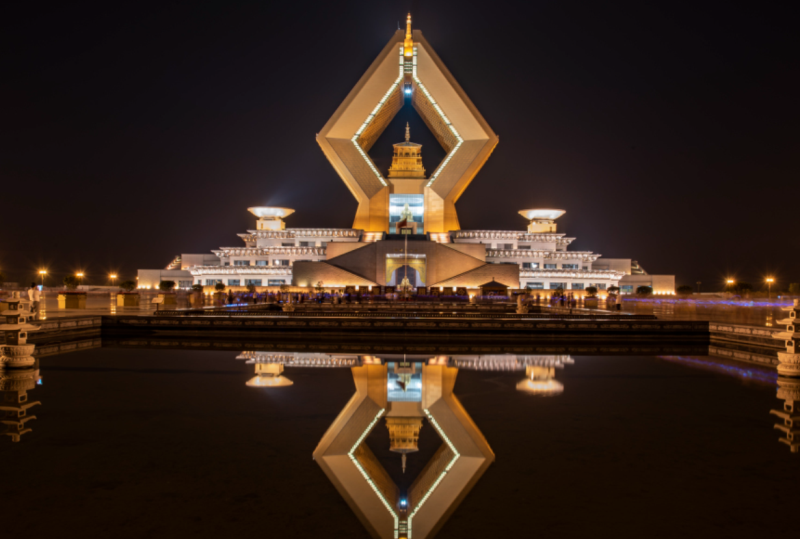
The Famen Cultural Scenic Area, whose full name is the "Famen Temple Cultural Scenic Area," is located in Famen Town, Fufeng County, Baoji City, Shaanxi Province. It is about 110 kilometers east of Xi'an and about 90 kilometers west of the urban area of Baoji. The scenic area is a national 5A-level tourist attraction and a comprehensive cultural tourism destination built around Famen Temple's Buddhist culture, integrating Buddhist cultural experience, historical sightseeing, and art appreciation. The scenic area covers a total area of about 1,300 mu. Its core area consists of the Mountain Gate Square, the Buddha's Light Avenue, the Famen Temple Monastery, the Namaste Relic Pagoda, and related cultural facilities. Among them, the Namaste Relic Pagoda is 148 meters high, with a building area of 76,000 square meters. It is the landmark building of the scenic area. Its shape incorporates the Buddhist image of "hands pressed together in namaste," and it is magnificent in scale.
Historical Culture
Famen Temple was first built in the late Eastern Han Dynasty (around the 1st century AD). It was originally named "Ashoka Temple" and is one of the earliest temples built after Buddhism was introduced to China. It has long been known as the "ancestor of pagodas and temples in the Guanzhong region." According to records, in order to spread the Dharma, King Ashoka of ancient India distributed the Buddha's finger bone relics among 84,000 pagodas worldwide. Nineteen of them were in China, and Famen Temple was the fifth. Because a pagoda was built for the relic and a temple was built because of the pagoda, it became a Buddhist holy site.
The Tang Dynasty was the period of Famen Temple's greatest prosperity, and it was honored by the royal family as the "Pagoda of the True Body That Protects the Nation." Many emperors, including Emperor Taizong, Emperor Gaozong, and Empress Wu Zetian, welcomed and escorted the Buddha's finger bone relic six times and held grand Dharma assemblies. Famen Temple thus became an important place for royal prayer and national ceremonies. In 1987, the archaeological discovery of the Famen Temple underground palace shocked the world. The Buddha's finger bone relic and thousands of Tang Dynasty court treasures were unearthed, including secret-color porcelain, gold and silver wares, and silk. It has been praised as the "Ninth Wonder of the World," confirming the superb craftsmanship of the Tang Dynasty and the prosperity of Buddhist culture.
Main Attractions
Namaste Relic Pagoda
The Namaste Relic Pagoda is the core building of the scenic area. It is 148 meters high and was designed by the famous Taiwanese architect Li Zuyuan. The pagoda body is shaped like hands pressed together in namaste, and the hollow center enshrines the Buddha's finger bone relic. Inside the pagoda are spaces such as the Thousand Buddha Hall and the Relic Hall. On major Buddhist events or weekends, the Buddha's finger bone relic is raised inside the pagoda for believers to view. Its architectural scale and artistic value are rare in the world.
Famen Temple Monastery
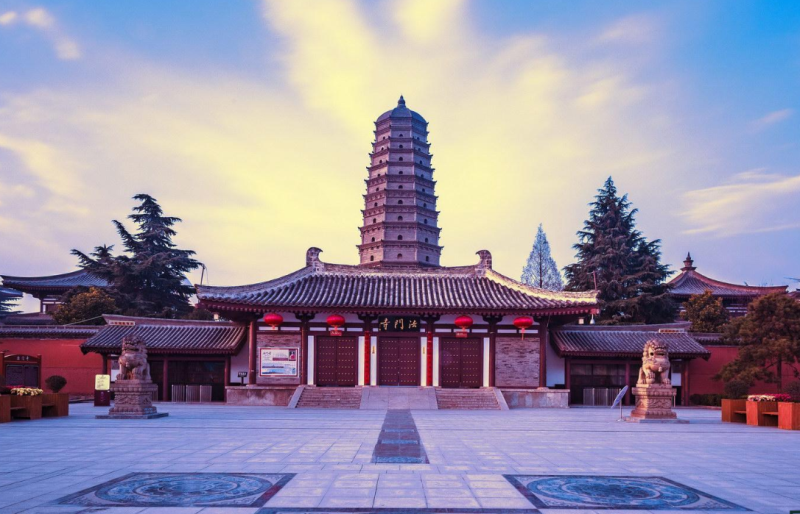
The Famen Temple Monastery is the core Buddhist architectural complex of the scenic area. Existing buildings include the Ming Dynasty brick pagoda, the Bell and Drum Towers, and the Mahavira Hall. The True Body Treasure Pagoda in the monastery (rebuilt in the Ming Dynasty) is 47 meters high, octagonal, and has 13 stories. The pagoda body is carved with Buddhist scriptures and patterns. The Buddha's finger bone relic and cultural relics unearthed from the underground palace in 1987 were all discovered here. The monastery has a cultural relics exhibition hall displaying reproductions of some underground palace treasures and Buddhist cultural exhibits.
Buddha's Light Avenue
Buddha's Light Avenue is 1,230 meters long and 108 meters wide. It is a landscape avenue connecting the Mountain Gate Square and the Namaste Relic Pagoda. On both sides of the avenue are 10 huge golden Bodhisattva statues, each about 20 meters high, symbolizing the Buddhist realm of the "Ten Grounds Bodhisattvas." At the end of the avenue is a 40-meter-high Ashoka Pillar, symbolizing the spread and prosperity of the Dharma. The entire avenue is solemn and filled with a religious cultural atmosphere.
Mountain Gate Square
The Mountain Gate Square is the entrance area of the scenic area, covering about 150,000 square meters. In the center is a huge lotus sculpture, symbolizing the purity and auspiciousness of Buddhism. Ticket offices, visitor service centers, and other facilities are distributed on both sides of the square. It is the first stop for tourists entering the scenic area, and its open spatial design provides a venue for large cultural activities.
Food
Fufeng Yikouxiang
Fufeng Yikouxiang is a local specialty saozi noodles. The noodles are thin, smooth, and chewy. The saozi is made by stir-frying pork, tofu, carrots, and other ingredients, and is paired with a sour, spicy, fresh, and fragrant soup. Its unique feature is that each bowl contains only a small amount of noodles (about one bite), so diners can continuously taste many bowls. It is commonly called "yikouxiang" (one bite fragrant), reflecting the boldness and refinement of Guanzhong food culture. It is often seen at local festivals and banquets.
Lugao Mo
Lugao Mo is a traditional Fufeng noodle food. It is named because its shape resembles a deer and its surface has patterns like a pastry. The bun is soft and porous with a chewy texture. It can be eaten directly or stuffed with braised meat, cold dishes, and more. It is said to have been used as a tribute in the Tang Dynasty and has a history of more than a thousand years. It is a classic staple food to go with local mutton soup and cold noodles.
Youpo Noodles
This classic Shaanxi noodle dish is also widely available around the Famen Cultural Scenic Area. Youpo noodles use wide noodles as the main ingredient. After boiling, chili powder, chopped scallions, and minced garlic are sprinkled on top, and hot rapeseed oil is poured over them, releasing a rich aroma. Served with bean sprouts, green vegetables, and other side ingredients, it has a spicy, fragrant, and chewy taste and is a popular dish loved by tourists.
Cufen
Cufen is a specialty snack in Fufeng. It is made by steaming the residue left after brewing edible vinegar. It has a delicate, smooth texture and a sour, appetizing flavor. It is often served with mashed garlic, sesame oil, mustard, and other seasonings. It has a unique flavor and is an excellent summer food to relieve heat and cut greasiness, reflecting local people's ingenious use of ingredients.
Tickets:
Tickets are 100 yuan per person.
You can search for the official WeChat public account "Famen Cultural Scenic Area" to get the latest updates or buy tickets online.
Opening Hours:
Peak season (March 1–November 30): 8:30–19:00 (last entry at 18:00);
Off season (December 1–end of February the following year): 9:00–18:00 (last entry at 17:00);
The Namaste Relic Pagoda opens for relic viewing on the first and fifteenth days of each lunar month and on weekends. The specific time is subject to scenic area announcements.
Tour Routes:
Cultural Experience Route: Mountain Gate Square → Buddha's Light Avenue (visit the Ten Grounds Bodhisattva statues and Ashoka Pillar) → Famen Temple Monastery (True Body Treasure Pagoda, underground palace site, cultural relics exhibition hall) → Namaste Relic Pagoda (view the Buddha's finger bone relic, Thousand Buddha Hall)
Quick Tour Route: Mountain Gate Square → take the sightseeing bus → Namaste Relic Pagoda → Famen Temple Monastery → Buddha's Light Avenue (walk back)
In-depth Prayer Route: Famen Temple Monastery (pray at the Mahavira Hall) → walk around the True Body Treasure Pagoda → view the relic at the Namaste Relic Pagoda → take a quiet walk along Buddha's Light Avenue
Transportation:
High-speed rail: Take the high-speed rail from Xi'an North Station to Yangling South Station (about 30 minutes). After leaving the station, transfer to a bus or taxi to the scenic area (about 30 kilometers, about 40 minutes by car).
Bus:
Xi'an Chengxi Passenger Transport Station has multiple direct buses to the Famen Temple Scenic Area every day. The ride takes about 2.5 hours;
Baoji Bus Station (Jing'er Road) has daily buses to Fufeng County. Transfer to a county bus to the scenic area (total ride about 2 hours).
Self-driving:
From Xi'an: Take the Ring Expressway to the Xibao Expressway (G30), exit at Jiangzhang, and drive about 20 kilometers along the Jiangfa Class II Highway to reach the scenic area;
From Baoji: Take the Lianhuo Expressway (G30) to the Famen Temple exit, and drive about 10 kilometers along the Fatang Highway to reach the scenic area. There is a large parking lot in the scenic area, and the parking fee is about 10–20 yuan per day.
Must-visit Attractions:
Namaste Relic Pagoda: The world's tallest Buddhist building. View the Buddha's finger bone relic of Shakyamuni (pay attention to opening hours) and feel the solemnity and shock of Buddhist culture.
Famen Temple Underground Palace Site: The site of the 1987 archaeological discovery. Learn about the structure of the Tang Dynasty royal underground palace and witness the history of the unearthed Buddha's finger bone relic and thousands of treasures (some artifact reproductions are displayed at the site).
Buddha's Light Avenue: Stroll along the 1,230-meter landscape avenue, admire the Ten Grounds Bodhisattva statues and the Ashoka Pillar, and experience the ritual sense and artistry of Buddhist culture.
True Body Treasure Pagoda: A Ming Dynasty brick pagoda. Climb the pagoda to overlook the entire monastery. The pagoda body has exquisite carvings and carries a thousand years of historical changes.
Travel Suggestions:
It is recommended to arrange at least 3–4 hours for visiting. If you need to deeply visit the underground palace relics and Buddhist exhibitions, you can reserve half a day.
Respect religious etiquette. Keep quiet when entering the monastery and the relic pagoda, and avoid loud noise or inappropriate behavior (such as wearing shorts or short skirts into core areas).
Pay attention to sun protection in summer. Some areas in the scenic area have no shade. In winter, temperatures are low, so it is recommended to bring warm clothing.
Taking the sightseeing bus can save energy, especially suitable for elderly tourists or families with children (the sightseeing bus stops cover the main attractions).
If you plan to view the Buddha's finger bone relic, it is recommended to check scenic area announcements in advance and avoid peak times (such as the first and fifteenth days of the lunar month and holidays).
Notes:
Smoking and littering are prohibited in the scenic area. Protect cultural relics and public facilities. Do not carve or write on buildings or sculptures.
Photography and video recording are prohibited in the underground palace site and the relic pagoda. Follow the guidance of on-site staff.
Buddha's Light Avenue is quite long. When walking, it is recommended to wear comfortable sports shoes and avoid high heels or slippers.
When buying souvenirs around the scenic area, it is recommended to choose formal shops and avoid casually buying from mobile vendors.
In case of severe weather (such as heavy rain or strong winds), some areas may be temporarily closed. Before traveling, please pay attention to the weather forecast and scenic area notices.